How Much Does a Horse Weigh? Scale Averages by Breed and Height

Before you set a hay ration, load a trailer, or read a dewormer label, you need to know how much a horse weighs. Weight runs from about 200 pounds for a Miniature Horse to nearly 1,900 for a draft. Most owners guess low.
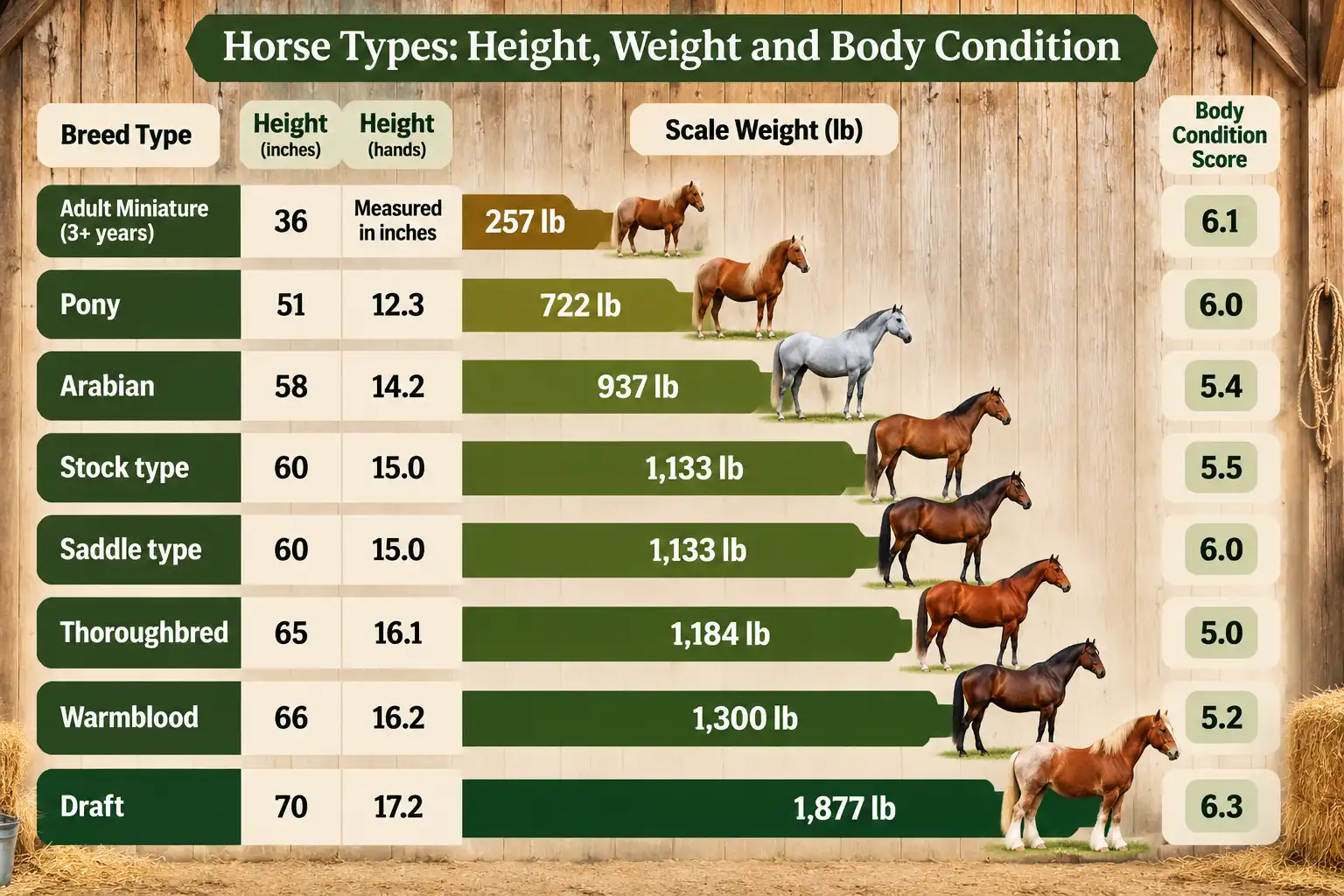
Most full-size riding horses weigh 900 to 1,300 pounds. On University of Minnesota Extension scales, stock horses averaged 1,133 pounds, Thoroughbreds 1,184, Arabians 937, and drafts 1,877. Adult Miniature Horses averaged 257.
Average Weight of a Horse by Breed Type
The average weight of a horse runs from about 940 pounds for an Arabian to about 1,880 for a draft. University of Minnesota Extension weighed 1,472 horses between 2011 and 2017 and sorted the averages by breed type.
| Breed type | Height (inches) | Height (hands) | Scale weight (lb) | Body condition score |
|---|---|---|---|---|
| Adult Miniature (3+ years) | 36 | Measured in inches | 257 | 6.1 |
| Pony | 51 | 12.3 | 722 | 6.0 |
| Arabian | 58 | 14.2 | 937 | 5.4 |
| Stock type | 60 | 15.0 | 1,133 | 5.5 |
| Saddle type | 60 | 15.0 | 1,133 | 6.0 |
| Thoroughbred | 65 | 16.1 | 1,184 | 5.0 |
| Warmblood | 66 | 16.2 | 1,300 | 5.2 |
| Draft | 70 | 17.2 | 1,877 | 6.3 |
First, height alone does not predict weight. A Thoroughbred stands 5 inches taller than a stock horse. Yet it weighs only about 50 pounds more, because a stock horse packs more body onto a shorter frame.
Second, most groups sat above a body condition score of 5, the middle of the 1 to 9 Henneke scale. So a breed average is not the same as an ideal weight, and extra condition shows up on the scale.
Horse Height in Hands: How to Read and Measure It
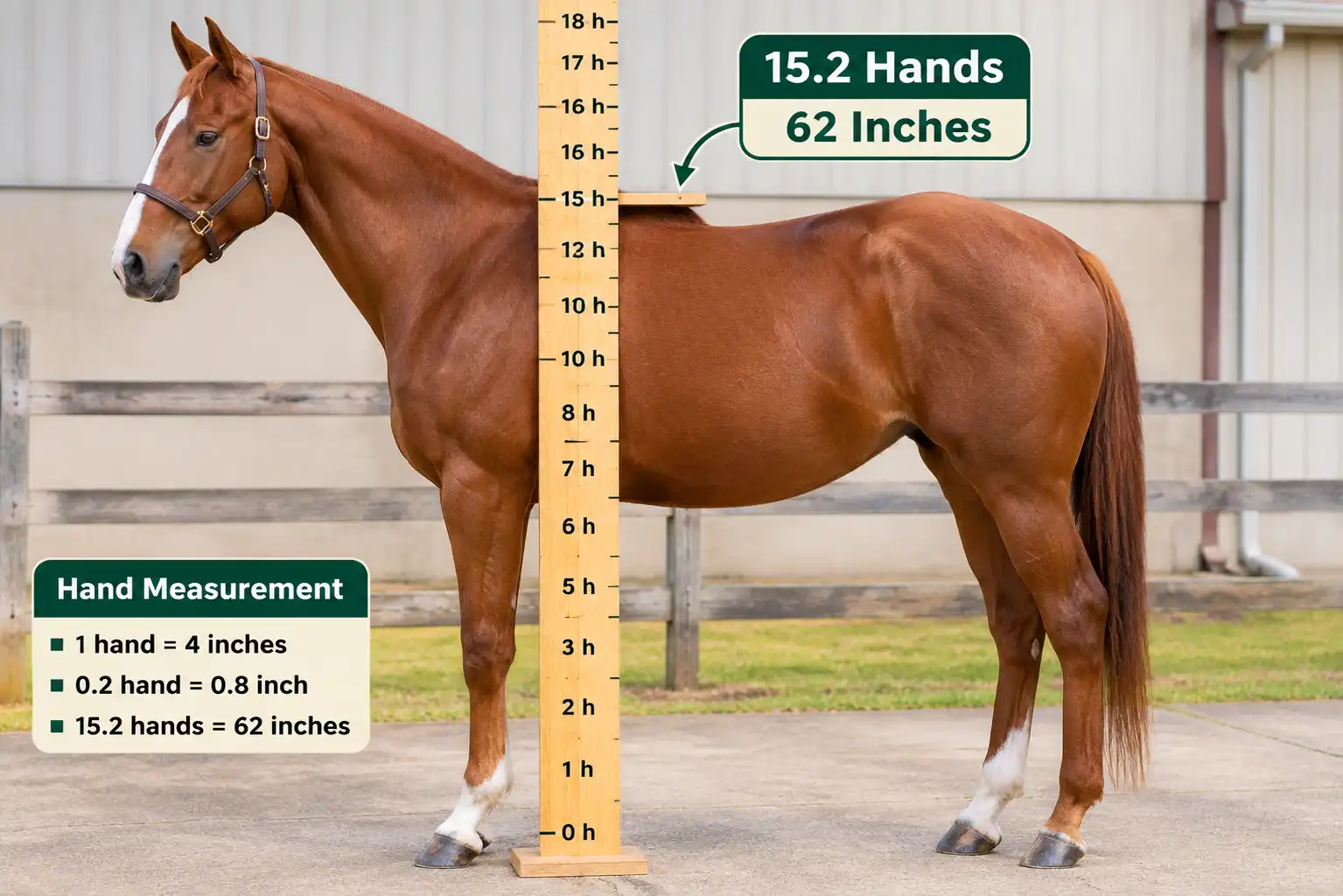
One hand equals 4 inches, and horse height is measured from the ground to the highest point of the withers. The number after the point counts extra inches, not tenths. So 15.2 hands means 15 hands and 2 inches, or 62 inches.
That digit only runs from 0 to 3. A horse at 15 hands and 4 inches is written as 16.0.
| Hands | Inches | Feet and inches |
|---|---|---|
| 14.2 | 58 | 4 ft 10 in |
| 15.0 | 60 | 5 ft 0 in |
| 15.2 | 62 | 5 ft 2 in |
| 16.0 | 64 | 5 ft 4 in |
| 16.2 | 66 | 5 ft 6 in |
| 17.0 | 68 | 5 ft 8 in |
| 18.0 | 72 | 6 ft 0 in |
The 14.2-hand mark is the usual line between pony and horse. For example, Oregon State Extension notes that a Welsh pony cannot exceed 14.2 hands. Miniature Horses are measured in inches instead, from the last hairs at the base of the mane to the ground.
To measure, stand the horse square on level concrete. Then use a measuring stick with a level crossbar, not a soft tape. A tape follows the curve of the shoulder and reads tall. Take two readings and average them.
Average Horse Height by Breed
The average horse height for full-size riding breeds falls between 14.2 and 16.2 hands. In the Minnesota scale data, Arabians averaged 14.2 hands, stock and saddle types 15.0, Thoroughbreds 16.1, and warmbloods 16.2. Drafts stood tallest at 17.2.
Breed ranges from Oregon State Extension fill in the edges:
- Quarter Horse: 14.3 to 16 hands
- Arabian: 14 to 15 hands
- Clydesdale stallions: 16 to 17 hands
- Shire: usually 17 to 18 hands
- Shetland pony: under 43 inches, or 43 to 46 inches, by division
Height matters past the show ring. A taller horse needs more headroom in a trailer and a stall. A heavier one needs a stronger hitch and floor. Weight changes with condition month to month. Height, however, stays fixed once a horse matures, so it is the steadier number for planning space.
How to Estimate a Horse’s Weight Without a Scale
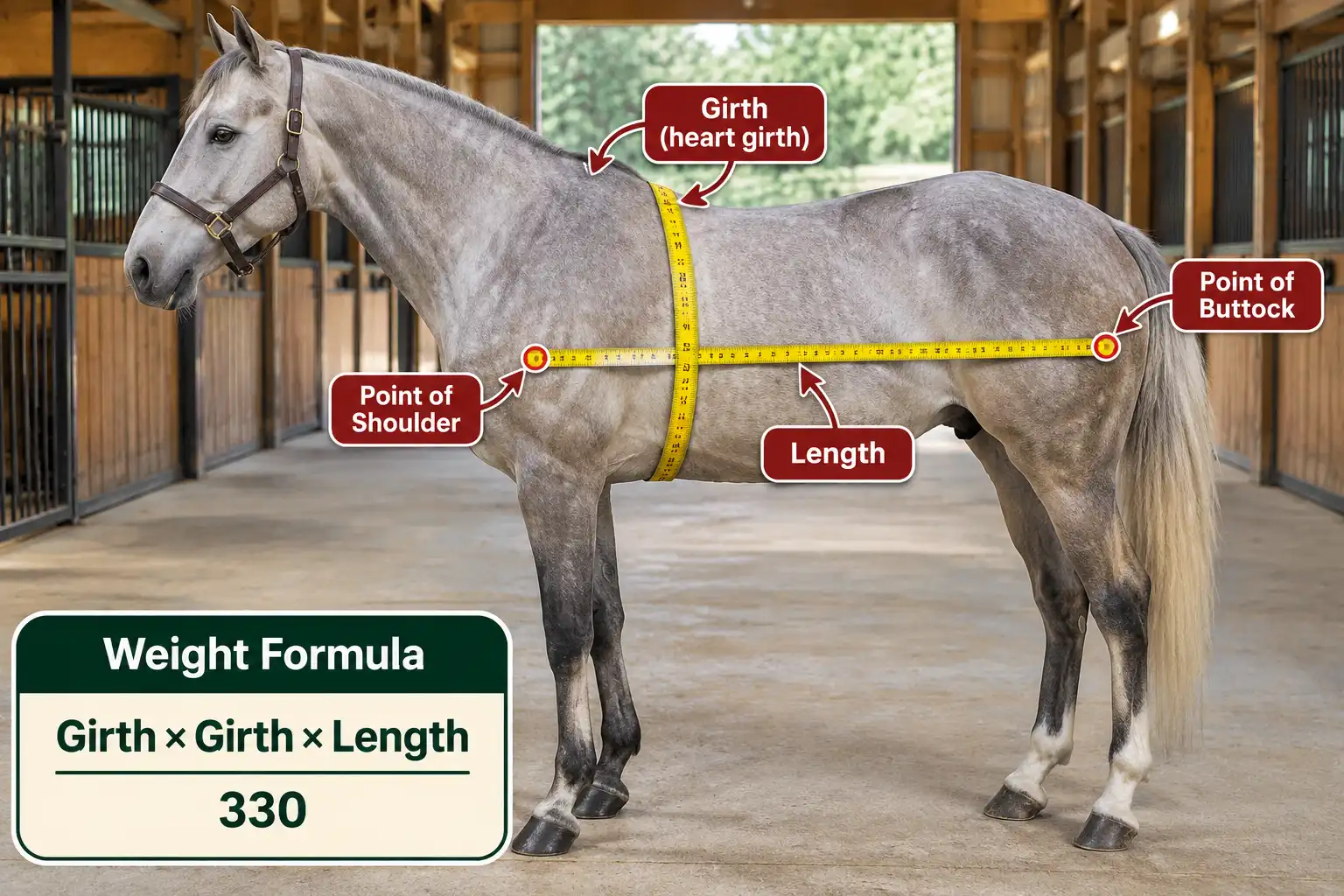
Multiply heart girth by heart girth by body length, all in inches, then divide by 330. That equation, published by Texas A&M AgriLife, gives a fair estimate for a mature light horse.
- Stand the horse square on level ground. A horse that shifts its weight changes both readings.
- Measure heart girth. Run the tape around the barrel just behind the elbows and over the lowest point of the withers. Read it snug, without denting the coat.
- Measure body length. Go from the point of the shoulder straight back to the point of the buttock.
- Run the formula. Write down both measurements so the next reading uses the same spots.
Here is a worked example. A horse with a 72-inch girth and a 66-inch body length gives 72 × 72 × 66 = 342,144. Divided by 330, that is about 1,037 pounds.
The 330 formula fits most mature riding horses. However, it does not suit every horse. Foals, drafts, and Miniature Horses need other methods, and University of Minnesota Extension publishes separate equations for each breed type. So for a draft or a mini, use the breed-specific equation instead.
How Accurate Are Weight Tapes and Guesses?
Guesses miss by more than most owners expect. A Florida study cited by Texas A&M AgriLife found 88 percent of horse people underestimated actual weight. The average miss was 186 pounds.
The Minnesota work found the same pattern across breed types. Draft and warmblood owners missed by about 115 pounds. Thoroughbred owners were within about 95 pounds, and saddle-type owners within about 84. Miniature Horse owners came within 35 pounds, but on an animal that small, 35 pounds is a 15 percent error.
A feed-store weight tape reads girth alone, so it misses the length that the formula adds. Use it to track change on the same horse, not as a final weight.
The most accurate figure comes from a livestock scale. Vet clinics, fairgrounds, and some feed mills keep one. A practical routine:
- Weigh on a scale once, then tape the horse the same day.
- Compare the two figures. That gap is your tape’s correction for that horse.
- Tape monthly at the same time of day, and apply the correction.
How Much Does a Quarter Horse Weigh?
A mature Quarter Horse weighs about 1,100 to 1,300 pounds and stands 14.3 to 16 hands, per Oregon State Extension. The breed carries heavier muscling than other light breeds, especially through the thigh, gaskin, and forearm.
The scale data back that up. In the Minnesota study, stock-type horses averaged 1,133 pounds at 15 hands. Saddle-type horses matched that weight at the same height, yet stock horses did it half a condition point leaner. The difference is muscle, not fat.
Quarter Horse lines also split by job. Halter and ranch horses tend toward the heavy end. By contrast, racing Quarter Horses carry considerable Thoroughbred blood, per Oregon State Extension, and run leaner.
For planning, a 1,200-pound Quarter Horse eats about 24 pounds of hay a day at 2 percent of body weight. Over a 120-day winter, that comes to 2,880 pounds, or about 58 small square bales at 50 pounds each.
How Much Does a Race Horse Weigh?
A Thoroughbred racehorse weighs about 1,000 pounds and stands about 16.1 hands, per The Jockey Club’s America’s Best Racing guide. That figure describes horses in race training, which are young and kept lean.
Mature Thoroughbreds weigh more. In the Minnesota scale data, Thoroughbreds averaged 1,184 pounds at the same 16.1 hands. That group had an average age of 10 and a body condition score of 5. So the 184-pound gap reflects age and job, not a disagreement between sources.
That gap matters when a horse leaves the track. An off-track Thoroughbred often gains weight as it matures and moves to a forage diet. Feed amounts and product labels should follow the horse’s weight now, not a race-day figure on old paperwork.
How Much Does a Clydesdale Horse Weigh?
Most Clydesdales weigh 1,600 to 1,800 pounds and stand 16.2 to 18 hands, per Oklahoma State University’s Breeds of Livestock. Some mature stallions and geldings stand taller and reach 2,200 pounds.
Oregon State Extension gives a narrower figure for stallions: 1,700 to 1,900 pounds at 16 to 17 hands. Both ranges hold. Oklahoma State describes the whole breed, while Oregon State describes stallions only.
Other draft breeds run heavier. Oregon State Extension puts mature Belgian stallions at 1,900 to over 2,200 pounds. It lists Percheron stallions at 1,900 to 2,100 and Shires at more than 2,000. Across all draft types in the Minnesota study, the scale average was 1,877 pounds at 17.2 hands.
Draft owners miss weight by about 115 pounds on average, per the same Minnesota data. At this size, small errors add up fast. An 1,800-pound Clydesdale eats about 36 pounds of hay a day at 2 percent of body weight. Over a 120-day winter, that comes to 4,320 pounds. That is about five round bales at 900 pounds each.
How Much Does a Miniature Horse Weigh?
Adult Miniature Horses averaged 257 pounds on University of Minnesota Extension scales. Minis under 3 years old averaged 200 pounds.
Height defines the breed, not weight. Oregon State Extension notes that the American Miniature Horse Association registers horses 34 inches and under. The American Miniature Horse Registry adds a Division B for horses 34 to 38 inches. The Minnesota adults averaged 36 inches, so that sample included some taller Division B horses.
Condition is the bigger concern. Those adult minis averaged a body condition score of 6.1, above the moderate 5. Per the Minnesota data, one condition point on an adult mini is worth about 18 pounds. So a mini two points heavy carries about 36 extra pounds, close to 14 percent of its body weight.
Small horses get overfed easily, because one flake of hay can cover most of a day’s ration. At 2 percent of body weight, a 250-pound mini needs about 5 pounds of hay a day. Weigh hay on a hanging scale rather than counting flakes. If a mini needs to lose weight, plan the change with your veterinarian. Fast feed cuts carry their own risks for small horses.
How Much Does a Horse Trailer Weigh?
An empty two-horse bumper pull weighs about 2,400 pounds without a dressing room. With one, it weighs about 3,200, per Double D Trailers, a horse trailer manufacturer. Goosenecks and living quarters push the figure far higher.
| Trailer type | Empty weight (lb) |
|---|---|
| 2-horse bumper pull, no dressing room | 2,400 |
| 2-horse bumper pull, dressing room | 3,200 |
| 3-horse bumper pull, dressing room | 4,100 |
| 2-horse gooseneck | 4,600 |
| 3-horse gooseneck | 5,300 |
| 4-horse gooseneck | 6,300 or more |
| 2-horse living quarters, 6 ft short wall | 6,300 |
| 2-horse living quarters, 8 ft short wall | 7,300 |
| 3-horse gooseneck, 10 ft short wall | 8,900 |
Options add weight in steps, per Double D Trailers. Each extra foot of living quarters adds about 500 pounds, and each extra stall adds 240 to 250. A full 8-foot width adds about 1,000 pounds.
Treat these as manufacturer averages, not your trailer’s weight. The VIN label and spec sheet for the trailer you own or plan to buy govern.
What a Loaded Horse Trailer Weighs
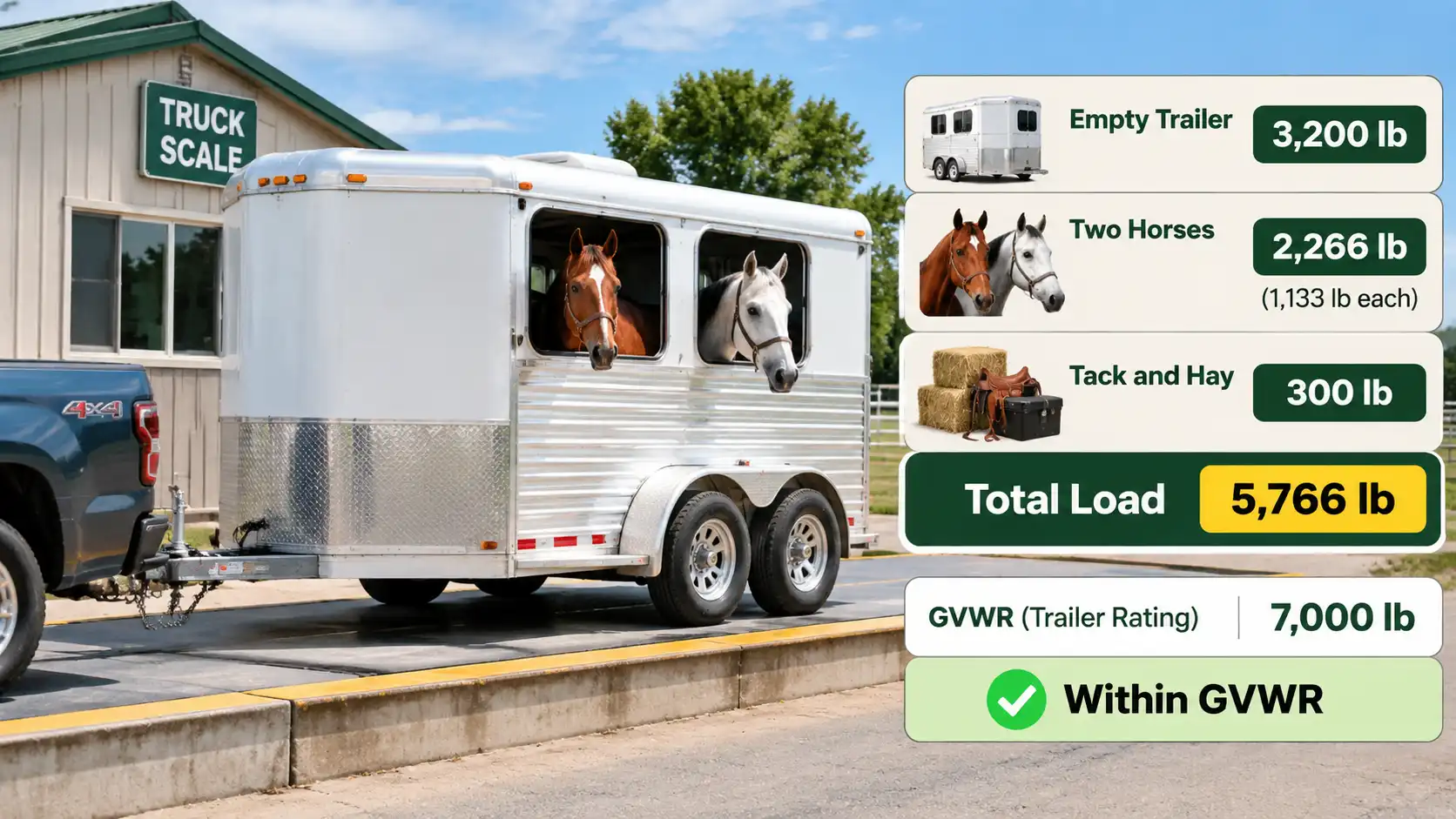
A loaded two-horse bumper pull with a dressing room usually lands near 5,800 pounds. Run the figure for your own rig:
| Item | Weight (lb) |
|---|---|
| Empty 2-horse bumper pull with dressing room | 3,200 |
| Two stock-type horses at 1,133 each | 2,266 |
| Tack, hay, and water (estimate) | 300 |
| Loaded total | 5,766 |
Then compare that total with the trailer’s GVWR, the maximum fully loaded weight it is built to carry. Double D Trailers notes the GVWR sticker usually sits inside an escape door or on the frame.
Next, check the tow vehicle. Its towing capacity must exceed the loaded trailer weight. The hitch also carries its own rating for gross weight and tongue weight. A draft pair changes the math fast, since two 1,800-pound Clydesdales alone outweigh the empty trailer.
How Much Hay and Water a Horse Needs at Each Weight
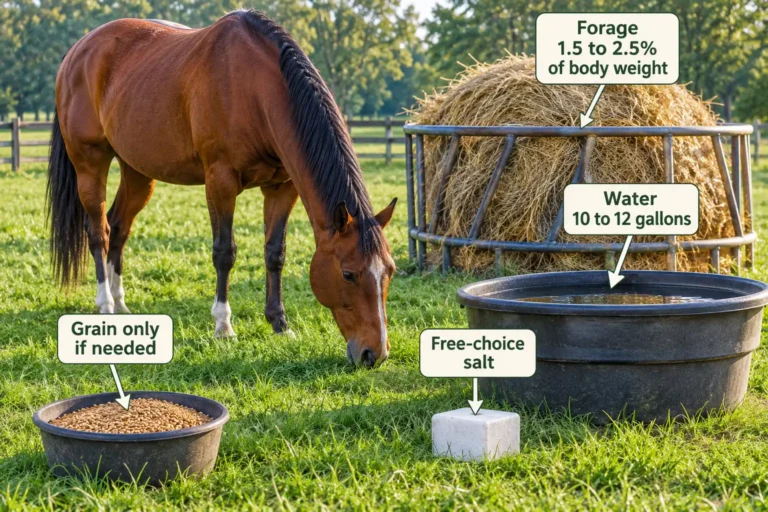
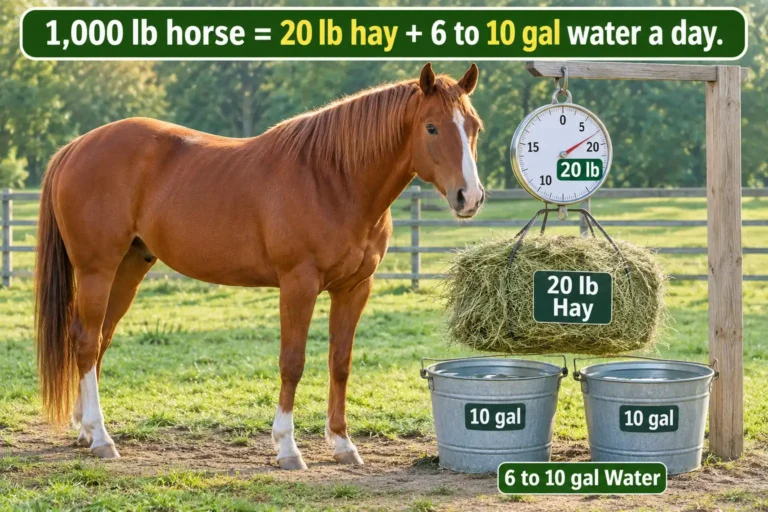
Most horses eat about 2 percent of body weight in hay a day, per University of Minnesota Extension. The workable range is 1.5 to 2.5 percent. The top of that range is close to the most a horse will willingly eat.
Carried through a 120-day winter on hay alone, the rule gives:
| Horse | Weight (lb) | Hay per day (lb) | Hay for 120 days (lb) | 50 lb small squares | 900 lb round bales |
|---|---|---|---|---|---|
| Adult Miniature | 257 | 5 | 620 | 12 | Under 1 |
| Pony | 722 | 14 | 1,730 | 35 | 2 |
| Stock type | 1,133 | 23 | 2,720 | 54 | 3 |
| Thoroughbred | 1,184 | 24 | 2,840 | 57 | 3 |
| Draft | 1,877 | 38 | 4,500 | 90 | 5 |
Add extra for waste, more if hay is fed on the ground.
Water scales with weight too. Minnesota Extension puts most 1,000-pound horses at 10 to 12 gallons a day. A horse working in summer heat can drink 12 to 16 gallons. The same per-head-to-winter arithmetic works for a cow’s daily hay intake. More on feeding and watering livestock sits in the management guides. Stocking rate for your pasture also runs on body weight, through animal units.
Why Horse Weight Matters for Medication Labels
Many horse dewormers and other products are labeled by body weight, so a weight guess becomes a dose guess. Guess low and the horse gets less than the label intends, which can leave parasites alive and help resistance build. Guess high and you waste product.
We publish no dose figures. Read the label on the product you hold, and confirm the amount and any use restrictions with your veterinarian. Some products also require a veterinary prescription.
Weight change is also a health signal. A horse that drops weight without a change in feed or work needs a veterinarian, not a new ration. So track tape readings monthly, and a slow loss shows up early. For more on working with a large animal vet, see livestock health management.
How Body Condition Changes the Scale
One body condition point is worth about 18 to 86 pounds, depending on the horse, per University of Minnesota Extension. The scale uses the 1 to 9 Henneke system, where 5 is moderate.
| Breed type | Pounds per condition point |
|---|---|
| Adult Miniature | 18 |
| Pony | 22 |
| Arabian | 33 |
| Saddle type | 33 |
| Stock type | 37 |
| Warmblood | 37 |
| Thoroughbred | 57 |
| Draft | 86 |
So a draft that slips from a 6 to a 4 loses about 170 pounds. A stock horse making the same drop loses about 75. Use these values to read a tape trend. For example, a steady gain of 35 to 40 pounds on a stock horse means about one condition point. Check the ration before the next point goes on.
FAQs About Horse Weigh
How much does a horse weigh in tons?
A typical 1,100-pound riding horse weighs just over half a ton, or 0.55 tons. Even a 2,200-pound Clydesdale stallion, near the top of its breed, comes to only 1.1 tons.
How much does a baby horse weigh at birth?
A Thoroughbred foal weighs about 100 pounds at birth, per The Jockey Club. Draft foals start heavier and Miniature foals far lighter, so tape or weigh a foal often in year one.
How tall is a 16-hand horse?
A 16-hand horse stands 64 inches, or 5 feet 4 inches, at the highest point of the withers. Its head and neck rise well above that, so check trailer and stall headroom with the head raised.
What is the heaviest horse breed?
Draft breeds are the heaviest horses, led by the Belgian and the Shire. Oregon State Extension puts mature Belgian stallions at 1,900 to over 2,200 pounds and Shires above 2,000.
How much does a pony weigh?
Ponies averaged 722 pounds at about 12.3 hands on University of Minnesota Extension scales. Weight spans a wide range, though, since Oregon State Extension puts Shetland ponies at only 300 to 400 pounds.
How often should I weigh my horse?
Tape your horse monthly and after any change in feed, work, or season. Weigh on a scale once or twice a year, and call your vet about any loss you cannot explain.
Putting This Into Practice
Get one true scale weight for each horse, then tape it the same day. That shows how far the tape reads off. From there, tape monthly and let that figure drive the hay order, the water plan, and the trailer load. For anything labeled by weight, read the product label and confirm it with your veterinarian. More breed and care guides sit in the horse section.