How Much Hay Does a Cow Eat Per Day? Pounds by Weight and Stage
How much hay a cow eats per day depends on her weight, her milk, and the quality of the hay. Below are the daily figures, the waste to add on top, and the math for a full winter.
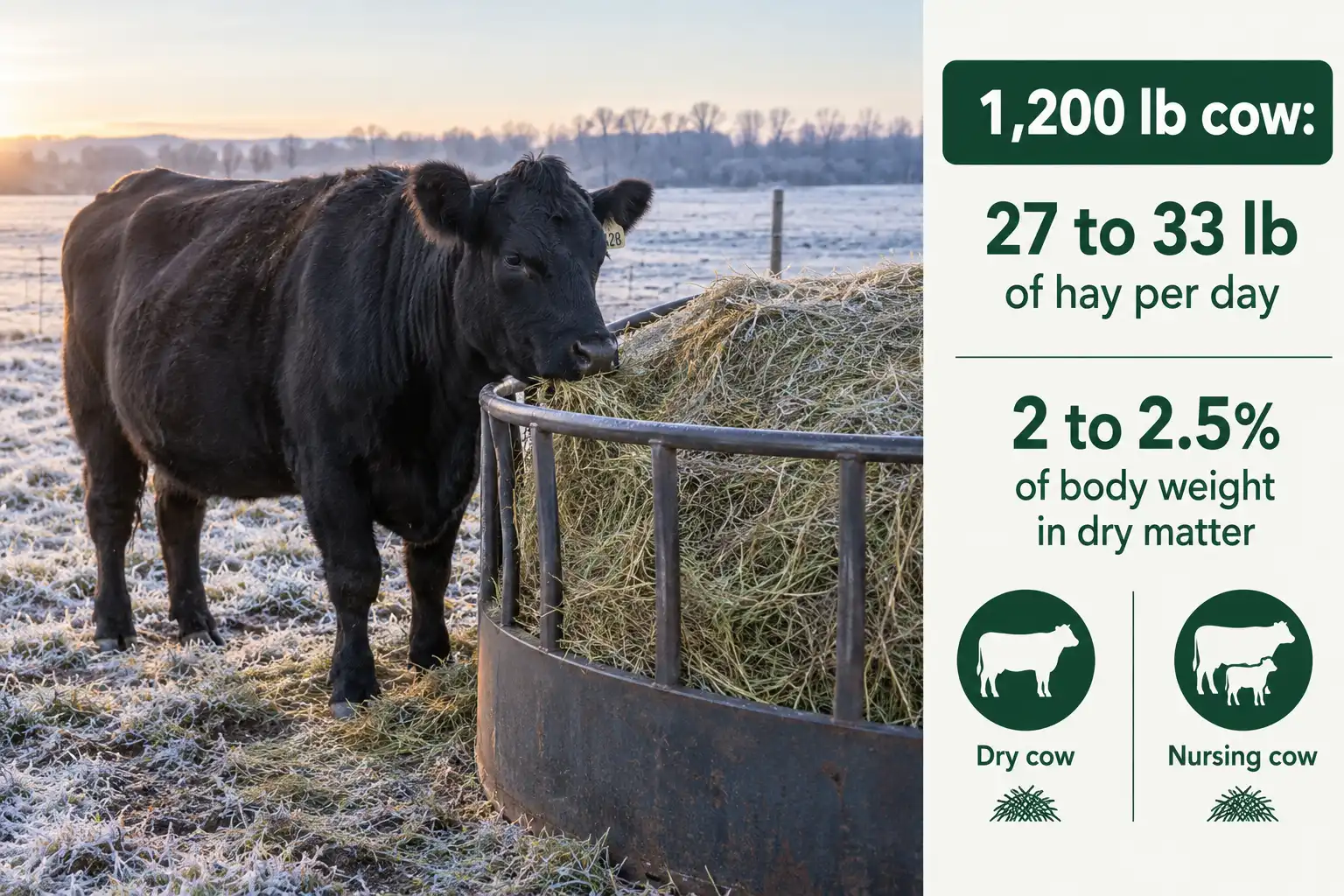
A beef cow eats about 2 to 2.5 percent of her body weight in hay dry matter per day. That means a 1,200 pound cow on average grass hay eats roughly 27 to 33 pounds as fed, before waste.
How Much Hay a Cow Eats Per Day by Body Weight
On average grass hay, a dry beef cow eats 2.0 to 2.3 percent of her body weight in dry matter. A nursing beef cow eats 2.3 to 2.5 percent, per University of Nebraska-Lincoln Extension. Oklahoma State Extension’s figures of 2.2 and 2.5 percent fall inside those ranges. So we give the range, not a single number.
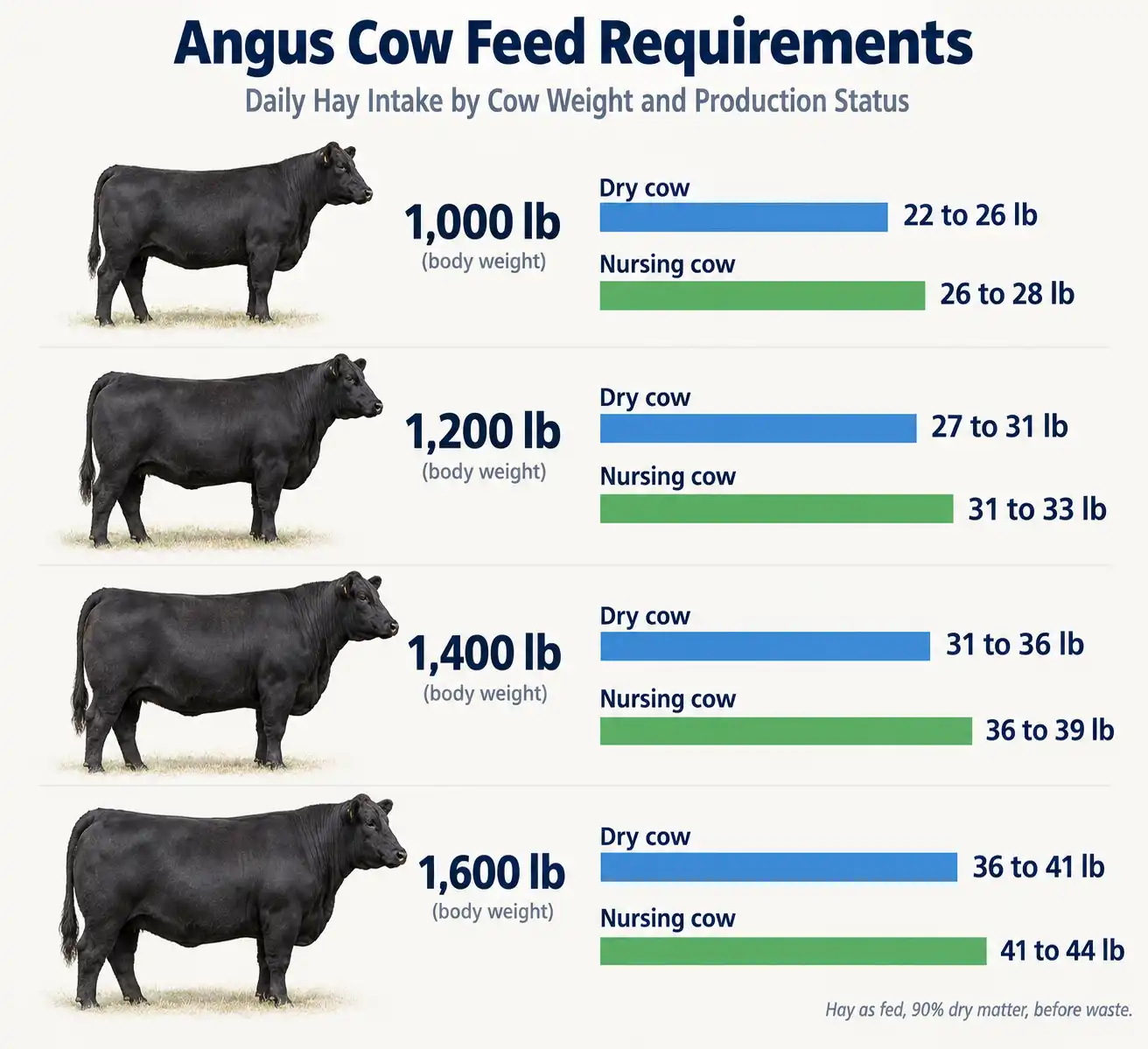
The table turns those rates into pounds of hay a beef cow eats each day. It assumes hay at 90 percent dry matter and counts only what she eats, not what she wastes.
| Cow weight | Dry cow (lb of hay a day) | Nursing cow (lb of hay a day) |
|---|---|---|
| 1,000 lb | 22 to 26 | 26 to 28 |
| 1,200 lb | 27 to 31 | 31 to 33 |
| 1,400 lb | 31 to 36 | 36 to 39 |
| 1,600 lb | 36 to 41 | 41 to 44 |
Weight moves the answer more than most people expect. Oklahoma State’s Beef Cattle Manual gives an example. A 1,300 pound dry cow needs 32 percent more energy daily than a 900 pound cow. Frame size also varies widely across beef cattle breeds, and cows often weigh more than owners guess. In a Nebraska Extension survey, 8 of 17 Washington County herds reported average cow weights over 1,400 pounds.
Dry Matter vs. As-Fed: Converting the Figures
Intake research is reported as dry matter, so you add the water back before you weigh out hay. The formula is short:
Pounds of hay as fed = pounds of dry matter ÷ the hay’s dry matter percent
For example, Nebraska Extension puts a 1,200 pound beef cow on average hay at 24 pounds of dry matter. At 88 percent dry matter, that comes to about 27 pounds as fed. Nebraska Extension also notes grass hay often runs 7 to 10 percent moisture. So this guide uses 90 percent dry matter.
The gap grows with wetter feed. If baleage tests 50 percent dry matter, the same 24 pounds of dry matter means 48 pounds as fed. So take the dry matter figure from your forage test, not from a guess.
How Stage of Production Changes Daily Hay Needs
Lactation raises hay intake more than anything else in a cow’s year. Oklahoma State’s Beef Cattle Manual says an average milking beef cow needs nearly 50 percent more energy than when dry. She eats more of the same hay to get it.
Her needs rise in quality, too. The manual’s nutrient tables for a 1,200 pound beef cow show both shifts:
| Stage, 1,200 lb cow | Dry matter intake (lb a day) | Hay as fed at 90% DM (lb a day) | Diet energy needed (TDN, % of DM) |
|---|---|---|---|
| Middle third of pregnancy | 21.4 | 24 | 50 |
| Last third of pregnancy | 23.9 | 27 | 54 |
| Early lactation, 25 lb milk | 31.3 | 35 | 59 |
That last row explains a common winter problem. A nursing cow needs hay near 59 percent TDN. Mature grass hay under 52 percent cannot supply that, however much she eats.
Calving date decides which row your hay season lands in. In a spring-calving beef cattle herd, most of winter falls in late pregnancy. A fall-calving herd nurses through winter, so budget those cows at the lactating rate.
Water climbs with intake, too. Oklahoma State’s tables put a 1,300 pound dry beef cow near 9 gallons a day at 40 degrees F. Giving 15 pounds of milk, the same cow needs about 12. Check tanks and heaters as part of your feed and water planning.
How Hay Quality Changes How Much a Cow Can Eat
Better hay gets eaten in larger amounts because it digests faster and leaves the rumen sooner. Poor hay sits longer, so the cow stops because she is full, not because her needs are met. On wheat straw, a beef cow may manage only 1.6 to 1.8 percent of body weight, per Nebraska Extension.
Oklahoma State Extension’s forage capacity table sets beef cow intake by hay quality:
| Hay quality (TDN) | Typical hay | Dry cow (% of body weight) | Nursing cow (% of body weight) |
|---|---|---|---|
| Low (under 52%) | Mature grass or legume hay, straw | 1.8 | 2.2 |
| Average (52 to 59%) | Boot to early bloom grass hay, late bloom legume hay | 2.2 | 2.5 |
| High (over 59%) | Prebloom legume hay, preboot grass hay | 2.5 | 2.7 |
The two services split on low quality hay for nursing cows. Oklahoma State puts it at 2.2 percent, while Nebraska puts it at 2.0. For a 1,200 pound cow, that gap is about 2.7 pounds of hay a day as fed.
Protein changes the picture as well. Oklahoma State notes these rates assume the cow’s protein needs are met. When hay runs short on protein, she eats less than the table shows. A forage test for crude protein and TDN answers both questions.
Cold Weather Raises the Daily Hay Need
Below her lower critical temperature, a beef cow needs more energy. She eats more to cover it if the hay allows. Ohio State University Extension lists these lower critical temperatures for beef cattle:
| Hair coat | Lower critical temperature |
|---|---|
| Wet, or summer coat | 59°F |
| Dry fall coat | 45°F |
| Dry winter coat | 32°F |
| Dry heavy winter coat | 18°F |
Below that line, energy needs rise about 1 percent for each degree, per Ohio State. A wet coat loses its insulation, so a cold rain can hit harder than a dry, colder day. Mud can add 7 to 30 percent more, and it may cut intake at the same time.
Wind counts as well. Take a 1,200 pound cow at 20 degrees F in a 14 mph wind. Oklahoma State’s manual puts that cow’s energy need about 28 percent above a calm 32 degree day.
Here is the catch. Ohio State notes cows on average to good hay may raise intake enough to keep up. On poor hay they cannot, so they burn body fat instead. That is the reason to hold back your best bales for cold, wet weeks, or to add an energy supplement.
How Much Extra Hay to Put Out for Waste
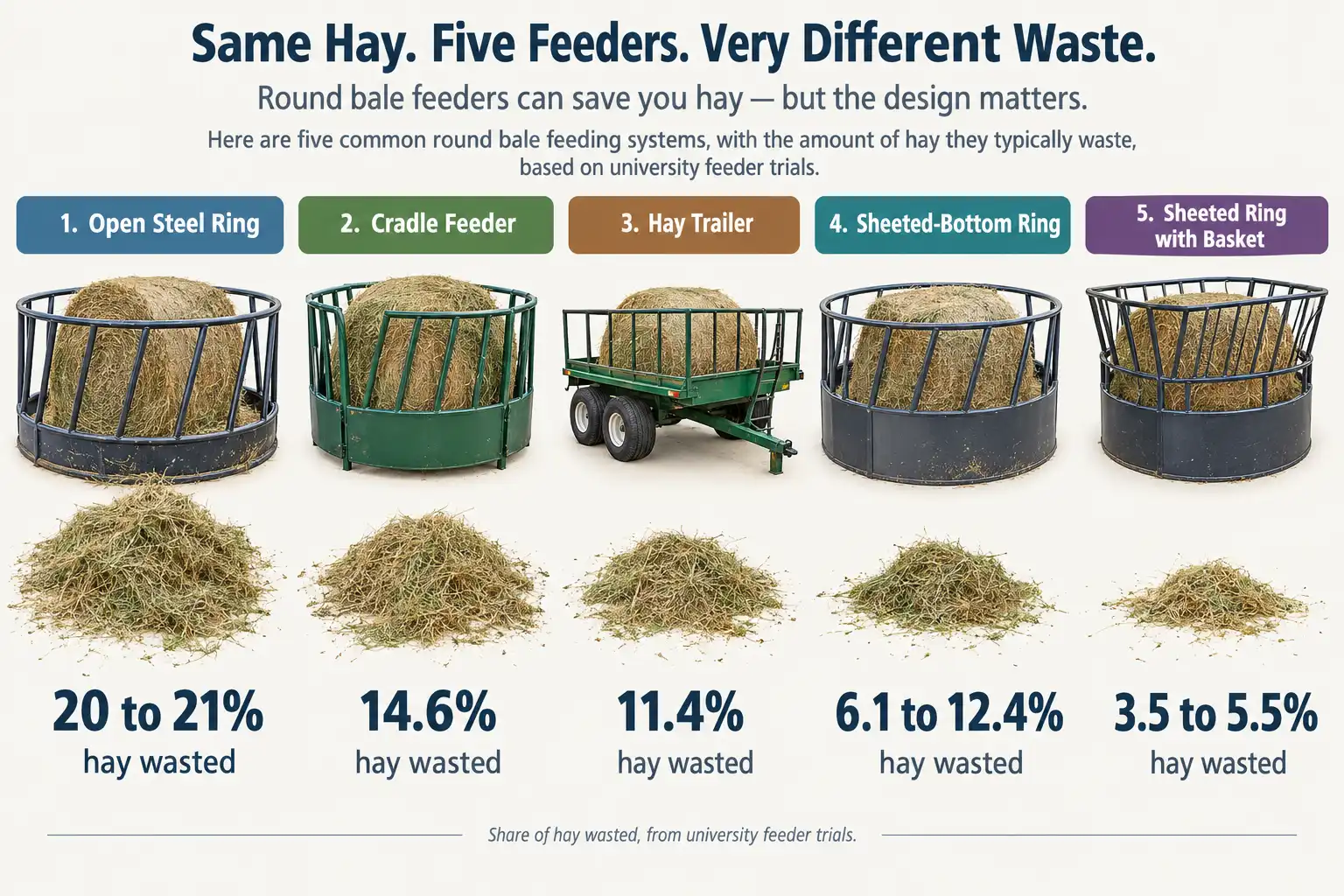
Put out more hay than the cow eats, because some always gets trampled or soiled. Nebraska Extension says most feeding systems lose at least 10 percent. Beyond that, feeder design sets the loss, per trials summarized by Oklahoma State Extension and Michigan State University Extension:
| Feeding method | Hay waste (%) | Trial source |
|---|---|---|
| No feeder | 45 | Older trial cited by Oklahoma State |
| Open-bottom steel or poly ring | 20 to 21 | Oklahoma State |
| Cradle feeder | 14.6 | Michigan State |
| Sheeted-bottom ring | 6.1 to 12.4 | Michigan State, Oklahoma State |
| Hay trailer feeder | 11.4 | Michigan State |
| Sheeted ring with basket or cone | 3.5 to 5.5 | Michigan State, Oklahoma State |
Hay type shifts these figures. In a Missouri trial reviewed by Oklahoma State, alfalfa haylage waste stayed at 5 to 7 percent in every feeder. Dry fescue hay, by contrast, ran from 8.9 to 19.2 percent.
To budget waste, divide what the cow eats by the share not wasted. A beef cow eating 30 pounds needs 37.5 pounds delivered to an open ring (30 ÷ 0.80). In a basket feeder, she needs about 32 (30 ÷ 0.945). Over a 120 day winter, that gap adds up to about 690 pounds of hay per cow. For 40 cows, it comes close to 14 tons. So compare waste figures before you buy hay feeding equipment.
Winter Hay Budget: A Worked Example
To budget a winter, add waste to daily dry matter, multiply by feeding days, then divide by bale dry matter. Here is the math for one 1,200 pound dry beef cow on average grass hay:
- Find daily dry matter. 1,200 lb × 2.2% = 26.4 lb, using Oklahoma State’s rate for a dry cow.
- Add feeder waste. In a sheeted-bottom ring at 12.4% waste: 26.4 ÷ 0.876 = 30.1 lb delivered.
- Multiply by feeding days. For a 120 day season: 30.1 × 120 = 3,616 lb of dry matter.
- Divide by bale dry matter. A firm 5×5 round bale holds about 980 lb of dry matter: 3,616 ÷ 980 = 3.7 bales.
University of Missouri Extension puts a 5×5 bale at 880 to 1,180 pounds of dry matter. Tighter bales hold more. Those figures are already dry matter, so no moisture step is needed. In as-fed terms, 3,616 pounds of dry matter is about 2 tons of hay at 90 percent dry matter.
For a fall-calving cow nursing through winter, use 2.5 percent in step 1. That raises her need to about 4.2 bales.
Feeding days come from your own records. Oklahoma State notes most Oklahoma cow-calf operations plan on two to three months of hay. Herds where snow buries standing forage feed longer, so every extra week of fall grazing shortens the hay season.
Scaled to Your Herd Size
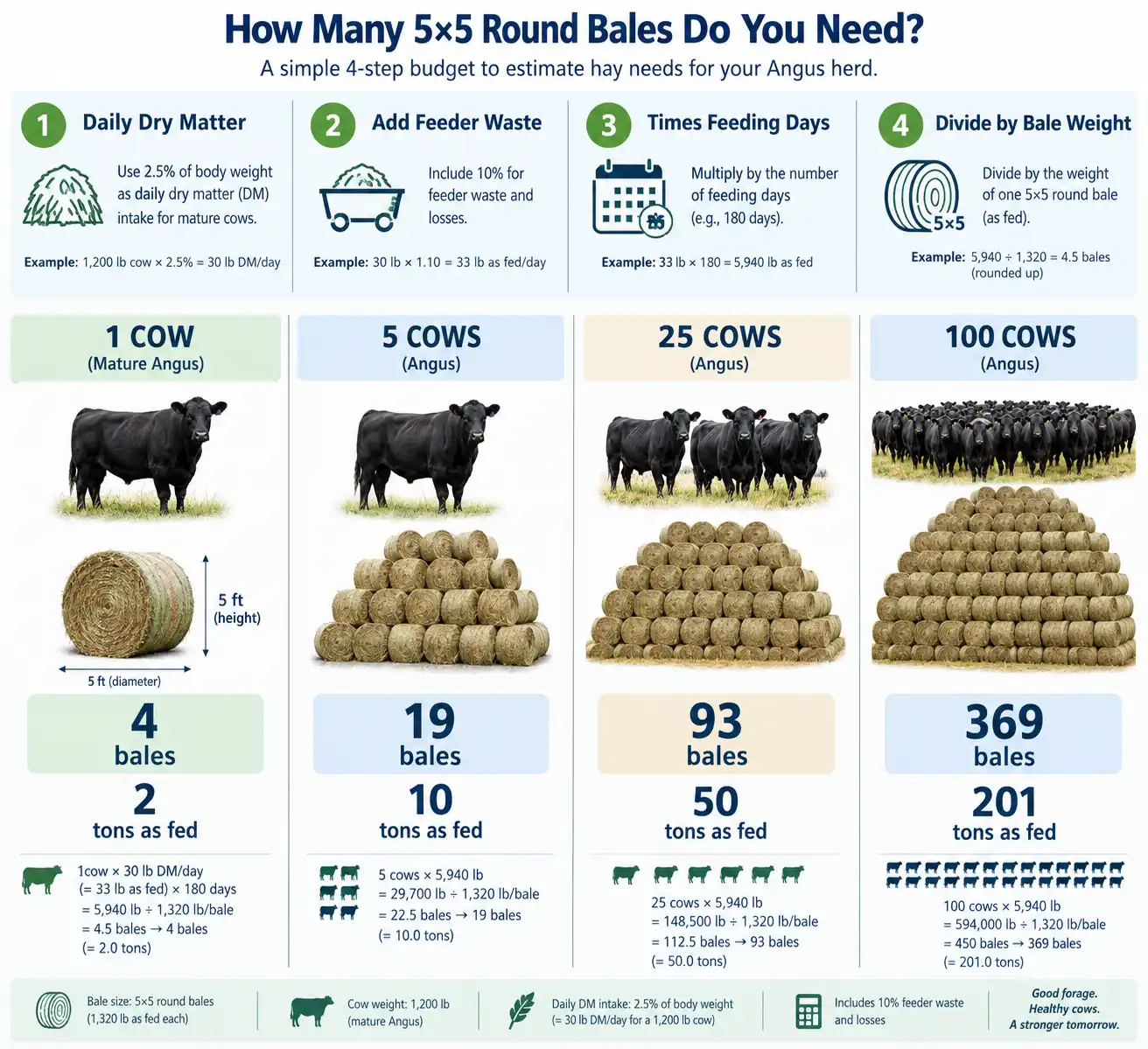
The table keeps the same assumptions. That means 1,200 pound dry beef cows on average grass hay, a sheeted-bottom ring, and 120 days. Bales are 5×5 at 980 pounds of dry matter.
| Herd size | Hay dry matter needed (lb) | Hay as fed at 90% DM (tons) | 5×5 round bales, rounded up |
|---|---|---|---|
| 1 cow | 3,616 | 2.0 | 4 |
| 5 cows | 18,080 | 10.0 | 19 |
| 25 cows | 90,400 | 50.2 | 93 |
| 100 cows | 361,600 | 200.9 | 369 |
Dairy Cows Eat More, but Less of It Is Hay
A milking dairy cow eats far more dry matter than a beef cow, but much is grain and silage. Ohio State University Extension puts a Holstein giving 60 pounds of milk near 47 pounds of dry matter a day. At 80 pounds of milk, she eats about 54. A Jersey giving 50 pounds eats about 39.
Dry dairy cows sit closer to beef cows. Ohio State lists 30 pounds of dry matter a day for a dry Holstein and 22 for a dry Jersey. On hay alone at 90 percent dry matter, that is about 33 and 24 pounds as fed.
Ohio State notes the forage share in rations for milking dairy cattle depends on cost, forage quality, and production goals. So no single hay figure fits. For a family milk cow, a county extension dairy agent can balance the ration against your forage test.
Is She Eating Enough? Check Body Condition
Body condition tells you whether the hay is enough sooner than any formula. Nebraska Extension calls it the best way to measure whether cows are meeting their needs. So score beef cows on the 1 to 9 scale through winter, not only at calving.
Oklahoma State’s body condition scoring fact sheet puts each score at about 7 percent of a cow’s score 5 weight. For a 1,200 pound cow, one score is about 84 pounds. Its calving target is score 5 to 6 for mature cows and 6 for first-calf heifers.
Calving thin is hard on the cow and hard to undo. In an Oklahoma State trial, thin heifers fed to regain condition after calving rebred at 67 percent. Heifers that calved in good condition and held it rebred at 91 percent.
Watch for a cow that loses condition while herdmates on the same hay hold theirs. She, or any cow that goes off feed, needs a large animal veterinarian. Several health problems show up first as weight loss or poor appetite.
Common Hay Budget Mistakes
- Guessing bale weight. University of Missouri Extension found people often overestimate bale weights by a couple hundred pounds. That is a 15 to 20 percent error, enough to run short in late winter.
- Guessing cow weight. A budget built for 1,100 pound cows comes up short for 1,400 pound cows. Weigh a few cows, or use recent cull cow weights.
- Feeding low protein hay. Cows eat less than the table rates when protein runs short, per Oklahoma State. Hay can sit in the ring while cows lose condition.
- Leaving out waste. Nebraska Extension puts round bale waste at 6 to 20 percent or more, depending on the feeder.
- Budgeting every cow at the dry rate. Cows that calve before grass greens up need the nursing rate for those weeks.
FAQs About Daily Hay Intake for Beef Cows
How many round bales does a cow eat in a winter?
A 1,200 pound dry beef cow needs about four 5×5 round bales for a 120 day winter, including feeder waste. Loose bales, open ring feeders, or a nursing cow can push that toward five.
How much hay does a cow eat in a month?
A 1,200 pound dry beef cow eats about 810 to 930 pounds of average grass hay a month, before waste. A nursing cow of the same weight eats about 930 to 990 pounds.
Do cows eat more hay in cold weather?
Yes, once it falls below their lower critical temperature, 32 degrees F in a dry winter coat, per Ohio State. On poor hay, though, cows cannot eat enough extra and lose condition instead.
How much hay does a bull eat per day?
A mature beef bull eats roughly 33 to 45 pounds of dry matter a day, depending on size. Oklahoma State’s tables put a 1,700 pound bull near 33 pounds and a 2,300 pound bull near 45.
How much hay does a weaned calf eat?
A 500 pound weaned calf gaining 1 pound daily eats about 12 pounds of dry matter, per Oklahoma State. That gain needs a diet near 59 percent TDN, so hay alone often falls short.
How do I know what quality my hay is?
Send a sample for a forage test that reports crude protein and TDN. Oklahoma State uses 52 and 59 percent TDN as the lines between low, average, and high quality beef cow hay.
Putting This Into Practice
Start with weight and stage. Budget 2 to 2.5 percent of body weight in hay dry matter for a beef cow, then add feeder waste. Weigh a few cows and a few bales before you buy, and test the hay. Through winter, let body condition tell you whether the budget holds.