
How to Calculate Stocking Rate: Formula, Steps, and Worked Examples
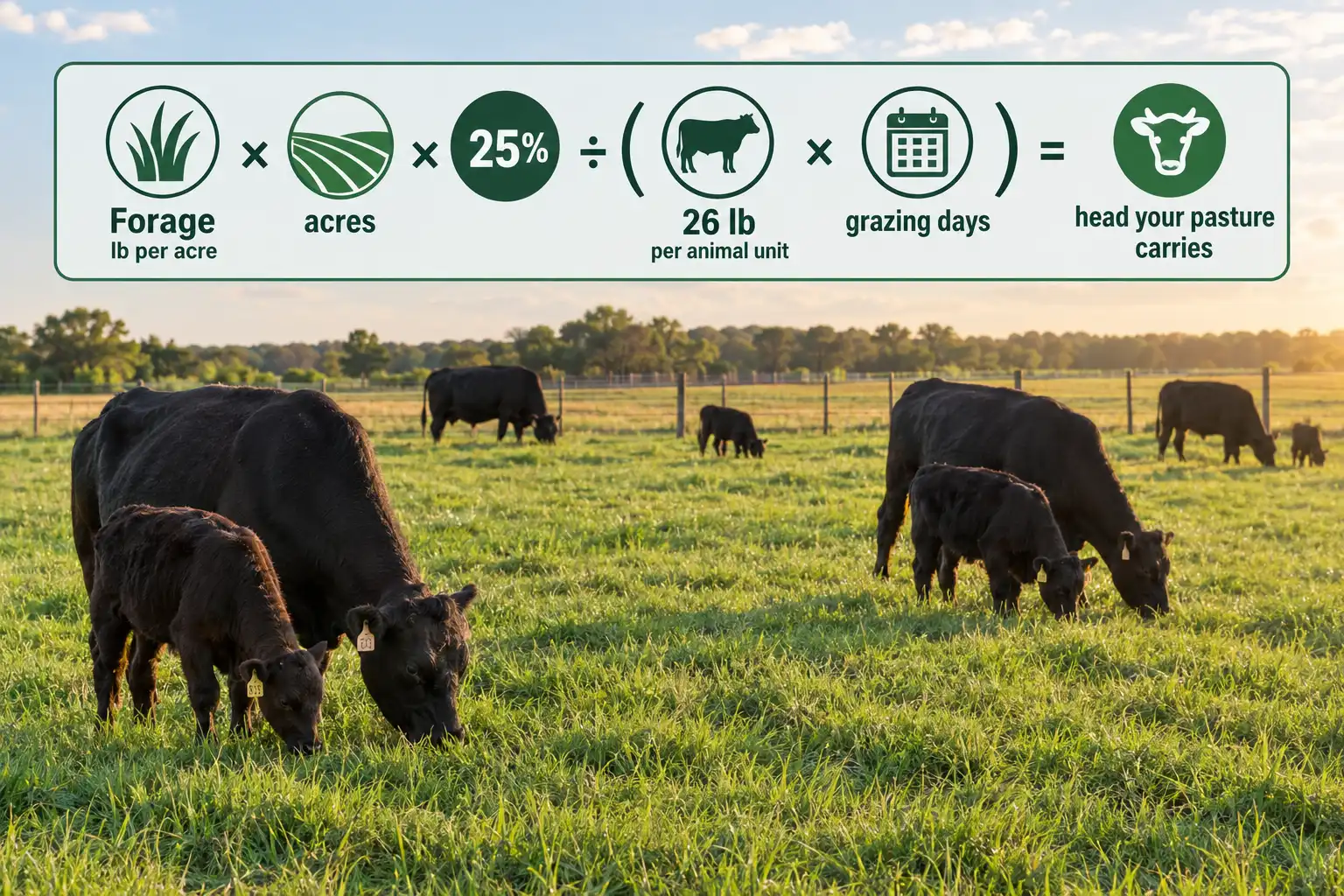
Stocking rate sets how many animals your pasture can feed without wearing out the grass. Here is how to calculate stocking rate from four inputs: forage grown per acre, the share animals can safely use, intake per animal, and days on pasture.
To calculate stocking rate, multiply forage per acre by acres and by harvest efficiency (Oklahoma State Extension uses 25% on rangeland). Divide by one animal’s daily intake times grazing days. The result is the head your pasture carries.
Stocking Rate, Stocking Density, and Carrying Capacity
Stocking rate is the number of animals on a set area of land over a set period. Oklahoma State Extension expresses it in animal units per unit of land, where one animal unit (AU) is a 1,000-pound cow. Carrying capacity is the stocking rate your land can hold year after year without losing grass.
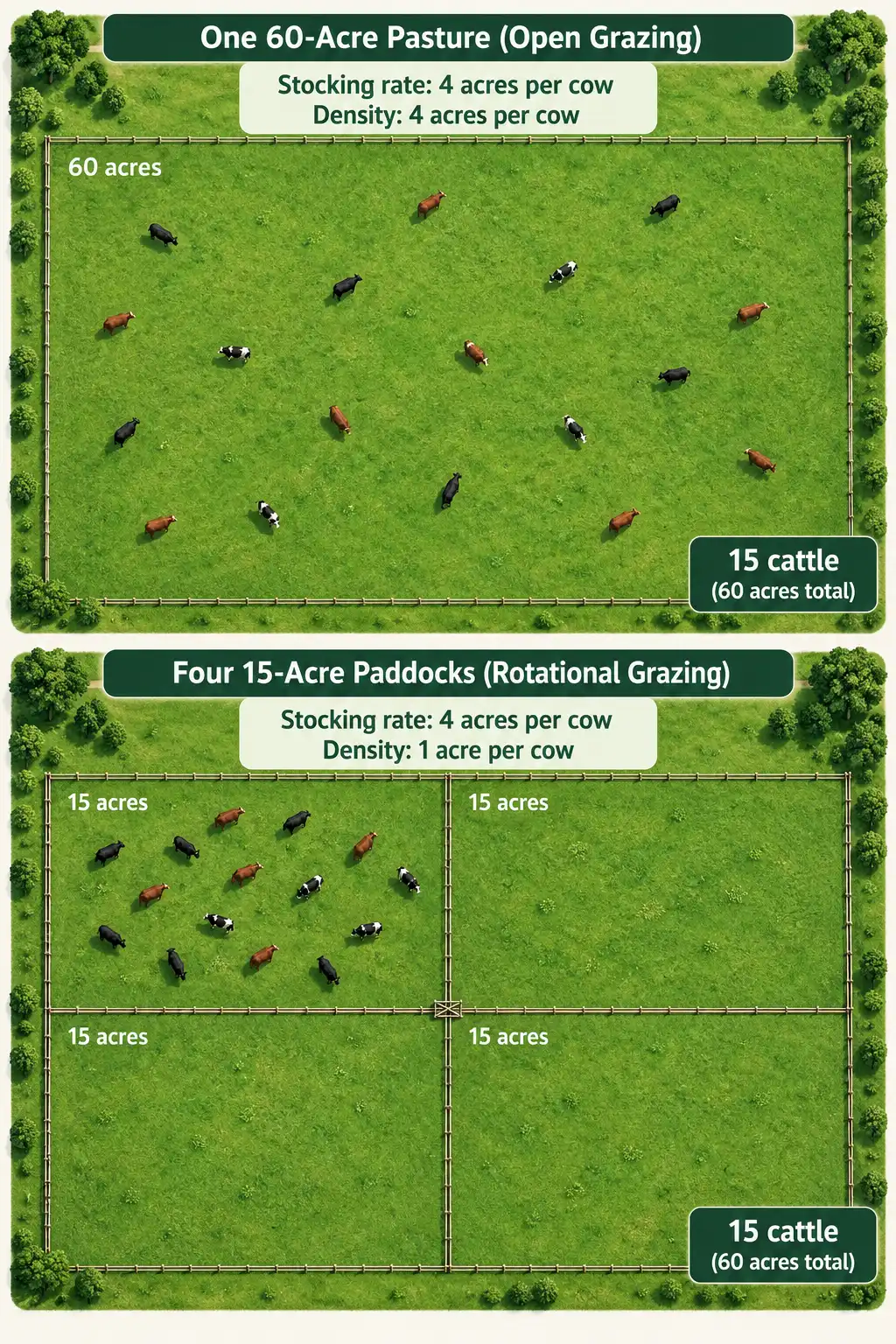
Stocking density is a different measure. It counts the animals in one paddock at one moment. University of Georgia Extension shows the gap with a 60-acre farm and 15 cows. Grazed as one pasture, both figures equal 4 acres per cow. Split into four 15-acre paddocks, the stocking rate stays at 4 acres per cow, but stocking density jumps to 1 acre per cow.
So rotation changes density, not rate. Rate is the figure that decides whether the whole place runs short of grass.
The Stocking Rate Formula
Every extension method comes down to one division: usable forage over forage demand.
Head your pasture carries = (forage lb per acre × acres × harvest efficiency) ÷ (daily intake per head × grazing days)
Acres per head = acres ÷ head your pasture carries
Oklahoma State Extension sets daily intake at 26 pounds of forage dry matter for a 1,000-pound beef cow, the standard animal unit. Larger and smaller animals scale from that figure, so the steps below convert every animal to animal units first.
You can also run the math in animal unit months (AUM). One AUM is the forage one animal unit eats in a month. That way, a pasture rated in AUM per acre divides straight into the AUM your herd needs.
How to Calculate Stocking Rate, Step by Step
Work through five steps in order. Each step fixes a number the next one depends on.
Step 1. Find How Much Forage Your Land Grows
Start with pounds of forage dry matter per acre for the year or season. Without that figure, every later step is a guess.
For a first estimate, use USDA NRCS Web Soil Survey. Oklahoma State Extension’s guide walks through it. Draw your area of interest, open the Soil Data Explorer tab, then Suitabilities and Limitations for Use, then Vegetative Productivity. Choose Range Production for native range, rated for a favorable, normal, or unfavorable year. Choose Yields for introduced pasture. Ratings come back in pounds per acre, tons per acre, or AUM.
However, Oklahoma State notes these ratings assume a high level of management. Treat them as a starting point. University of Nebraska-Lincoln Extension also recommends truth-testing them against your own pasture.
To measure directly, clip. Nebraska-Lincoln’s method tosses a 2-foot by 2-foot frame at random and clips everything inside at ground level. Air-dry the sample for a week, then weigh it. Divide by the square feet you clipped and multiply by 43,560 to get pounds per acre. More throws give a better average, so sample low spots and uplands alike.
Step 2. Apply Harvest Efficiency
Animals never eat everything that grows. So cut the forage figure down to what they actually take.
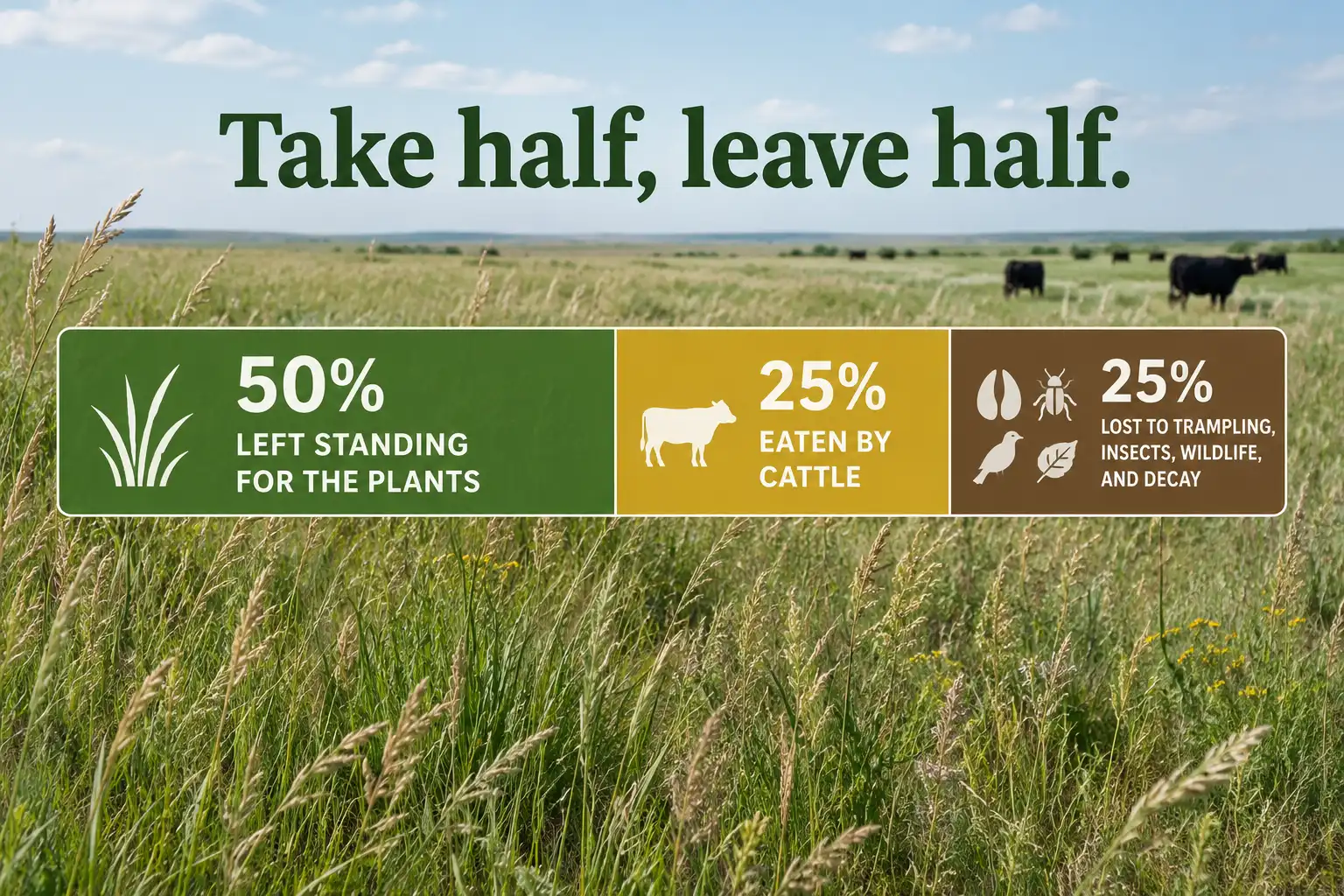
On rangeland, Oklahoma State Extension starts from the take half, leave half rule. Half the forage stays standing to protect the plants. Of the half removed, only half reaches the animal, because trampling, insects, wildlife, and decay claim the rest. That leaves a harvest efficiency of 25%. Nebraska-Lincoln Extension uses the same 25% as a starting figure for continuous season-long grazing.
Introduced pasture can take more. Oklahoma State lists maximum utilization near 75% for bermudagrass and 70% for tall fescue, given adequate moisture and fertility. Still, a ceiling is not a planning figure. University of Georgia Extension reports that continuous grazing often captures only 30 to 40% of available forage. By contrast, rotational grazing at the right stocking density reaches 60 to 75%.
In practice, match the percentage to how you graze. Use the low end for one pasture grazed all season. Save the high end for systems where animals move and paddocks rest.
Step 3. Convert Every Animal to Animal Units
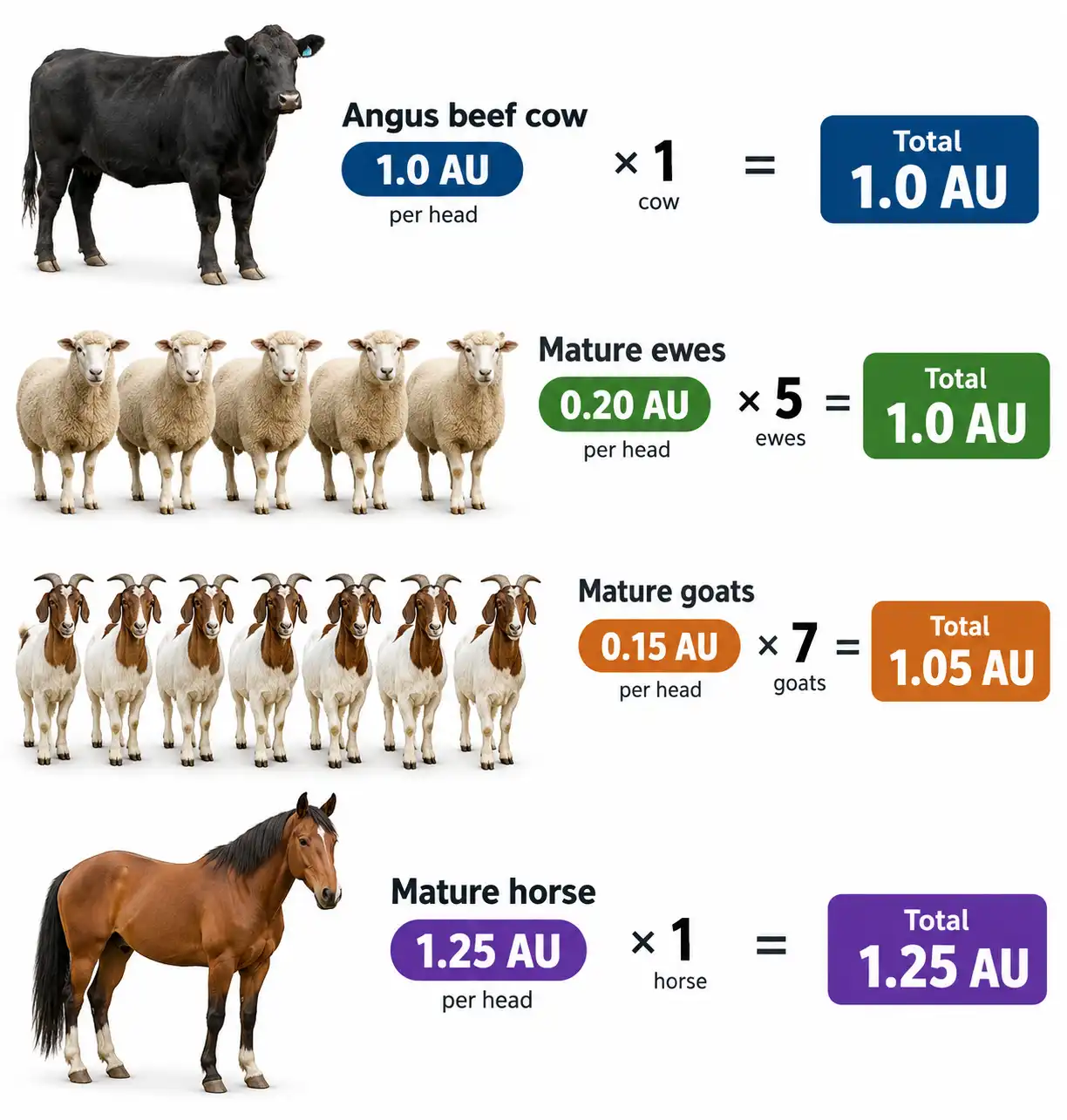
An animal unit is a 1,000-pound cow, but few beef cows weigh that now. University of Georgia Extension puts today’s average beef cow near 1,300 to 1,400 pounds. So convert each class of animal to animal unit equivalents (AUE) before you divide.
| Animal | USDA NRCS AUE | Oklahoma State AUE |
|---|---|---|
| Beef cow, 1,000 lb, with calf | 1.00 | 1.0 |
| Mature bull | 1.35 | 1.25 |
| Mature horse | 1.25 | 1.25 |
| Mature sheep | 0.20 | 0.2 |
| Mature goat | 0.15 | 0.17 |
The two lists agree on most classes and split on bulls and goats. The gap is small, so pick one list and use it consistently.
For cattle, a weight-based rule beats a fixed table. Nebraska-Lincoln Extension adds 0.1 AU for every 100 pounds over 1,000, so a 1,200-pound cow is 1.2 AU. Once her calf passes 3 months old, add its weight too. Oklahoma State offers a shortcut instead: count each cow at about 1.4 AU to cover calves, bulls, and replacement heifers.
Oklahoma State’s rangeland fact sheet scales by metabolic body weight, which puts a 1,400-pound cow at 1.3 AU rather than 1.4. When unsure, use the straight weight method. It gives the more conservative answer.
Step 4. Set Intake and Days on Pasture
Next, set how much each animal unit eats and for how long.
Oklahoma State Extension and Nebraska-Lincoln Extension both set one AUM at 780 pounds of forage. That is a 1,000-pound beef cow eating 26 pounds a day for 30 days. USDA NRCS tables use 790 pounds per AUM, the same cow eating 26 pounds a day over an average 30.4-day month. The gap is under 2%, so use whichever figure your local office uses.
Real intake moves with the animal. Nebraska-Lincoln puts a grazing beef cow at 2.2 to 2.3% of body weight in dry matter daily. A lactating beef cow also eats noticeably more than a dry one.
Count grazing days from turnout to removal. If the plan runs 150 days, budget forage for all 150, not just the months the grass looks good.
Step 5. Divide, Then Round Down
Now run the division. Nebraska-Lincoln Extension shows the AUM route with a range producing 1,250 pounds of forage per acre. At 25% harvest efficiency, about 313 pounds per acre is available to cattle. Divide 313 by 780, and the site rates 0.4 AUM per acre. In other words, one animal unit needs 2.5 acres for every month it grazes there.
Always round the head count down. A fraction of a cow still eats, and a pasture stocked to the decimal has no cushion for a dry month.
Worked Example: 40 Acres of Rotationally Grazed Bermudagrass
Here is the full calculation for a small cow-calf operation. It uses Oklahoma State Extension’s bermudagrass figures and Nebraska-Lincoln Extension’s calf-weight method.
- Pasture: 40 acres of bermudagrass producing 5,000 pounds of dry matter per acre a season, the figure in Oklahoma State’s own example
- Grazing: rotational, at the 65% utilization Oklahoma State uses in that example
- Season: 120 days, or four months
- Herd: 1,200-pound beef cows with spring calves weighing 200, 300, 400, and 500 pounds over the four months
First, usable forage: 5,000 × 40 × 0.65 = 130,000 pounds.
Next, demand per pair. As the calf grows, each pair counts 1.4, 1.5, 1.6, and then 1.7 AU, for 6.2 AUM in total. At 780 pounds per AUM, one beef cow and her calf need 4,836 pounds of forage for the season.
Then divide: 130,000 ÷ 4,836 = 26.9, so stock 26 pairs. That works out to about 1.5 acres per pair for the 120 days.
Now run it again for one pasture grazed continuously at 40%, the top of University of Georgia’s 30 to 40% range for continuous grazing. Usable forage drops to 80,000 pounds, and the same 40 acres carries 16 pairs. The grazing method alone moves the answer by ten pairs.
Remember that 120 days is not a year. The other eight months need stockpiled forage, other ground, or a winter feed budget worked out separately.
Worked Example: 1,000 Acres of Native Rangeland
At ranch scale the method stays the same. Oklahoma State Extension works it on 1,000 acres of tallgrass rangeland that averaged 6,360 pounds of standing forage per acre over ten years of clipping.
At 25% harvest efficiency, the ranch holds 1,590,000 pounds of usable forage. At 26 pounds a day for 365 days, that feeds 168 animal units of 1,000-pound beef cows year-round. That equals about 6 acres per animal unit year.
However, Oklahoma State advises counting each cow at about 1.4 AU to cover calves, bulls, and replacements. Redo the math at 36.4 pounds a day per cow, and the ranch carries 119 cows, or 8.4 acres per cow.
Grazing method matters here too. In the same fact sheet, rotational stocking lifts harvest efficiency to 35%. At that rate, still counting 1.4 AU per cow, the 1,000 acres carries 167 cows.
Regional Stocking Rates: Why One Number Never Fits
Published stocking rates swing by region because rainfall and forage growth swing. We give each figure as its source published it, rather than averaging them into a number nobody recommends.
| Region and forage | Published figure | Source |
|---|---|---|
| Georgia, most managed pastures | About 2 acres per animal unit | University of Georgia Extension |
| Kansas Flint Hills, native tallgrass | 8.1 acres per 1,250 lb cow and calf, full summer lease of about 180 days (range 3 to 20) | 2025 Kansas Bluestem Pasture Survey, K-State and Kansas Department of Agriculture |
| Oklahoma tallgrass rangeland, example site | About 6 acres per animal unit year, continuous grazing | Oklahoma State Extension |
| Nebraska Panhandle, upland range in good condition | 0.3 to 0.5 AUM per acre, or 2 to 3.3 acres per animal unit each month | University of Nebraska-Lincoln Extension |
| Semi-arid Nebraska range at 0.35 AUM per acre | About 23 acres per cow-calf pair for a 5-month season | University of Nebraska-Lincoln Extension |
The Flint Hills row reflects actual lease terms, not a research recommendation. Its 3 to 20 acre range also shows how much single pastures differ within one region.
So treat every row as a check on your own math, not a substitute for it. If your answer lands far outside the figure for your region, recheck the forage number first.
Adjust for Bigger Cows, Growing Calves, and Bulls
The same head count on the same acres can still overstock a place over time. Nebraska-Lincoln Extension calls this stocking rate creep. For example, 100 cows at 1,400 pounds put the grazing pressure of 20 extra cows on the grass, compared with 100 cows at 1,200 pounds.
Calves add load every month. In Nebraska-Lincoln’s example, a 1,200-pound cow and her calf count 1.4 AU in June and 1.75 AU by October, as the calf nears a 550-pound weaning weight.
Bulls count too. In the same example, an 1,800-pound bull grazing a 60-day breeding season uses 3.6 AUM. Spread across 25 cows, that adds 0.14 AUM to each cow’s season.
So weigh what you can. Without a scale, Nebraska-Lincoln suggests cull cow sale weights as a stand-in for the herd average.
Adjust for Drought and Dry Years
Rainfall drives forage, so stocking rate moves every year. Oklahoma State Extension calls it a moving target. It also notes that long-running operations tend to stock conservatively, because low-rainfall years are the ones that put producers out of business.
Web Soil Survey helps you see that risk. Its range production ratings come for favorable, normal, and unfavorable years. Plan on the normal year, then check whether the unfavorable figure would leave you short.
After a drought, plants need time to recover. Nebraska-Lincoln Extension advised Panhandle producers to cut carrying capacity by 20 to 30% the following year. At that reduced rate, a beef cow and her calf needed 7.5 acres for a single month.
Sheep, Goats, and Horses on the Same Ground
Animal units let you add species together. Nebraska-Lincoln Extension scales sheep and goats by weight, the same way as cattle. Five 200-pound ewes equal one AU, and ten 150-pound does count as 1.5 AU. Four horses on pasture at 1.25 AU each need the forage of five 1,000-pound beef cows, per the USDA NRCS and Oklahoma State tables.
However, the math assumes animals eat what you measured. Cattle mostly graze grass. By Nebraska-Lincoln’s figures, sheep choose about 60% grass, 30% forbs, and 10% browse. Goats lean the other way, choosing about 20% grass, 20% forbs, and 60% browse.
That changes Step 1. A grass-only clipping or Web Soil Survey rating misses much of what goats on brushy ground actually eat. So clip the plants each species uses, as Nebraska-Lincoln advises, before you trust the total.
How to Tell If Your Stocking Rate Is Off
Your calculation is a plan, and the pasture shows whether it works. So check stubble height through the season against Oklahoma State Extension’s targets.
| Forage | Height to leave or moderate-use height |
|---|---|
| Tall fescue | 4 to 5 inches |
| Bermudagrass | 1.5 to 3 inches |
| Alfalfa | 4 to 6 inches |
| Tallgrass prairie | 6 to 10 inches |
| Midgrass prairie | 4 to 5 inches |
| Shortgrass prairie | 2 to 3 inches |

Overstocking shows as grass grazed below these heights across most of the pasture. Oklahoma State adds that desirable grasses thin out while broomsedge, threeawn, and weeds move in. Animal gains fall, and hay feeding starts earlier.
Understocking looks different. Animals regraze the same patches while the rest of the pasture grows rank and stemmy, which wastes forage.
If one corner is grazed hard and another sits untouched, the problem may be distribution rather than head count. Oklahoma State points to new water sources, moved mineral feeders, cross fencing, and prescribed fire as fixes.
Mistakes That Overstock a Pasture
Most stocking errors come from the inputs, not the arithmetic.
- Using total forage instead of usable forage. Skipping harvest efficiency can quadruple the head count on rangeland.
- Mixing fresh and dry weights. Nebraska-Lincoln Extension notes spring grass runs 70 to 80% water, so 10 pounds fresh holds only 2 to 3 pounds of dry matter.
- Counting ground animals won’t graze. Oklahoma State Extension lists distance from water and slope as reasons to discount acres in the calculation.
FAQs About Stocking Rate Calculation
How many acres do I need per cow?
It ranges from about 2 acres per animal unit on Georgia pasture to 23 acres per pair for five months on semi-arid Nebraska range. Those figures come from each state’s extension service, so run the math with your own forage.
What is an animal unit month?
An animal unit month (AUM) is the forage one 1,000-pound beef cow eats in a month. Oklahoma State and Nebraska-Lincoln Extension use 780 pounds of dry forage, while USDA NRCS tables use 790.
How many goats equal one cow?
About six to seven mature goats equal one 1,000-pound cow. USDA NRCS lists a mature goat at 0.15 AU, and Nebraska-Lincoln Extension scales goats by weight, so a 150-pound doe also counts as 0.15.
Does rotational grazing let me carry more animals?
Usually, yes. University of Georgia research found rotational stocking raised cow-calf stocking rate by about 38% over continuous stocking on mixed tall fescue and bermudagrass, mainly through better forage use and stand persistence.
How often should I recalculate stocking rate?
Recalculate every year, and again whenever rainfall runs well below normal. Oklahoma State Extension calls stocking rate a moving target, because precipitation drives forage production more than any other factor.
Putting This Into Practice
Start with a Web Soil Survey number, then apply 25% on range or a utilization figure that matches how you graze. Count every animal at its real weight, and round the head count down. Check stubble height every few weeks once animals go out. Before you buy stock, ask your county extension agent or local USDA NRCS field office to walk the pasture and truth-test your forage figure. Then keep grazing records, because next year’s calculation starts from this year’s results.