How Long Are Horses Pregnant? Gestation Chart, Due Dates, and Signs
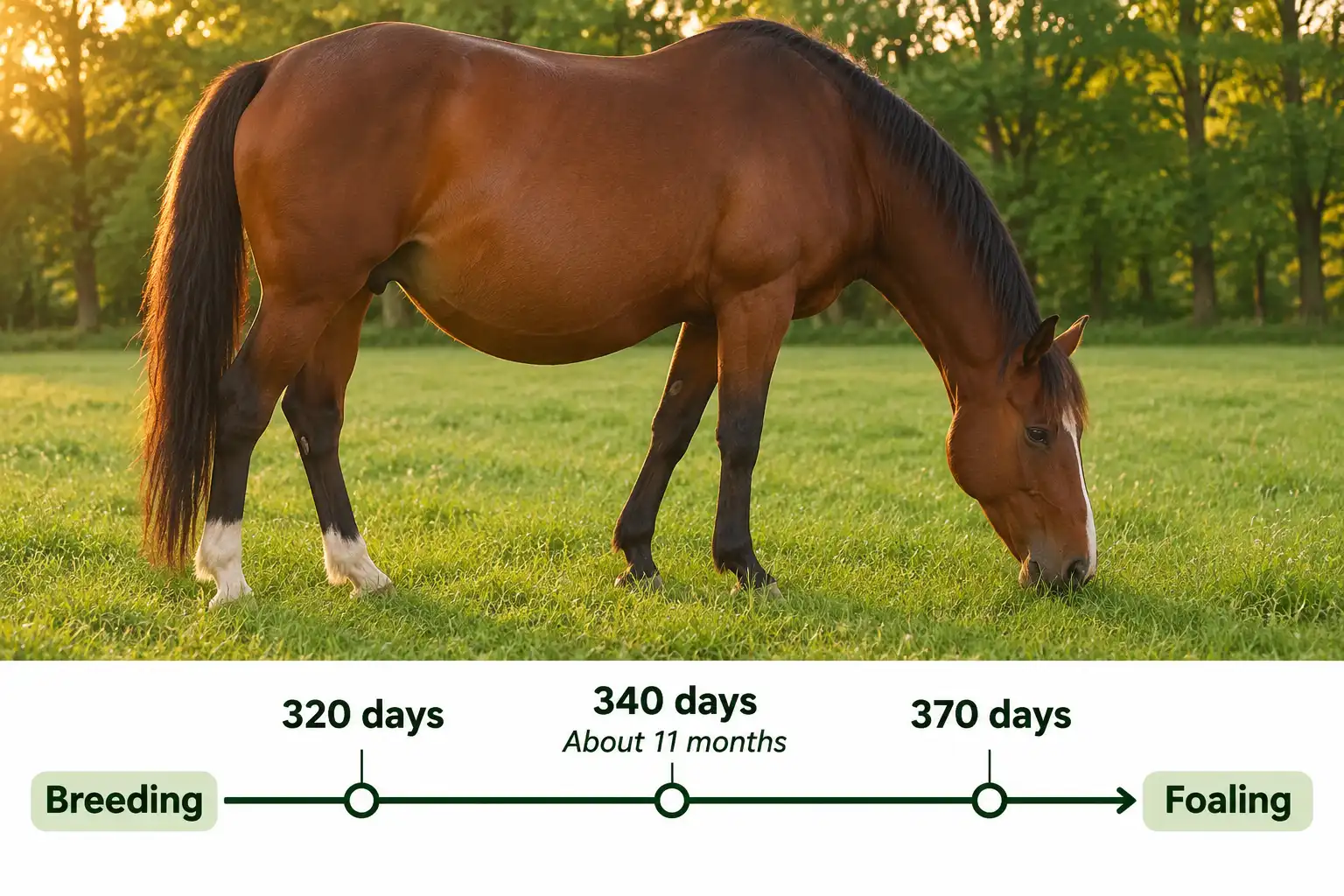
A mare carries her foal for close to a year. The exact length varies more than most first-time breeders expect. Knowing how long horses are pregnant lets you set a foaling window and book vet checks on time. It also tells you when to change her feed.
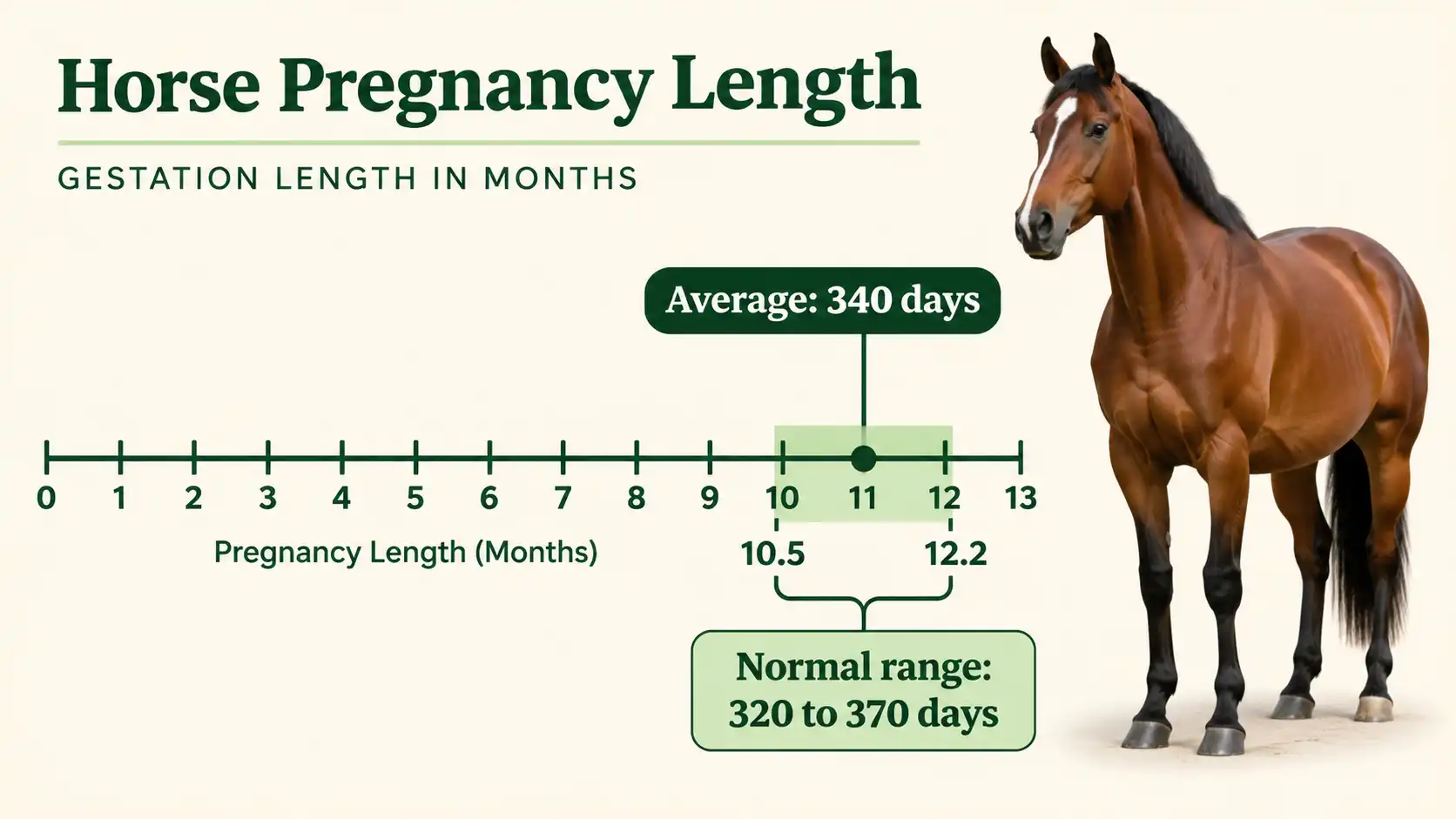
Most mares foal about 340 days after breeding, or just over 11 months. University of Nebraska-Lincoln Extension puts the normal range at 320 to 370 days. Plan for a seven-week foaling window, not a single date.
Horse Gestation Period: The Average and the Normal Range
The horse gestation period averages 335 to 345 days, depending on which extension service you read. University of Nebraska-Lincoln Extension puts the average at 335 to 340 days, with a normal range of 320 to 370. Oklahoma State Extension sets the average slightly higher, at 338 to 345 days, and stretches the range to 380.
| Figure | Nebraska-Lincoln | Oklahoma State |
|---|---|---|
| Average | 335 to 340 days | 338 to 345 days |
| Normal range | 320 to 370 days | 320 to 380 days |
| Premature if born before | 326 days | 320 days |
The two services agree on the animal. Instead, they differ on how far past the average a healthy mare can go. Oklahoma State notes that gestations near 365 days are not unusual, but longer ones may signal a foaling problem. So a mare past day 365 deserves a call to your veterinarian, even if she looks comfortable.
The early cutoff differs too. Nebraska-Lincoln counts a delivery before 310 days as an abortion. In both systems, a premature foal usually needs a veterinarian right away.
Individual mares also repeat themselves. According to Nebraska-Lincoln, most mares follow a similar pattern year after year. That makes her own foaling record your best predictor. If she foaled at 352 days last time, plan around 352, not 340.
Read next: Are Pigs Smarter Than Dogs? What the Research Shows
How Long Are Horses Pregnant in Months?
Horses are pregnant for about 11 months, or 11.2 months at the 340-day average. The Nebraska-Lincoln range converts to roughly 10.5 to 12.2 months. Oklahoma State’s upper limit stretches to 12.5 months.
Many breeders simply count 11 months from the last breeding date, a shortcut Nebraska-Lincoln Extension describes. In practice, 11 months lands near day 335, a few days ahead of the average. That works in your favor. Oklahoma State Extension uses a predicted date of 335 days for that reason. It falls before the average, so you start watching sooner.
| Days | Months (approx.) | What it means |
|---|---|---|
| 310 | 10.2 | Nebraska-Lincoln counts delivery before this as abortion |
| 320 | 10.5 | Low end of normal; Oklahoma State premature cutoff |
| 335 | 11.0 | Common predicted date; start close checks |
| 340 | 11.2 | Typical average |
| 365 | 12.0 | Not unusual, per Oklahoma State |
| 370 | 12.2 | Top of the Nebraska-Lincoln range |
| 380 | 12.5 | Top of the Oklahoma State range |
How to Calculate a Mare’s Due Date
Add 340 days to the last breeding date for the average due date. Then mark the normal range on both sides to get your foaling window.
- Pick the right start date. Use the last breeding date, or the ovulation date if your vet recorded one. If she was bred more than once in a heat, count from the last cover.
- Add 340 days. For a quick shortcut, subtract 25 days from the breeding date and move to the same date next year. Because 365 minus 25 is 340, the two methods match. A leap day in between shifts the result by one day.
- Mark the window. Add 320 days for the early edge and 370 days for the late edge.
- Plan backward. Move the mare to her foaling site 4 to 6 weeks before the due date, as University of Minnesota Extension recommends.
Worked Example: Bred May 1, 2026
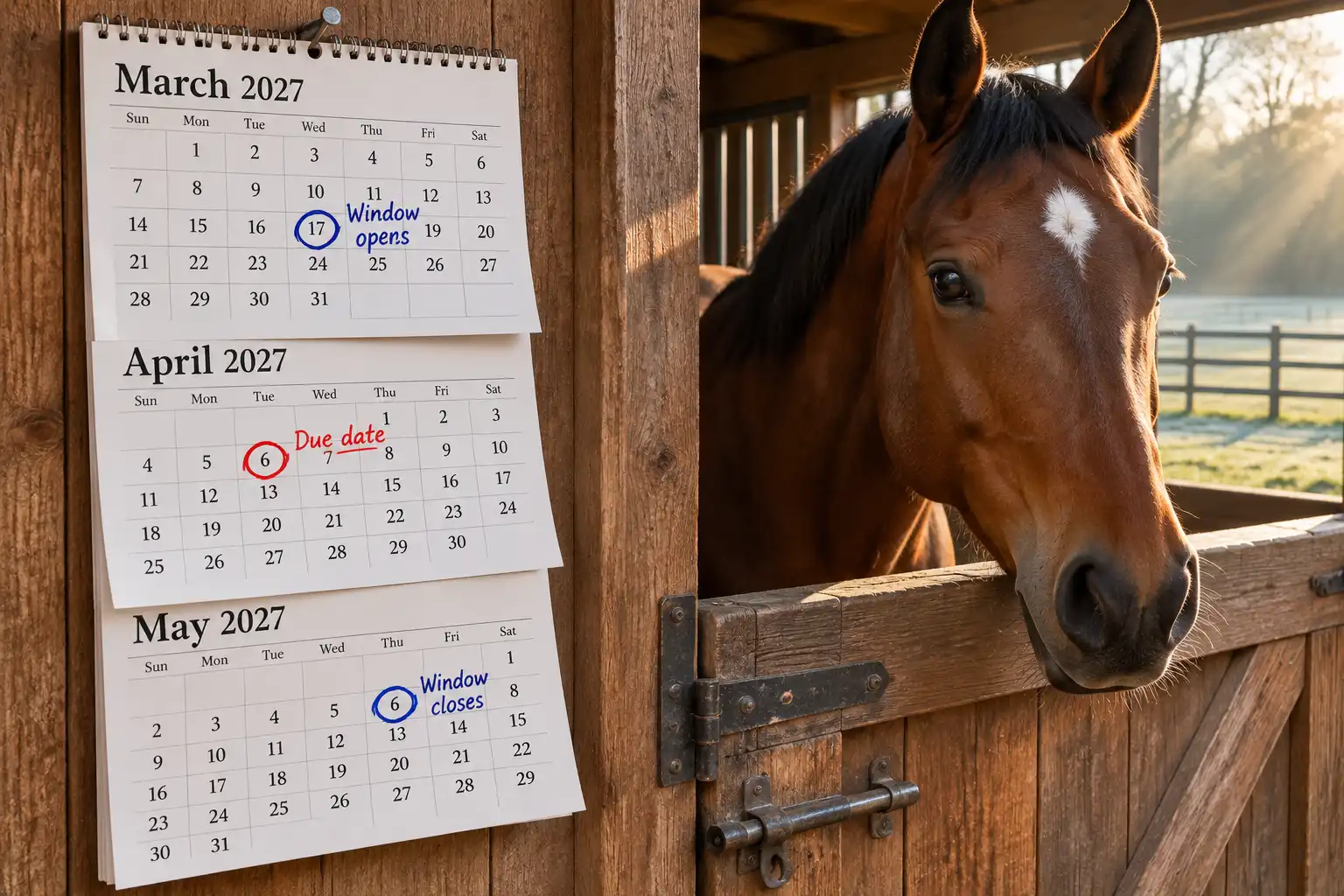
- Day 320: March 17, 2027 (window opens)
- Day 335: April 1, 2027 (Oklahoma State’s predicted date)
- Day 340: April 6, 2027 (average due date)
- Day 370: May 6, 2027 (top of the Nebraska-Lincoln range)
- Day 380: May 16, 2027 (top of the Oklahoma State range)
So a May 1 breeding puts the foal anywhere from mid-March to early May, with early April most likely. Write all five dates on the barn calendar the day you breed.
Horse Gestation Chart: Milestones From Breeding to Foaling
This horse gestation chart pairs each stage with the job it creates for you. The day counts come from University of Minnesota Extension, Oklahoma State Extension, Cornell University, and Penn State Extension. The sections below explain each one.
| Day or stage | What is happening | Your job |
|---|---|---|
| Day 0 | Breeding or ovulation | Record the date |
| Days 14 to 16 | Pregnancy and twins visible on ultrasound | First vet scan |
| Days 18 to 20 | An open mare would return to heat | Watch or tease |
| Days 24 to 25 | Heartbeat may show on ultrasound | Optional scan |
| Days 30 to 35 | Ongoing pregnancy confirmed | Second scan |
| From day 35 | Endometrial cups form | A loss now delays rebreeding 3 to 4 months |
| Days 45 to 100 | eCG blood test window | Blood test if no scan |
| Day 90 to term | Estrone sulfate test window | Mid or late confirmation |
| About day 150 | Placenta takes over pregnancy hormones | No action needed |
| Months 1 to 8 | Needs stay at maintenance | Normal ration |
| Last 3 months | Most fetal growth | Raise protein and minerals |
| 60 to 90 days out | Fescue risk window | Remove from infected fescue |
| 4 to 6 weeks out | Final preparation | Move to foaling site |
| 2 to 4 weeks out | Udder fills | Start foaling checks |
| 1 to 4 days out | Teats wax | Watch closely |
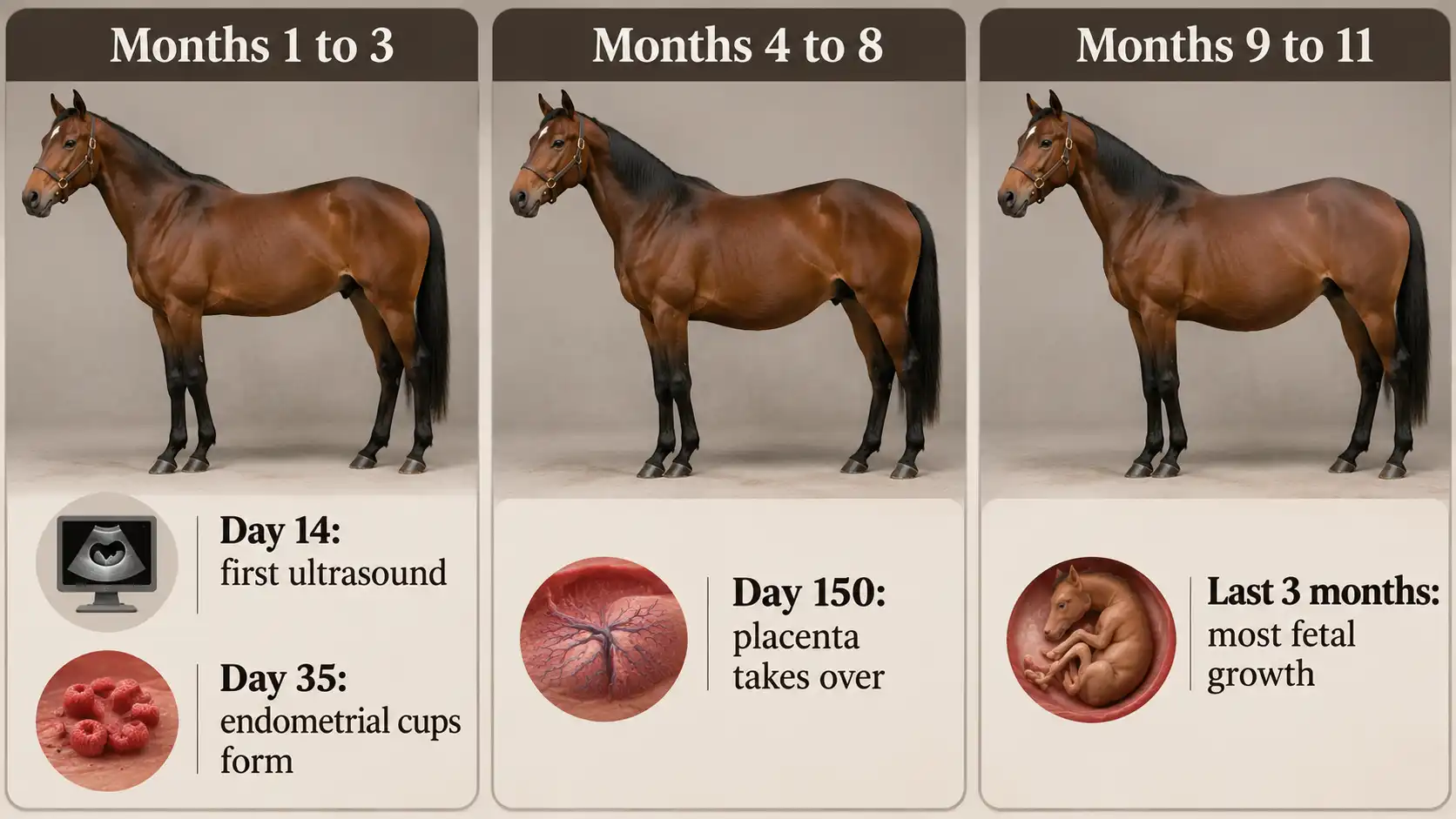
Early Pregnancy: Months 1 to 3
The first three months are about confirming the pregnancy and protecting it. University of Minnesota Extension schedules the first ultrasound at days 14 to 16, when the vet can still correct twins. A heartbeat may show at days 24 to 25. Then a second exam at days 30 to 35 confirms the pregnancy is holding.
Early loss happens often enough to plan for. Minnesota puts a young mare’s risk of loss near 6 percent by day 40. After day 40, the figure is 8 percent. The risk climbs in older mares, so a broodmare in the second half of a horse’s lifespan needs closer follow-up.
Timing matters here, because endometrial cups form around day 35. According to Minnesota Extension, a mare that loses the pregnancy after that point usually stays infertile for 3 to 4 months. That is one reason the early scans are worth booking.
Mid Pregnancy: Months 4 to 8
Mid pregnancy is the quiet stretch. Minnesota Extension says a mare’s nutrient needs stay at her level at conception through the first 8 months. So there is no reason to push grain.
Around day 150, the placenta becomes the main source of the hormones that hold the pregnancy, per Oklahoma State Extension. For that reason, Cornell’s diagnostic lab advises against using progesterone tests to monitor mid or late pregnancy.
Late Pregnancy: Months 9 to 11
The last three months carry most of the foal’s growth. Minnesota Extension says a mare gains 9 to 12 percent of her body weight during pregnancy. About two-thirds of that gain arrives in the final three months.
For an 1,100 pound mare, that comes to roughly 100 to 130 pounds in total. Of that, about 65 to 90 pounds go on in the last trimester. Start from her actual body weight rather than a guess, because every feed figure below scales from it.
This is also the window for pre-foaling vaccines, deworming, and moving her to where she will foal.
How Do You Tell If a Horse Is Pregnant?
A veterinarian’s ultrasound is the reliable way to tell, starting about 14 days after breeding. Blood tests fill gaps later on. Signs you can see at home are clues at best.
Ultrasound Exam
Ultrasound gives the earliest and most useful answer. University of Minnesota Extension times the first exam at days 14 to 16 after breeding. At that scan, the vet confirms the pregnancy, checks for twins, and plans a rebreeding if the mare is open.
A second exam at days 30 to 35 confirms the pregnancy is still going. Vets can also feel the uterus by rectal palpation, but ultrasound is what spots twins early.
Blood Tests
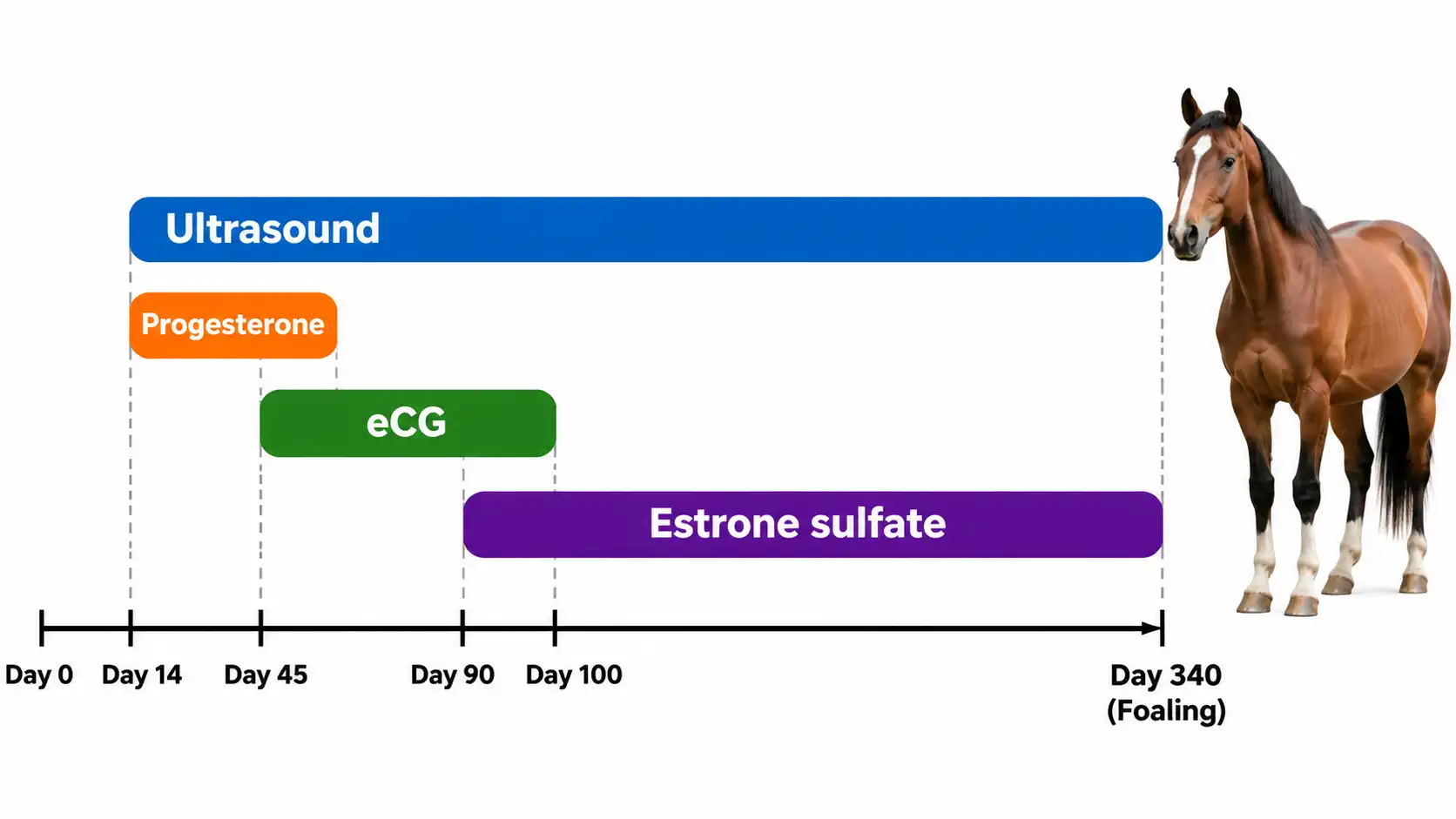
Blood tests help when a scan is not practical. A small pony or a mare that will not stand for an exam are common examples. Cornell University’s Animal Health Diagnostic Center lists three, each with its own window:
- Progesterone, days 14 to 45: supports a diagnosis, but the result only means something against her expected cycle stage.
- eCG (also called PMSG), days 45 to 100: levels can stay high after a pregnancy is lost, so a false positive is possible.
- Estrone sulfate, day 90 to term: the test for mid and late pregnancy.
Cornell adds that maiden and older mares can give unclear estrone sulfate results at days 90 to 120. In that case, it advises a recheck a month later. Likewise, a positive eCG result is worth confirming with a later test or scan.
Signs You Can Spot at Home
Home signs are slow and unreliable, so treat them as reasons to call the vet. The earliest clue is a missed heat. Per Oklahoma State Extension, a mare showing no heat 18 to 20 days after ovulation may be pregnant.
However, some open mares cycle without showing it. University of Missouri Extension found silent heat in about 5 percent of mares that refused the stallion during regular teasing. So a missed heat is a hint, not a result.
A growing belly comes even later. Most of her weight gain arrives in the last three months, so early on she looks the same. University of Minnesota Extension describes low belly swelling and udder growth starting only about a month before foaling. By then, the question has answered itself.
What Changes How Long a Mare Carries
The foal’s sex, the season, the mare’s condition, and her feed all shift the due date. University of Nebraska-Lincoln Extension documents most of these effects.
| Factor | Effect on gestation |
|---|---|
| Foal sex | Colts run 2 to 7 days longer than fillies |
| Season | Late spring and summer foalers carry shorter than January or February foalers |
| Lighting | Artificial long days in the last third shortened gestation by about 10 days |
| Body condition | Thin mares (score 4 or below) carry slightly longer than mares at 5 to 8 |
| Infected tall fescue | Prolongs gestation and causes foaling problems |
| The mare herself | Most repeat a similar pattern each year |
All of these come from Nebraska-Lincoln except fescue, which Oklahoma State Extension and Penn State Extension both flag. The seasonal effect matters most for early foals. A mare due in January tends to carry longer than one due in May. So start her watch on time, but expect to keep it longer.
Body condition is the factor you control. A mare scoring 4 or below is thin enough to stretch her pregnancy. Bring her up to condition before breeding, not in the last trimester.
Fescue and Prolonged Pregnancy in Mares
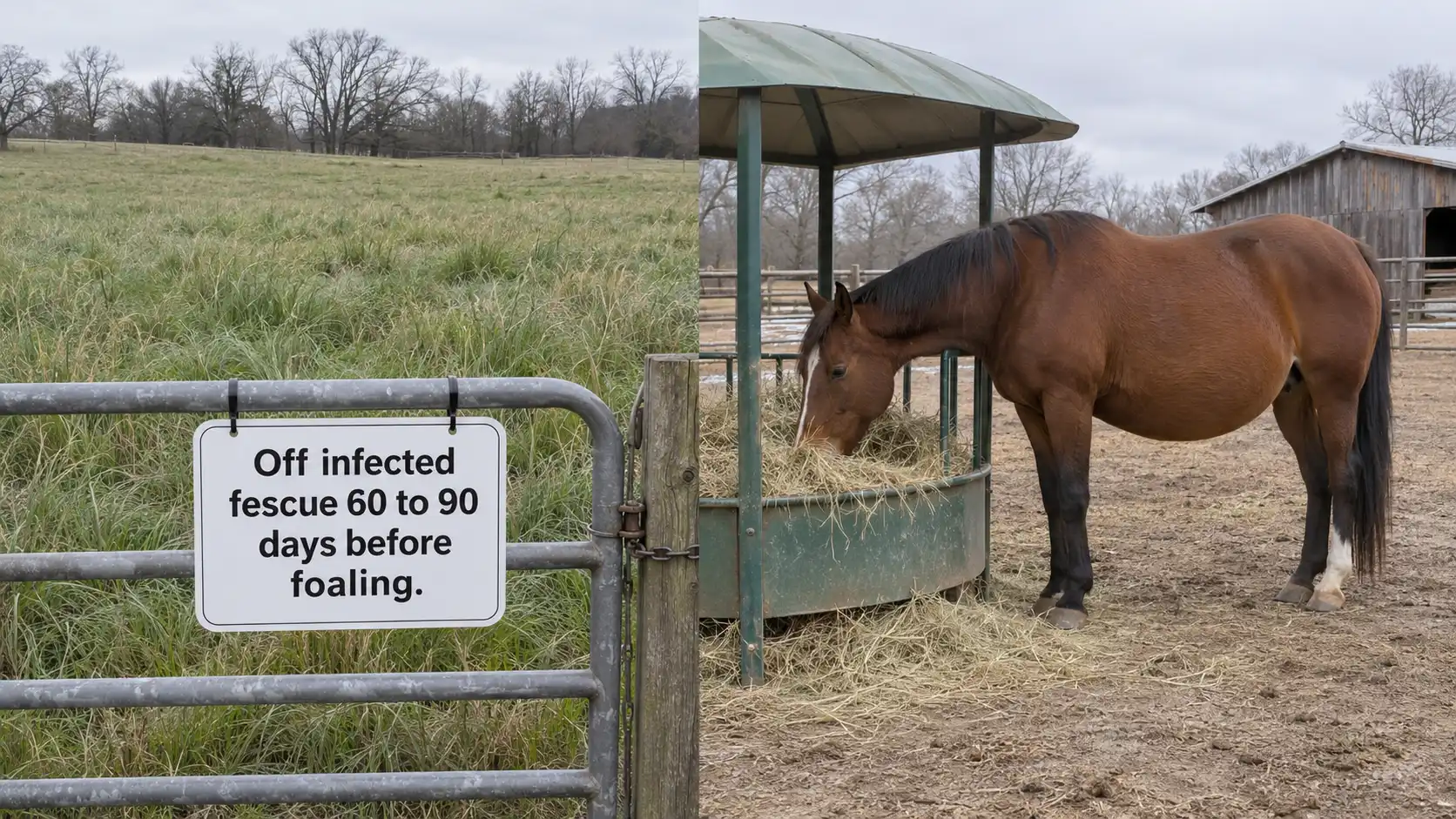
Endophyte-infected tall fescue is a well-documented feed cause of long pregnancies in mares. Penn State Extension notes that most horses graze it without trouble, but pregnant broodmares can develop fescue toxicosis. Oklahoma State Extension lists prolonged gestation, low milk production, and foaling problems among the risks.
The two services set different removal windows. Penn State recommends taking pregnant mares off infected fescue 60 to 90 days before foaling. Oklahoma State sets the cutoff at 45 to 60 days and names hay as well as pasture. Starting at 90 days covers both recommendations.
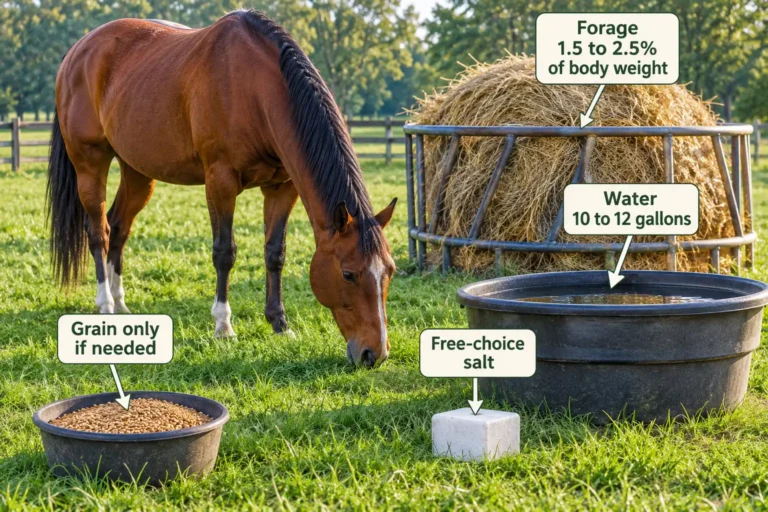
For a mare due April 6, 90 days out is January 6. From then on she needs fescue-free hay. Nebraska-Lincoln Extension puts a late-gestation mare’s forage at 1.0 to 1.5 percent of body weight daily. For an 1,100 pound mare, that is 11 to 16.5 pounds a day. Over 90 days, it adds up to about 1,000 to 1,500 pounds. That works out to roughly 20 to 30 small square bales at 50 pounds each. Our guide to daily feed amounts for horses covers the full ration.
The fungus does not show on the plant. A lab test of the pasture or hay tells you, and your county extension office can point you to one.
Feeding a Pregnant Mare
A pregnant mare eats like any adult horse for most of her pregnancy. Then she needs more protein and minerals at the end. University of Minnesota Extension keeps her requirements at her level at conception through the first 8 months.
In the last trimester, her needs for protein, calcium, and phosphorus rise faster than her energy needs. Minnesota puts protein for a mare near 8 percent of the ration in early pregnancy. In late pregnancy, it rises to 11 to 12 percent. Nebraska-Lincoln puts a late-gestation mare’s total intake at 1.5 to 2.0 percent of body weight. Of that, 0.5 to 1.0 percent is concentrate.
That is why piling on grain is the wrong fix. Extra grain adds calories she does not need yet, while the real gap is protein and minerals.
Minerals need attention too. Minnesota recommends a daily salt, calcium, and phosphorus mix for pregnant mares. Grass is low in calcium, and both grass and alfalfa run low in phosphorus. The foal also stores copper, zinc, manganese, and iron in its liver before birth. In Minnesota’s guidance, mares given no copper supplement in the last trimester had fewer sound foals.
Minnesota also recommends natural vitamin E daily for pregnant mares over the final 30 days. Amounts depend on your hay test, so have your veterinarian or an equine nutritionist check the ration.
Exercise, Travel, and Vet Care During Pregnancy
A pregnant mare can keep working longer than many owners assume. University of Minnesota Extension says rigorous work, including racing and jumping, can continue to about five months. After that, light trail riding can continue until the last month. A mare that is not ridden should still get at least six hours of turnout a day.
Travel is easier early than late. In research Minnesota cites, nine hours of hauling between days 16 and 38 did not raise miscarriage risk. Late in pregnancy, finish long trips at least 30 days before the due date. On long hauls, stop every 5 to 8 hours. Then move her to the foaling site 4 to 6 weeks ahead, so she settles before foaling.
Vaccines and deworming before foaling protect both mare and foal. Still, the products and timing depend on your region and her history. Set that schedule with your veterinarian rather than from a generic chart.
Signs a Mare Is Close to Foaling
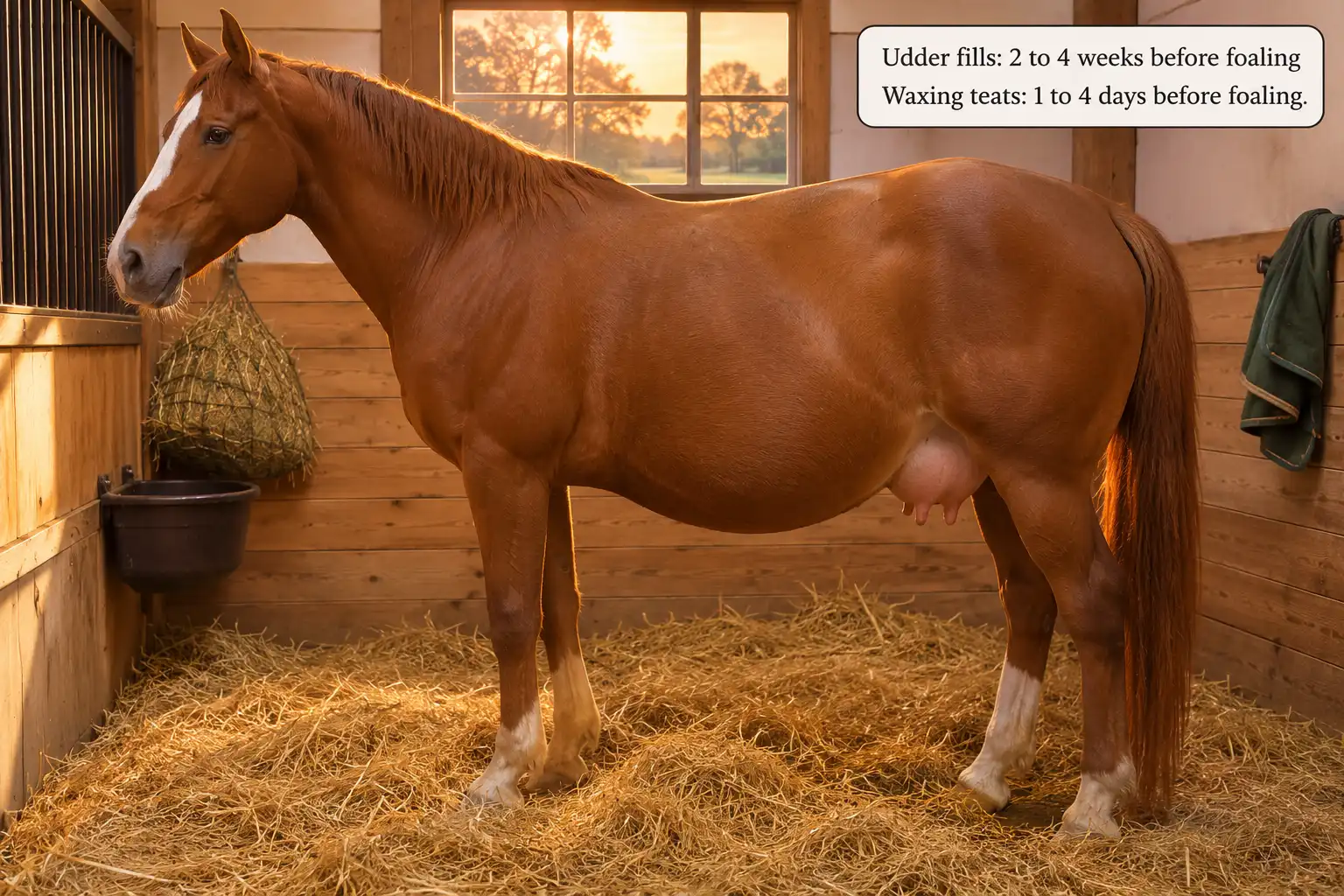
A filling udder is the first dependable sign, usually 2 to 4 weeks before foaling. Oklahoma State Extension lays out the typical sequence:
| Sign | Typical timing before foaling |
|---|---|
| Udder fills | 2 to 4 weeks |
| Tailhead and belly changes | 1 week to 1 month |
| Teats fill with milk | 2 days to 1 week |
| Milk dripping | 1 day to 1 week |
| Waxing (beads of colostrum on teats) | 1 to 4 days |
| Milk calcium rises | 1 to 1.5 days |
| Vulva and tailhead relax | 12 to 24 hours |
Nebraska-Lincoln Extension gives a wider udder window of 2 to 6 weeks. Both services warn that not every mare shows every sign. Also, a maiden mare’s signs can differ from those of an experienced broodmare.
Milk Calcium Test Strips
Milk calcium testing narrows the window better than watching the udder. Once milk calcium passes 200 ppm, Oklahoma State gives a 54 percent chance of foaling within 24 hours. That rises to 84 percent within 48 hours and 97 percent within 72.
Below 200 ppm, the chance of foaling in the next 24 hours is under 1 percent. Nebraska-Lincoln notes the test is most useful for showing when a mare will not foal. In other words, it tells you which nights you can sleep.
How Long Foaling Takes and When to Call the Vet
If any stage below runs past its normal time, call a large animal veterinarian right away. These times describe a normal foaling. They cannot tell you what is wrong when one runs long.
| Stage | Normal length | Call the vet if |
|---|---|---|
| Stage 1: early labor | 1 to 2 hours | No progress after an hour or two |
| Stage 2: water breaks to delivery | 15 to 20 minutes | Past 30 minutes |
| Stage 3: placenta passes | 1 to 3 hours | Not passed within 3 hours |
| Foal stands | About 1 hour | Not standing by 2 hours |
| Foal nurses | About 2 hours | Not nursed by 3 hours |
Those figures come from Oklahoma State Extension. Nebraska-Lincoln Extension gives a wider stage 1 range of 1 to 4 hours. Its stage 2 range is 10 to 30 minutes.
Stage 2 is the one that cannot wait. Oklahoma State also flags hoof soles pointing up as urgent, because the foal may be backward or upside down. Have your vet’s number by the stall before day 320.
Rebreeding to Keep the Same Foaling Date
To foal at the same time next year, a mare has to conceive within about 25 days of foaling. The arithmetic is simple: 365 days minus a 340-day pregnancy leaves 25 days of slack.
That is why some breeders use the foal heat. University of Missouri Extension says this first heat usually comes 7 to 9 days after foaling. However, Missouri advises against breeding on it if the foaling had any problems. A mare that retained her placenta or shows an abnormal discharge should wait until her vet clears her.
Skipping the foal heat moves the calendar. Say she conceives about 30 days after foaling. Next year’s foal then arrives about 5 days later than this year’s. Over several seasons, that drift adds up.
Owners who want earlier foals use lights instead. University of Minnesota Extension recommends 16 hours of continuous light, started 2 to 2.5 months before breeding. For a February breeding, that means late November or early December. Our breeding management section covers the season in more detail.
Frequently Asked Questions
Can a horse be pregnant for 12 months?
Yes, and it often means nothing is wrong. Oklahoma State Extension notes that gestations near 365 days are not unusual, though a mare running well past that, or one grazing infected fescue, needs a veterinarian’s attention.
How early can a vet confirm a horse is pregnant?
A vet can usually confirm pregnancy by ultrasound 14 to 16 days after breeding. That first scan also checks for twins, and University of Minnesota Extension schedules a second exam at days 30 to 35.
Can you ride a pregnant mare?
Yes, in most cases. University of Minnesota Extension says rigorous work can continue to about five months and light trail riding until the last month, provided your veterinarian agrees for your mare.
Do colts take longer than fillies?
Usually, though only by a few days. University of Nebraska-Lincoln Extension reports that colts gestate 2 to 7 days longer than fillies, so the gap will not tell you the foal’s sex in advance.
Is there a reliable home pregnancy test for horses?
No home sign is reliable on its own. Missed heats and a bigger belly can both mislead, so a veterinarian’s ultrasound or a timed blood test, such as estrone sulfate after day 90, gives the answer.
How soon after foaling can a mare get pregnant again?
A mare can conceive on her foal heat, which University of Missouri Extension says usually arrives 7 to 9 days after foaling. Missouri advises skipping that heat if the foaling or placenta had any problems.
What happens if a foal is born early?
Extension services treat a foal born before about 320 to 326 days as premature, and it usually needs a veterinarian right away. Nebraska-Lincoln draws the line at 326 days, while Oklahoma State uses 320.
Putting This Into Practice
Write down the last breeding date, add 340 days, and mark a window from day 320 to day 370. Book the day 14 to 16 ultrasound before you need it. Then plan backward from the due date. Pull her off infected fescue at 60 to 90 days and move her to the foaling site at 4 to 6 weeks. Start nightly checks once the udder fills. Finally, keep each mare’s foaling record, because her own history predicts next year better than any average. For more on keeping mares and foals, start with our horse care guides.