How Long Do Goats Live? Lifespan by Breed, Sex, and Role
A goat can stay with you for well over a decade. That shapes every plan, from a 4-H kid to a retired doe. Breed, sex, and job all change how long goats live, and the research is thinner for some breeds than others.
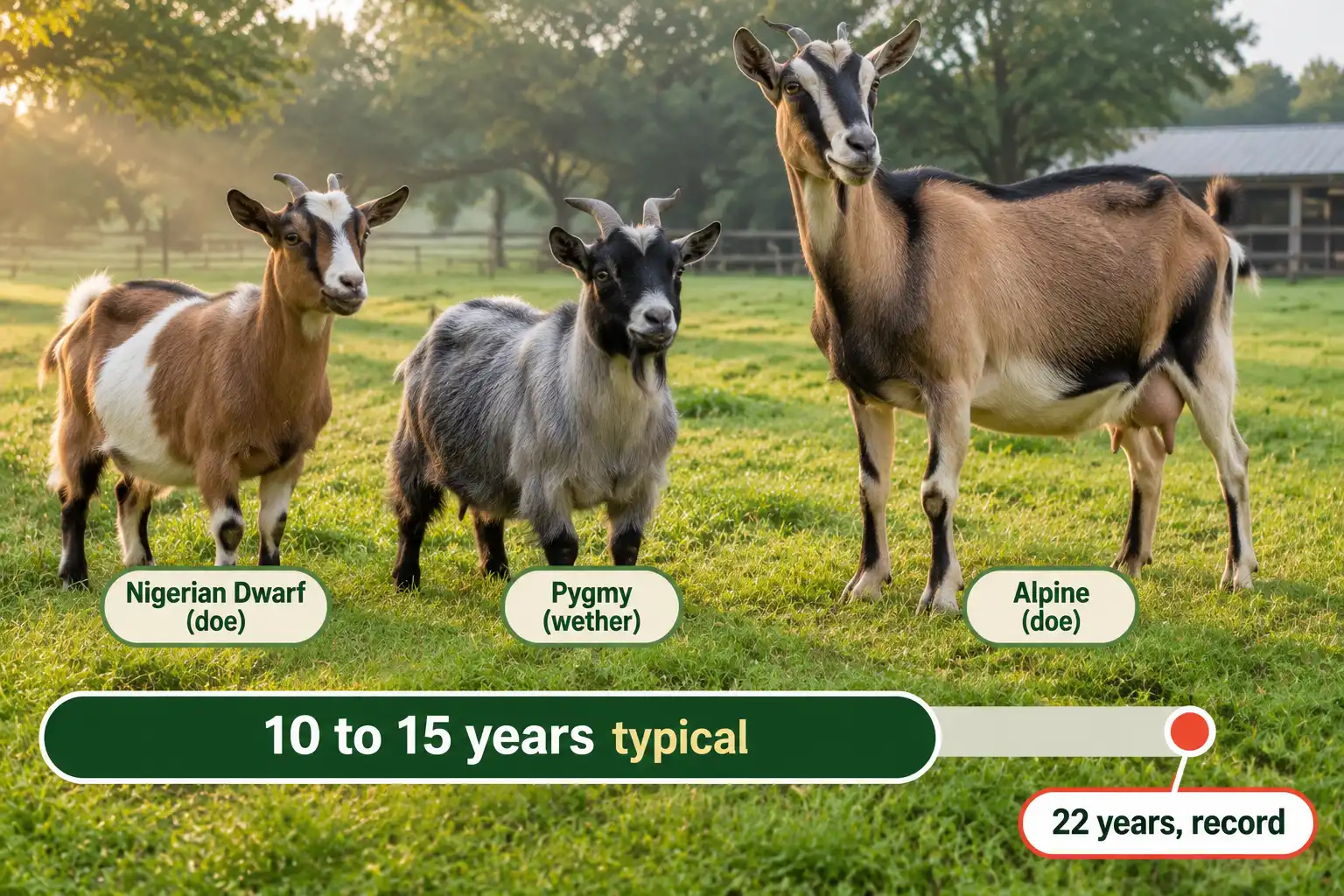
Most goats live 10 to 15 years, per Washington State University Extension. Nigerian Dwarf and Pygmy goats are reported in that same range. Parasites, urinary stones, and worn teeth end more lives early than old age does.
Goat Lifespan at a Glance
Most domestic goats live 10 to 15 years, the average taught in Washington State University Extension’s 4-H goat program. Still, sex and job change the risks each goat faces.
| Goat | Typical lifespan | What usually ends it | How solid the figure is |
|---|---|---|---|
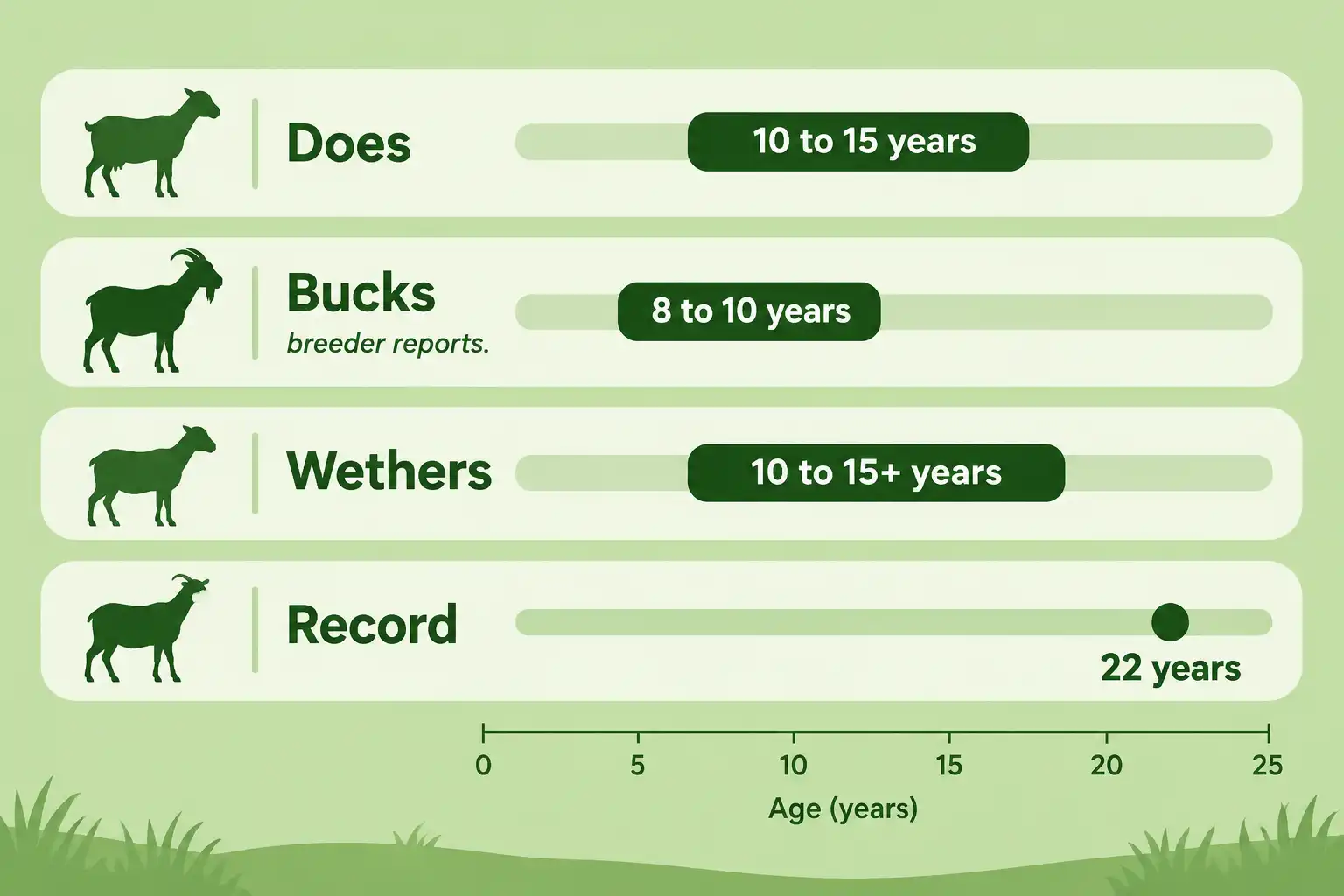
| All domestic goats | 10 to 15 years | Parasites, worn teeth, disease | Extension figure (Washington State) |
| Breeding does | 10 to 15 years; working life often shorter | Lost or worn teeth, kidding strain | Culling by teeth per University of Maryland Extension |
| Intact bucks | Often 8 to 10 years | Weight loss in rut, fighting injuries | Breeder reports only |
| Wethers | 10 to 15 years or more | Urinary calculi | Breeder reports; risk per University of Maryland Extension |
| Nigerian Dwarf | 10 to 15 years, some into the high teens | Kidding pace, same risks as the species | Breeder reports only |
| Pygmy | 10 to 15 years | Obesity, urinary calculi in wethers | Breeder reports only |
| Miniature dairy crosses | 10 to 15 years expected | Same risks as parent breeds | No published data |
| Verified record | 22 years, 5 months | Old age | Guinness World Records |
Guinness World Records lists McGinty, a doe from Hayling Island in England, as the oldest verified goat. She died in November 2003.
Read next article: How Long Are Cows Pregnant? Cow Gestation by Breed, Month
Why Goat Lifespans Vary So Much
Management sets the lifespan more than biology does. A pet wether on good hay faces different odds than a meat doe raising twins each spring on wet pasture.
Three things drive most of the gap:
- The job the goat does. Kidding, milking, and rut all draw down body reserves. Pets and wethers skip that strain.
- Whether anyone makes a culling decision. Commercial herds sell does once teeth or production slip. So the average age in a working herd runs well below what goats can reach.
- Climate and parasites. Warm, wet pasture breeds barber pole worm, which can kill a goat in its prime.
As a result, two honest answers exist. A goat can live 15 years or longer. However, a goat in a production herd often leaves the herd years earlier.
Lifespan by Sex: Does, Bucks, and Wethers
Does and wethers usually outlive intact bucks, and each needs its own plan.
Does
A doe can live 10 to 15 years, but her working life usually ends with her teeth. University of Maryland Extension notes that teeth start to spread and break after about age 5. By roughly age 10, many goats have lost their incisors entirely. Producers call these goats “gummers,” and tooth problems are a common reason does get culled.
Kidding also takes a toll, since every pregnancy and lactation pulls on body condition. No extension service sets a fixed retirement age. Instead, breeders retire a doe once she cannot regain condition between kiddings.
Bucks
Intact bucks often live 8 to 10 years, according to breeder reports. No extension trial has measured buck lifespan directly, so treat that range as a pattern, not a rule.
The cause is the rut. Bucks go off feed, lose weight fast, and fight. After each breeding season, a buck needs good forage and shelter to rebuild before winter.
Wethers
Wethers, or castrated males, can be the longest-lived goats on a farm. They never face rut or kidding. Even so, one condition threatens them more than any other: urinary calculi.
Males castrated before puberty face higher risk, per University of Maryland Extension. Their urethras do not develop as fully. Castration hurts at any age, so talk with your veterinarian about timing, method, and pain control first.
How Long Do Nigerian Dwarf Goats Live?
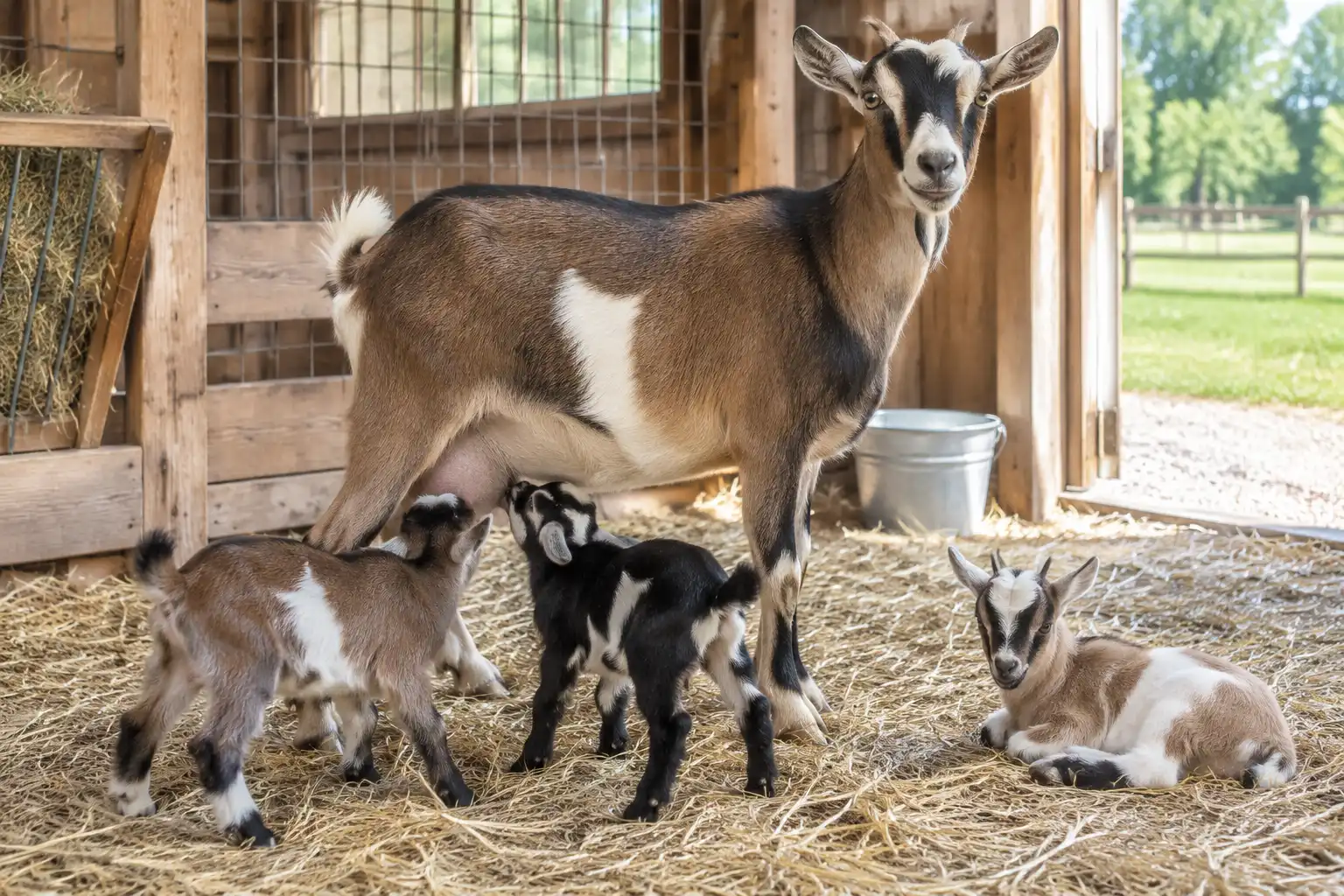
Nigerian Dwarf goats generally live 10 to 15 years. Well-kept does and wethers are often reported into their high teens. That figure comes from breeders, though. Neither Oklahoma State’s breed profile nor any extension service we reviewed publishes a lifespan for the breed.
The Nigerian Dwarf is a miniature dairy goat. Oklahoma State puts ideal height at 17 to 19 inches for does and ideal weight near 75 pounds.
Its breeding pattern matters more for longevity than its size. Oklahoma State notes that the breed cycles year-round. Litters of three or four are common, and many breeders kid does three times in two years. That pace drains a small doe. So spacing kiddings to once a year gives her time to rebuild condition between litters.
Are “Nigerian Goats” the Same Thing?
Yes, in the United States. “Nigerian goat” almost always means the Nigerian Dwarf, so the same 10 to 15 year range applies. The West African Dwarf goats kept in Nigeria itself are a stockier, separate type. No comparable US lifespan data exists for them.
How Long Do Pygmy Goats Live?
Pygmy goats live about 10 to 15 years, the same range as goats in general. Like the Nigerian Dwarf, that figure rests on breeder and keeper reports rather than extension research.
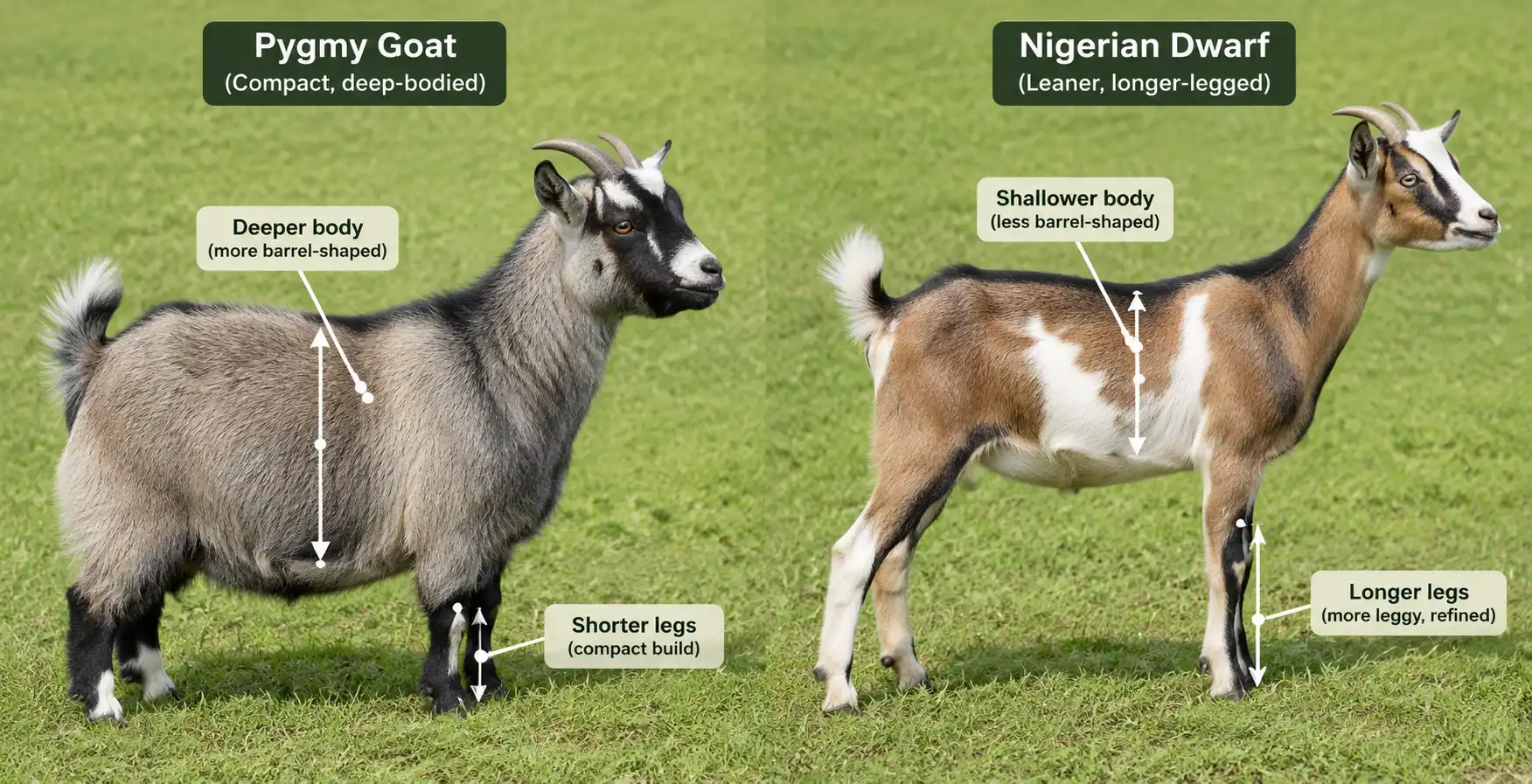
Pygmies differ from Nigerian Dwarfs in build. Oklahoma State describes the Pygmy as a compact, heavy-boned goat, while the Nigerian Dwarf keeps dairy proportions. That stocky frame changes the risks.
Most Pygmy goats live as pets, and pets get treats. Extra weight strains joints, raises kidding trouble in does, and shortens lives. Meanwhile, Pygmy wethers fed grain face the same urinary calculi risk as any wether.
So a Pygmy’s lifespan rests on two habits. Keep grain and treats low, and keep fresh water available all year. The National Pygmy Goat Association registers the breed in the United States and is a good contact for breeder referrals.
How Long Do Miniature Goats Live?
Miniature goats generally live 10 to 15 years. “Miniature” is not one breed, though. It covers Pygmy and Nigerian Dwarf goats, plus mini dairy crosses. The Miniature Dairy Goat Association registers crosses such as the Mini Nubian and Mini LaMancha.
For the crosses, published lifespan data does not exist. Expect the parent breeds’ range, since the same risks apply: parasites, urinary calculi, and worn teeth.
Kidding is the one risk to plan around. First-generation minis usually come from a Nigerian Dwarf buck bred to a standard-size doe. Breeding the other way can leave a small doe carrying kids too large to deliver. If you plan a cross, ask your veterinarian before the breeding, not after.
You can compare body types, temperaments, and uses across other goat breeds before you buy.
Working Goats vs Pets: Why Herd Ages Look Lower
Commercial goats rarely reach old age, because producers sell them first. A meat or dairy doe stays only while she kids, milks, and holds condition.
That changes what “lifespan” means for your operation:
- Pet and fiber herds. Expect most animals to live out the full 10 to 15 years. Plan for senior care, softer feed, and end-of-life costs.
- Small dairy herds. Does often stay into their later years for their milk lines, then retire as pets or get sold.
- Commercial meat herds. Does typically leave once teeth go, often well before age 10, per the University of Maryland Extension tooth-wear timeline.
Neither approach is wrong, but the plan should be deliberate. An old doe sold at auction with worn teeth often faces a hard winter elsewhere.
How to Tell a Goat’s Age by Its Teeth
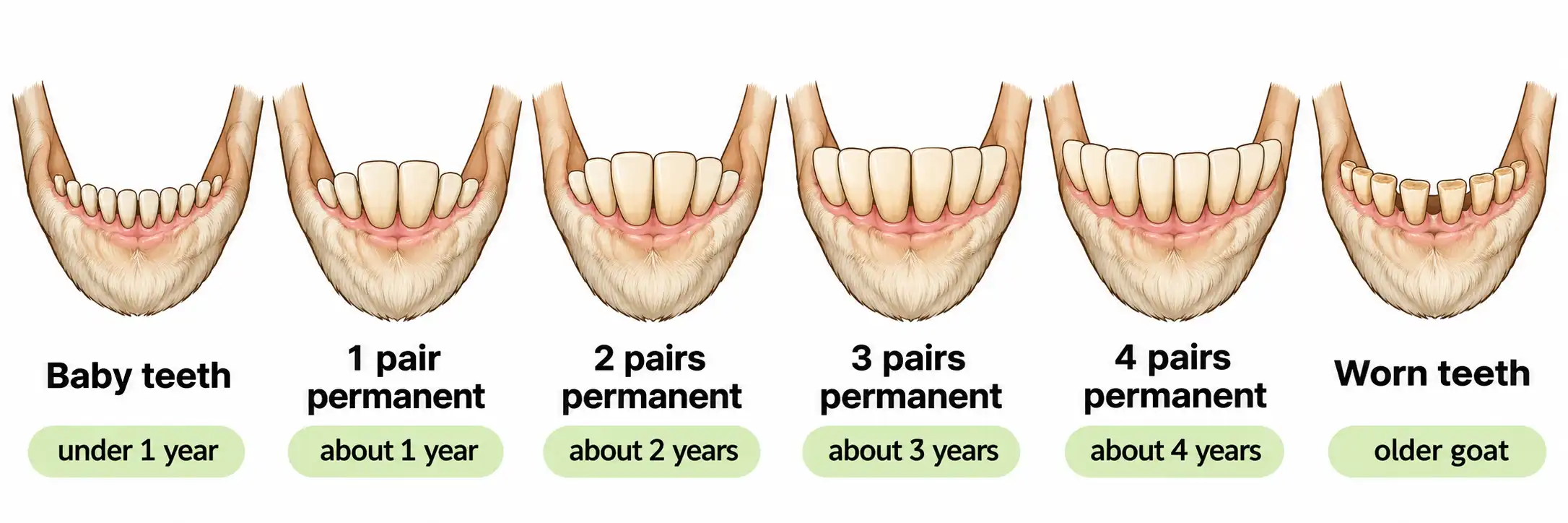
Count the permanent lower incisors. Langston University explains that goats have incisors only on the lower jaw, with a hard dental pad above. Each year, one pair of baby teeth gives way to a larger permanent pair.
| Lower incisors | Approximate age | Source |
|---|---|---|
| All baby teeth | Under 1 year | Langston University |
| 1 pair permanent | About 1 year | Langston University |
| 2 pairs permanent | About 2 years | Langston University |
| 3 pairs permanent | About 3 years | Langston University |
| 4 pairs permanent (“full mouth”) | About 4 years | Langston University |
| Teeth spreading, worn, or broken | Over 5 years | University of Maryland Extension |
| No incisors (“gummer”) | Around 10 years | University of Maryland Extension |
Past age 4, the count stops helping. Langston notes that gums recede and teeth look longer with age. Gritty feed and sandy ground also wear teeth faster, so two 7-year-old goats can have very different mouths.
Estimating How Many Years a Goat Has Left
Subtract the goat’s estimated age from the 10 to 15 year range. Then adjust for teeth and condition. This is a planning figure, not a prediction.
Worked example 1: buying a mature doe. A doe at a sale has a full mouth of sound teeth. She is at least 4. So she likely has 6 to 11 years left. If her teeth already show spreading, assume she is past 5 and plan on fewer productive years.
Worked example 2: a 4-H project. A 10-year-old child buys a 3-month-old Nigerian Dwarf wether. At the end of the 10 to 15 year range, the child will be about 20 to 25. In practice, the goat will likely outlast the 4-H years. It may still need a home after the child leaves for college.
Worked example 3: a pet pair. Goats are herd animals and should not live alone. If you buy two kids together, they will reach old age together. When one dies, the survivor needs a new companion fast. Buying goats a few years apart in age spreads that risk.
What Cuts Goat Lives Short
This section describes common causes. It does not diagnose. A goat that is off feed, straining, weak, or pale needs a large animal veterinarian. Many goat illnesses look alike early on.
Most goats that die young die of something preventable. The list below covers the causes that come up most often in extension guidance.
Barber Pole Worm
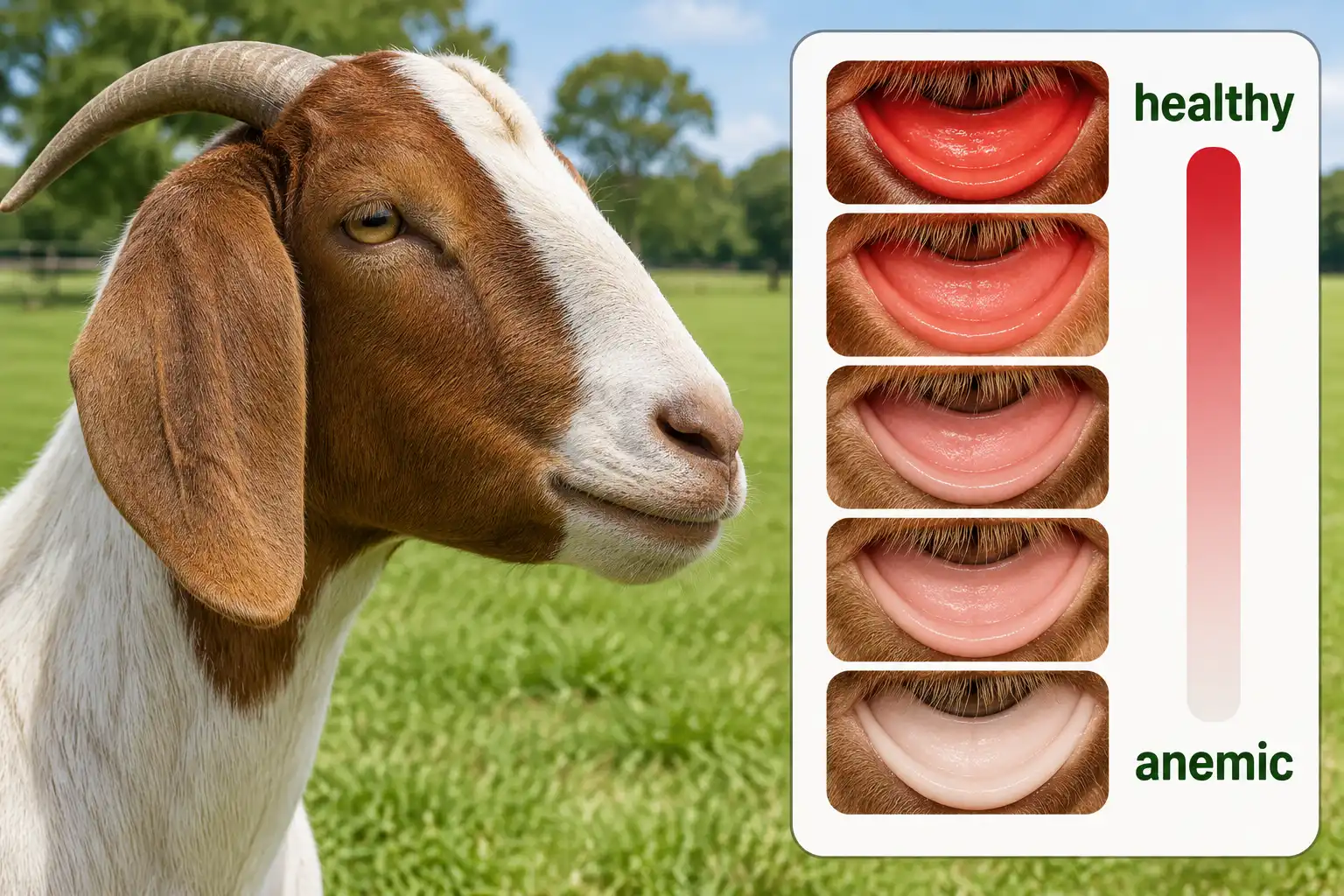
Internal parasites are a leading cause of death for US sheep and goats, per University of Minnesota Extension. The barber pole worm attaches to the stomach, feeds on blood, and causes severe anemia. It thrives between 50°F and 96°F, so warm, wet summers bring the worst losses.
Dewormers alone no longer solve it. University of Minnesota Extension reports resistance across every chemical dewormer class. As a result, control now rests on pasture rotation, FAMACHA eyelid scoring, fecal egg counts, and selecting resistant animals. A full plan for managing internal parasites covers each tool, and your veterinarian should guide any treatment.
Urinary Calculi in Wethers and Bucks
Urinary calculi are mineral stones that block the urethra. University of Maryland Extension warns the blockage can be fatal, because the bladder keeps filling and may rupture.
Goats with a blockage may strain to urinate, dribble, twitch the tail, or stand hunched. Several other problems look similar, so call your veterinarian right away. A blocked male does not have days to wait.
Prevention is mostly feeding. For male goats, University of Maryland Extension recommends a mostly forage diet. It sets the calcium-to-phosphorus ratio near 2 to 1. It also stresses fresh water at all times, ice-free in winter.
Overfeeding and Obesity
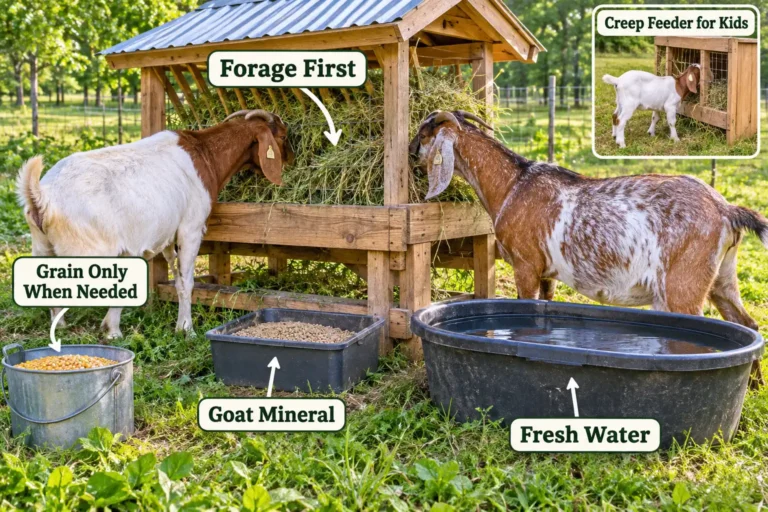
Pet goats rarely starve. Instead, they get too much grain and too many treats. Fat goats have more kidding trouble, more joint strain, and more urinary stones in males. A forage-first goat diet prevents most of it.
Use a mineral formulated for goats. Goats need more copper than sheep tolerate. So a mix labeled for both is held at a sheep-safe level, which usually leaves goats short over time.
Predators and Dogs
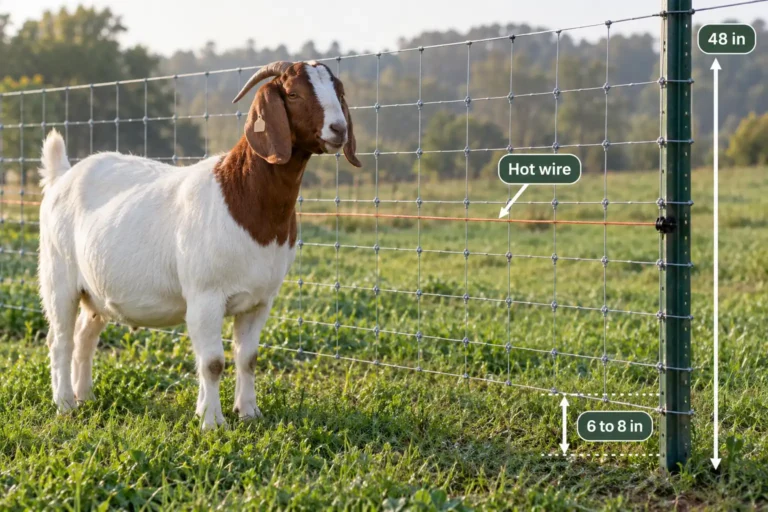
Dogs kill more backyard goats than many owners expect, and coyotes take kids on open range. A fence height that holds goats keeps goats in, but a predator fence also has to keep dogs out. Lock goats in a shelter at night where predators are common.
Kidding Problems
Difficult births and late-pregnancy metabolic trouble kill does in their prime. Risk climbs in does that are very fat, very thin, or carrying three or more kids. Plan kidding with your veterinarian, and know before kidding season who will answer a night call.
Chronic Disease: CAE and Johne’s
Caprine arthritis encephalitis (CAE) is a viral disease. It causes painful joints in adult goats and has no cure. Johne’s disease causes slow wasting. Both spread within herds. So buy from herds that test, and test your own goats with your veterinarian’s help.
Helping a Goat Reach Its Teens
Long-lived goats share a few habits in their care. None is complicated, but each one has to happen every year:
- Feed forage first. Keep grain small or skip it for pets and wethers.
- Offer a loose mineral formulated for goats, with added copper.
- Build a parasite plan with your veterinarian, using FAMACHA and fecal egg counts instead of calendar deworming.
- Ask your veterinarian about a vaccination plan for clostridial diseases and tetanus.
- Trim hooves on a regular schedule so goats stay sound on their feet.
- Keep at least two goats together.
- Give dry, draft-free shelter with clean bedding.
- Check teeth and body condition by hand every few months.
- Buy from herds that test for CAE and Johne’s.
Body condition scoring by feel matters more than looks. A long winter coat can hide a goat that is losing weight.
Caring for a Senior Goat
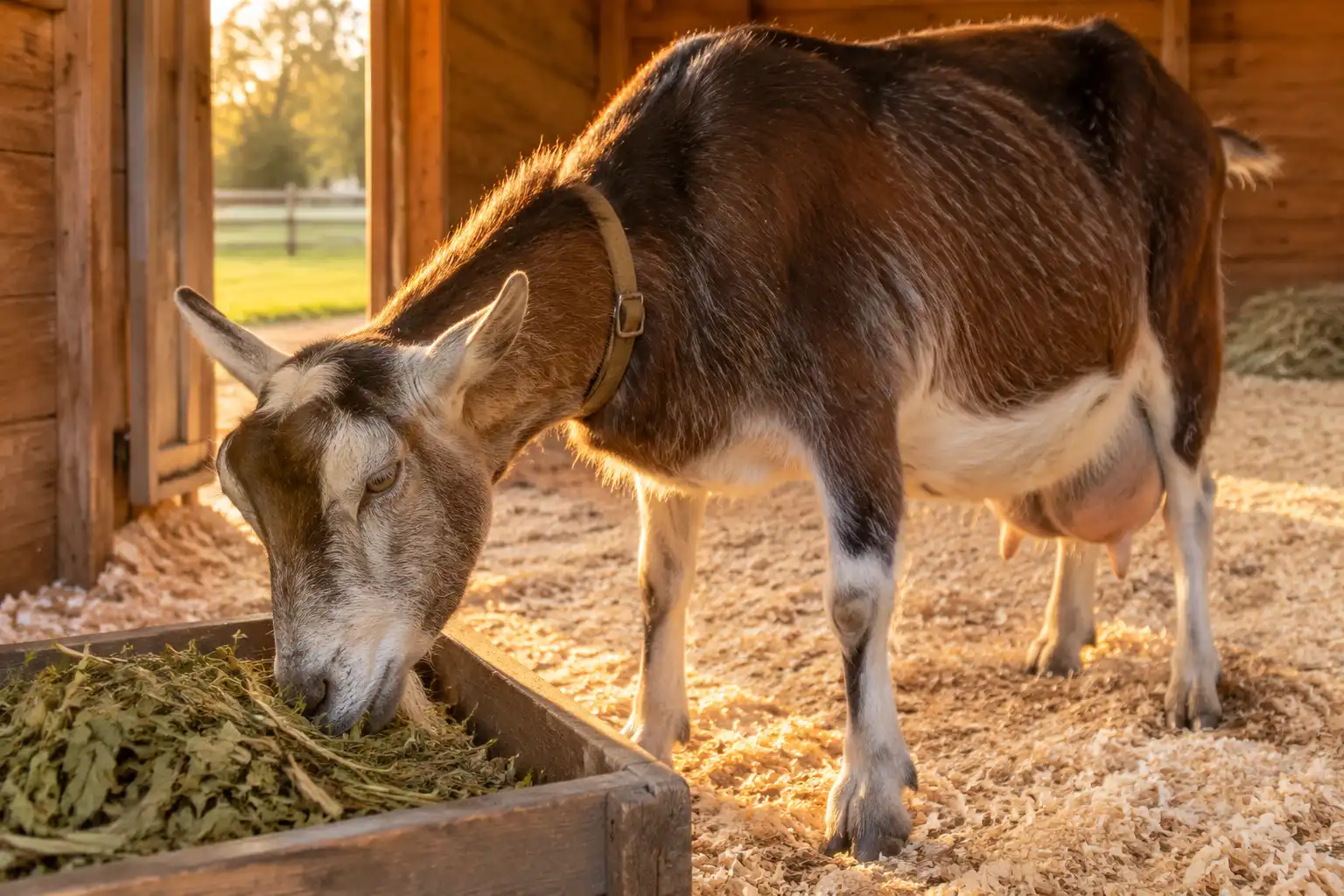
Most goats count as seniors around age 10, once teeth wear down. At that point, the goal shifts from production to comfort.
Feed for the mouth the goat has. Goats with worn or missing incisors struggle to bite off coarse hay. Leafy hay, chopped forage, and pelleted feeds made for goats help an old goat hold weight.
Feed old goats apart. Younger herdmates push seniors off the feeder. Give the old goat a separate pen or feeding time.
Watch weight closely. Run your hands over the spine and ribs every couple of weeks. Weight loss in a senior calls for a veterinarian early. Teeth, parasites, and chronic disease all show up this way.
Retire from kidding. Once a doe struggles to regain condition between kiddings, stop breeding her. Many retired does live years longer as companions.
Add bedding and warmth. Old goats lose condition faster in cold, wet weather. Deep, dry bedding eases stiff joints.
When Quality of Life Runs Out
Euthanasia is part of keeping goats, and planning for it is kinder than waiting. Warning signs include weight loss even on soft feed, trouble rising, and pain that treatment does not ease.
A veterinarian should perform euthanasia. It needs training and the right method to be humane and safe. Letting an old goat slowly starve on worn-out teeth is a welfare failure, even though it happens often.
Plan carcass disposal ahead of time, too. Rules for burial, rendering, and composting vary by state and county. Your veterinarian or county extension office can tell you what applies where you are.
FAQs on Goats Lifespan
Do female goats live longer than male goats?
Does and wethers usually outlive intact bucks. Breeders commonly report bucks living 8 to 10 years, since rut drains them each fall. Does and wethers often reach 10 to 15 years.
How long do pet goats live compared with farm goats?
Pet goats often live longer, mainly because nobody culls them. Commercial does usually leave the herd once their teeth wear, often before age 10. Well-kept pets can reach the full 10 to 15 years.
Can a goat live 20 years?
Yes, but it is rare. Guinness World Records lists McGinty, a doe in England, as the oldest verified goat at 22 years, 5 months. Most goats fall well short of 20, even with excellent care.
At what age is a goat considered old?
Most goats count as seniors around age 10. By then, University of Maryland Extension notes, many have lost their incisors. Softer feed, closer weight checks, and separate feeding help them hold condition.
How can I tell how old my goat is?
Count the permanent lower incisors. Langston University places one pair at about 1 year, then one more pair each year. A full mouth arrives near age 4, and after that only wear hints at age.
Do goats live longer with a companion?
Goats are herd animals and do poorly alone. A single goat is often stressed and calls constantly. Keeping at least two goats together supports normal eating and behavior, which helps long-term health and condition.
Do Nigerian Dwarf goats live longer than Pygmy goats?
No published research shows a difference. Breeders report both breeds living 10 to 15 years. In practice, feeding, parasite control, and kidding pace matter far more than which of the two breeds you keep.
Key Points for Your Herd
Plan on 10 to 15 years for most goats. Treat anything past that as a bonus. Bucks often fall short of that range, while wethers can exceed it if you prevent urinary stones. For Nigerian Dwarf, Pygmy, and other miniature goats, the same range applies, though breeders supply most of that data. In every case, parasites, feeding, and teeth decide more than breed does.