
Fence Height for Goats: What 48 Inches Holds and What It Doesn’t
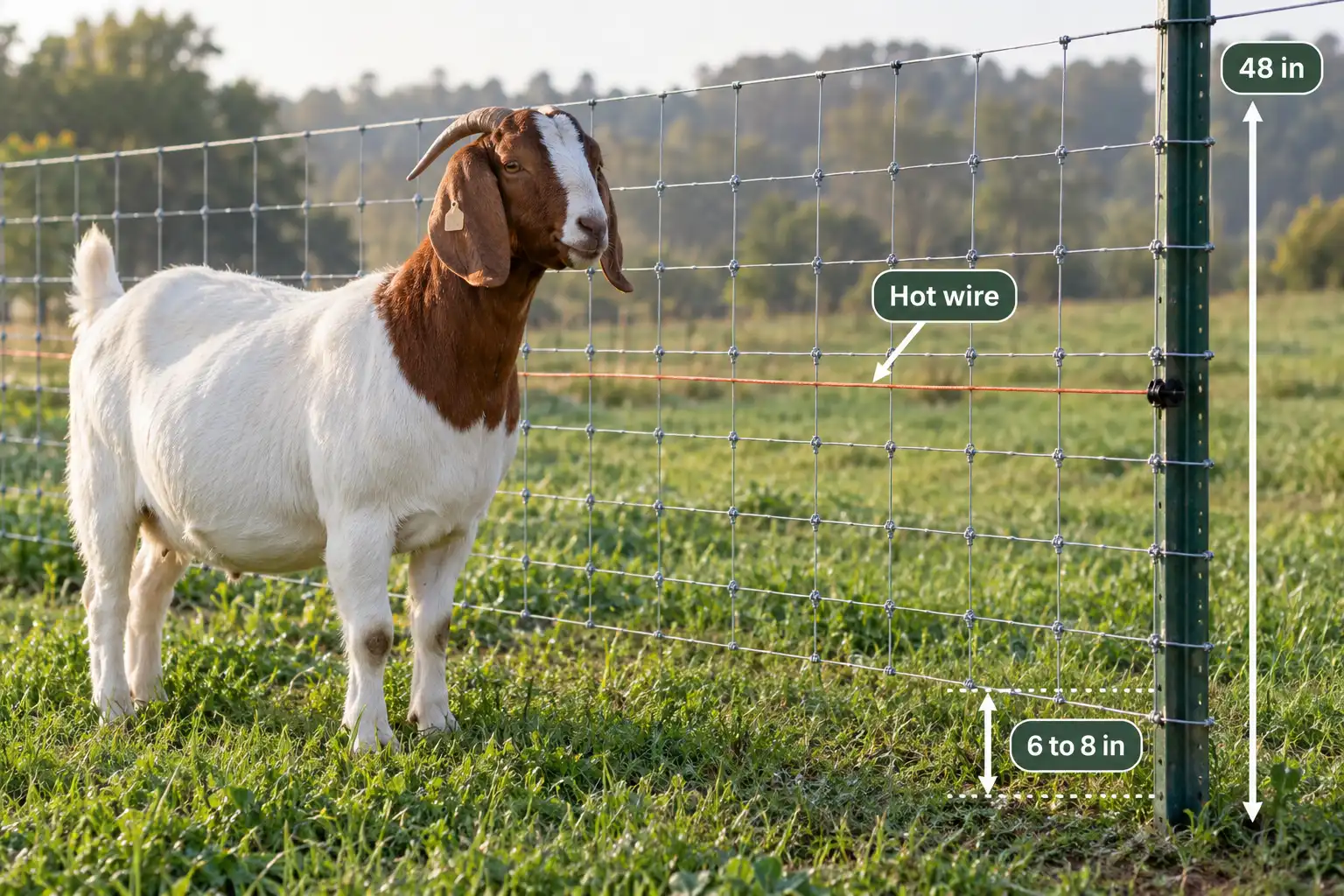
Most guides give fence height for goats as one number. The right height depends on the fence type, the goats behind it, and what sits along the fence line. Goats also test the bottom of a fence harder than the top.
The right fence height for goats is 48 inches, per Langston University, though published minimums start at 39. Keep the bottom wire close to the ground too. Goats crawl under a fence more often than they jump it.
How Tall Should a Goat Fence Be?
A goat fence should stand 48 inches tall on a permanent perimeter. Langston University says a fence that height contains goats except under extreme circumstances. So 48 inches is the planning figure in this guide.
Other programs publish lower minimums. NC State Extension puts perimeter height at 42 inches or more. Oklahoma State Extension sets woven wire at 39 inches or more. It also notes that the right height depends on the breed.
We give all three rather than average them. Each one is a minimum, but only Langston’s figure accounts for goats under pressure. Pressure is what tests a fence: short pasture, fear, or a buck near does in heat.
Langston also calls goats one of the harder livestock species to contain. That is why the perimeter deserves more planning than most parts of a goat operation.
Fence Height for Goats by Fence Type
Fence type changes the height you can count on. An electric fence gets its height from the number of wires, so a low wire count means a short fence.
The USDA NRCS fence specification for Massachusetts (Practice 382) sets these minimums for goats and sheep:
| Fence type | Minimum height | Bottom wire from ground | NRCS perimeter rating |
|---|---|---|---|
| Electric, 3 high-tensile wires | 30 in | 8 in | Interior only |
| Electric, 4 wires, 2 or more hot | 36 in | 8 in | Interior only |
| Electric, 5 wires, 2 or more hot | 38 in | 8 in | Meets |
| Electric, 6 wires, 2 or more hot | 48 in | 8 in | Meets |
| Non-electric high-tensile, 7 wires | 42 in | 6 in | Meets |
| Woven wire plus one or more top wires | 47 in, top wire included | Not listed | Exceeds |
| Four boards, 6 in wide | 46 in | 6, 6, 8, 10 in between boards | Exceeds |
Two points stand out. First, only the six-wire electric fence reaches 48 inches. Second, NRCS rates the three and four wire fences for interior paddocks only. So a fence that works for rotation can still fail as a boundary.
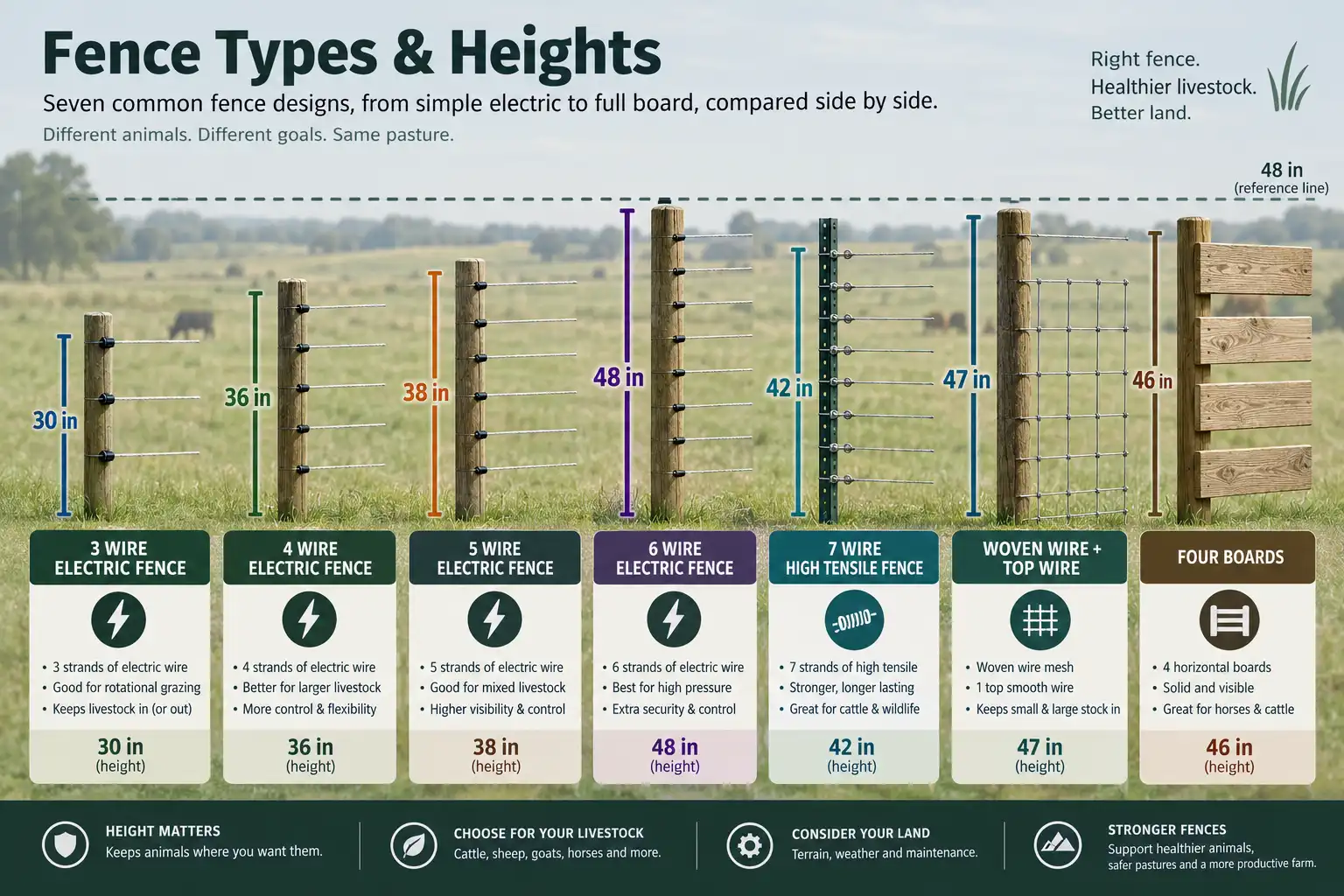
NRCS also calls these heights recommendations to adjust for the producer and the livestock. Each state keeps its own version of Practice 382, so check yours with your local NRCS field office before you build.
Why Goats Go Under Before They Go Over
Most goats test the bottom of a fence first. NC State Extension notes that goats crawl under a fence rather than jump it. So the bottom wire belongs close to the ground.
That makes bottom spacing as important as total height. NC State spaces electric wires 6 to 8 inches apart near the ground. Near the top, the gaps widen to 8 to 12 inches. The NRCS table above sets the bottom wire at 6 inches for non-electric high-tensile and 8 inches for electric.
Kids need tighter spacing still. Langston University’s nine-strand barbed wire design puts the bottom strand 3 inches off the ground. The gaps above it run 4, 4, 4, 5, 5, 6, 8, and 8 inches. That gives a 47 inch fence with bottom spacing tight enough to hold kids.
Oklahoma State Extension adds one firm rule here: never electrify barbed wire.
Low spots undo good spacing. Where the fence crosses a dip or a wash, the gap under the bottom wire grows. Walk the line after heavy rain, then block or fill those gaps.
Mesh Size and Horned Goats
For horned goats, mesh opening matters as much as height. Two sound approaches exist, and they point in opposite directions.
Texas A&M AgriLife Extension recommends woven or net wire with openings under 4 inches wide. At that size, a goat cannot push its head through at all.
Langston University takes the other route. For horned goats, it prefers 12 inch stay spacing over 6 inch spacing. The wider gap lets a goat work its head and horns back out.
Both approaches avoid the same trap. Six inch stays let the head in, then catch the horns on the way back, per Langston. A trapped goat cannot reach water or get away from a dog. It can also hurt itself pulling against the wire.
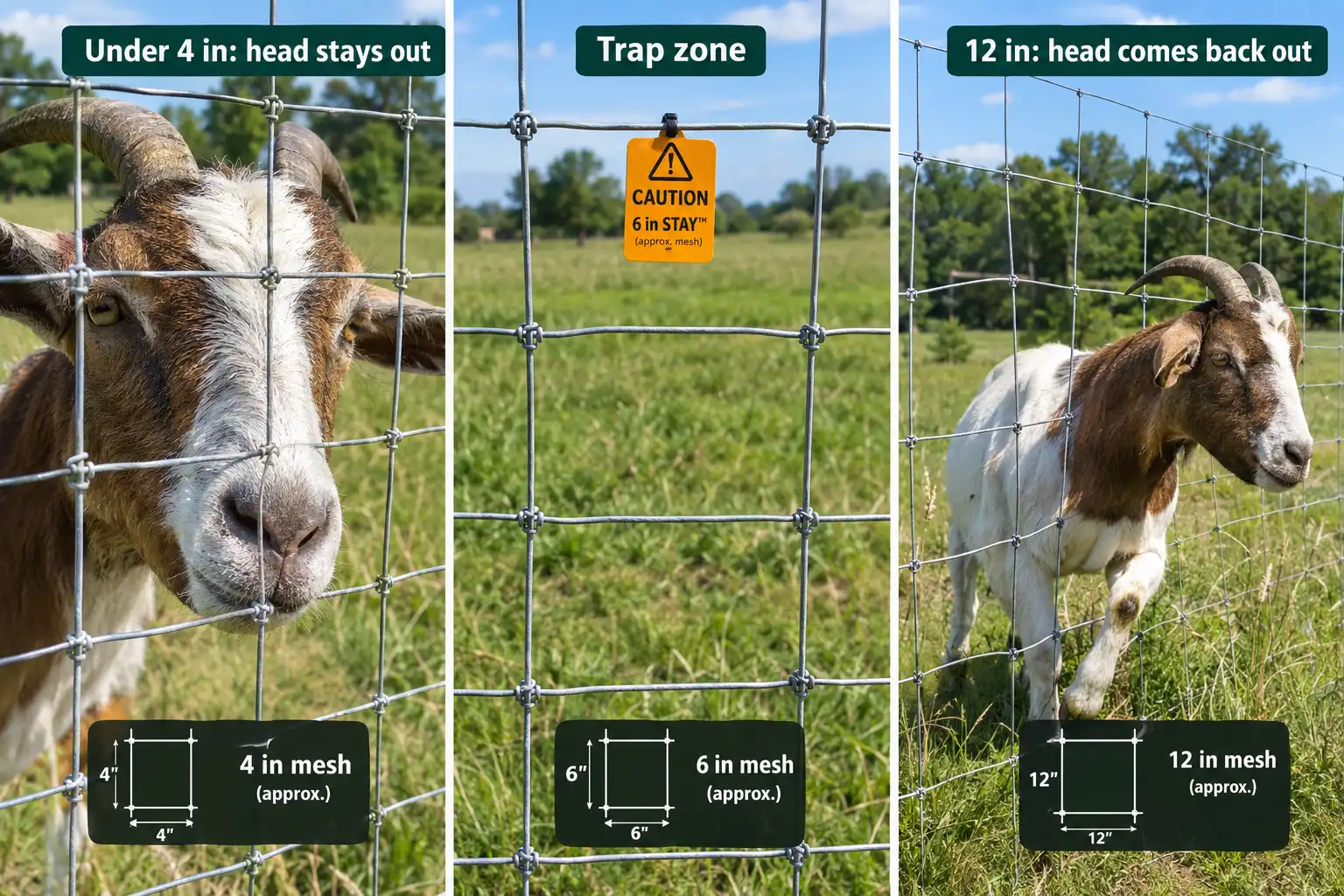
Read the roll tag before you buy. Oklahoma State Extension explains the code with an example: 1047-12-11. That roll has 10 line wires and stands 47 inches tall. Its stays sit 12 inches apart, and its filler wire is 11 gauge.
Already have 6 inch stays? NC State recommends an electric wire offset about 9 inches from the woven wire, on the goat side. Set it 12 to 15 inches off the ground, and fewer goats get caught.
How Many Wires an Electric Goat Fence Needs
Most published designs put a permanent electric perimeter for goats at five or six wires. The count varies by program, so here is each one.
Penn State Extension describes a perimeter of five to six smooth high-tensile wires, with two or three electrified. Texas A&M AgriLife sets the floor at five wires and stresses keeping the fence very hot. NC State uses four to five electrified high-tensile strands. Langston University gives a range of three to seven wires and favors five for goats new to electric fence.
Interior fences can run lighter. Penn State allows two or three wires for subdivisions but prefers three for goats. Langston adds that trained adult goats may respect a single hot wire about 24 inches off the ground.
Training decides whether any of this works. NC State trains goats in a small paddock, where they test the wire early. Langston notes that one or two contacts usually teach them to avoid it. Even so, frightened or crowded goats may go straight through. Electric fence is a mental barrier, not a physical one.
Voltage has a floor too. The NRCS Massachusetts specification sets 2,000 volts as the minimum for sheep and goats. Check it on the fence with a tester, because grass touching the wires drains the charge, per Langston.
Electric netting suits rotational grazing, but it carries a horn risk. Penn State says netting must stay electrified so horned goats don’t get caught. NC State reports producers losing goats that tangled their horns in it.
Adding Height With a Top Wire or Offset
An electrified wire adds height or stops climbing without replacing the fence. Where you place it decides which job it does.
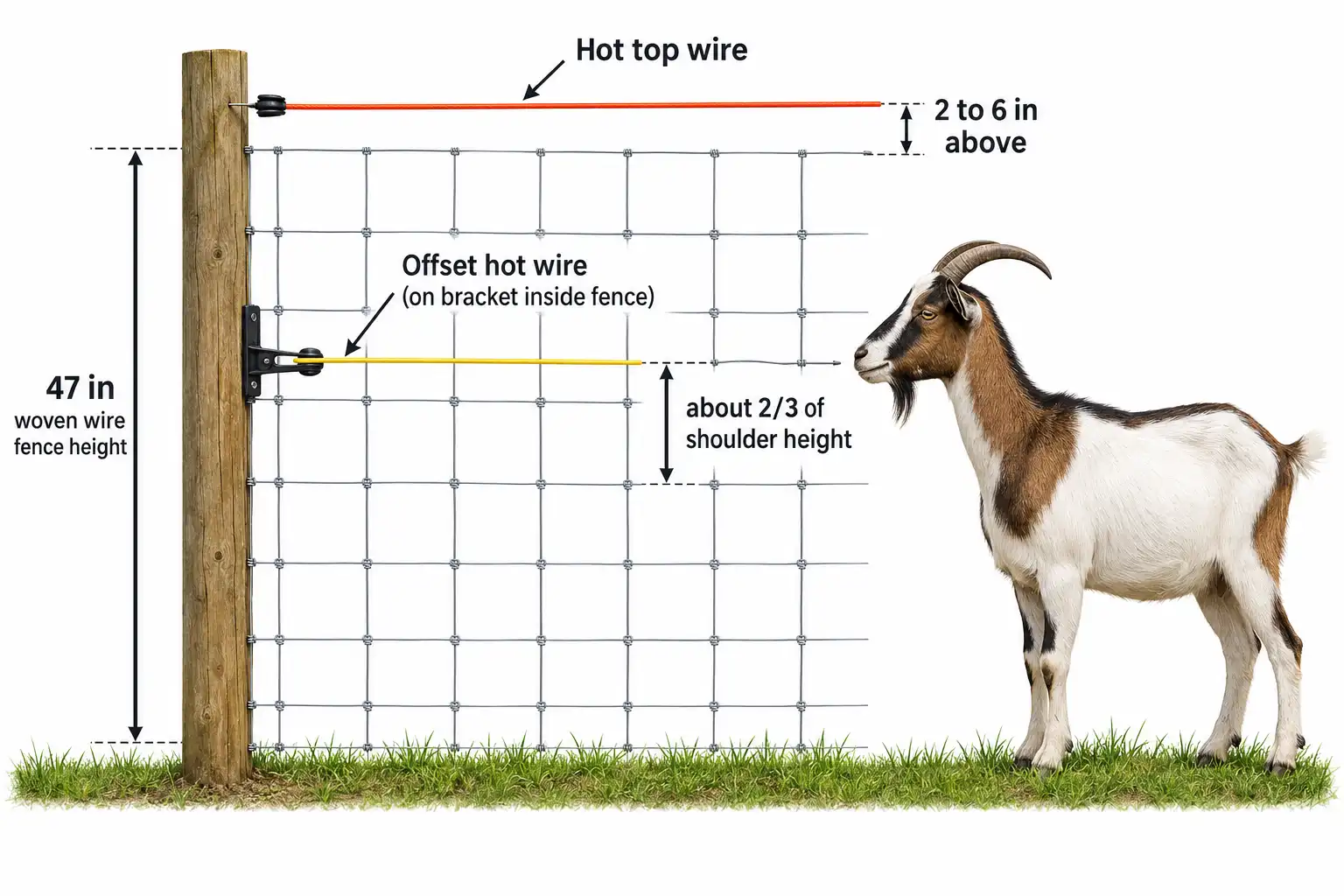
A top wire adds height. The NRCS specification places strands 2 to 6 inches above the woven wire. On a 47 inch roll, that brings the fence to 49 to 53 inches. NC State also suggests a hot wire about a foot inside the fence near the top if goats jump.
An offset wire stops rubbing and climbing. NRCS places offset brackets at the chest height of the animals. Oklahoma State Extension puts the offset at about two thirds of the animal’s height. At that level, it keeps goats from rubbing on the fence.
Work out the offset height for your own goats. Measure a typical adult at the shoulder, then multiply by two thirds. A goat 30 inches at the shoulder takes an offset near 20 inches. A smaller goat at 21 inches takes one near 14.
Keep offsets clear of weeds and broken fence wire. Oklahoma State warns that a broken wire touching the hot strand causes a short.
Bucks, Small Breeds, and Kidding Pens
Bucks need the most fence, yet published extension figures for buck pens are thin. Langston’s 48 inch figure holds goats except under extreme circumstances. A buck next to does in heat is exactly that circumstance.
Without a published buck height, start at 48 inches and add a hot top wire. On a 47 inch roll, that reaches the 49 to 53 inch range above. Finish the buck pen before breeding season, since a weak spot then means unplanned kids.
Small goat breeds such as Nigerian Dwarf and Pygmy are short. Still, no extension source we checked gives them a lower fence height. Oklahoma State notes that height depends on the breed but lists no smaller figure. So build their fence to the same 48 inches and tighten the bottom spacing, since small goats fit through gaps that hold a Boer.
Kidding pens follow the same rule. Oklahoma State Extension sets kidding pens at a minimum of 48 inches high.
Where Goat Fences Fail
A fence is only as tall as the highest thing beside it. Hay feeders, water troughs, stumps, round bales, and shelters all work as steps.
Check the effective height on your own place. Subtract the height of anything a goat can stand on next to the fence. A 48 inch fence with a 24 inch trough against it is a 24 inch fence. A 30 inch snowdrift along a northern fence line leaves 18 inches.
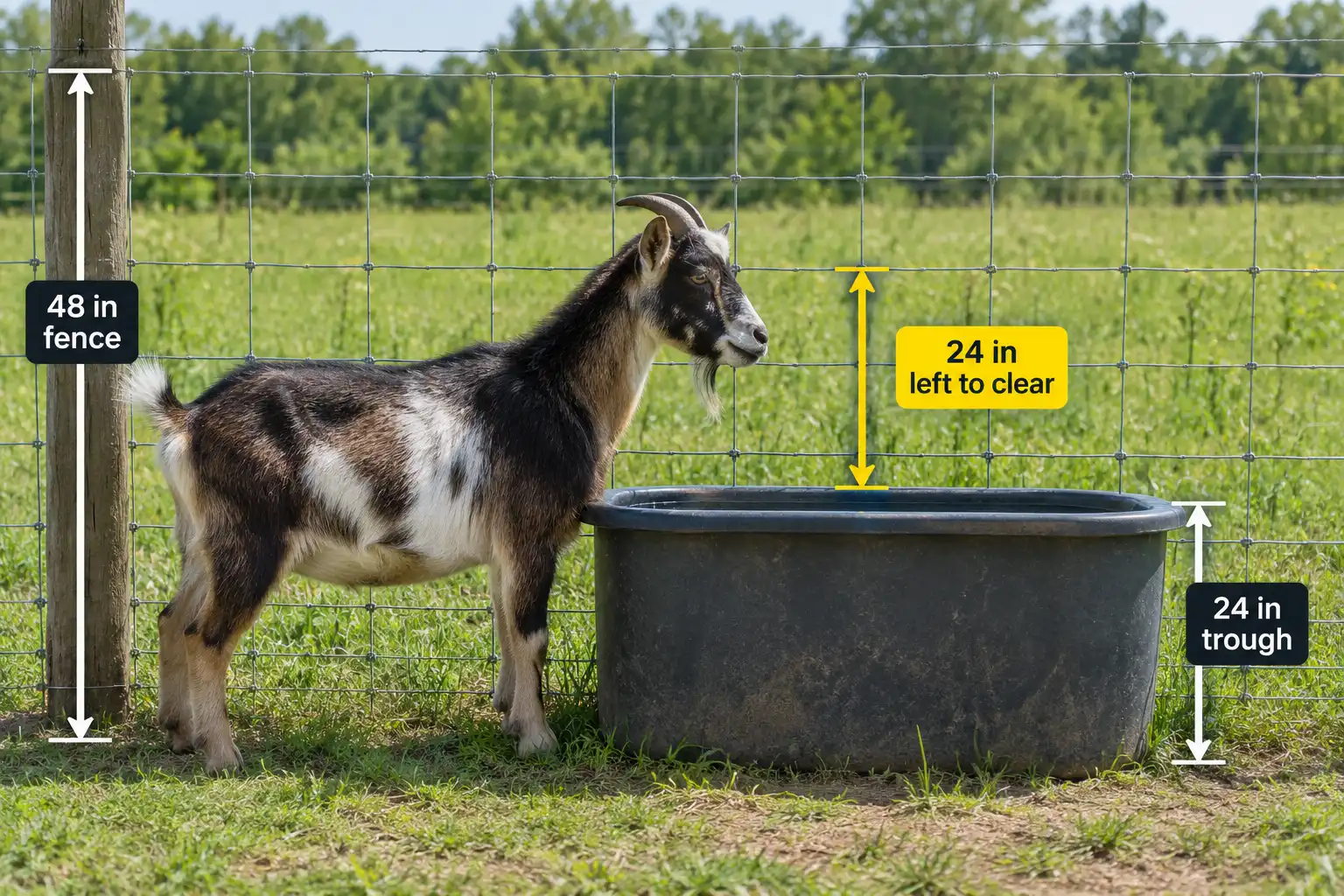
The extension sources in this guide give no setback distance. So use a simple test instead. A goat standing on the object should not reach the top wire with its front feet.
A shelter built into a fence line turns its roof into a ramp. Plan barn and fence layout together so no roof meets the perimeter.
| What you see | Likely cause | Fix |
|---|---|---|
| Goats under the fence | Bottom wire too high, or a washed-out dip | Drop the bottom wire to 6 to 8 inches and fill low spots |
| Top of woven wire sagging | Goats standing on the mesh | Add an offset hot wire at chest height |
| Horned goat caught in the mesh | 6 inch stays | Change the spacing or add an offset 9 inches out |
| Goats walking through electric | Low voltage, weeds on the wires, or no training | Test voltage, clear the line, retrain in a small paddock |
| Only the bucks get out | Fence built to the minimum | Add a hot top wire above the woven wire |
FAQs About Goat Fence Height
Is a 4 foot fence tall enough for goats?
For most does and wethers, yes, if the bottom is tight. Langston University says 48 inches holds goats except under extreme circumstances, such as a buck near does in heat.
Will a 3 wire electric fence hold goats?
Only as an interior fence, and only with trained goats. Langston University limits 3 wire systems to trained animals, and NRCS rates a 30 inch, 3 wire fence for paddocks, not boundaries.
Why does my goat keep getting its head stuck in the fence?
The openings are likely in the trap range: big enough for the head, too small for the horns to come back out. Langston University names 6 inch stays as the spacing that catches horns.
How high should the bottom wire be on a goat fence?
About 6 to 8 inches off the ground for adult goats. NRCS uses 6 inches for non-electric high-tensile and 8 for electric, while Langston University starts barbed strands at 3 inches to hold kids.
How tall should a buck pen be?
Plan on 48 inches plus a hot top wire. Extension figures for buck pens are thin, so add a strand 2 to 6 inches above a 47 inch roll, per NRCS, for 49 to 53 inches.
Do goats jump fences or climb them?
Both, but they crawl under more often than they jump, per NC State Extension. Climbing gets easier with anything next to the fence, such as a feeder, trough, or shelter roof.
What to Check Before Turnout
Measure the fence at its lowest point, not its tallest. Then check four things. Is the bottom gap 6 to 8 inches along every dip? Do woven wire openings sit under 4 inches, or stays at 12, never at 6, for horned goats? Are feeders, troughs, and shelters off the fence line? Does every hot strand read at least 2,000 volts on a tester?
A 48 inch fence that passes all four checks matches the published guidance for most goats.