How Long Are Cows Pregnant? Cow Gestation by Breed, Month, and Due Date
A cow carries her calf for a little over nine months. Breed, calf sex, season, and sire can move that date by a week or more. So knowing how long cows are pregnant is the first step toward a calving date you can plan around.
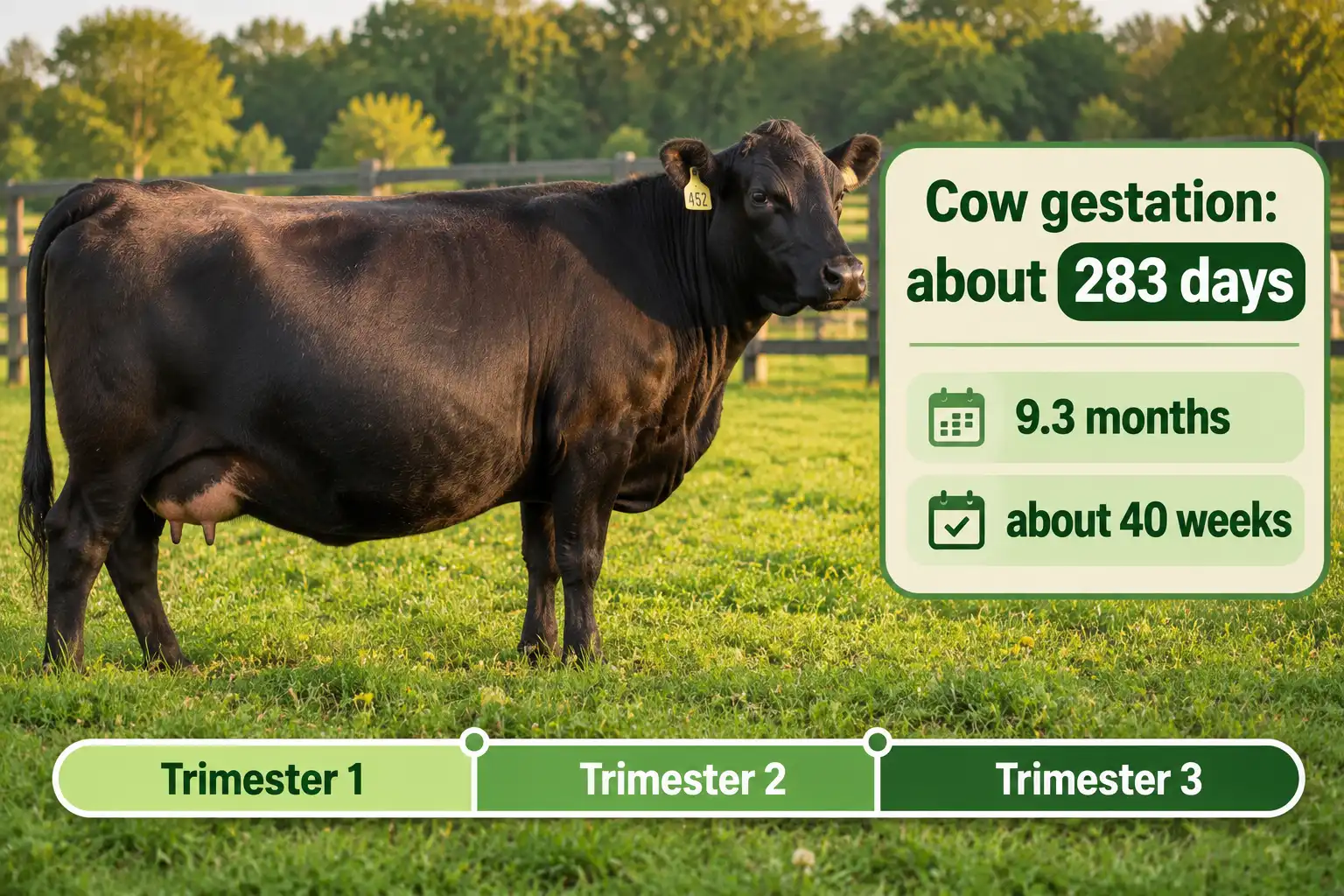
Cows carry a calf for about 283 days, or roughly 9.3 months, by the figure most gestation tables use. Oklahoma State Extension’s 2026 review of AI-bred beef cows found a 280-day average, and breed can shift it 10 days.
How Long Are Cows Pregnant in Months?
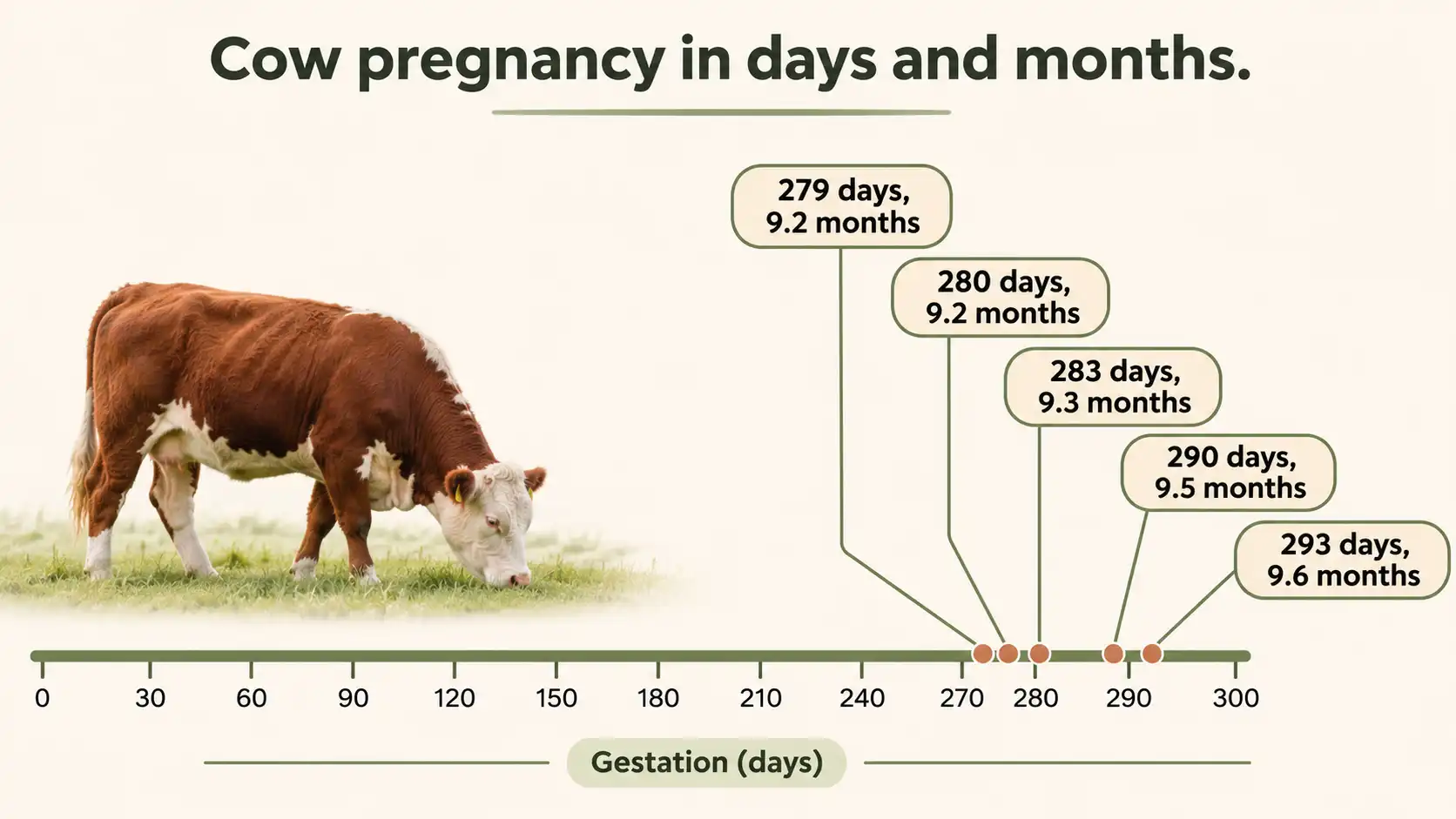
A cow is pregnant for about 9.3 months, based on the standard 283-day figure. That works out to a little over 40 weeks. Breed moves it, so a range of 9.2 to 9.6 months covers most cattle in the United States.
| Gestation length | Weeks | Months | Where you see it |
|---|---|---|---|
| 279 days | 39.9 | 9.2 | Recent Angus AI calves |
| 280 days | 40.0 | 9.2 | Average Bos taurus beef cow, recent data |
| 283 days | 40.4 | 9.3 | Standard printed gestation tables |
| 290 days | 41.4 | 9.5 | Charolais |
| 293 days | 41.9 | 9.6 | Brahman |
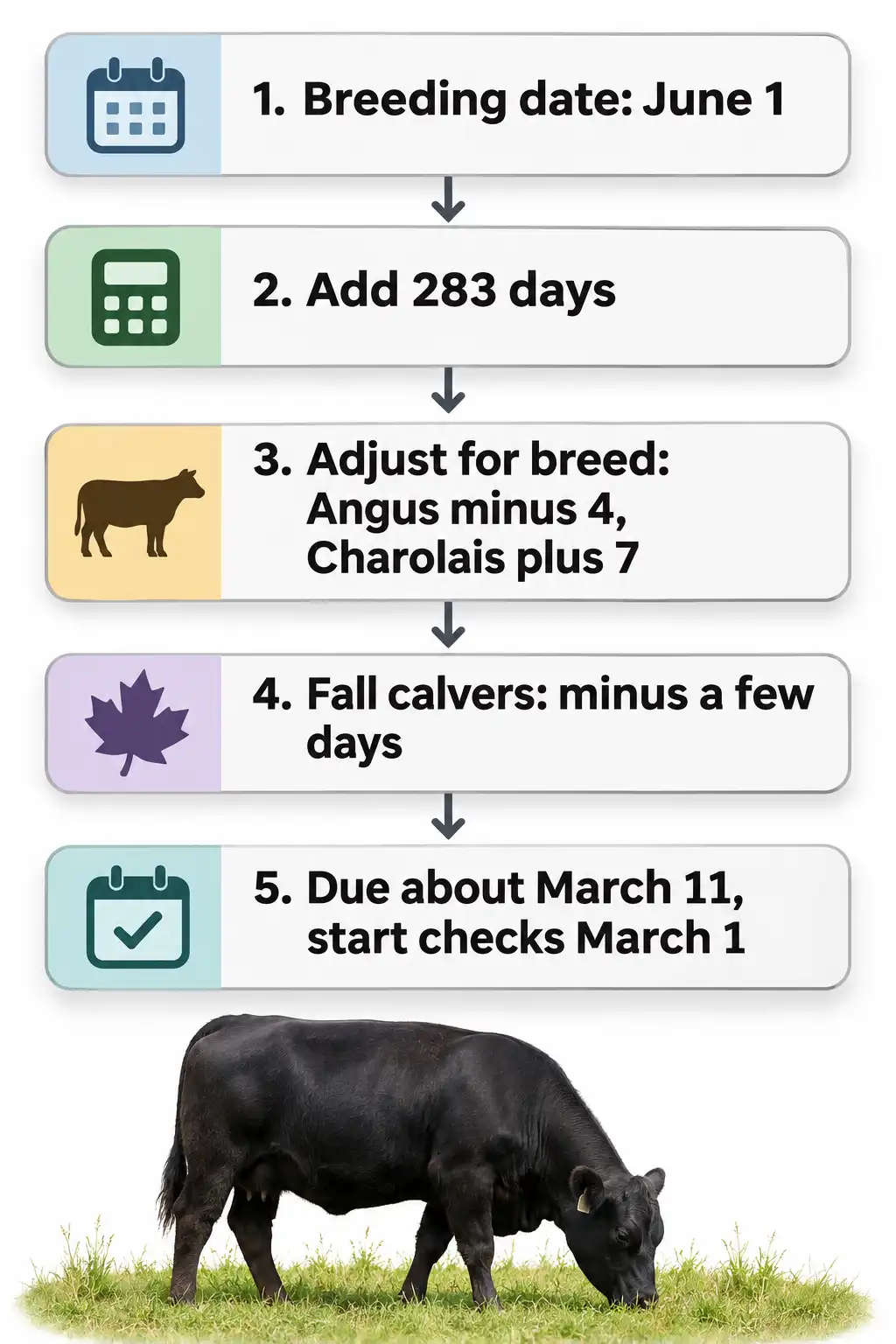
For a quick estimate, add nine months and 10 days to the breeding date. That shortcut lands within two days of a full 283-day count in every month of the year. For example, a cow bred June 1 is due about March 11.
Still, “nine months” alone is not precise enough for calving checks. Those extra seven to 10 days decide whether you are watching cows when the first calf arrives.
Read next: Can Horses Have Bananas? Safe Amounts
Cow Gestation Period by Breed
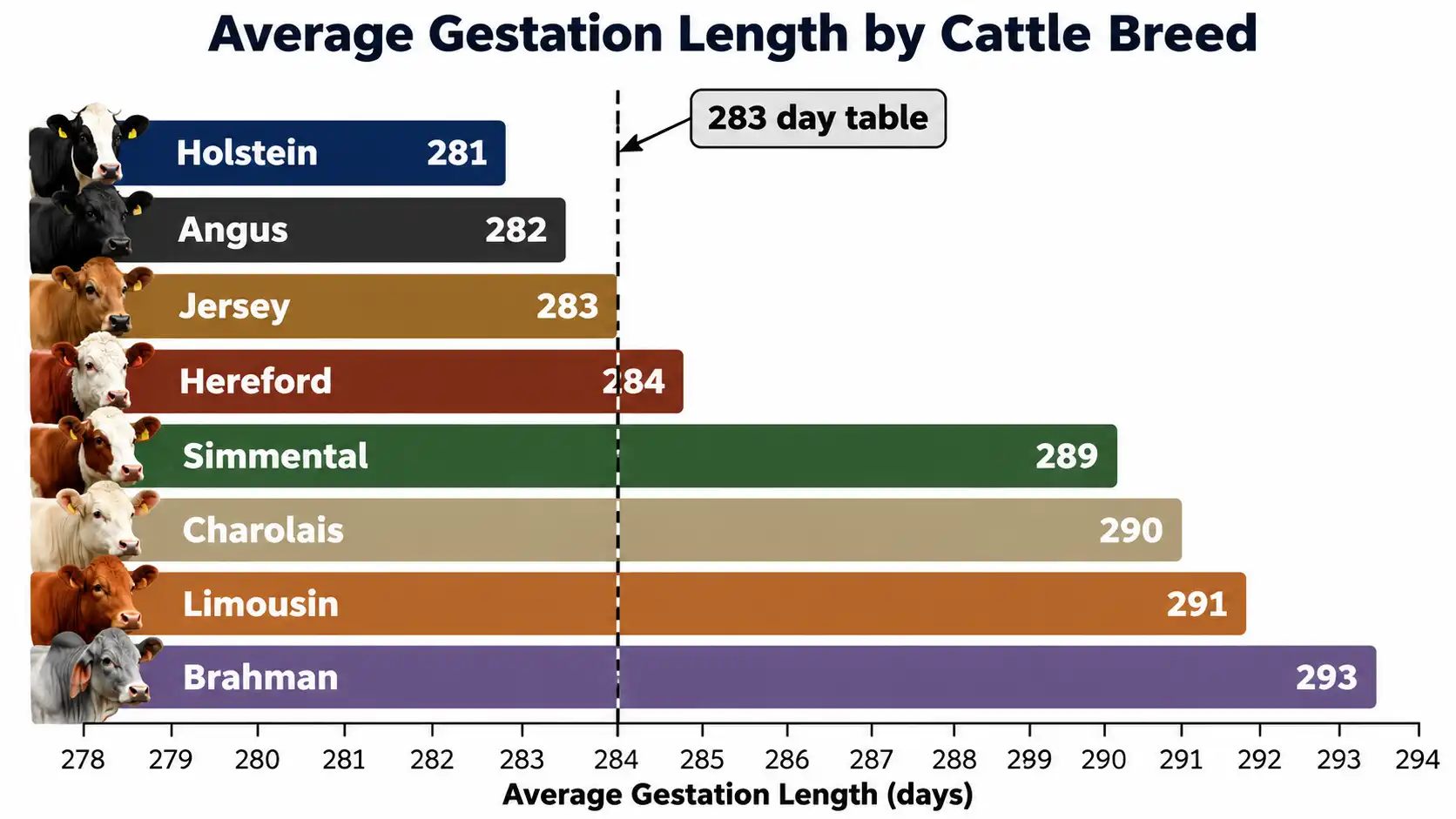
Breed changes the cow gestation period more than any other factor. Oklahoma State Extension publishes these breed averages from the USDA Meat Animal Research Center’s Germ Plasm Evaluation project.
| Breed | Type | Gestation (days) | Months | Versus the 283-day table |
|---|---|---|---|---|
| Holstein | Dairy | 281 | 9.2 | 2 days early |
| Angus | British beef | 282 | 9.3 | 1 day early |
| Jersey | Dairy | 283 | 9.3 | On the table |
| Hereford | British beef | 284 | 9.3 | 1 day late |
| Simmental | Continental beef | 289 | 9.5 | 6 days late |
| Charolais | Continental beef | 290 | 9.5 | 7 days late |
| Limousin | Continental beef | 291 | 9.6 | 8 days late |
| Brahman | Bos indicus | 293 | 9.6 | 10 days late |
The pattern is easy to remember. British beef breeds and dairy breeds sit near 282 days. Continental breeds run about a week longer. Brahman and other Bos indicus cattle run longest, close to 10 days past the table.
Crossbreds are harder to pin down, because published figures for crosses such as Brangus or Simbrah are thin. Until your own records say otherwise, expect a crossbred calf between the two parent breed averages.
Why Modern Beef Cows Often Calve Before the Table Date
The 283-day figure is decades old, and newer data puts most beef cows a few days under it. Oklahoma State Extension summarized a 2024 Journal of Animal Science study of 10,037 AI-bred cows in Virginia beef herds. Average gestation was 280.2 days. The shortest was 253 days, and the longest was 300.
For comparison, a 1952 study cited in the same summary put Angus at 281.7 days and Hereford at 286.1. So the shortening is not new, and it has continued.
Kansas State Research and Extension reported an even shorter figure for Angus. Across 101,787 Angus AI records from 2000 to 2020, gestation averaged 278.6 days. About two thirds of those calves arrived between day 274 and day 283.
Gestation also dropped by 4.3 days over that study period. K-State links the drop to years of selection for lighter birth weights and easier calving.
The old table still works as a planning number. In an Angus or Angus-based herd, though, expect the first calves four to five days ahead of it.
What Changes Cattle Gestation Time
Within a breed, four things move cattle gestation time: calf sex, the cow’s age, the season, and the sire.
Calf Sex
Bull calves stay in the womb slightly longer. In the Virginia data Oklahoma State summarized, bull calves averaged 280.8 days and heifer calves 279.6. That is about one day, so it matters for records more than for planning.
Age of the Dam
Young cows calve a little sooner. K-State’s Angus data shows 2-year-old dams at 277.7 days, rising each year to 279.6 days by age 8. As a result, a first-calf heifer may calve about two days ahead of mature cows bred the same day.
Season and Heat
Hot weather in late pregnancy shortens gestation. In the Oklahoma State summary, fall calvers averaged 279.1 days against 281.1 for spring calvers. Separate Oklahoma State research found that early fall calvers carrying calves through summer heat calved about six days ahead of the table. Fall herds should start checking cows sooner.
The Sire
Gestation length is highly heritable, so the bull matters. K-State puts its heritability at 0.57 in Angus, higher than birth weight at 0.36. In practice, your sire choice shifts the due date of every calf he produces.
Gestation in Dairy Cows Bred to Beef Bulls
Dairy cows carrying beef-sired calves stay pregnant longer. Penn State researchers analyzed records from 39,249 Holstein cows in 10 herds across the Northeast and Midwest.
Compared with Holstein-sired calves, Angus-sired calves were carried one day longer. Limousin-sired calves added five days, and Wagyu-sired calves added eight. The risk of a difficult birth did not differ by sire breed in that study.
That matters for barn planning. Move cows into the close-up pen on the beef sire’s due date, not the Holstein one. Dairy herds also count the dry period for dairy cows back from that same date. An accurate breeding record therefore protects both the calf and the next lactation.
Longer Gestation Means Heavier Calves and Harder Births
Each extra day in the womb adds weight, and heavier calves are harder to deliver. In K-State’s Angus records, assisted calvings averaged 279.3 days of gestation and 87.8 pounds at birth. By contrast, unassisted calvings averaged 277.6 days and 78.1 pounds.
That gap of about 1.7 days and 10 pounds is a welfare issue, not only a labor issue. A hard pull can injure the cow, stress the calf, and kill either one. First-calf heifers, still growing themselves, have the least room for a big calf.
For heifers, that means choosing a bull with a short gestation and a strong calving ease record. K-State found the two traits are linked, so selecting for one tends to help the other.
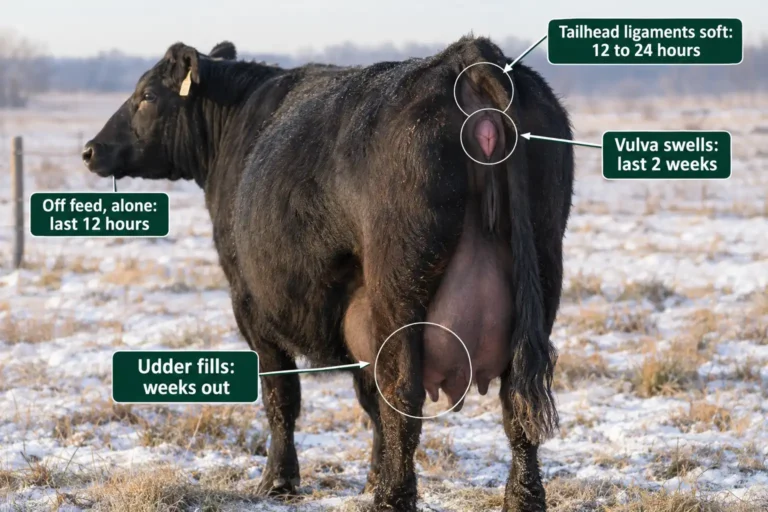
A cow or heifer in labor without progress needs help now. Call a large animal veterinarian rather than waiting on the calendar. Learning the signs that calving is close tells you when to start watching each cow closely.
How to Calculate a Cow’s Due Date
Start from the breeding record, then adjust for what you know about the herd.
- Record the breeding date. For AI, use the insemination date. For pasture breeding, write down the day the bull goes in and the day he comes out.
- Add 283 days. Most printed gestation tables use this figure, per Oklahoma State Extension, so it is the common starting point.
- Adjust for breed. Subtract four to five days for Angus AI calves, based on the K-State data. Add six to eight days for a Simmental, Charolais, or Limousin sire, and about 10 for Brahman.
- Adjust for season. Take off a few more days for fall calvers that carried calves through summer heat.
- Start checks early. Oklahoma State Extension recommends starting routine heifer and cow checks at least a week to 10 days before the first expected calf.
Here is a worked example for a pasture-bred herd. Bulls go in June 1 and come out August 2, a 63-day season covering three 21-day heat cycles. Add 283 days to each date. The first calves are due about March 11, and the last about May 12. So checks should start around March 1.
In a leap year, a due date that falls after February 29 lands one calendar day earlier.
Cow Gestation Calendar: Breeding Date to Due Date
This calendar adds 283 days for the standard table and 279 days for recent Angus AI data. It assumes the calf is born in a non-leap year.
| Bred on | Due at 283 days | Due at 279 days |
|---|---|---|
| January 1 | October 11 | October 7 |
| February 1 | November 11 | November 7 |
| March 1 | December 9 | December 5 |
| April 1 | January 9 | January 5 |
| May 1 | February 8 | February 4 |
| June 1 | March 11 | March 7 |
| July 1 | April 10 | April 6 |
| August 1 | May 11 | May 7 |
| September 1 | June 11 | June 7 |
| October 1 | July 11 | July 7 |
| November 1 | August 11 | August 7 |
| December 1 | September 10 | September 6 |
To work backward, subtract 283 days from your target first-calf date. For a March 1 start, bulls go in about May 22. For a September 1 fall start, they go in about November 22 of the year before.
The 82-Day Window to Rebreed
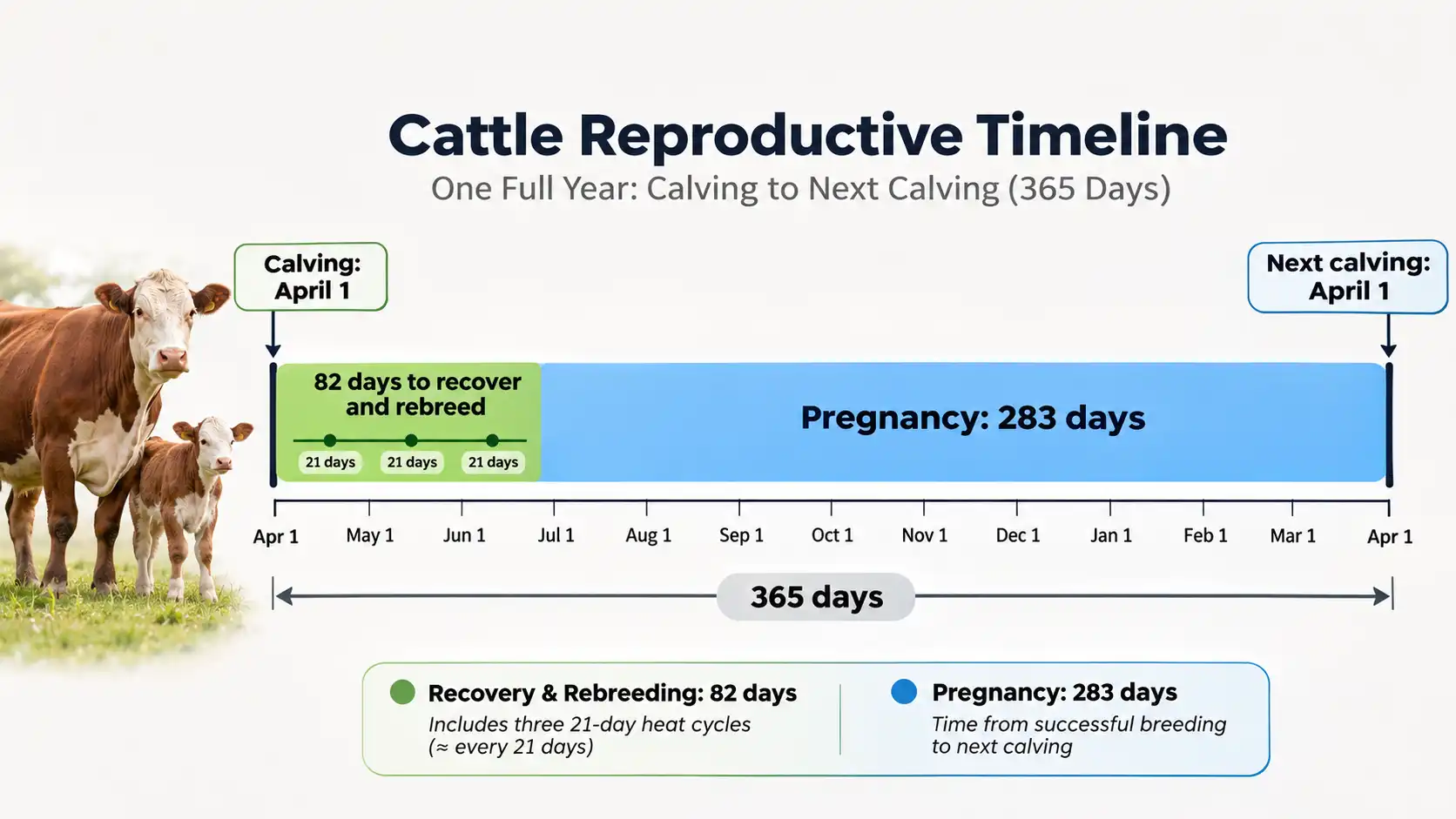
A cow that calves once a year has 82 days to settle again. That figure is simply 365 days minus a 283-day pregnancy. Within that window she has to recover from calving, nurse a calf, return to heat, and conceive.
Each missed heat cycle costs 21 days. For example, a cow that settles on her second cycle calves 21 days later next year, on a 386-day interval. If it happens again, she drifts 42 days behind. At a fixed weaning date, her calf then goes to the sale that much younger and lighter.
That is why body condition at calving matters. A thin cow is slower to return to heat, so feeding in late gestation shapes next year’s calving date as well as this year’s calf.
A cow that keeps slipping eventually falls out of the breeding season. In turn, that shortens her productive life in the herd.
When a Pregnancy Can Be Confirmed
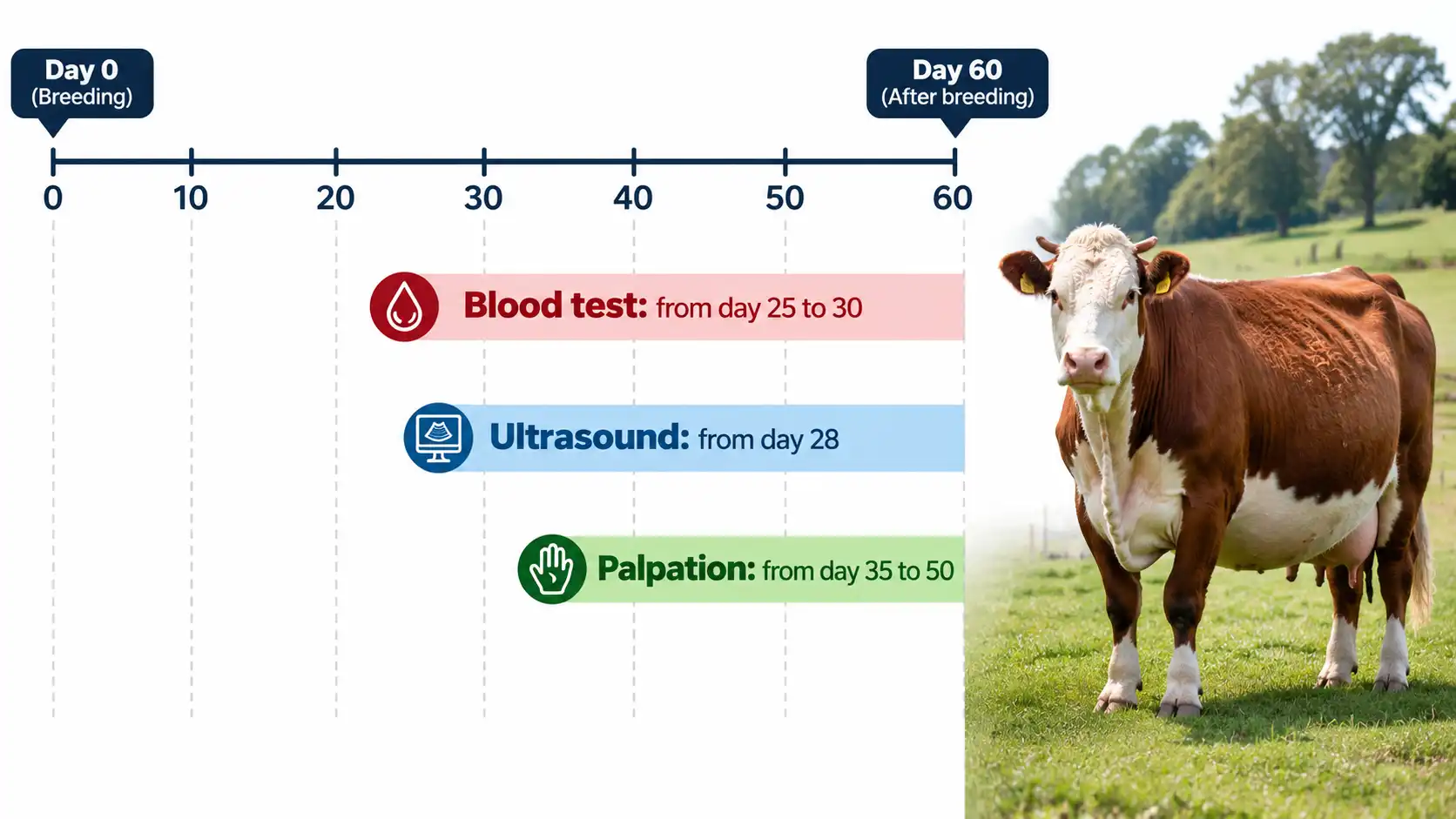
A cow that does not return to heat 18 to 24 days after breeding may be pregnant. That is a clue, not proof. A veterinarian or trained technician confirms pregnancy, and University of Nebraska-Lincoln Extension gives these windows:
- Ultrasound: from about 28 days after breeding
- Blood test: from about 25 to 30 days
- Rectal palpation: from about 35 to 50 days
An early check also sharpens the due date. According to Nebraska Extension, an experienced technician can estimate pregnancy age out to about 120 days. That places pasture-bred cows on the calendar, even when you only know the bull-in and bull-out dates.
Early handling carries some risk, though. UNL Extension cites pregnancy losses of 1 to 3.5 percent in cows checked by palpation or ultrasound at 40 to 75 days of gestation. Talk through timing and method with your veterinarian, and weigh that risk against the value of finding open cows early.
How a Cow’s Needs Change Across Gestation
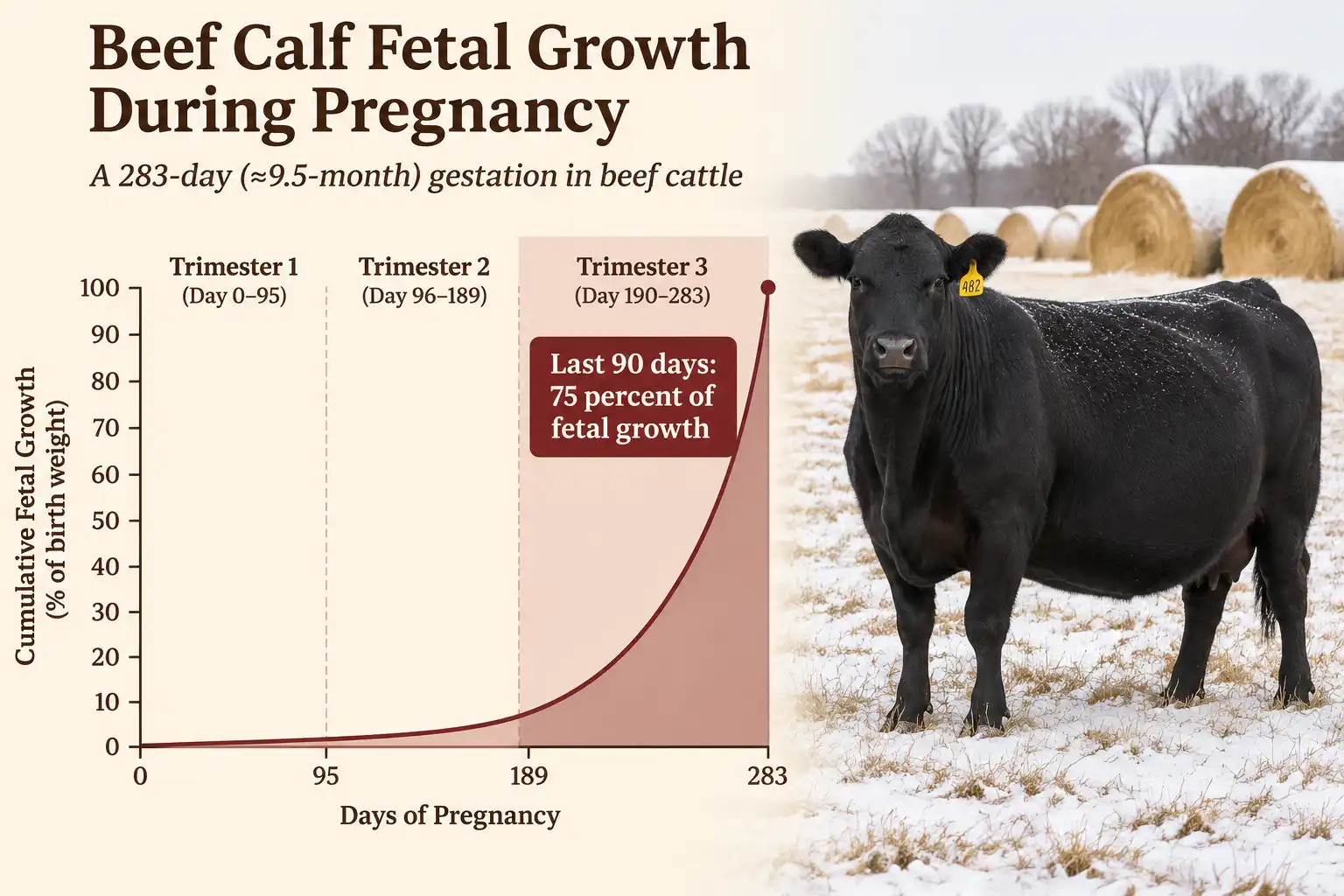
Cow gestation splits into three trimesters of about 94 days each. Fetal growth starts slow and finishes fast. Montana State University Extension reports that a beef calf completes only 25 percent of its growth in the first two thirds of pregnancy. The other 75 percent comes in the last 90 days.
That late growth drives the beef cow’s needs up sharply. From mid to late gestation, Montana State puts the rise at 14 to 15 percent for energy and 26 to 27 percent for protein. The calf, membranes, and fluids together add 100 to 150 pounds in the last third.
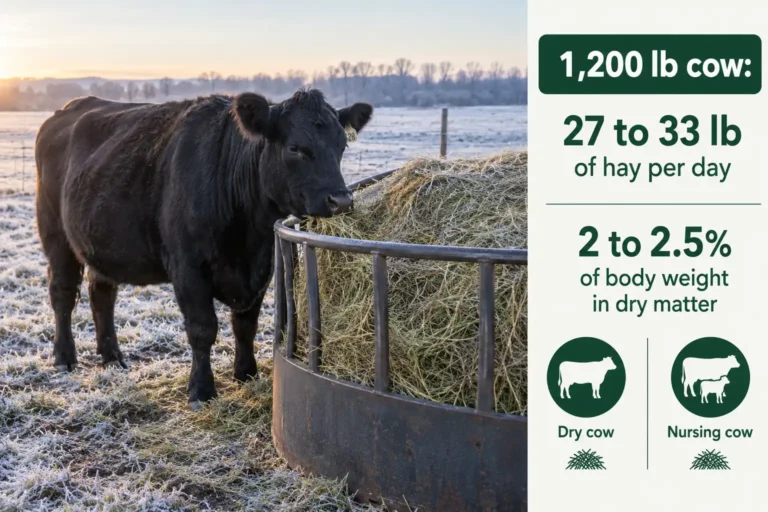
Now apply that to a spring herd due March 11. The last trimester starts around December 7, in the coldest part of the year. So the winter hay budget has to cover the hungriest stretch of the pregnancy. Working from daily hay intake for a beef cow turns that need into a hay order for the whole herd.
Frequently Asked Questions
Can a cow be pregnant for 10 months?
Rarely. Brahman cattle average about 293 days, or 9.6 months, and the longest gestation in the Virginia data Oklahoma State summarized was 300 days. A cow well past her breed’s window needs a veterinarian’s exam.
How soon after calving can a cow get pregnant again?
To calve every 12 months, a cow needs to settle within 82 days of calving, since pregnancy takes about 283 days. Thin cows often take longer to return to heat, so body condition at calving matters.
How long is a dairy cow pregnant?
Holsteins average about 281 days and Jerseys about 283, per USDA Meat Animal Research Center figures. A beef sire can stretch that. Penn State found Wagyu-sired calves were carried eight days longer than Holstein-sired calves.
When should bulls go in for a March 1 calving start?
Count back 283 days from your target date, which puts bull turnout around May 22. In an Angus herd, though, the first calves may still arrive four to five days before March 1.
Can you tell a cow is pregnant just by looking?
Not reliably until late in gestation. Skipping a heat 18 to 24 days after breeding is an early clue. However, only a veterinarian’s ultrasound, palpation, or blood test confirms the pregnancy.
Putting This Into Practice
Start with 283 days, then adjust for your herd. Take four to five days off for Angus AI calves, add about a week for Continental sires, and add 10 for Brahman. Begin calving checks 10 days before the earliest date. Keep breeding and calving records, because within a few seasons your own herd average will beat any printed table.