
Internal Parasites in Sheep and Goats: Signs, Testing, and Control
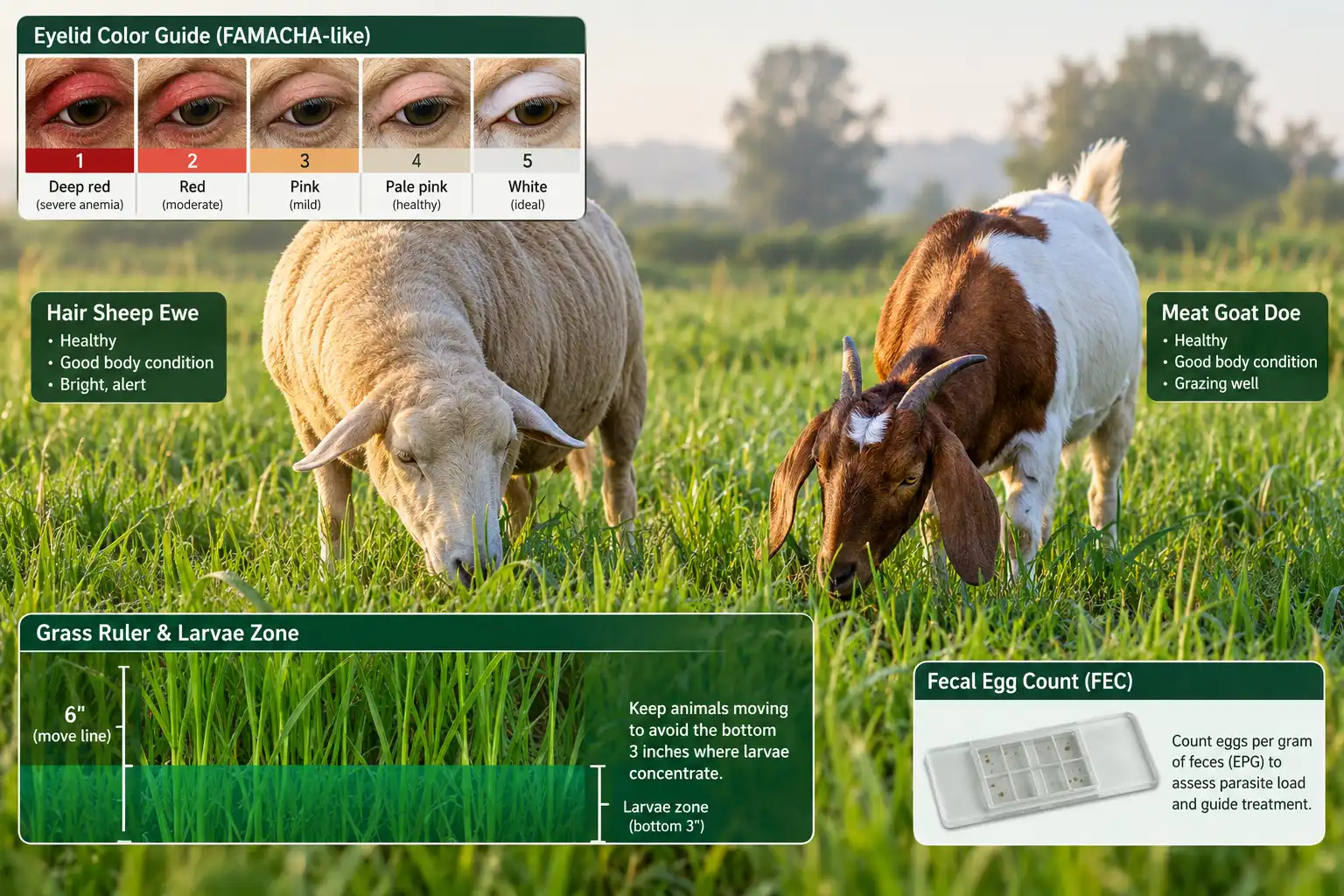
Internal parasites in sheep and goats are a leading cause of death nationwide, per University of Minnesota Extension. Dewormers no longer fix the problem alone. This guide covers which worms matter, how to spot trouble, how to test a dewormer, and how grazing cuts exposure.
Barber pole worm is the main threat among internal parasites in sheep and goats. Treat only anemic animals flagged by FAMACHA, test dewormers with fecal egg counts, and rotate pasture before animals graze it short.
Before you treat: pale eyelids, bottle jaw, and scours each have causes other than worms. A large animal veterinarian should confirm the cause first and direct any dewormer used outside its label.
Which Internal Parasites Affect Sheep and Goats?
Three roundworms cause most losses: the barber pole worm, the brown stomach worm, and the bankrupt worm (also called black scour worm), per University of Missouri Extension. The barber pole worm does the most damage because it feeds on blood. Coccidia, flukes, and a few others round out the list.
| Parasite | Where it lives | What you see | When or where risk peaks |
|---|---|---|---|
| Barber pole worm (Haemonchus contortus) | True stomach (abomasum) | Pale eyelids, bottle jaw, sudden death | Warm, humid summers |
| Brown stomach worm (Teladorsagia) | True stomach | Scours, poor growth | Spring and fall, cooler regions |
| Bankrupt worm (Trichostrongylus) | Small intestine | Dark scours, weight loss | Spring and fall |
| Coccidia (Eimeria, protozoa) | Intestine | Scours in lambs and kids | Weaning and other stress |
| Tapeworm (Moniezia) | Small intestine | Rice-like segments in manure | Pasture mites carry it |
| Liver fluke (Fasciola hepatica) | Liver | Weight loss, unthriftiness | Wet, low ground with snails |
| Meningeal worm (Parelaphostrongylus tenuis) | Spinal cord and brain | Hind-leg weakness, circling | Signs show in fall and winter |
| Lungworm (Dictyocaulus filaria) | Lungs | Chronic cough | Cooler months |
Seasons for the three roundworms come from University of Missouri Extension. The other rows follow Langston University‘s goat parasite training module.
One detail shapes everything below. FAMACHA eyelid scoring only flags barber pole worm anemia, per Langston University. So brown stomach and bankrupt worms only show up in fecal egg counts and body condition.
How Barber Pole Worms Build Up on Pasture
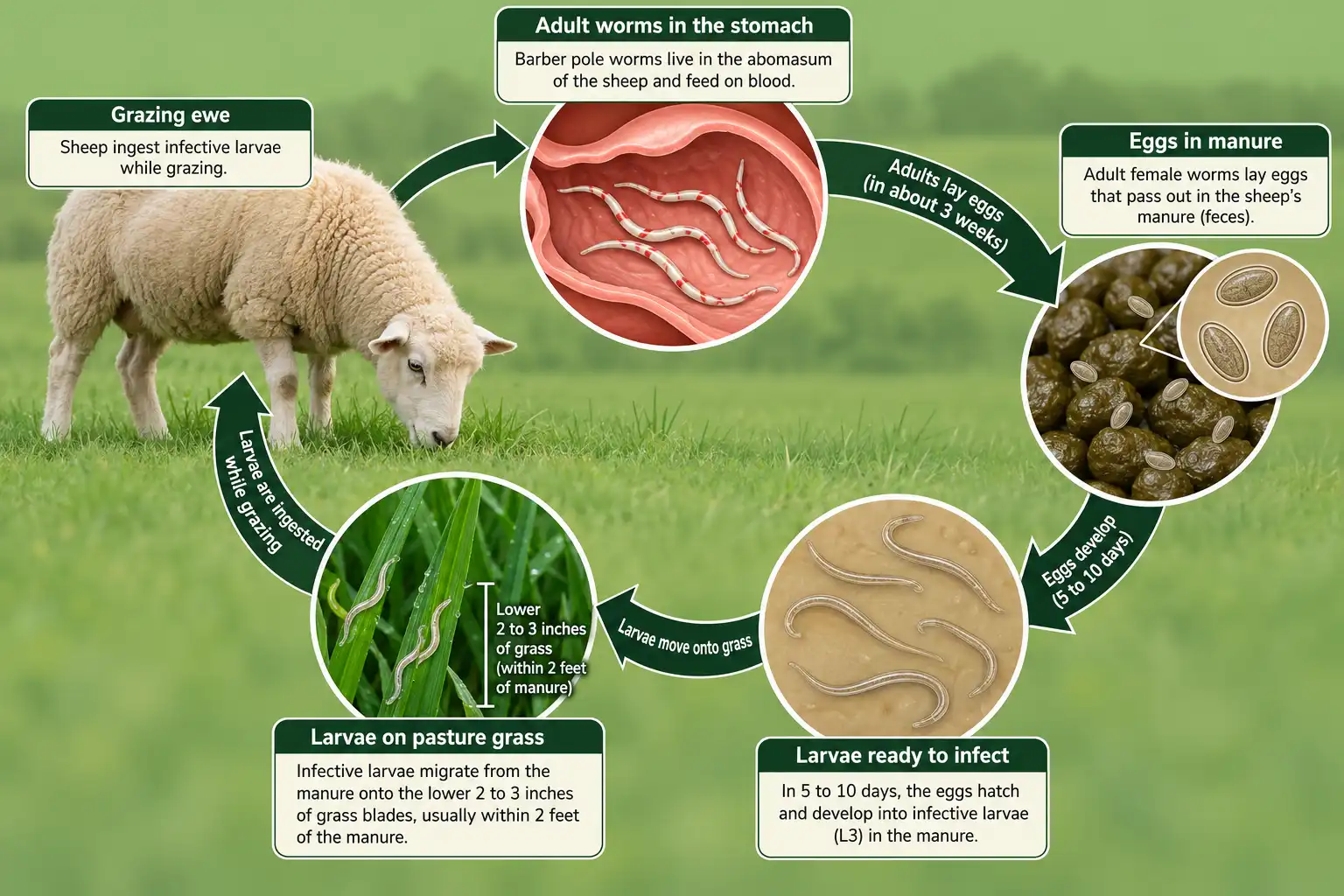
A barber pole infection snowballs because eggs turn infective fast and adults bleed the host. In summer, eggs in manure become infective larvae in 5 to 10 days. University of Minnesota Extension gives 5 days on grass, while Langston University gives 7 to 10. Swallowed larvae then mature and lay eggs in about 3 weeks, per Langston.
Larvae stay close to home. University of Missouri Extension finds them crowded within 12 to 24 inches of manure and 2 to 3 inches up the plant. That means close grazing near droppings is where most infection happens.
They also wait a long time. Larvae survive up to 2 months on pasture in warm weather and 6 months or more in cool weather, per University of Minnesota Extension.
The blood loss adds up quickly. Mississippi State Extension reports that 5,000 barber pole worms in one sheep can take about 8 fluid ounces of blood a day. Over a week, that is close to half a gallon.
Shedding is uneven, too. About 25 percent of animals shed 80 percent of the eggs, per University of Minnesota Extension. In a 40-ewe flock, roughly 10 ewes put most of the eggs on your pasture. Find those 10 and you have found most of the problem.
Why Goats and Sheep Need Different Worm Plans
Sheep and goats carry the same worms, but drug approvals, copper tolerance, and natural defenses differ. Those gaps change what a safe plan looks like.
| Factor | Sheep | Goats |
|---|---|---|
| Feeding habit | Graze grass, overgraze favorite patches | Browse leaves and brush above the larvae zone |
| Natural resistance | Hair breeds rank higher; St. Croix leads | Less documented than in hair sheep |
| FDA-approved dewormers | Albendazole, levamisole, ivermectin, moxidectin | Fenbendazole, morantel tartrate (feed), albendazole (liver fluke) |
| Drug metabolism | Labels are written for sheep | Absorb and clear drugs differently; the vet sets the rate |
| Copper sensitivity | High; copper builds up in the liver | Lower |
| Fifth Five Point Check spot | Nose (nasal bots) | Coat (goats do not get nasal bots) |
| FDA-approved coccidiostats | Decoquinate (non-lactating), lasalocid (confinement) | Decoquinate (non-lactating), monensin (confinement) |
The rows draw on University of Minnesota Extension (feeding, resistance), Mississippi State Extension (St. Croix, albendazole), FDA CVM (approvals, metabolism), Langston University (copper), and Penn State Extension (nasal bots, coccidiostats).
The goat column carries more risk. FDA CVM notes that goats absorb and break down these drugs differently than sheep, and the effective goat rate for many products is still unknown. So a sheep label rate is not a goat rate. Your veterinarian sets it.
Feeding habit matters as well. Goats with brush to browse eat above the larvae, per University of Minnesota Extension. Put the same goats on short grass and that edge is gone.
Signs of Worms and the Five Point Check
Pale eyelids, bottle jaw, weight loss, a rough coat, and scours are the common signs, per Mississippi State Extension. Some animals show nothing before they die, per University of Minnesota Extension. These signs describe a pattern, not a diagnosis, so a veterinarian confirms the cause.
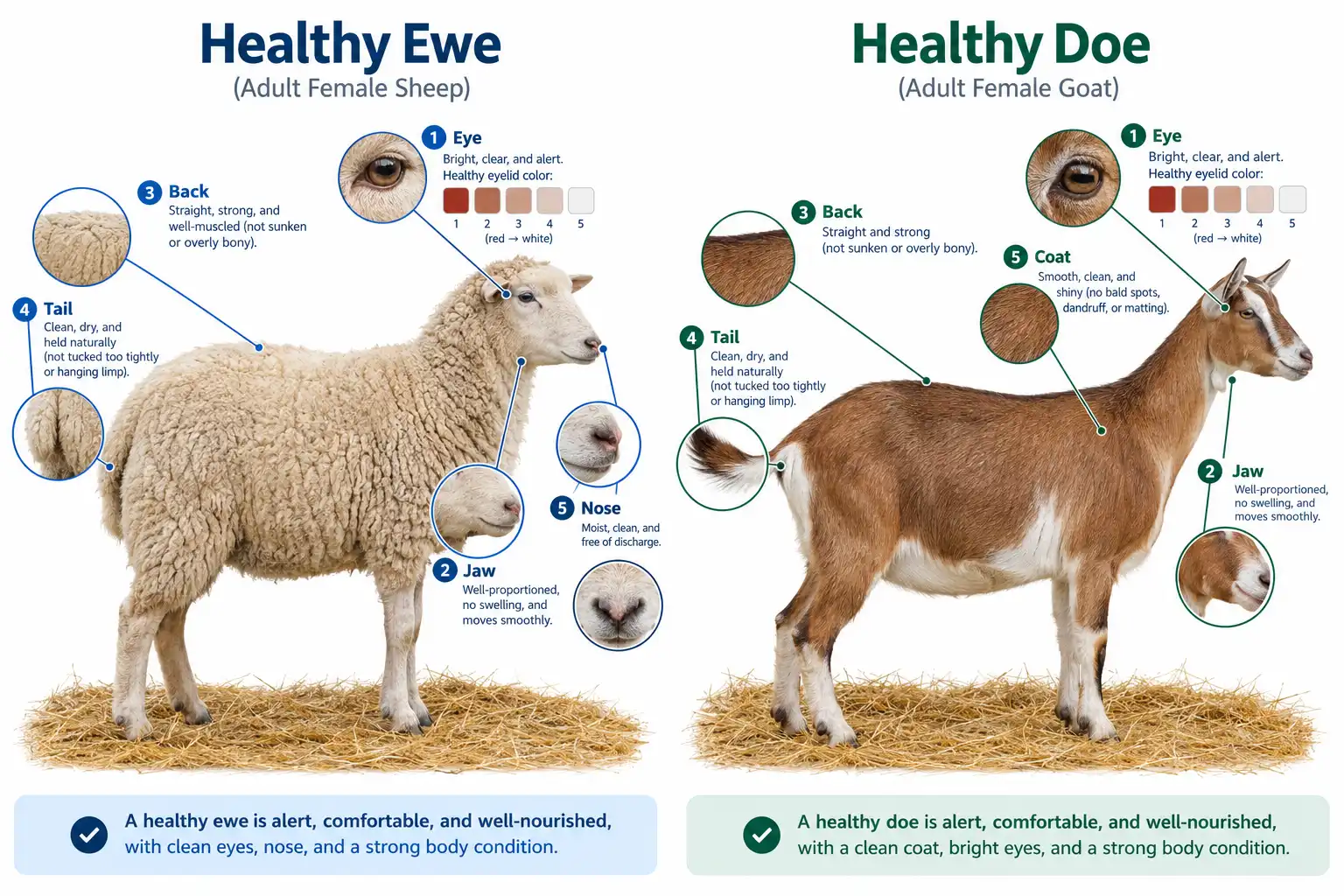
The Five Point Check
Penn State Extension scores five spots to decide which animal needs treatment:
- Eye: FAMACHA score for barber pole worm anemia.
- Jaw: bottle jaw, a soft swelling under the chin. Poor nutrition can cause it too.
- Back: body condition. Every worm type pulls condition down.
- Tail: dag score for scours, which points to brown stomach worm, bankrupt worm, or coccidia.
- Nose or coat: nasal discharge from nasal bots in sheep; a dull, rough coat in goats.
Mississippi State Extension treats a FAMACHA score of 4 or 5, or a body condition score under 3, as a trigger.
How FAMACHA Scoring Works
FAMACHA compares the inner lower eyelid to a five-step color chart, per Langston University. A score of 1 is red and healthy, 3 is pink and mildly anemic, and 5 is white and severely anemic.
The payoff is fewer treatments. In trials Langston reports, animals were checked weekly and treated only when anemic. Up to 70 percent of adults needed no dewormer, and total treatments fell by up to 90 percent. In a 50-doe herd, that is up to 35 does skipped in a season. Learn the method at a hands-on workshop through your county extension office, because reading eyelid color takes practice.
How to Test Whether Your Dewormer Still Works
Run a fecal egg count reduction test: count worm eggs before treatment, then again 10 to 14 days later on the same animals, per Penn State Extension. The result tells you which dewormer class still works on your farm.
- Pick one group. Choose 15 to 20 animals of one class that need treatment, such as weaned lambs or mature does, per Penn State.
- Collect and label samples. Bag each sample, press out the air, and refrigerate it without freezing. University of Minnesota Extension says to test within 48 hours.
- Treat with one dewormer class. Record the product and each animal’s ID.
- Resample the same animals 10 to 14 days later.
- Run the math. Subtract the average post-treatment eggs per gram from the pre-treatment average, divide by the pre-treatment average, and multiply by 100.
Here is a worked example. A group averages 1,200 eggs per gram before treatment and 180 after. That is 1,020 fewer eggs, and 1,020 divided by 1,200 is 85 percent.
Penn State Extension treats a drop of at least 90 percent as a working product, and FDA CVM uses the same 90 percent cutoff. So 85 percent means resistant worms are surviving that class. FDA also flags a falling trend across repeat tests as a warning, even above 90 percent.
Your veterinarian or a diagnostic lab can run the counts. Trained producers can run their own, per Penn State.
Dewormer Classes and Why They Stop Working
US producers can choose from three dewormer classes, per Penn State Extension. Worms on US farms now resist every one of them.
| Class | Examples named by Mississippi State Extension |
|---|---|
| Benzimidazoles | Fenbendazole, albendazole |
| Macrocyclic lactones | Ivermectin, moxidectin |
| Levamisole group | Levamisole, morantel tartrate |
Resistance came fast and stayed. Mississippi State Extension notes that the first resistance case appeared within 3 years of thiabendazole’s release, about 60 years ago. FDA CVM now reports resistance to every active ingredient approved for sheep and goats, including moxidectin, the newest.
FDA also names two habits that drive it: treating every animal in the flock, and frequent routine deworming without diagnostic tests. Whole-flock treatment kills the drug-sensitive worms and leaves the resistant ones to breed, per University of Minnesota Extension.
Underdosing is the other trap. FDA CVM notes that the effective goat dose for many products is still unknown. Goats can end up under- or overdosed as a result, and that may feed resistance. So weigh each animal rather than guessing, and let your veterinarian set the goat rate.
Treat Selectively and Follow the Legal Rules
Treat only the animals that need it, and leave the rest alone. FDA CVM calls this preserving refugia. The untreated worms stay drug-sensitive and dilute the resistant survivors. The Five Point Check triggers above tell you which animals to treat.
Combination treatment has a narrow place. Mississippi State Extension, citing the American Consortium for Small Ruminant Parasite Control, reserves it for clinically parasitized animals. It calls for the most potent drug from each class, each given separately by mouth and never mixed. Your veterinarian decides when it fits.
The legal rules matter just as much. Several dewormers carry sheep approval only. Veterinarians often prescribe them for goats as extra-label use under AMDUCA, per FDA CVM, and that use requires a veterinarian’s prescription. The prescribing veterinarian also sets a substantially extended withdrawal period for meat and milk, often using FARAD data.
Every labeled product carries its own withdrawal period, and it differs by product and by species. Read the label you hold, record each treatment by animal ID, and confirm the withdrawal with your veterinarian before sale or milking.
Parasite Seasons by Region
Temperature and rain set the worm calendar. University of Minnesota Extension puts the active range at 50°F to 96°F, with the fastest growth at 86°F to 96°F. Below 50°F, worms go dormant but still survive on pasture. Rain speeds hatching, while dry weather kills larvae.
Each worm also has its season, per University of Missouri Extension. Barber pole worm peaks in warm, humid summers. The brown stomach worm and the bankrupt worm cause the most trouble in spring and fall.
| Region | What to plan around |
|---|---|
| Southeast | Overwintered larvae can cause severe barber pole worm disease by mid-June or earlier (Missouri). Liver fluke snails stay active from January or February through May or June on low, wet ground (Langston). |
| Northern states | Larvae survive winter on pasture. Routine winter deworming is not advised (Minnesota). |
| Tropical and subtropical climates | Larvae survive about 30 to 35 days on pasture, compared with more than 10 weeks in temperate areas (Missouri). |
The Periparturient Rise
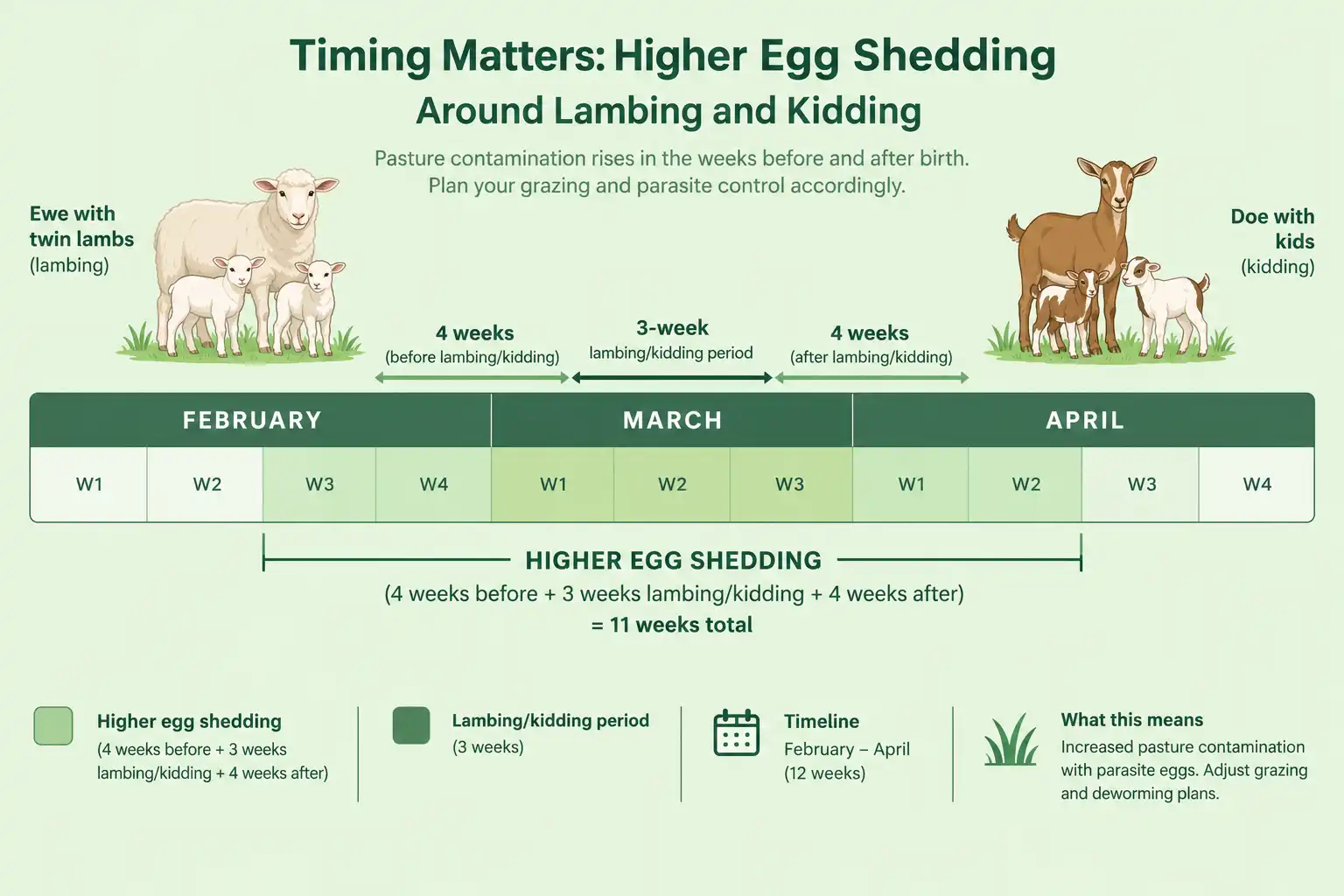
Ewes and does lose part of their worm immunity around birth. University of Minnesota Extension puts the window at 4 weeks before through 4 weeks after lambing or kidding. Egg shedding climbs during that span, just as lambs and kids start grazing.
Now run that window against your own calendar. Say your ewes lamb from March 1 to March 21. The high-shedding window then runs from about February 1 to April 18, roughly 11 weeks of extra pasture contamination. So build extra FAMACHA checks and your cleanest paddocks into your lambing season plan.
Grazing Height, Rotation, and Rest
Larvae sit low, so keep animals off short grass. Sources differ on the cutoff. University of Minnesota Extension says to move animals before forage drops below 6 inches. Penn State Extension sets the floor at 4 inches. The 6 inch figure leaves a wider margin, so lean on it for wet pasture or when FAMACHA scores start climbing.
Move often, too. Minnesota advises rotating every 5 days or less in warm seasons, since eggs need about 5 days to turn infective. University of Missouri Extension suggests under 4 days per paddock.
Then rest each paddock long enough. Minnesota calls for at least 2 months in summer. After spring or fall grazing, it advises resting the paddock for the rest of the season. Missouri puts the rest at more than 65 days in temperate climates and 35 days in tropical ones.
To size your rotation, divide rest days by grazing days, then add one paddock for the group in use.
| Climate | Days grazed | Days rested | Paddocks needed |
|---|---|---|---|
| Temperate | 5 | 65 | 14 |
| Tropical | 4 | 35 | 10 |
Few small farms have 14 paddocks of fence for rotational grazing. The next section covers the tools that fill that gap.

Cutting hay cleans a paddock. University of Minnesota Extension notes that cutting, drying, and baling kills larvae, so haying a resting pasture is safe. University of Missouri Extension suggests alternating hay and grazing at least 2 to 3 times per season.
Other livestock help as well. Sheep and goats generally do not share their common worms with cattle or horses, per Missouri. In one system Missouri cites, ewes grazed for 1 week, the paddock rested 3 weeks, and cattle grazed 1 week. Lambs grew faster than under single-species grazing. Missouri suggests cattle 2 years or older for this role.
Mississippi State Extension calls cattle and horses larval “vacuum cleaners” after sheep or goats. However, it advises against mixed grazing in tick-infested areas.
Finally, give young stock the best ground. Mississippi State recommends grazing young or low-immunity animals on clean paddocks that contaminated adults have not recently grazed. Goats with brush gain a further edge, since they browse above the larvae zone.
Breeding and Culling for Worm Resistance
Parasite resistance is heritable, per University of Minnesota Extension, so breeding choices build on each other over generations. Hair sheep carry higher natural resistance, and Mississippi State Extension reports that St. Croix ranked above other hair breeds. Compare hair sheep breeds on that basis if worms limit your flock.
Goat data is thinner. Minnesota notes that goats have less recognized inherent resistance, and published breed comparisons for goats remain limited. So select within your own herd using egg counts, whichever goat breeds you raise.
Mississippi State gives three selection rules:
- Breed only from rams and bucks with proven resistance, such as estimated breeding values or ram and buck test results.
- Use fecal egg counts, the most accurate selection tool.
- Cull animals that constantly need deworming or carry persistently high loads, plus older animals with teeth problems.
Culling pays off quickly because shedding is uneven. Remove the heavy shedders, and the rest of the flock grazes cleaner pasture.
Nutrition and Nonchemical Tools
Well-fed animals handle worms better. University of Missouri Extension links good nutrition and high-quality forage to resilience. Mississippi State Extension adds that weaned animals and ewes around lambing and lactation suffer most when nutrition falls short.
Several tools cut worm pressure, though none replaces monitoring.
| Tool | What it does for sheep and goats | Caution |
|---|---|---|
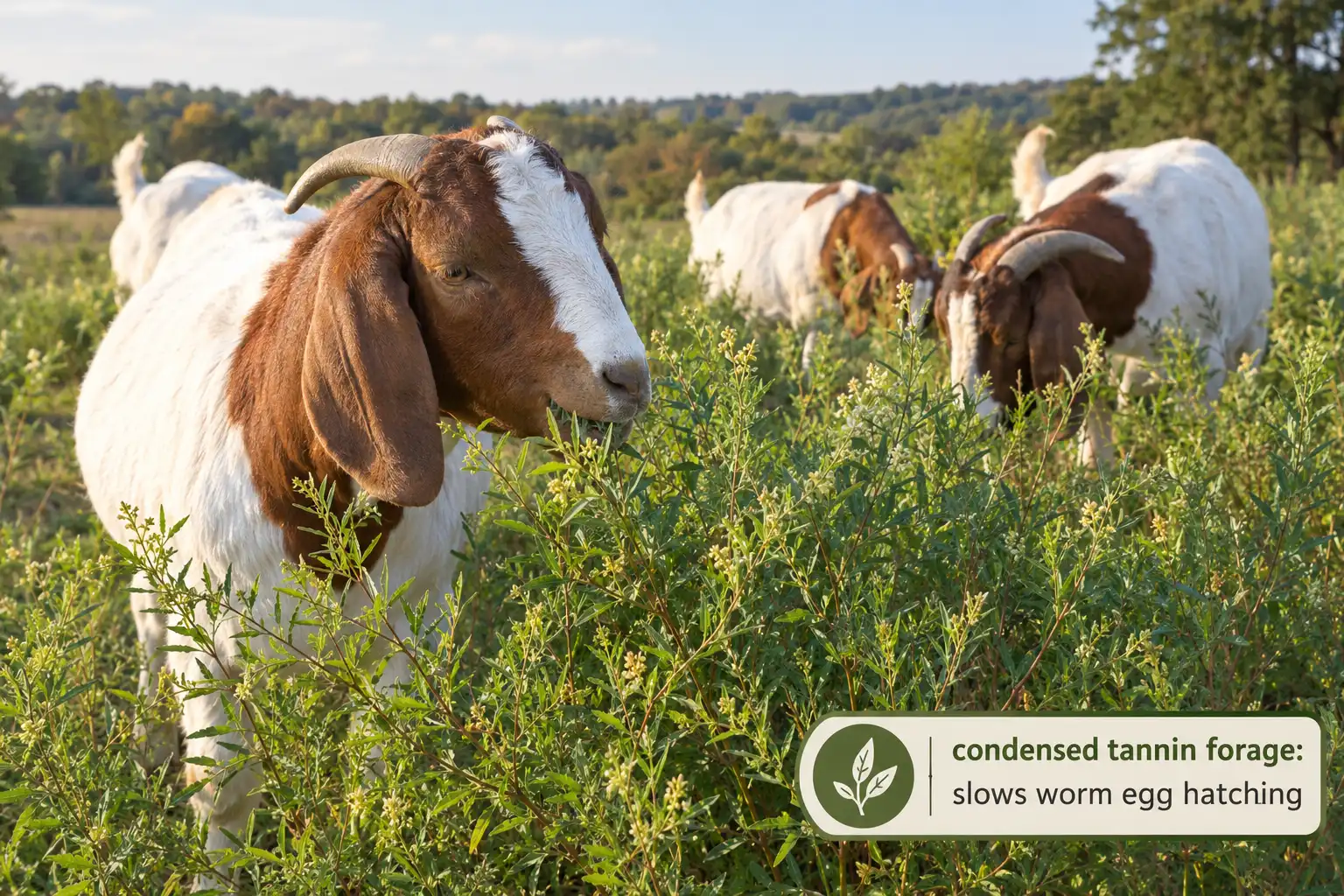
| Condensed tannin forages | Sericea lespedeza and birdsfoot trefoil slow egg hatching and cut shedding (Minnesota) | Egg counts rise again once animals leave the forage (Missouri) |
| Copper oxide wire particles | Targeted treatment guided by FAMACHA or egg counts (Mississippi State) | Sheep risk copper toxicity, so Mississippi State limits sheep to once per grazing season |
| Nematode-trapping fungus (Duddingtonia flagrans) | Kills larvae in fresh manure (Minnesota, Mississippi State) | Prevents new larvae only, so feed it continuously from turnout |
| Dung beetles | Cut infective larvae on pasture by 30 percent or more (Missouri) | Macrocyclic lactones pass into manure and can harm them |
| Diatomaceous earth | No scientific evidence of control (Minnesota) | Do not rely on it alone |
Sericea lespedeza runs 4.6 to 15.2 percent condensed tannin on a dry matter basis, per University of Missouri Extension. That clears the 3 percent level at which legumes can reduce barber pole worm burdens in sheep and goats. Ask your veterinarian before using copper wire particles in either species.
Coccidiosis and Tapeworms
Coccidia are protozoa, not worms, so a standard dewormer does not treat them. Tapeworms, by contrast, look alarming but usually do little harm.
Coccidiosis
Coccidia infect the lining of the small intestine, per Langston University. Outbreaks follow filth, moisture, and stress such as kidding, weaning, and transport. Shed oocysts become infective in 2 to 7 days, and losses can come quickly, most often at weaning. Signs include scours, unthriftiness, weight loss, and sometimes death.
Prevention starts with dry pens and feeders kept free of manure. Anticoccidial feed additives carry species-specific labels, as the comparison table above shows, so check that the label covers your species. Most animals build solid immunity after infection, but a severe case can leave a lamb or kid stunted. Call your veterinarian at the first sign of scours in young stock.
Tapeworms
Tapeworms (Moniezia) reach goats through field mites eaten with forage, per Langston. Adults cause very little damage. The giveaway is moving white segments, like grains of rice, in fresh manure. Growth in young kids may slow somewhat, and intestinal blockage is rare. So segments alone are not a reason to treat the whole herd.
Liver Fluke, Meningeal Worm, and Lungworm
All three need a veterinarian to confirm, because routine fecal floats miss them or their signs mimic other diseases.
Liver Fluke
Liver fluke is a major problem in low, perennially wet areas of the Southeast, per Langston University. An amphibious snail carries it. Signs include unthriftiness, weight loss, and sometimes death. A standard flotation test is unreliable, so ask the lab for a sedimentation test. Deer fluke is rarer, but it can kill by destroying the liver where deer share the grazing.
Meningeal Worm
White-tailed deer carry meningeal worm, and small slugs and snails pass it on. Langston warns that goats are at risk wherever deer are found. Signs include rear-leg weakness, stumbling, circling, an abnormal head position, and blindness. Disease usually appears in fall and winter, about 3 to 4 months after infection. Monthly preventive deworming has been tried, but Langston calls it unproven and notes it may speed resistance in other worms. Call your veterinarian promptly for any of these signs.
Lungworm
Dictyocaulus filaria lives in the lungs and spreads directly through manure, mainly from November through April, per Langston. Signs include chronic coughing and unthriftiness, and a Baermann test confirms it. Lungworm problems in the Southeast are sporadic.
Common Mistakes That Make Worm Problems Worse
Each of these habits speeds resistance or puts more larvae on pasture.
- Deworming everyone on a schedule. FDA CVM lists treating every animal and routine deworming without tests among the drivers of resistance.
- Using a sheep rate on goats. FDA CVM notes the effective goat dose for many products is unknown, so let your veterinarian set it.
- Guessing weights. An underdosed animal leaves survivors, and FDA links underdosing to resistance. Weigh or tape each animal.
- Never testing the drug. Without Penn State Extension’s reduction test, you cannot tell a failing product from a working one.
- Grazing too short or returning too soon. Larvae sit low and survive for months, which is why Minnesota sets a 6 inch floor and a 2 month summer rest.
- Treating scours in kids with a dewormer. Coccidia are protozoa, per Langston University, so a dewormer misses them.
- Mixing combination drugs. Mississippi State Extension says to give each drug separately, never mixed together.
- Skipping the new-animal check. FDA CVM advises examining new livestock for roundworms before they join the flock, then treating accordingly.
- Trusting unproven products. University of Minnesota Extension finds no scientific evidence that diatomaceous earth controls worms.
FAQs About Internal Parasites in Sheep and Goats
Should you deworm sheep and goats in winter?
Usually not as a routine. University of Minnesota Extension advises against routine winter deworming in northern climates, since worms go dormant below 50°F, and favors targeted treatment of individual animals instead.
Can sheep and goats graze the same pasture?
Yes, but they share the same worms, so grazing them together does not lower parasite pressure. Adult cattle or horses grazing after them clean up larvae instead, per University of Minnesota Extension.
How long should a pasture rest before sheep or goats return?
At least 2 months in summer, per University of Minnesota Extension. University of Missouri Extension puts temperate pastures at more than 65 days and tropical pastures at 35 days, because larvae survive longer in cooler climates.
Does diatomaceous earth control worms in sheep and goats?
No published evidence shows that it does. University of Minnesota Extension finds no scientific support for diatomaceous earth and discourages using it alone, so test any product with a fecal egg count reduction test.
Should you treat when you see tapeworm segments?
Not on that sign alone. Langston University reports that adult tapeworms cause very little damage, though growth in young kids may slow somewhat, so ask your veterinarian before treating the whole herd.
Can you use a sheep dewormer on goats?
Only with a veterinarian’s prescription. FDA CVM treats that as extra-label use under AMDUCA, and the veterinarian sets the goat dose and a substantially extended withdrawal period for meat and milk.
Where to Start
Start with the animals, not the calendar. Score eyelids and run the Five Point Check through the grazing season, and treat only the animals that need it. Next, run a reduction test so you know which classes still work on your farm. Then move animals before grass gets short, rest paddocks long enough, and breed from the animals that rarely need treatment. Together, those steps cut dewormer use and keep the products working longer.