What Do Goats Eat? Browse, Hay, Minerals, and How Much a Day

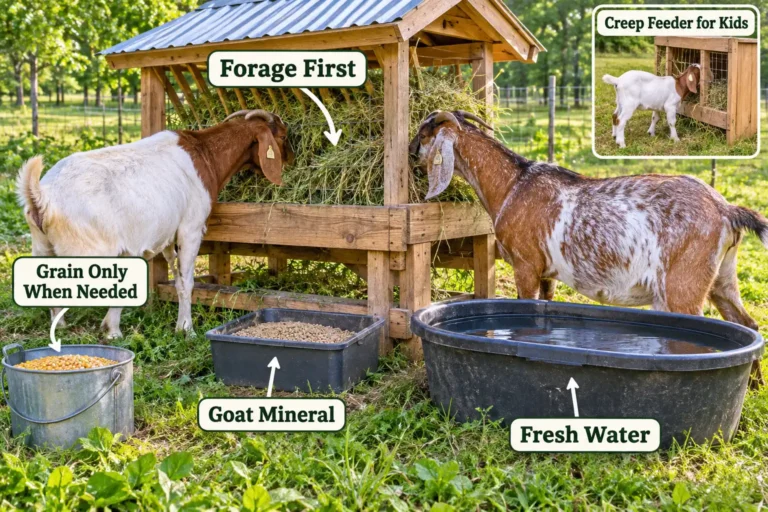
Goats eat browse first: leaves, twigs, brush, and broadleaf weeds. Pasture, hay, a goat mineral, and clean water fill in the rest. Below is what goats eat, how much one eats in a day and a winter, and what mountain goats eat in the wild.
Goats are browsers. They eat leaves, twigs, brush, and broadleaf weeds by choice, plus grass, hay, and a goat-specific mineral. Oklahoma State Extension puts daily intake at 2 to 4 percent of body weight on a dry matter basis.
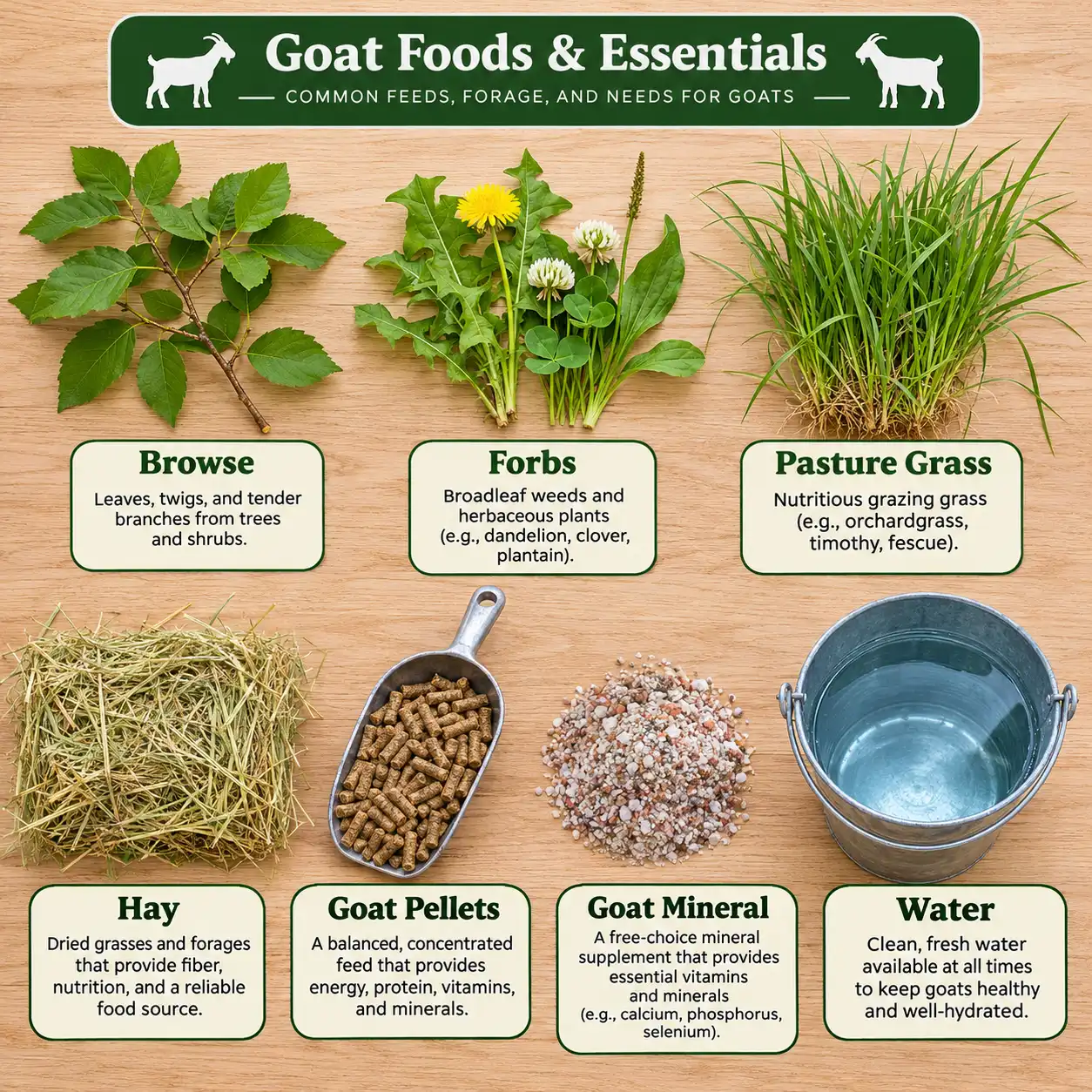
What Goats Eat, by Feed Type
A goat’s diet has seven parts. Browse and pasture carry most of it through the growing season. Hay carries it through winter. Grain, mineral, and water then fill specific gaps.
| Feed | What it is | Role in the goat diet |
|---|---|---|
| Browse | Leaves, buds, twigs, vines, brush | Preferred forage, picked first |
| Forbs | Broadleaf weeds and wildflowers | Eaten readily, high in protein when young |
| Pasture grass | Bermudagrass, orchardgrass, fescue, small grains | Fills in where browse runs short |
| Hay | Grass, legume, or mixed | Winter base and drought backup |
| Grain and pellets | Corn, oats, commercial goat feed | Extra energy for late pregnancy, milk, and growth |
| Goat mineral | Loose salt and trace mineral mix | Copper, selenium, and other trace elements |
| Water | Clean and free choice | The nutrient goats run short of fastest |
Cost matters here. Oklahoma State Extension notes that feed is the largest cost in goat production, typically 60 percent or more of the total. So the cheapest feed on the place is the brush goats harvest themselves. Most herds lean on browse from spring to fall, then switch to hay.
Why Goats Browse Instead of Graze
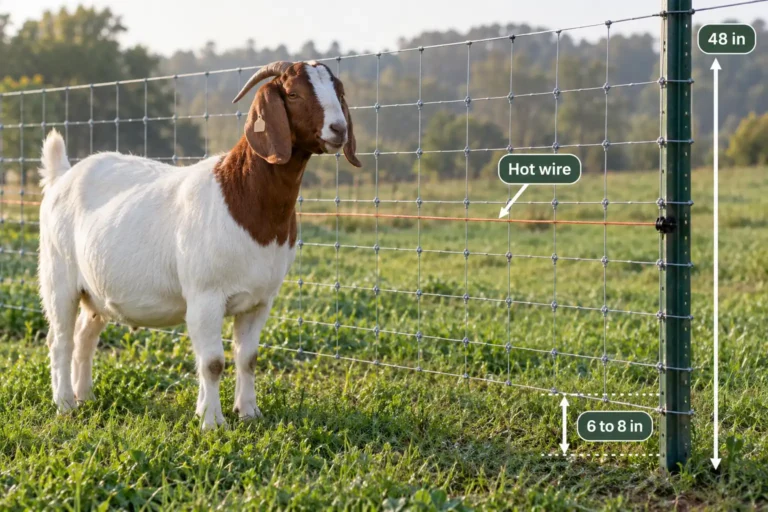
Goats browse because their mouths are built to select. Langston University notes that goats have nimble lips that pick out the most nutritious parts of a plant. They also stand on their hind legs and reach over 6 feet into shrubs. A goat that reaches that high will also test a fence, so fence height for goats matters as much as the brush.
Goats also handle plants other livestock avoid. Langston University adds that goats tolerate more tannins than cattle or sheep, and they rarely bloat.
That feeding habit shapes the pasture. Goats graze from the top of a plant down and avoid the ground layer. Most worm larvae sit low on grass, so browsing goats pick up fewer of them. On short, overgrazed grass they lose that advantage. That is one reason internal parasites like barber pole worm hit grass-only goat herds hard.
Season changes the menu, too. Oklahoma State Extension’s seasonal figures put spring goat diets near 34 percent browse, 49 percent grass, and 17 percent forbs. Preference then shifts as plants mature, and young, tender growth wins every time.
In practice, goats pair well with cattle. Cattle take the grass, while goats clean up the brush and weeds cattle leave.
How Much Do Goats Eat a Day?
A goat eats 2 to 4 percent of its body weight in dry matter each day, per Oklahoma State Extension. Smaller goats sit at the high end, because they need more feed per pound to hold weight. Activity, pregnancy, and milk all push the figure up.
Dry matter is feed with the water taken out. Penn State Extension notes that most goat feeds run 88 to 90 percent dry matter. So divide the dry matter figure by 0.9 to get the hay you actually put out.
| Goat weight | Dry matter, low (2%) | Dry matter, high (4%) | Hay as fed at 3% |
|---|---|---|---|
| 50 lb | 1.0 lb | 2.0 lb | 1.7 lb |
| 75 lb | 1.5 lb | 3.0 lb | 2.5 lb |
| 100 lb | 2.0 lb | 4.0 lb | 3.3 lb |
| 150 lb | 3.0 lb | 6.0 lb | 5.0 lb |
| 200 lb | 4.0 lb | 8.0 lb | 6.7 lb |
For market goats, Penn State Extension narrows the range to 2.5 to 3 percent of body weight. A dry, idle adult sits near the low end. A heavy-milking dairy doe, by contrast, sits near the top.
Turning Daily Intake Into a Winter Hay Order
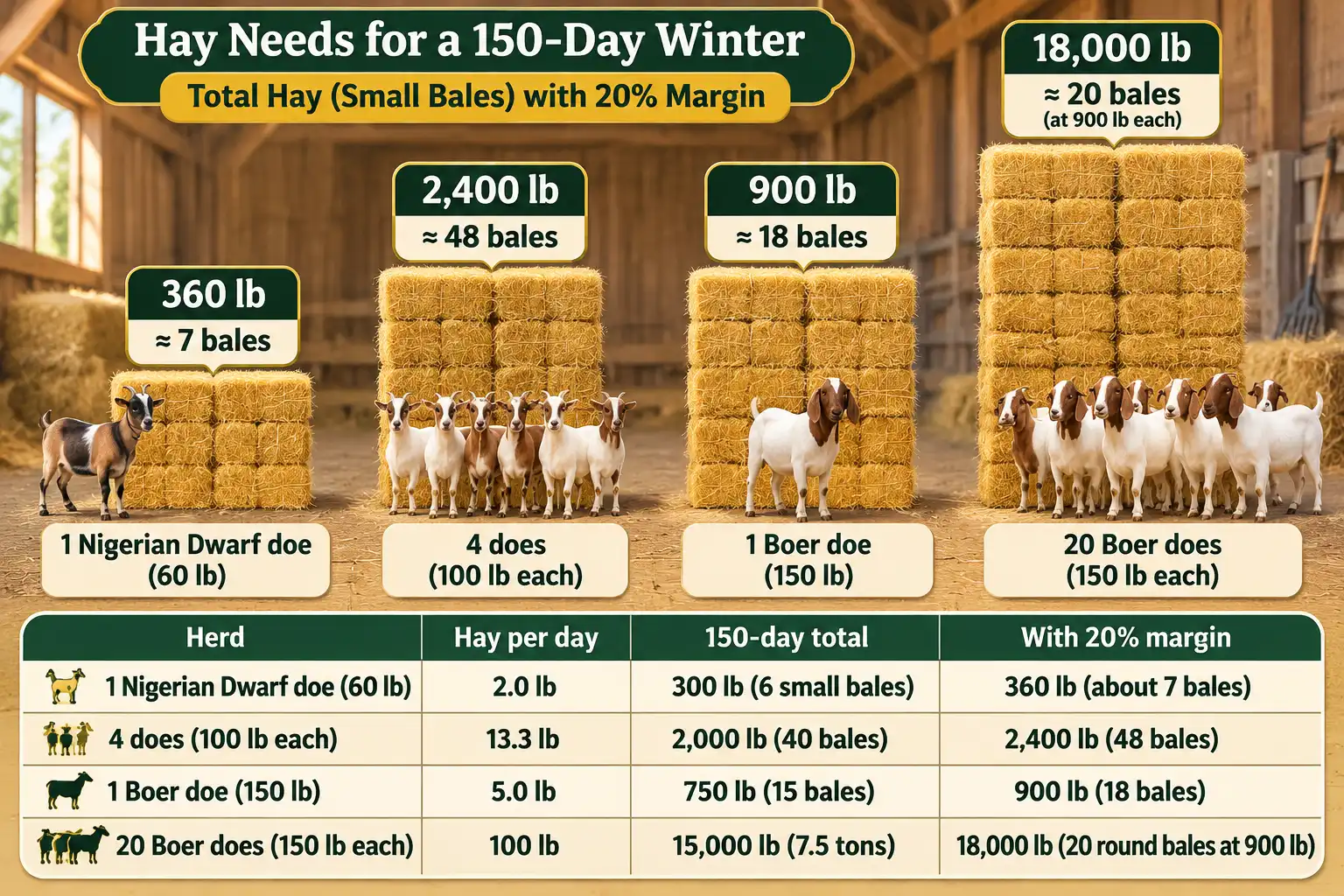
The daily figure only helps once you carry it through the season. The table below uses 3 percent of body weight, hay at 90 percent dry matter, a 150-day winter, and 50-pound small square bales.
We add a 20 percent margin for waste. That is an editorial planning figure, not a published one. Goats pull hay out of feeders and refuse what hits the ground, so real waste depends on your feeder.
| Herd | Hay per day | 150-day total | With 20% margin |
|---|---|---|---|
| 1 Nigerian Dwarf doe, 60 lb | 2.0 lb | 300 lb (6 small bales) | 360 lb (about 7 bales) |
| 4 does, 100 lb each | 13.3 lb | 2,000 lb (40 bales) | 2,400 lb (48 bales) |
| 1 Boer doe, 150 lb | 5.0 lb | 750 lb (15 bales) | 900 lb (18 bales) |
| 20 Boer does, 150 lb each | 100 lb | 15,000 lb (7.5 tons) | 18,000 lb (20 round bales at 900 lb) |
Adjust the season length to your area. A Gulf Coast winter with standing browse runs shorter than a northern Plains winter. Then rerun the math for pregnant and milking does, who eat toward 4 percent. For whole-farm planning across species, see our feed and water management guides. A covered goat hay feeder that keeps hay off the ground also shrinks that waste margin.
Hay for Goats: Grass, Legume, or Mixed
The best hay for goats is leafy, fine-stemmed, and free of mold and dust. Goats sort hay hard and leave coarse stems behind, so stemmy hay costs more than it looks.
- Grass hay (bermudagrass, orchardgrass, timothy, fescue): lower in protein and calcium. It suits dry does, bucks, and wethers.
- Legume hay (alfalfa, clover): higher in protein and calcium. It suits milking does, does in late pregnancy, and growing kids.
- Mixed hay: sits between the two and works for mixed groups.
A hay test takes the guessing out. Oklahoma State Extension recommends sending hay to a forage testing laboratory, and your county Extension office can send the sample for you. The report gives crude protein and energy. That tells you whether goats on that hay need grain at all.
Moldy or dusty hay is not goat feed at any price. Discard it rather than mixing it in.
Grain and Concentrates: When Goats Need Them
Most adult goats on good browse or hay need little or no grain. Grain earns its place in three cases: late pregnancy, heavy milk production, and fast growth in market kids.
Penn State Extension notes that most goat grain mixes run 14 to 18 percent protein, and many show exhibitors feed a 16 percent mix. Many commercial goat feeds are also complete feeds, which means they include a fiber source.
Grain carries two risks. First, a sudden jump in grain upsets the rumen, so change goat rations gradually. Second, grain is high in phosphorus.
University of Maryland Extension links high-concentrate, low-roughage diets to urinary calculi in male goats, especially wethers. It recommends a calcium-to-phosphorus ratio near 2:1 in goat rations. Read both figures on every feed tag before you buy.
Urinary calculi means stones block the urinary tract. A male goat straining to urinate needs a large animal veterinarian the same day, because the condition kills quickly. Some goat feeds include a urine acidifier, and whether your herd needs one is a question for that vet.
Minerals and Copper: The Goat-Only Rule
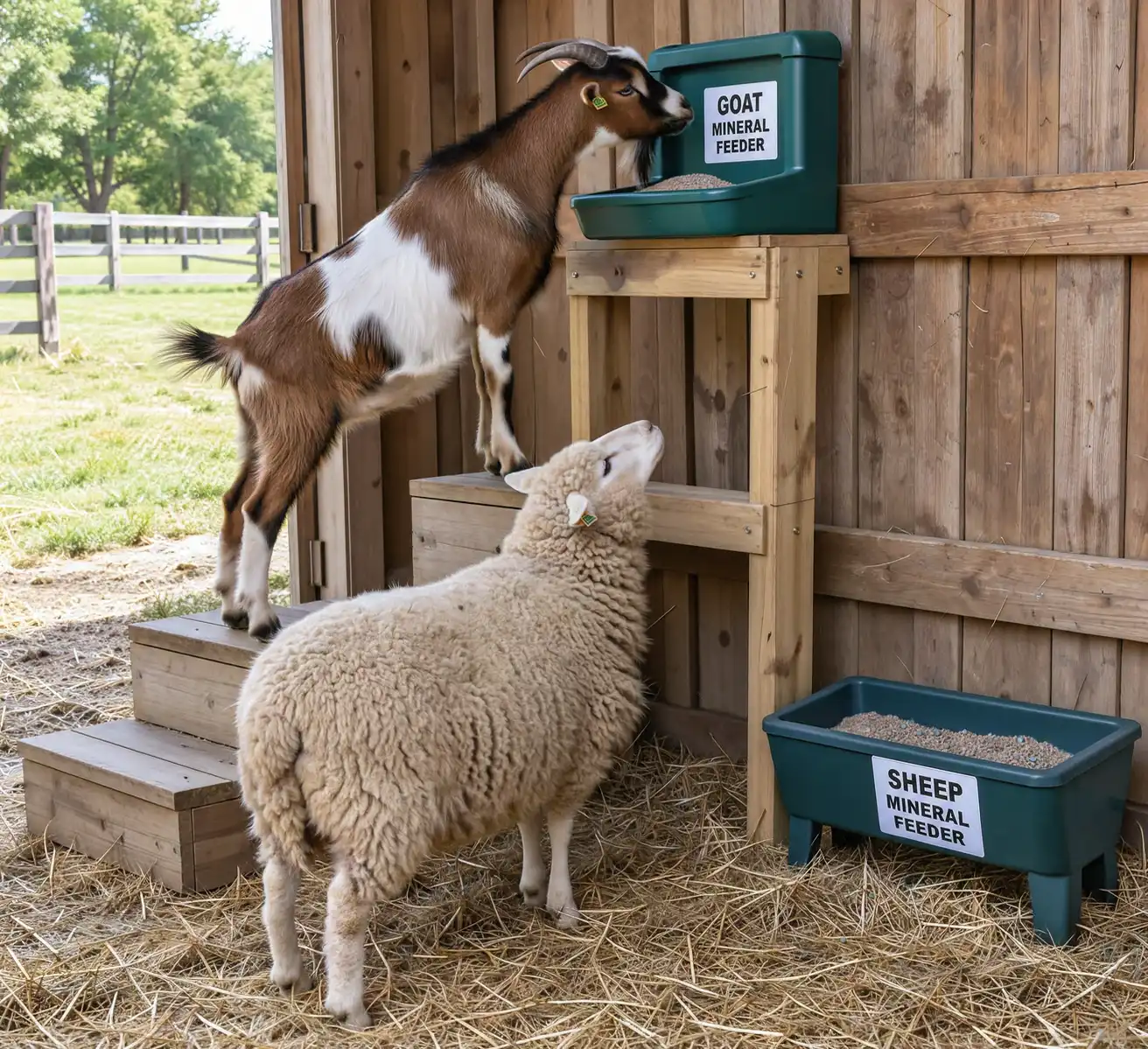
Goats need a loose mineral labeled for goats, offered free choice. A sheep mineral, or a mix labeled for sheep and goats, is formulated to keep sheep safe. As a result, it usually leaves goats short of copper.
University of Maryland Extension notes that sheep accumulate copper in the liver more readily than other farm animals, which makes them very susceptible to copper poisoning. Goats, by contrast, tolerate copper better. Maryland Extension also notes that minerals formulated for cattle usually carry enough copper for goats.
That creates a real problem on mixed farms. If goats and sheep share a pasture, feed each species its own mineral. Put the goat mineral on a raised stand or behind a barrier sheep cannot reach. Then watch it, because a sheep with steady access to goat mineral can die of copper poisoning.
Magnesium matters on lush pasture. Oklahoma State Extension advises a goat mineral with 5 to 10 percent magnesium when goats in early lactation graze lush small grains, annual ryegrass, or grass-legume pasture.
Selenium varies by region. Ask your county Extension office whether your soils run low, since that changes which goat mineral you buy. Copper boluses and selenium injections are veterinary decisions, not substitutes for a good goat mineral.
How Much Water Do Goats Need?
A goat needs 1 to 3 gallons of water a day, per Langston University, depending on diet, intake, and weather. Needs sit toward the low end in winter and the high end in summer heat.
Milk raises the figure. Langston University research puts it at an extra quart of water for every pint of milk. So a doe giving 5 pints at peak while raising twins needs about 2.5 gallons a day. That makes water planning for milking does a separate job from the rest of the herd.
Now scale it up. Twenty does in July at 3 gallons each drink 60 gallons a day. A 100-gallon trough, then, lasts under two days without a refill.
Forage changes the total. Goats on green browse drink less, because leaves carry water. Goats on dry hay drink more.
Goats also refuse dirty water. Langston University advises that if water is not clean enough for people to drink, the trough needs cleaning. That matters for feed, too, since Penn State Extension notes that poor water lowers feed intake.
Feeding Goats by Life Stage
Each stage of a goat’s life calls for a different ration. The base stays forage. What changes is protein, energy, and water.
| Stage | Base feed | What changes |
|---|---|---|
| Newborn kids | Colostrum, then the doe’s milk | Colostrum in the first hours; milk replacer labeled for goat kids if bottle-raised |
| Growing kids | Milk, leafy hay, browse, creep feed | Highest protein need per pound |
| Dry does | Browse, pasture, or grass hay | Usually no grain; watch body condition |
| Late pregnancy | Good hay plus some grain | Energy for twins or triplets |
| Milking does | Legume or mixed hay, grain by production | Highest water and energy needs |
| Bucks | Grass hay and browse | Keep calcium and phosphorus balanced |
| Wethers | Grass hay, browse, little or no grain | Highest urinary calculi risk |
Late pregnancy is the stage that catches people out. Goats commonly carry twins, and the growing kids crowd the rumen just as energy needs climb. Underfed does in late pregnancy risk pregnancy toxemia, which needs a veterinarian.
Body condition scoring every few weeks shows whether the ration works. Feel over the ribs and spine rather than trusting the eye, because a full rumen and a winter coat hide a thin goat.
Plants and Foods That Poison Goats
Goats eat a wide range of plants, but some kill quickly. University of Delaware Extension lists the heath family (azalea, rhododendron, and mountain laurel) as highly toxic to grazing animals. Yew sits on the same highly toxic list.
Wilting makes some leaves worse. Delaware Extension notes that wild cherry and red maple leaves become more toxic after they wilt. So a storm-downed cherry branch in a goat pasture is an emergency to clear, not a free snack.
Delaware’s list also includes nightshades and jimsonweed, black locust, buttercups, and larkspur.
Most poisonings follow a change. Drought, overstocking, and a move to a new paddock push hungry goats onto plants they normally avoid. Walk a new pasture before turnout, and never toss landscape clippings over the fence.
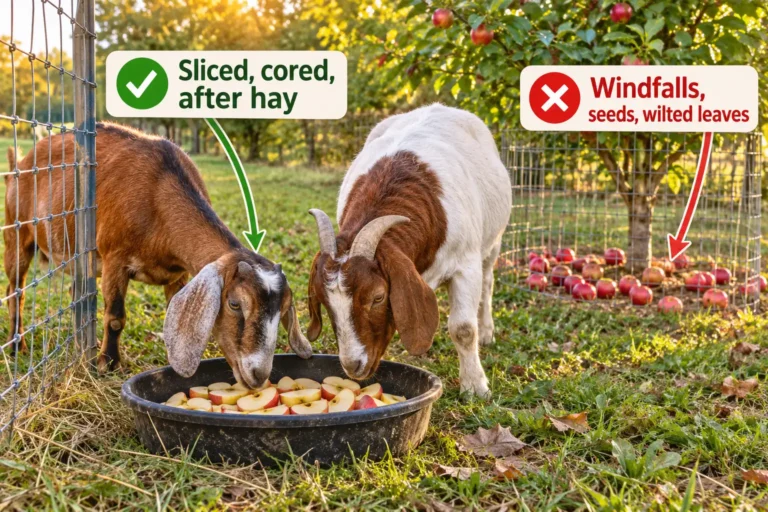
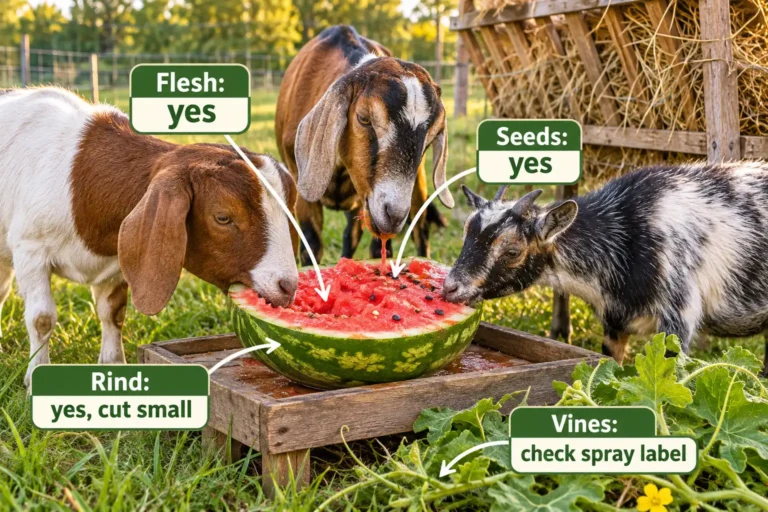
Kitchen scraps and bread are not goat feed either. Small treats of fruit or vegetables do no harm, but they add nothing a goat ration lacks.
If you suspect poisoning, call a large animal veterinarian right away. Bring a sample of the plant, because treatment depends on what the goat ate.
What Do Mountain Goats Eat?
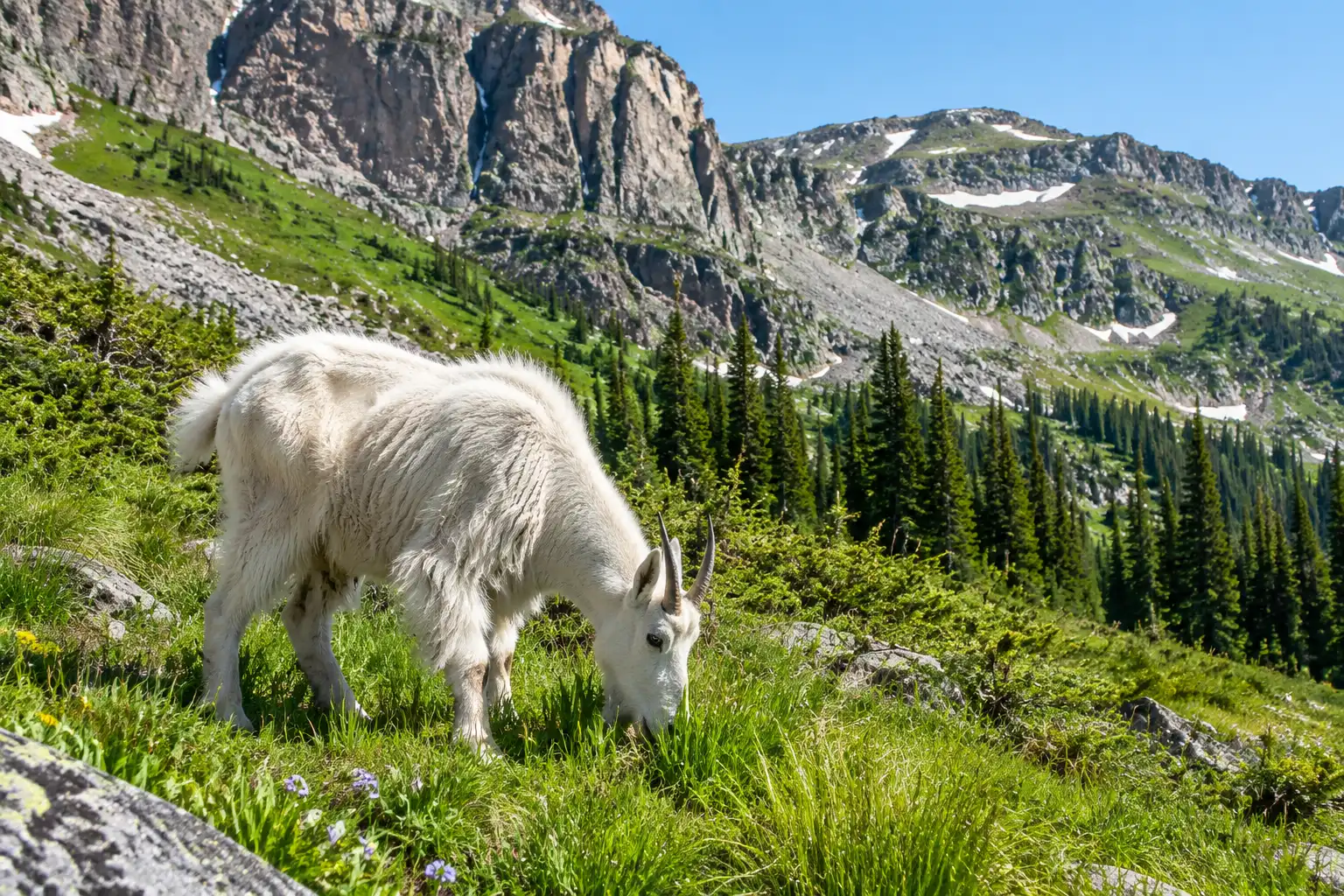
Mountain goats eat mostly grasses, sedges, and forbs in summer, then shift to shrubs and conifers in winter. In a National Park Service study in Olympic National Park, grasses and grasslike plants made up about 60 percent of June through November diets. Shrubs and conifers dominated in winter, while Idaho fescue and sedges led the summer and fall diet.
Mountain goats (Oreamnos americanus) are not true goats. They share the subfamily Caprinae with farm goats, but they sit in their own genus, apart from Capra. Their range runs through the Rocky Mountains, the Cascades, and north into Canada and Alaska.
Salt drives much of their movement. The National Park Service notes that mountain goats in Glacier National Park do not get enough salt from the plants they eat. So they leave the safety of cliffs to reach natural mineral licks. At Logan Pass, they have even learned to lick salt from human urine near trails.
Never feed a mountain goat. Feeding wildlife is prohibited in national parks, and goats that lose their fear of people become dangerous.
Mountain Goats vs Farm Goats: Diet Compared
The two animals share a name and little else at the feed trough.
| Mountain goat | Domestic goat | |
|---|---|---|
| Genus | Oreamnos | Capra |
| Main summer food | Grasses, sedges, forbs | Browse, forbs, grass |
| Main winter food | Shrubs, conifers, small amounts of moss | Hay, standing browse, some grain |
| Salt and minerals | Natural mineral licks | Free-choice goat mineral |
| Who feeds it | Nobody; feeding is prohibited in parks | The producer, every day |
Common Goat Feeding Mistakes
Several of these problems look alike in a sick goat. A vet call comes before any treatment.
- Sheep or sheep-and-goat mineral for goats. Leads to copper deficiency in goats over time.
- Too much grain for wethers. Raises the risk of urinary calculi, especially with a low calcium-to-phosphorus ratio.
- Sudden feed changes. A fast switch to lush pasture or grain upsets the rumen. Bloat is rarer in goats than in cattle, but it still happens on lush legumes.
- Short, overgrazed pasture. Forces goats to graze low, where worm larvae sit.
- Hay fed on the ground. Wastes hay and adds parasite exposure.
- Dirty water. Lowers water intake, and feed intake drops with it.
- Underfed does in late pregnancy. Raises the risk of pregnancy toxemia.
FAQs on Goat Feeding
Can goats live on grass alone?
Goats can live on good pasture, but most do better with browse in the mix. A grass-only diet on short pasture also raises parasite exposure, because most worm larvae sit low on the grass.
Do goats really eat tin cans?
No, goats do not eat tin cans. They investigate with their lips and chew paper labels, cardboard, and clothing, which started the myth, so keep trash and plastic out of the pen.
How much hay does a goat eat per day?
A 100-pound goat eats about 3.3 pounds of hay a day at 3 percent of body weight. Oklahoma State Extension’s range runs 2 to 4 percent, so adjust for size, pregnancy, and milk.
Can goats eat chicken feed or horse feed?
Neither is a good routine feed for goats. Chicken feed is formulated for birds and may be medicated, and horse sweet feed carries grain and minerals balanced for horses, not goats.
What should goats eat in winter?
In winter, goats eat mostly hay, plus any browse still standing and a goat mineral. Pregnant does need better hay and often some grain as kidding nears, because energy needs climb late in pregnancy.
Why is my goat not eating her mineral?
Goats often ignore mineral when forage already meets their needs, or when it comes as a hard block they dislike biting. Try a loose goat mineral kept dry, and ask your veterinarian if intake stays low.
Do baby goats need hay?
Yes, kids start nibbling hay and browse in their first weeks, and that forage builds a working rumen. Offer fine, leafy hay early alongside milk, so the rumen is ready before weaning.
Where to Start
Start with three things: browse or good hay as the base, a loose mineral labeled for goats, and clean water every day. Then size your hay order with the 3 percent figure and a waste margin. Add grain only for late pregnancy, heavy milk, or market kids, and check the calcium-to-phosphorus ratio on every tag. Breeds, housing, and health are covered in our goat guide.