What to Feed Goats: Forage, Minerals, Kids, and What to Avoid
Knowing what to feed goats starts with one fact: a goat is a browser built to run on forage. Grain, minerals, and milk all sit on top of that base. This guide covers adult goats, newborn kids, bottle babies, and the feeds and plants that harm them.
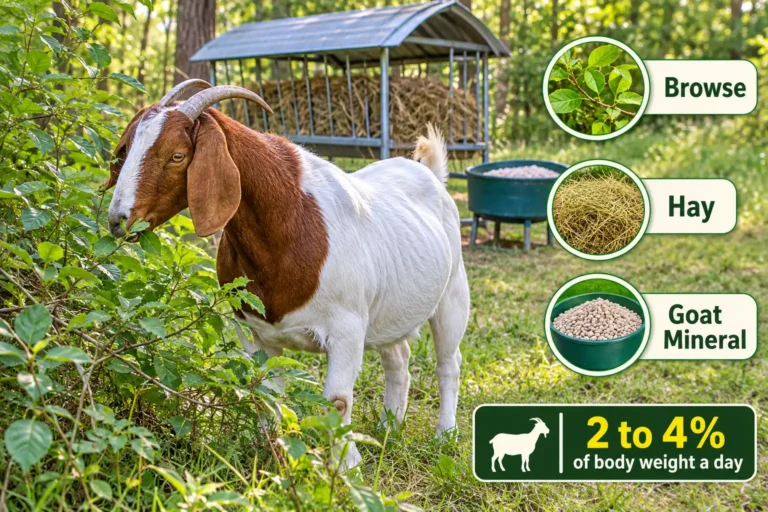
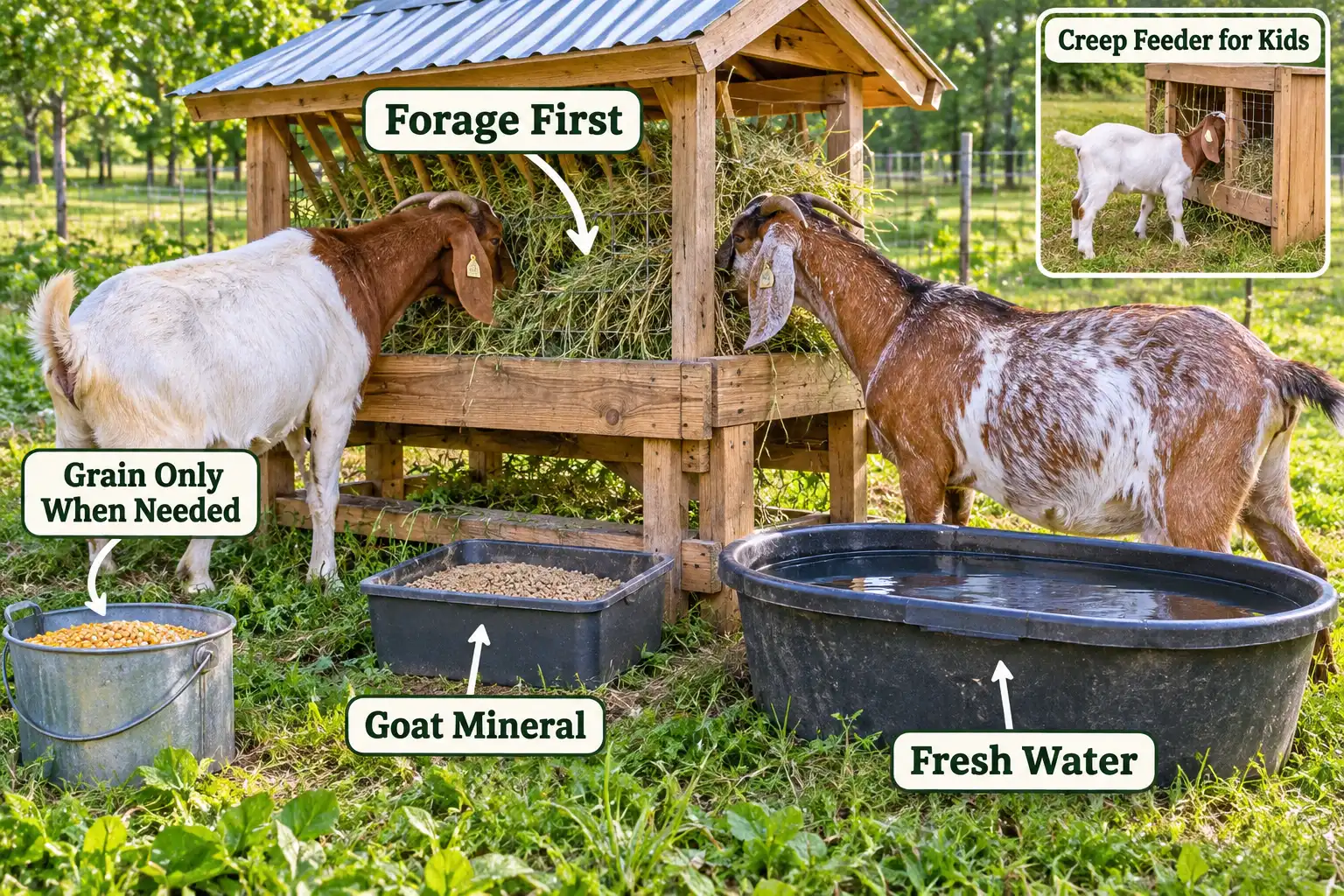
Feed goats forage first: browse, pasture, or hay. Mississippi State Extension puts a mature doe off pasture at 3 to 4 pounds of hay daily. Add goat-labeled loose mineral and clean water. Save grain for late pregnancy, milking, and growth.
What Goats Eat: Forage Comes First
Goats eat forage first, and they prefer browse over grass. Browse means leaves, twigs, vines, and brush. Penn State Extension calls pasture where goats can browse freely the foundation of goat nutrition. That is also why meat goat herds often earn their keep on brushy ground that cattle leave alone.
Browse helps with worms, too. Most parasite larvae sit in the first two inches of forage growth, per Penn State Extension. So goats feeding higher on brush pick up fewer of them. On grass pasture, keep forage at four inches or taller for the same reason. Our guide to barber pole worm and other internal parasites covers the rest of that picture.
Read next: Goat Feeding
Grass Hay or Alfalfa?
Either works. Penn State Extension notes goat hay can be grass or a legume such as alfalfa. However, the choice changes what else you feed.
| Hay type | Strength | Trade-off |
|---|---|---|
| Grass hay (orchardgrass, timothy, bermudagrass) | Steady fiber for dry does, bucks, and wethers | Lower protein, so milking does lean harder on grain |
| Alfalfa or clover hay | More protein and calcium for milking and late-pregnant does | Costs more, but lowers the protein your grain mix must carry |
Whatever the type, buy hay that is green, leafy, and free of mold and dust. Goats tend to refuse hay once it is soiled, so feed it off the ground in a covered rack.
How Much Hay a Goat Eats Over a Winter
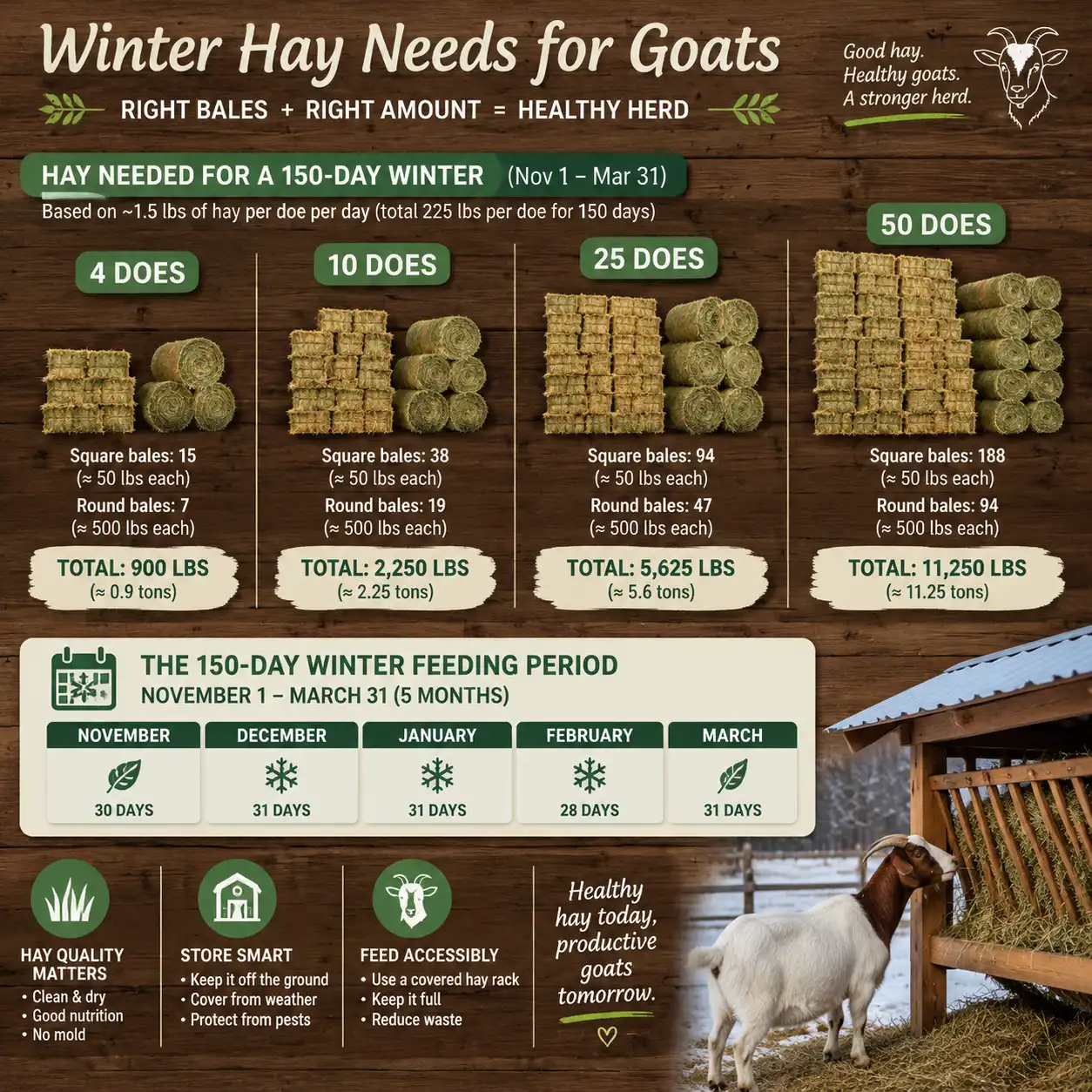
A mature doe eats about 3 to 4 pounds of hay a day when pasture or browse runs short, per Mississippi State Extension. Over a 150-day winter, that comes to 450 to 600 pounds per doe.
To budget your own herd, run this: pounds of hay per head per day, times days without grazing, times head, divided by your bale weight. Count the days from the last useful grazing in fall to spring green-up where you are.
| Herd size | Hay for 150 days at 3.5 lb a day | 50 lb small squares | 900 lb round bales |
|---|---|---|---|
| 4 does | 2,100 lb | 42 | about 2 to 3 |
| 10 does | 5,250 lb | 105 | about 6 |
| 25 does | 13,125 lb | about 263 | about 15 |
| 50 does | 26,250 lb | 525 | about 29 |
Then order extra. Goats pull hay from racks and waste some of every bale, and a late spring stretches the winter.
The 3 to 4 pound figure fits a full-size doe. A Nigerian Dwarf or Pygmy eats far less, while a heavy Boer buck eats more. For a figure matched to body weight and stage, Langston University’s Interactive Goat Nutrient Calculator works out intake from the goat’s weight and the hay you are feeding.
When Goats Need Grain
Goats need grain only when forage alone cannot meet the job they are doing. Penn State Extension treats grain as a supplement, used to stretch the grazing season or raise nutrient levels. Late pregnancy, heavy milking, and breeding season are the usual cases.
| Goat class | Grain guidance | Source |
|---|---|---|
| Doe, last third of pregnancy | 1/2 to 1 lb a day, by doe size and genetics | Penn State Extension |
| Doe, flushing before breeding | 1/2 to 1 lb corn a day, from 2 to 3 weeks before the buck goes in until 2 to 3 weeks after | Mississippi State Extension |
| Buck, before breeding season | 1 to 2 lb grain plus 3 to 4 lb hay or forage a day | Mississippi State Extension |
| Dairy doe, mid-lactation, good condition | 1 lb grain per 3 lb milk, plus all the hay she eats | University of Missouri Extension |
| Dairy doe, late lactation | No more than 1 lb grain per 5 lb milk | University of Missouri Extension |
| Dry dairy doe, not thin | 1/2 to 1 lb a day, plus all the forage she eats | University of Missouri Extension |
Match the grain’s protein to the hay. University of Missouri Extension suggests a 14 to 16 percent protein mix alongside legume hay, and 16 to 18 percent alongside grass hay. For more on milking herds, see our dairy goat section.
How to Feed It
Goats dislike finely ground, dusty feed. So Mississippi State Extension recommends coarsely ground, rolled, or crimped grain, and prefers pellets because goats sort a loose mix and eat only what they like.
Also, raise grain slowly. Langston University’s meat goat handbook advises working up to the target amount gradually and splitting it into a morning and evening feeding. That handbook also says every goat on concentrate should be protected against enterotoxemia, so set that plan with your veterinarian before grain goes up.
Goat Minerals and the Copper Problem
Goats need a loose mineral labeled for goats, offered free choice all year. Langston University’s meat goat handbook recommends a complete goat mineral that contains selenium in most production setups.
Why Goat Mineral and Sheep Mineral Differ
Copper is the reason. Goats need added copper in their mineral. Sheep store copper in the liver and die of it. So a mix labeled for both sheep and goats is held to a sheep-safe copper level, and it usually leaves goats short over time.
NC State Extension notes that growing and adult goats tolerate copper better than sheep. However, nursing goat kids are more sensitive than mature goats. NC State also says goats use copper carbonate and copper sulfate better than copper oxide, so check which form the goat mineral tag lists.
The research is thin here. NC State Extension states that copper requirements for meat goats have not been firmly set, and their upper tolerance is not well known. Talk to your veterinarian before adding copper beyond a goat mineral.
Calcium, Phosphorus, and Selenium
Mississippi State Extension advises adding trace mineralized salt and a 2:1 calcium to phosphorus supplement to any goat grain ration. That balance matters most for bucks and wethers, as the troubleshooting section explains.
Selenium varies by region. NC State Extension describes selenium as marginal to deficient across most of the Southeast, which is one reason a selenium-bearing goat mineral is the default there.

How Much Water Goats Drink
A 110-pound goat drinks 1 to 3 gallons of water a day, per Langston University. Expect the low end in winter and the high end on the hottest summer days.
Milk raises that figure fast. Langston adds 1 quart of water for every pint of milk a doe produces. A doe giving 5 pints at peak while raising twins needs about 2.5 gallons a day.
Now scale it. Twelve does at that peak drink about 30 gallons a day between them. Twenty dry does could need 20 to 60 gallons, depending on the weather. Size the tank and the refill routine for the peak, not the average.
Green forage supplies part of the water a goat needs. Hay supplies almost none, so goats on a dry winter ration depend on the trough. For water and feed planning in other species, see our feed and water planning guides.
What to Feed a Newborn Goat: Colostrum First
A newborn goat needs colostrum, the doe’s thick first milk, and nothing else on day one. A kid that is weak, cold, or not sucking needs your veterinarian now, not after the next feeding.
How Soon
NC State Extension says every kid should get colostrum within the first hour after birth, and certainly within 6 hours. Antibody levels in the doe’s colostrum drop quickly after kidding. At the same time, the kid’s gut loses its ability to absorb those antibodies, and Langston University notes a rapid decline by 24 hours.
How Much
NC State Extension and Langston University both put the target at 10 percent of the kid’s body weight in colostrum during the first 24 hours. NC State’s method: convert weight to ounces, take 10 percent, then split it across four feedings.
| Kid birth weight | Colostrum in first 24 hours | Per feeding, 4 feedings |
|---|---|---|
| 4 lb | about 6.4 oz | about 1.6 oz |
| 6 lb | about 9.6 oz | about 2.4 oz |
| 8 lb | about 12.8 oz | about 3.2 oz |
| 10 lb | 16 oz | 4 oz |
Storing Extra Colostrum
Freeze spare colostrum from high-producing does for orphans and bonus kids. NC State Extension says to thaw it at room temperature or in a warm water bath you can hold your hand in. Never thaw it in a microwave, because the heat destroys the antibodies.
A kid too weak to suck may need tube feeding. That takes training to do safely, so learn it from your veterinarian before kidding season starts.
What to Feed Baby Goats: Milk, Bottle, and Replacer
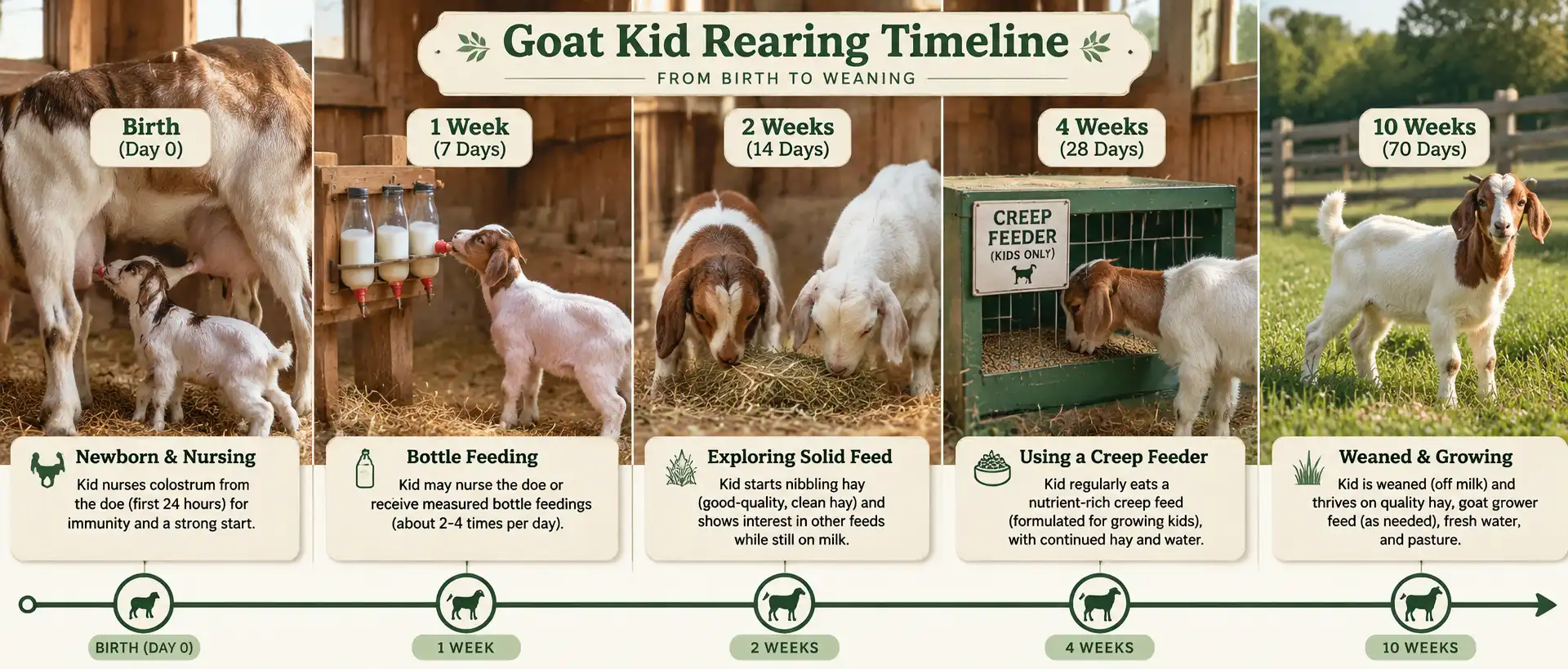
Baby goats live on milk for their first weeks, then shift to hay and grain. A dam-raised kid nurses on its own schedule. A bottle kid needs you to set one.
Bottle Feeding Schedule
University of Missouri Extension gives this schedule for dairy goat kids. Warm the milk to 100 degrees F before each feeding.
| Kid age | Milk per feeding | Feedings per day |
|---|---|---|
| 1 to 3 days | 4 oz (1/2 cup) | 4 or 5 |
| 4 to 14 days | 8 to 12 oz | 3 or 4 |
| 2 weeks to 3 months | 16 oz | 2 or 3 |
| 3 to 4 months | 16 oz | 2 |
That table fits full-size dairy breeds such as Nubian or Alpine. So scale it down for Nigerian Dwarf and Pygmy kids, and watch the kid more than the chart. NC State Extension warns that newborns overfeed easily, because a kid will keep sucking past full. Leave enough time between feedings for each meal to digest.
Which Milk Replacer?
The extension services split here. NC State Extension says to use goat milk replacer, not cow milk replacer, because calf products may carry more copper than young kids tolerate. University of Missouri Extension, by contrast, recommends a lamb or high-quality calf replacer with at least 20 percent protein and 20 percent fat and no vegetable products.
The gap is copper. A replacer labeled for goat kids answers NC State’s concern, and it meets Missouri’s standard too if the tag shows at least 20 percent protein and 20 percent fat. Lamb replacer is built for a copper-sensitive species, so it sits closer to NC State’s caution than calf replacer does. Either way, read the protein, fat, and copper lines on the bag before you buy.
Starting Solids and Weaning Kids
Kids start on hay and grain at 1 to 2 weeks, and most come off milk between 8 and 12 weeks. Eating solids early builds the rumen, so weaning goes smoothly.
| Kid age | What changes | Source |
|---|---|---|
| 1 to 2 weeks | Offer hay and grain | University of Missouri Extension |
| 2 weeks | Provide extra water | University of Missouri Extension |
| 2 to 3 weeks | Kid is active and eating some solids, so overfeeding on milk is less likely | NC State Extension |
| 4 to 6 weeks | Milk can stop once the kid eats hay and grain well | Mississippi State Extension |
| About 8 weeks | Rumen is fully developed | Mississippi State Extension |
| 8 to 12 weeks | Typical weaning from milk | Mississippi State Extension |
When a Kid Is Ready to Wean
Wean by intake, not by the calendar. University of Missouri Extension sets the line at 1/4 pound of grain a day, with the kid readily eating hay. A kid that hits 8 weeks but still picks at hay needs more time on milk.
After weaning, keep growth steady. For kids past 4 to 6 months, Missouri suggests good hay plus 1/2 pound of grain a day. On poor hay, that rises to 1 to 1 1/2 pounds.
What Not to Feed Goats
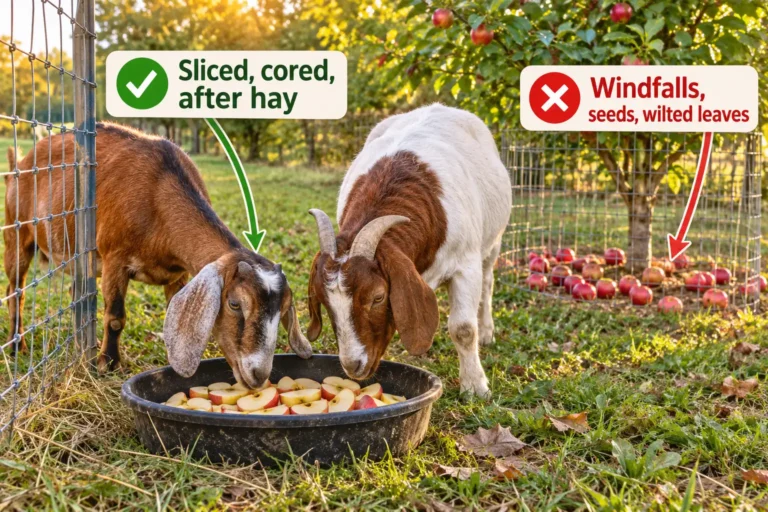
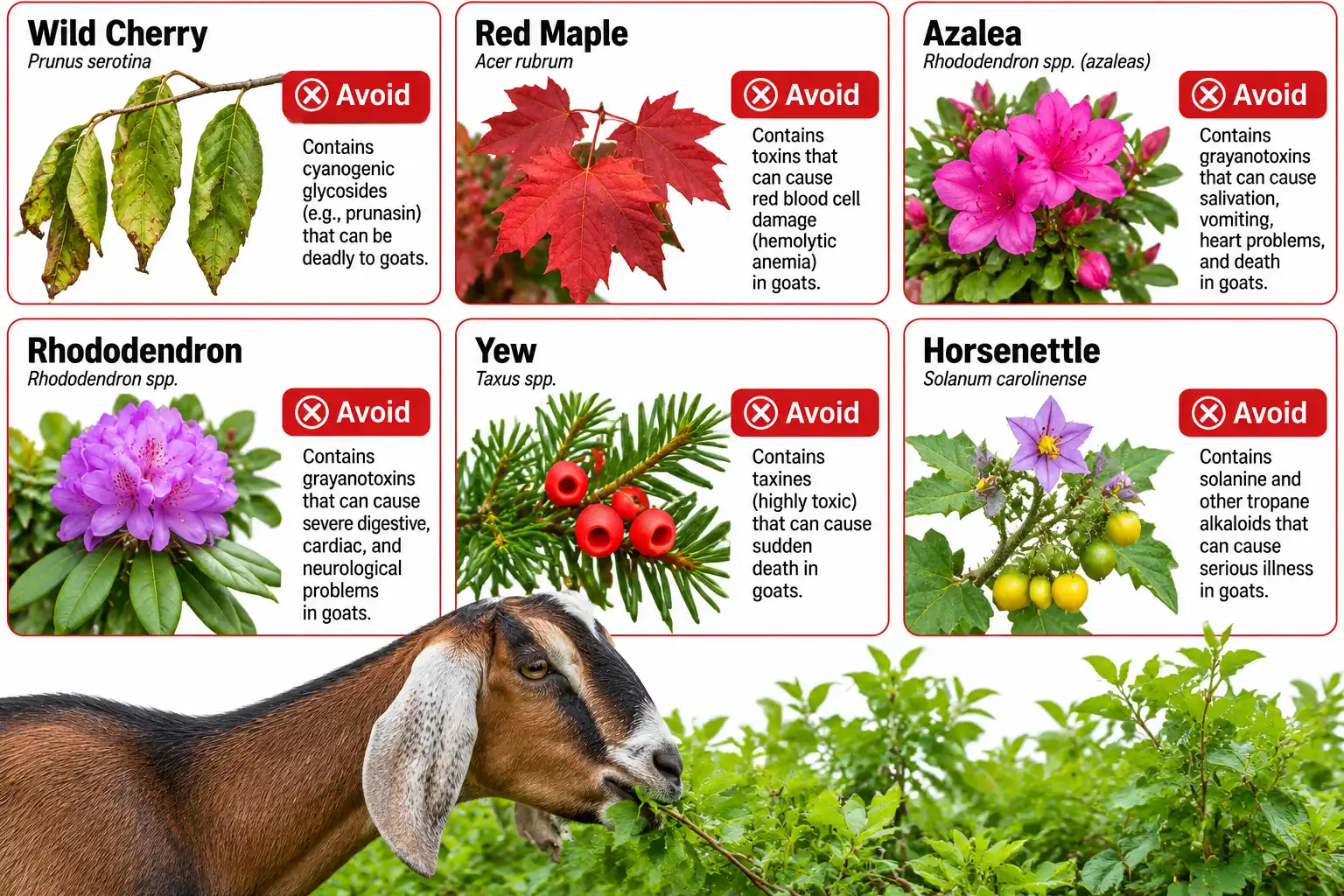
Do not feed goats wilted cherry leaves, azalea or rhododendron, yew, cow milk replacer for young kids, or a sudden load of grain. Goats taste almost anything, so the risk sits in what you let them reach.
| Avoid | Why | Source |
|---|---|---|
| Wilted wild cherry and chokecherry leaves | More toxic once wilted, as on a broken branch or storm debris | University of Delaware Extension |
| Wilted red maple leaves | Also more toxic after wilting | University of Delaware Extension |
| Azalea, rhododendron, mountain laurel | Heath family, rated highly toxic | University of Delaware Extension |
| English or American yew | Yew family, rated highly toxic | University of Delaware Extension |
| Nightshade, jimsonweed, horsenettle, tomato and potato plants | Nightshade family, flagged as toxic to grazing animals | University of Delaware Extension |
| Cow milk replacer for young kids | Copper load too high for nursing kids | NC State Extension |
| Sheep mineral as a goat’s only mineral | Too little copper for goats over time | See the mineral section |
| A sudden jump in grain | Upsets the rumen and raises enterotoxemia risk | Langston University handbook |
| Moldy or dusty hay and feed | Poor intake and respiratory and digestive trouble | General feed hygiene |
Most of these reach goats through landscaping. Keep hedge and shrub trimmings out of goat pens, since yew and azalea are common yard plants. Before turning goats onto new brush, walk it and pull what you can name. Your county extension office can identify a plant you cannot.
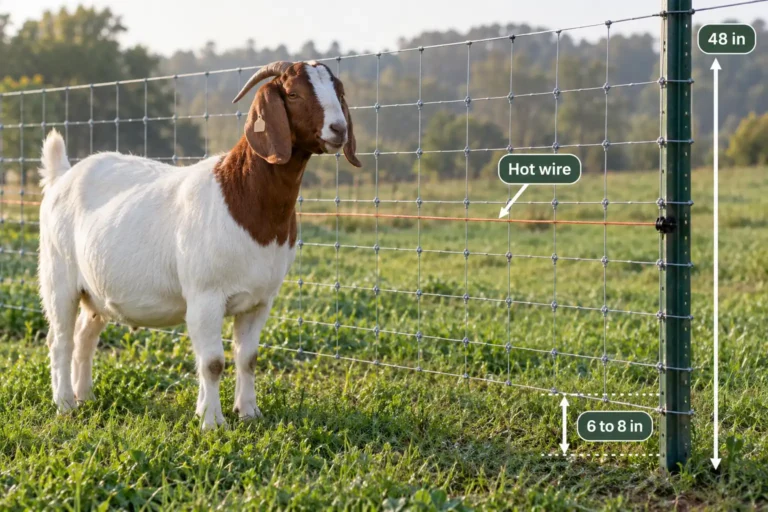
A fence that holds goats also keeps them out of the neighbor’s ornamentals. If you suspect a goat ate a toxic plant, call your veterinarian right away and bring a sample of the plant.
Common Goat Feeding Problems
Most goat feeding problems trace back to too much grain, too little forage, or the wrong mineral. The signs below describe patterns, not a diagnosis. Several conditions look alike, so any sick goat gets a veterinarian’s call before any treatment.
A Wether Straining to Urinate
This is the classic sign of urinary calculi, or bladder stones, in bucks and wethers. High grain, low roughage, and a poor calcium to phosphorus balance raise the risk. That is why Mississippi State Extension wants a 2:1 calcium to phosphorus supplement in any grain ration. A blocked male can die without fast treatment, so treat straining as an emergency and call your veterinarian.
Scours in a Bottle Kid
Overfeeding is the usual feeding cause. Mississippi State Extension notes that too much colostrum or milk can cause scours, and NC State Extension says kids need time to digest between meals. Even so, scours has infectious causes too, so call your veterinarian if it persists.
A Thin Doe in Late Pregnancy
Growing kids crowd the rumen late in pregnancy. As a result, a doe cannot eat enough forage to keep up. Penn State Extension says that is why most producers add 1/2 to 1 pound of grain per doe in the last trimester. Track body condition score from breeding onward, so thin does get help before kidding.
Goats Got Into the Feed Room
A large, sudden grain meal can bring on grain overload and enterotoxemia. Call your veterinarian as soon as you find the spill, even if the goats still look normal.
FAQs on Feeding for Goats
Can goats live on grass alone?
Goats can live on good pasture and browse, but grass alone rarely covers milking or late-pregnant does. Mississippi State Extension adds a grain supplement during flushing, late gestation, and early lactation, and every goat needs goat mineral.
Do goats need grain every day?
No. Langston University’s meat goat handbook says forage above 10 percent protein meets the needs of dry does and non-breeding bucks. Grain earns its place in late pregnancy, lactation, breeding, and growth.
Can baby goats drink cow’s milk?
Whole cow’s milk is an option for orphan kids after colostrum, per Mississippi State Extension. Cow milk replacer is different, since NC State Extension warns it can carry more copper than young kids tolerate.
How long do baby goats need milk?
Most kids drink milk until 8 to 12 weeks, per Mississippi State Extension. University of Missouri Extension uses intake as the signal instead: 1/4 pound of grain a day plus steady hay eating.
Can goats and sheep share a mineral?
Not safely over the long term. A goat mineral carries copper that can poison sheep, while a sheep-safe mix leaves goats short, so feed each species its own mineral where the other cannot reach it.
Is alfalfa good for goats?
Yes, alfalfa suits milking and late-pregnant does because it carries more protein and calcium than grass hay. University of Missouri Extension pairs legume hay with a lower-protein grain mix of 14 to 16 percent.
Putting This Into Practice
Start with forage, and budget hay for the whole winter before the first frost. Then put out a goat-labeled loose mineral and keep the water clean.
Add grain only for goats doing extra work: late-pregnant does, milkers, breeding bucks, and growing kids. For newborns, colostrum in the first hour matters more than anything that follows.
Finally, walk your pasture and fence lines for wilted cherry, azalea, and yew. Our goat guides pick up from here with breeds, dairy, and meat production.