
Why Do Goats Faint? What Myotonia Does to a Goat’s Muscles
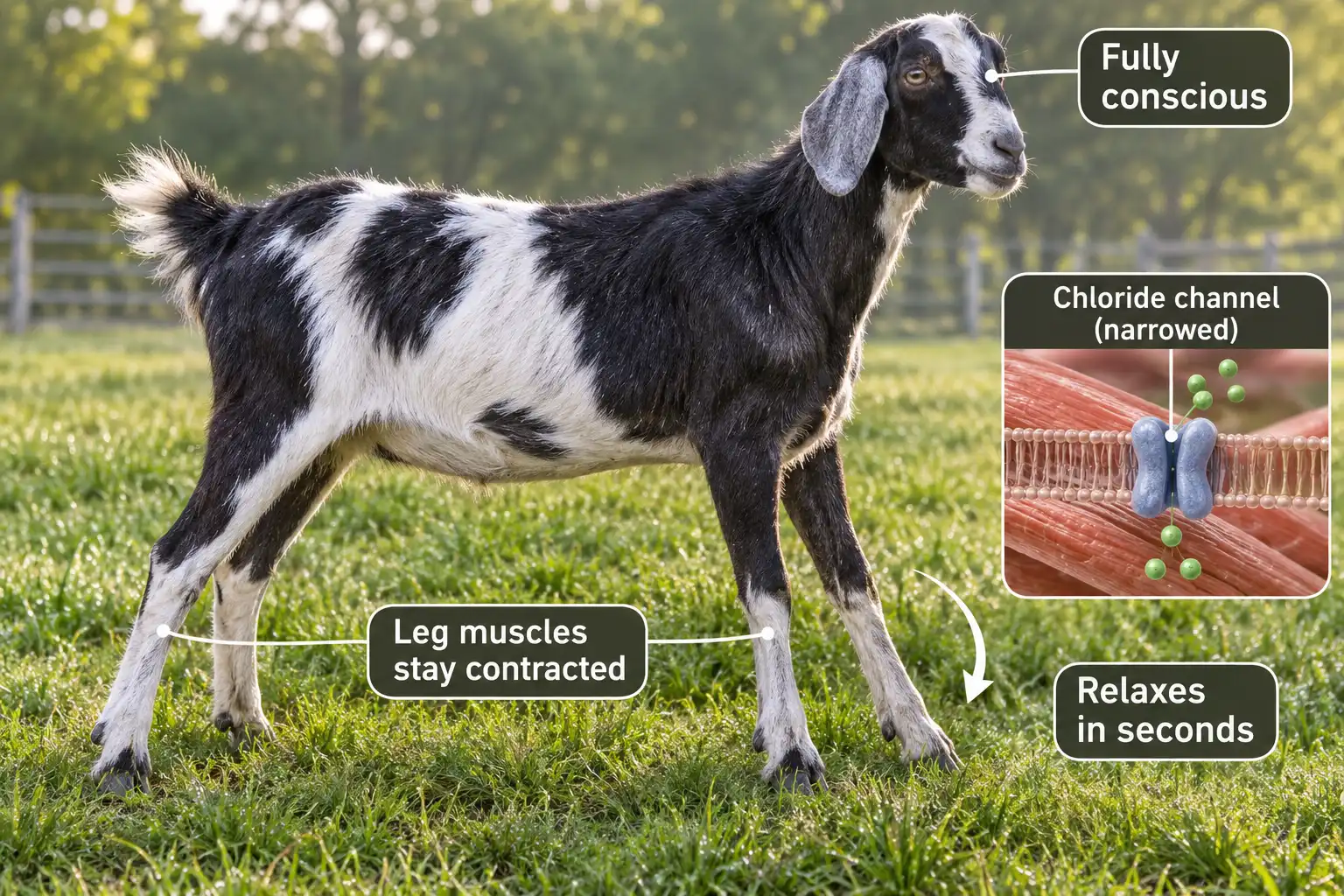
A goat that drops stiff-legged after a loud noise looks like it passed out. It did not. So why do goats faint? The answer is one muscle gene, and it explains which goats do it, why some fall more easily, and when a collapse means something else.
Goats faint because of myotonia congenita, an inherited muscle condition in the Myotonic breed. When startled, their muscles contract and fail to relax for a few seconds. The legs lock and the goat may fall, fully conscious throughout.
Do Fainting Goats Actually Faint?
No. A fainting goat never loses consciousness. True fainting, called syncope, happens when blood flow to the brain drops and the animal blacks out. A Myotonic goat stays awake, eyes open and ears working, the whole time.
Instead, everything happens in the muscles. Oklahoma State University’s Breeds of Livestock reference describes these goats locking up when frightened or excited, often falling over, and staying rigid for a few seconds. The Livestock Conservancy describes it as a prolonged muscle contraction that sets in when the goat is startled.
That is why breeders prefer the name Myotonic goat. The breed also goes by Tennessee fainting goat, wooden leg goat, stiff leg goat, nervous goat, and scare goat, per Oklahoma State and the Myotonic Goat Registry. Search phrases like “passing out goats” and “goats that pass out” describe the look, not the cause. Nothing passes out.
One caution before going further. A goat of any other breed that collapses is not fainting, and it needs a large animal veterinarian the same day. The last section below explains how to tell the two apart.
Why Do Fainting Goats Faint? The Muscle Gene Behind It
Fainting goats faint because one small change in one gene slows how their muscles relax. The UC Davis Veterinary Genetics Laboratory traces the condition to a single letter change in the CLCN1 gene.
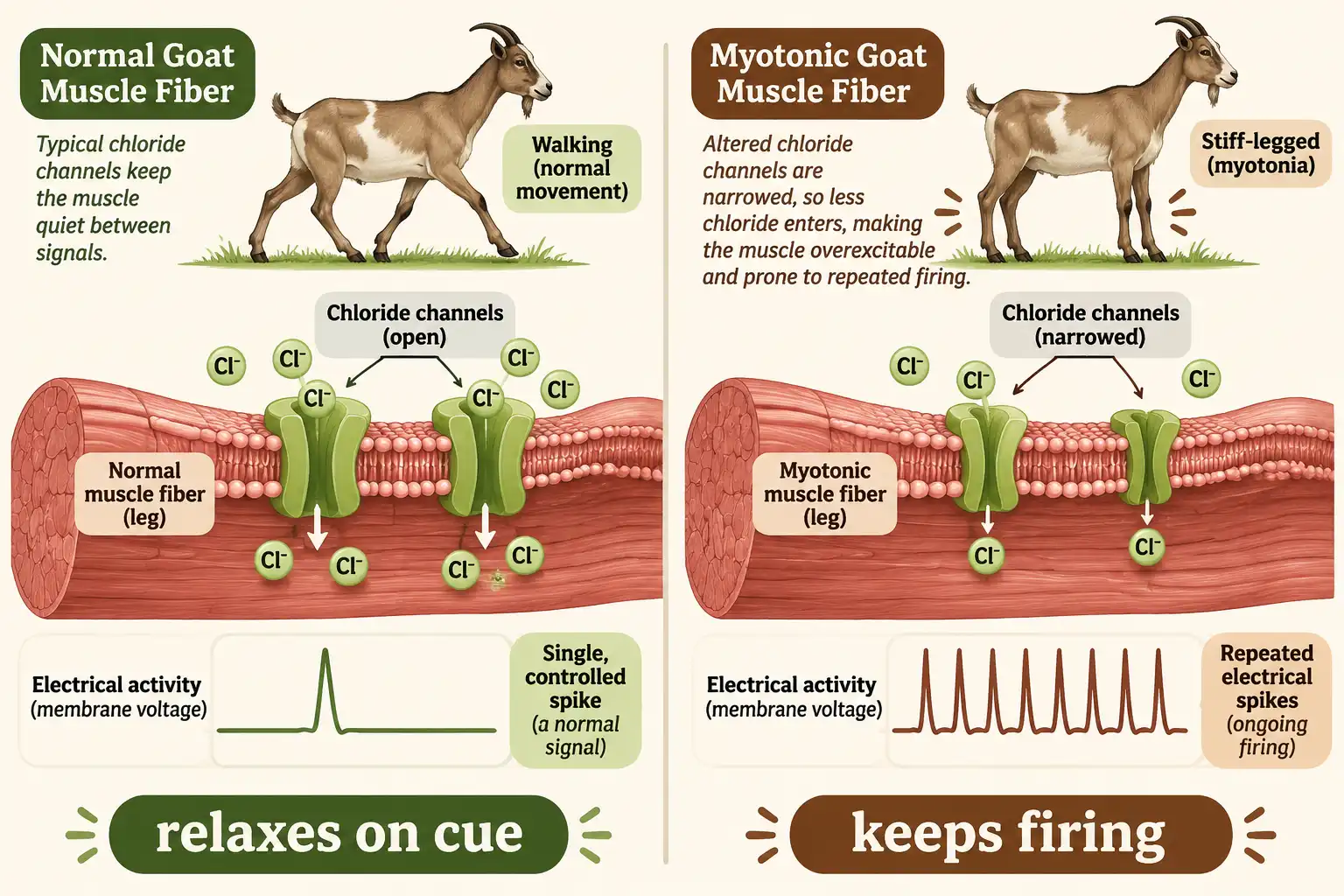
CLCN1 builds a chloride channel in skeletal muscle. MedlinePlus, from the National Library of Medicine, explains that chloride moving through this channel steadies the muscle cell’s electrical charge. That way the muscle stops contracting when the nerve signal stops. In Myotonic goats, the channel lets less chloride through. A 2024 review from the University of Sydney’s veterinary school describes the same thing: reduced chloride conduction in skeletal muscle.
Here is the sequence in a single episode:
- Something startles the goat, and it tenses to bolt.
- Its leg and body muscles contract hard and fast.
- The faulty channel cannot reset the muscle fibers, so they keep firing after the signal ends.
- The legs lock straight. If the goat is off balance, it tips over.
- After a few seconds the fibers settle, and the goat stands and walks off.
So the problem sits in the muscle itself, not in the brain, nerves, or heart. The same review classes myotonia congenita as a non-dystrophic muscle disorder, which means the muscle does not waste away over time.
Why Do Goats Faint When Scared?
Fear is the trigger, but the sudden movement is the cause. The UC Davis Veterinary Genetics Laboratory notes that affected goats stiffen after sudden forceful movements or a startle. A scared goat tenses every muscle at once to run. That burst of hard contraction is exactly what the faulty channel cannot switch off.
So anything that makes a goat jump can set it off. A banging gate, a barking dog, an umbrella snapping open, or a rush to the feed trough all qualify. Excitement works the same way as fear. Even a small hurdle can do it: the Myotonic Goat Registry notes that some goats stiffen in the rear legs when stepping over a barrier.
In practice, a calm goat walking at its own pace rarely locks up. Scared goats of other breeds do not freeze this way. They run, because their muscles relax on cue.
In people with the same condition, MedlinePlus notes that stiffness is worst when moving after rest and eases with repeated movement, called the warm-up effect. Published goat data on a warm-up effect is limited, though breeders report that a goat that keeps moving loosens up.
Why Do Goats Faint So Easily? It Depends on the Goat
Some goats faint easily because their myotonia is stronger than their herdmates’. The Livestock Conservancy notes that stiffness varies from goat to goat. Some lock up every time, while others stiffen only rarely.
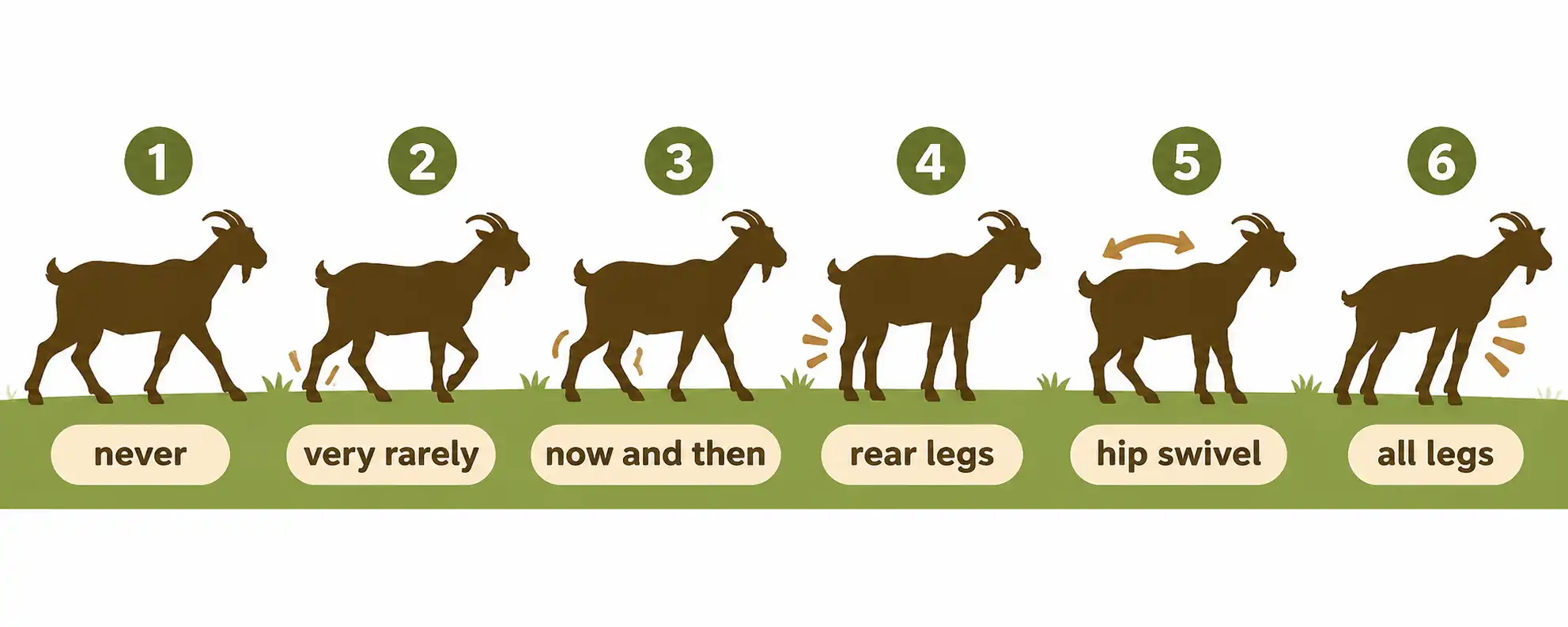
The Myotonic Goat Registry records this on every registration using a 1 to 6 scale. Here is that scale in summary form.
| Degree | What the goat does | How often it falls |
|---|---|---|
| 1 | Never seen to stiffen; breed type and pedigree still fit | Never |
| 2 | Stiffens very rarely | Never |
| 3 | Stiffens now and then | Rarely |
| 4 | Walks normally; rear legs stiffen readily when startled or stepping over a barrier, front legs less | Rarely to occasionally |
| 5 | Somewhat stiff rear gait with a swivel at the hip; stiffens readily | Occasionally |
| 6 | Walks stiffly on all four legs; locks up readily | Readily |
Age changes the picture too. Breeders consistently report that older goats learn to brace, spreading their legs or leaning on a fence, and stay upright through an episode. That pattern is widely described, but no published trial has measured it.
For your own herd, scoring each goat on this scale gives you a written record. That record helps later, when you pick replacement does or a herd sire.
Which Goats Faint? The Myotonic Breed and Its Crosses
True fainting belongs to the Myotonic goat, one of the few goat breeds that developed in the United States. Oklahoma State traces the best-known origin story to Marshall County, Tennessee, around 1880. A farm worker named John Tinsley arrived with four goats, a buck and three does, reportedly from Nova Scotia. When he moved on a year later, he left them behind. Oklahoma State also notes a second theory, a spontaneous mutation in a Tennessee herd around 1885. Nobody knows for certain.
During the 1950s, some of these goats went to the central Texas hill country, per the Livestock Conservancy. There, breeders selected for size and meat and produced the larger “Wooden Leg” strain. Oklahoma State notes that Texas herds still tend to run larger than eastern ones.
The breed was once rare. Now the Livestock Conservancy’s 2026 Conservation Priority List places the Myotonic or Tennessee Fainting goat in its Recovering category. That means numbers have passed the Watch thresholds but still need monitoring.
The gene is not limited to purebreds, either. The UC Davis Veterinary Genetics Laboratory has detected the same CLCN1 variant in Nigerian Dwarf goats, though its frequency in that breed is not yet known. The Myotonic Goat Registry also states that crossbred goats can be myotonic.

Is the Fainting Gene Dominant or Recessive?
The sources disagree, and the answer matters if you crossbreed. Oklahoma State and the UC Davis Veterinary Genetics Laboratory both describe the trait as recessive. Under that model, a goat with one copy is a carrier and looks normal. Two carriers then produce affected kids about 25 percent of the time, per UC Davis. Oklahoma State adds that crossbreds usually do not show it.
The University of Sydney review states the opposite. It describes goats as carrying an autosomal dominant form of myotonia congenita, unlike the other animal species studied. Under a dominant model, one copy is enough to cause stiffness.
We give both rather than pick one. For a breeding decision, the working rule is simple. Do not assume a crossbred kid will never stiffen, and do not assume a goat that never stiffens carries no copy. A DNA test settles it for an individual goat. UC Davis tests pulled hair, with the roots attached, from Myotonic goats, their crosses, and Nigerian Dwarf goats. That result can then go straight into planning your breeding season.
Does Fainting Hurt Goats?
The episode itself is not known to be painful, but the research here is thin. No published study we found has measured pain in a goat during an episode. What the sources do document is that the goat stays conscious, recovers within seconds, and has a muscle problem rather than a brain or heart problem.
In people with myotonia congenita, MedlinePlus describes stiffness that ranges from very mild to severe enough to interfere with walking. So the condition is real and physical, even when it looks comical on video.
The documented risk is the fall, not the stiffness. A goat that locks up can topple into a water tank or pond, slide down a ditch bank, or come off a loading ramp. While it is down and rigid, it cannot run from a loose dog or a coyote. At a crowded feeder, herdmates can step on it.
Two practices are legal and still hard on the animals, so we say so plainly. Startling goats on purpose, for videos or a laugh, causes falls and stress with no benefit to the goat. Breeding toward extreme stiffness for novelty does the same thing over generations. The Livestock Conservancy notes that one branch of the breed was selected for extreme stiffness and small size to sell as a novelty. A goat at degree 6 has fewer ways to keep its footing or escape a threat.
Handling and Facilities for Goats That Pass Out
Myotonic goats need the same care as other goats, plus a setup that limits startles and makes falls safe. Most of that work is in the layout.
- Move goats at a walk. Approach where they can see you, talk as you come, and skip the waving and shouting.
- Quiet the gates. Latch them softly, and fix any that slam in the wind.
- Keep water safe. Use troughs a fallen goat cannot slide into, and fence off deep ponds and steep ditch banks.
- Smooth the alleys. Remove low boards, curbs, and steps that goats must hop over, since a barrier can trigger stiffness.
- Give feeders room. Spread hay and feed so one stiff goat is not trampled in the rush.
- Put sides on ramps. A goat that locks up on a loading ramp needs a wall beside it, not an open edge.
Fencing is easier than with most breeds. The Livestock Conservancy notes that myotonia limits climbing and jumping, so these goats put less stress on fences. Still, the fence also has to keep dogs and coyotes out, because a downed goat cannot flee. Our guide to fence height for goats covers the heights and wire that hold goats.

Why Producers Keep Myotonic Goats
The same gene that makes these goats stiffen also builds muscle. That is why many producers raise them for meat. The Livestock Conservancy notes that heavy muscling tied to the myotonia is consistent across the breed.
Oklahoma State Extension’s meat goat handbook gathers several university findings. Virginia State University measured a meat-to-bone ratio of 4 to 1, well above other breeds. Prairie View A&M found 6 to 10 percent more meat yield when a Myotonic buck was bred to does of other breeds. Virginia State and Virginia Tech also found the breed more parasite resistant than others.
On the breeding side, Oklahoma State describes Myotonic does as easy kidders with good milk and strong mothering. The breed also works well as crossbreeding stock with Boer goats. Some breeders report two kiddings a year, though Oklahoma State presents that as breeder observation rather than trial data.
Parasite resistance is not immunity, so keep running FAMACHA scores and fecal egg counts. Our guide to barber pole worm and other internal parasites explains both checks. For how the breed fits a larger operation, compare it against other goat breeds or read more on meat goat production.
When a Collapsed Goat Is Not Myotonia
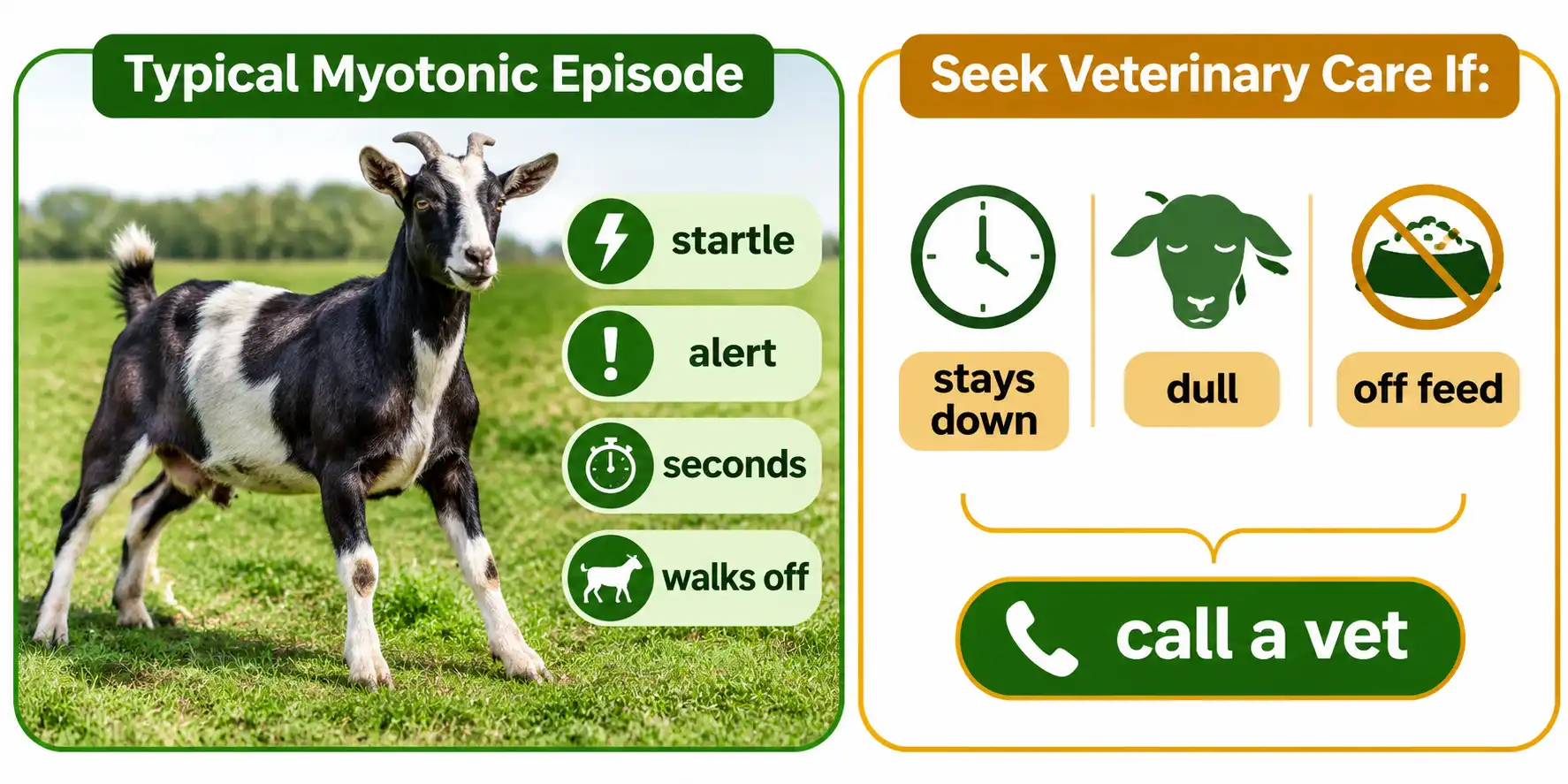
A goat of any other breed that goes down is not fainting, and it needs a large animal veterinarian the same day. The same holds for a Myotonic goat that stays down well past a few seconds, or seems dull once it rises. Myotonic episodes follow a clear pattern. Anything outside it is a different problem.
Use this comparison to describe what you see when you call. It is not a diagnosis.
| Sign | Typical myotonic episode | Collapse that needs a vet |
|---|---|---|
| Trigger | A startle, sudden move, or excitement | No trigger, or comes on gradually |
| Awareness | Alert, eyes open and tracking | Dull, unresponsive, circling, or paddling |
| Length | A few seconds | Minutes or longer; cannot rise |
| Afterward | Walks off and eats normally | Weak, wobbly, or off feed |
| History | Has stiffened the same way since it was young | New in an adult goat |
| Breed | Myotonic or a Myotonic cross | Any breed |
Several conditions put a goat down and can look alike at first. These include anemia from heavy barber pole worm loads, low blood calcium or pregnancy toxemia around kidding, heat stress, and brain conditions such as polioencephalomalacia and listeriosis. Some of them move fast, so the vet call comes before any treatment.
FAQs About Goats Faint
How long does a fainting goat stay stiff?
Usually just a few seconds, per Oklahoma State University. The muscles then relax on their own, and the goat gets up and goes back to grazing as if nothing happened, without any help from you.
Can you stop a goat from fainting?
No treatment cures myotonia in goats, because it is built into the CLCN1 gene. You can cut down on episodes, though, by handling goats calmly, quieting gates, and removing obstacles they must hop over.
Do fainting goats faint when excited, not just scared?
Yes. Oklahoma State notes that excitement triggers the same lock-up as fear, so feeding time, a reunion with herdmates, or play can set off an episode just as easily as a barking dog.
Is a fainting goat the same as a Myotonic goat?
Fainting goat is a common name for the Myotonic breed, not a separate breed. The Myotonic Goat Registry accepts goats at least 50 percent Myotonic, so a goat sold as a fainting goat may be a cross.
Can other livestock have myotonia?
Yes, though rarely. The University of Sydney review describes CLCN1 myotonia in Australian Merino sheep, and UC Davis lists horses among affected species, but no other livestock breed is defined by the trait the way Myotonic goats are.
Are fainting goats good for beginners?
Often, yes. The Livestock Conservancy calls them well suited to beginning and experienced farmers in low-input, forage-based systems, and their limited climbing makes them easier to keep fenced than most goats.
Is it cruel to scare a fainting goat on purpose?
It is hard on the goat and serves no purpose. Each startle risks a fall into water, off a ramp, or under herdmates, and a goat lying rigid cannot escape a dog or predator.
Putting This Into Practice
Goats faint because a CLCN1 change keeps their muscles contracted for a few seconds after a startle. The goat stays awake, and the episode passes on its own.
So your job is to limit startles and make falls safe. Walk the herd, quiet the gates, and keep water and ramps fall-proof. Score each goat on the registry’s 1 to 6 scale, and DNA test before crossbreeding if inheritance matters to your plan.
And if any goat stays down, call your veterinarian.