Are Pigs Smarter Than Dogs? What the Research Shows
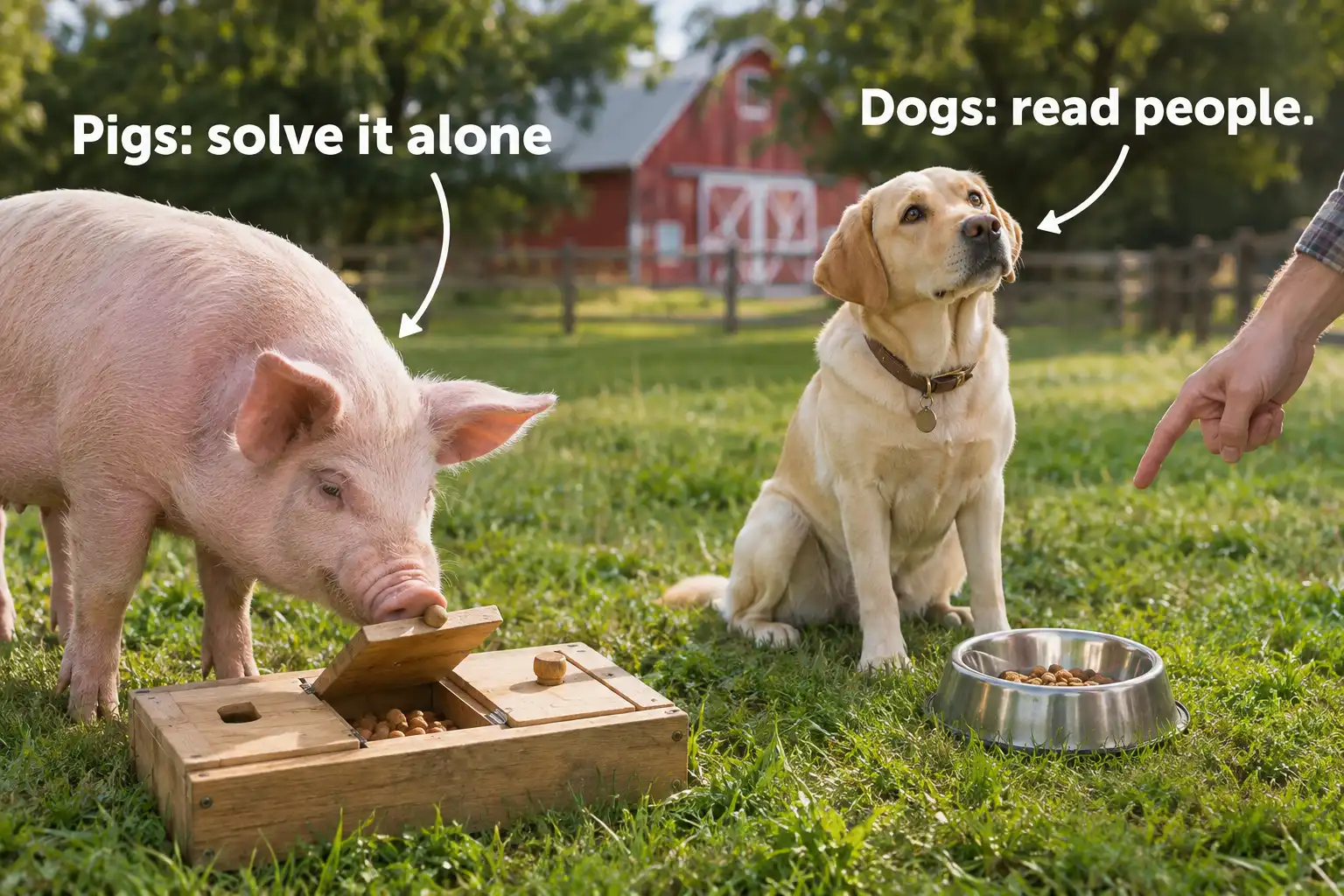
Pigs and dogs both score well on animal cognition tests, but they excel at different ones. The research on whether pigs are smarter than dogs points to two separate skill sets, not a winner. Below is what each species does well and what it means for handling pigs.
Neither species is smarter overall. Pigs keep working a puzzle on their own, while dogs turn to people for help and follow human pointing more readily, per Eötvös Loránd University trials with family-raised pigs and dogs.
Why Neither Species Wins Outright
No test measures overall animal intelligence on a single scale. Instead, researchers test one skill at a time: solving a puzzle, remembering a location, or reading a human gesture. A species can lead on one test and trail on the next.
That is why the popular claim that pigs rank as the fourth or fifth smartest animal is hard to use. We could not trace it to any published ranking or study.
History explains most of the gap between the two species. Pigs descend from wild boar, which forage for scattered food with the snout. Dogs, by contrast, spent thousands of years living and working beside people. So each species tends to do best on tasks that match its past.
Fair comparisons are also rare. A barn-raised pig and a house-raised dog have had very different lives. For that reason, the best evidence comes from the Family Pig Project at Eötvös Loránd University in Budapest, where miniature pigs were raised in family homes the same way pet dogs are.
Read next: How Long Do Goats Live? Lifespan by Breed, Sex
What Pigs Do Well
Pigs stand out on independent problem solving, learning unfamiliar tasks, and remembering what happened to them.
They Keep Working a Problem Alone
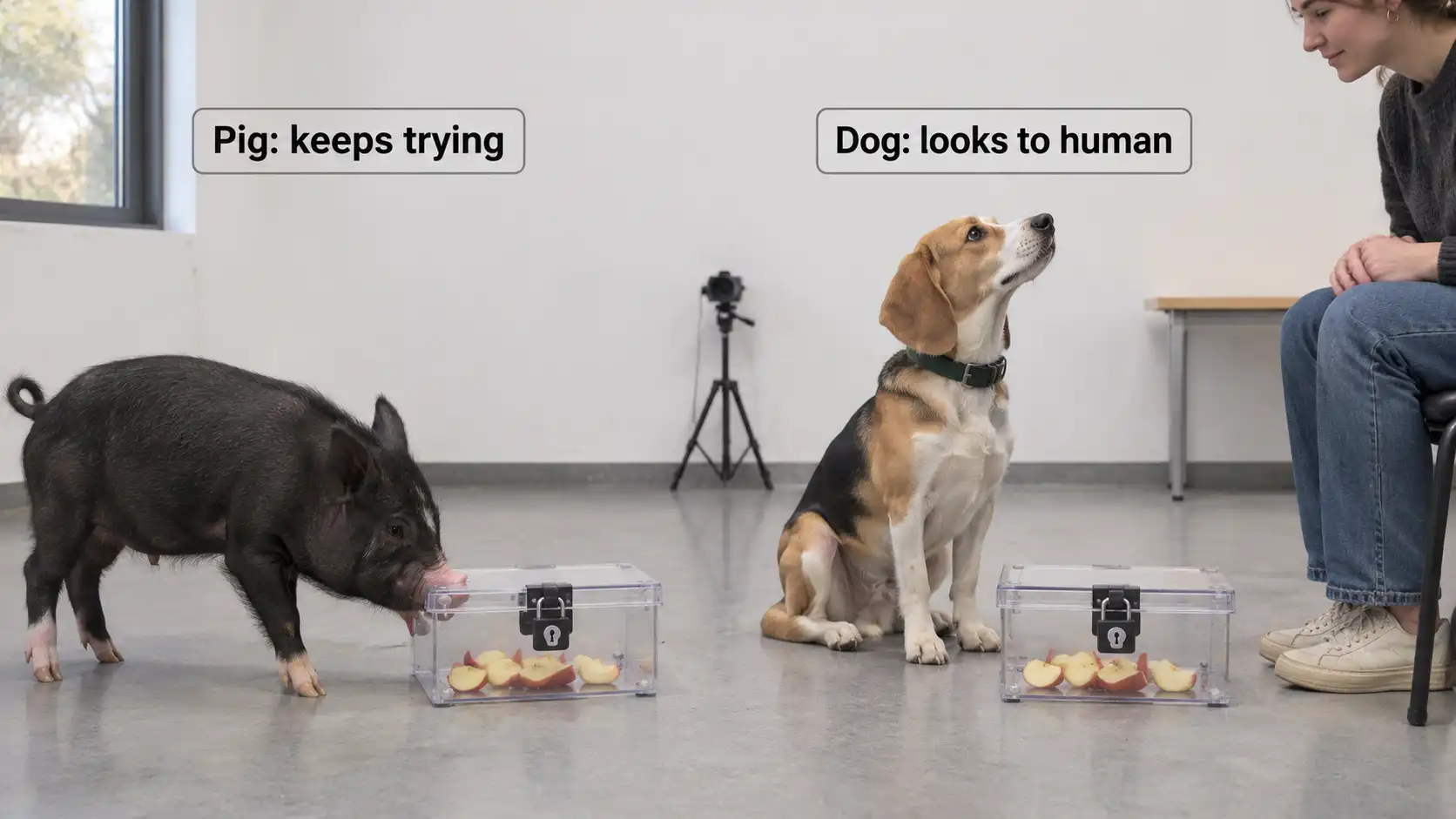
In a 2020 Eötvös Loránd University study, 10 pigs and 12 dogs faced a box with food inside. All were about 7 months old and had lived in family homes since about 8 weeks of age. At first, the lid opened easily. Then the researchers fixed it shut.
Once the task became impossible, the dogs turned toward the people in the room more than before. The pigs did the opposite. They looked at people less and kept working at the box. For a foraging animal, that persistence makes sense.
They Can Learn Tasks Built for Primates
Researchers at Purdue’s Center for Animal Welfare Science trained four pigs to steer a cursor on a screen with a joystick, using the snout. Two were 3-month-old Yorkshires. The other two were 2-year-old Panepinto micro pigs.
All four hit targets above chance. On the easiest targets, both micro pigs scored 84 percent. Still, study authors Candace Croney and Sarah Boysen pointed out that the pigs were farsighted and that a joystick was never designed for a snout. Both limits held the scores down.
They Remember Places and Painful Events
Pigs learn spatial layouts and tell visual and scent cues apart, per a swine extension fact sheet by Candace Croney. The same fact sheet notes that pigs remember aversive events, such as painful procedures. That memory matters for anyone who handles pigs, as the handling section below explains.
Mirror Use Comes With a Caveat
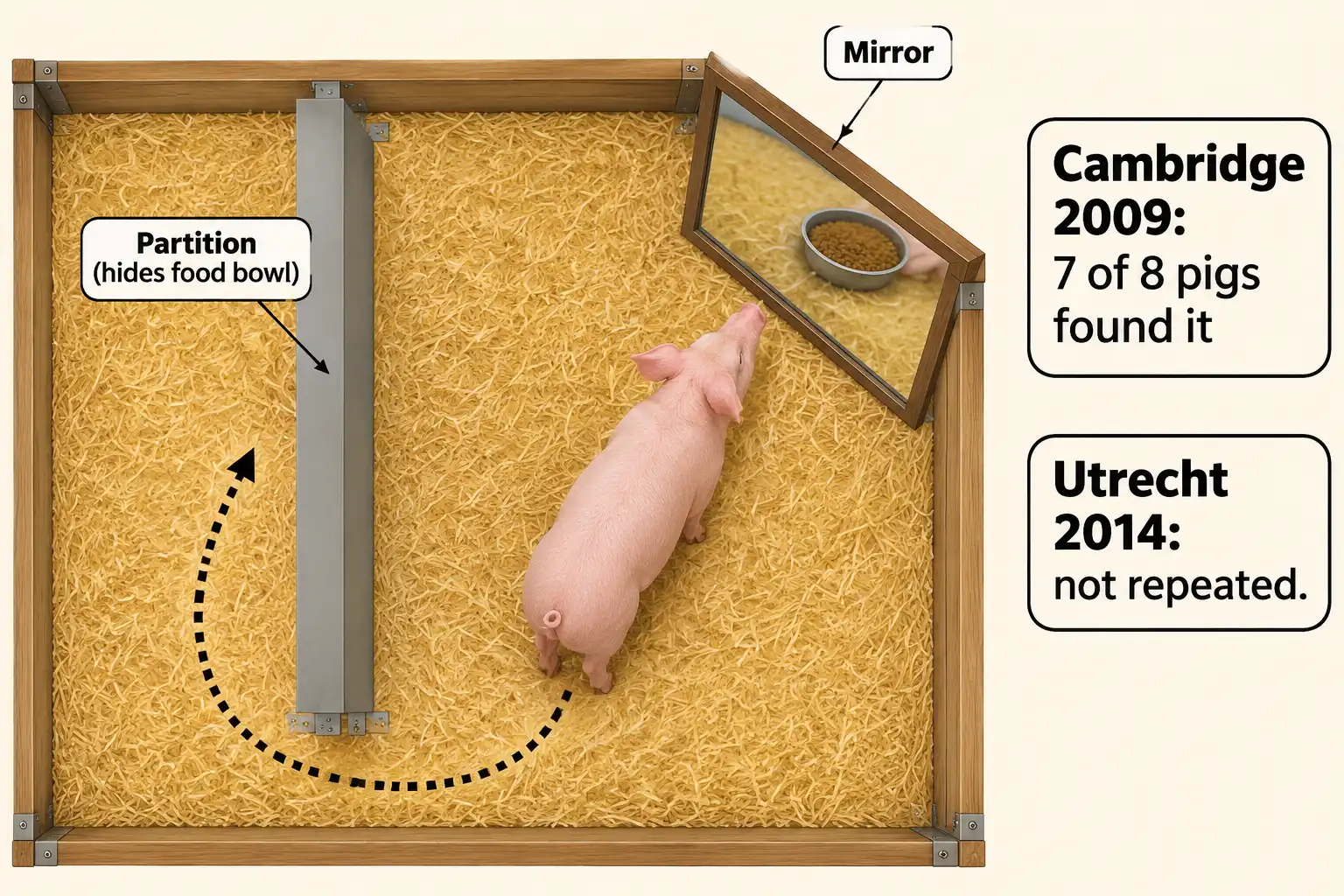
The mirror study is the most quoted piece of pig cognition research. It is also the shakiest. In 2009, a University of Cambridge team gave eight young pigs five hours with a mirror. Afterward, seven of the eight found a food bowl visible only in the mirror, in 23 seconds on average. Most pigs with no mirror experience searched behind the mirror instead.
However, a Utrecht University team could not repeat the result in 2014. In its first group of 11 piglets, only two found the hidden bowl. In a second group of 11, only one mirror-trained pig used the mirror to find it.
So treat mirror use in pigs as possible, not proven. Neither study tested self-recognition, which no published work has shown in pigs.
What Dogs Do Better
Dogs lead clearly on one skill: reading and using human communication.
In a 2019 Eötvös Loránd University study, family-raised dogs and miniature pigs watched a person point at one of two bowls from a distance. Only the dogs followed that point without training. The pigs instead developed a side bias, choosing the same side again and again. They also looked at human faces less, and almost only when food was involved.
The 2020 food box study showed the same pattern. When stuck, the dogs looked to people, which the researchers read as a bid for help. They linked this to dogs being naturally more dependent on, and cooperative with, humans.
Still, pigs are not blind to human cues. Researchers at Martin Luther University Halle-Wittenberg tested 17 seven-week-old pigs that had very little human contact. The pigs could use a pointing hand held close to the right bowl, and with some limits a more distant point. So the gap is about how readily each species uses human signals, not whether pigs can learn them at all.
Pig vs Dog Intelligence Compared
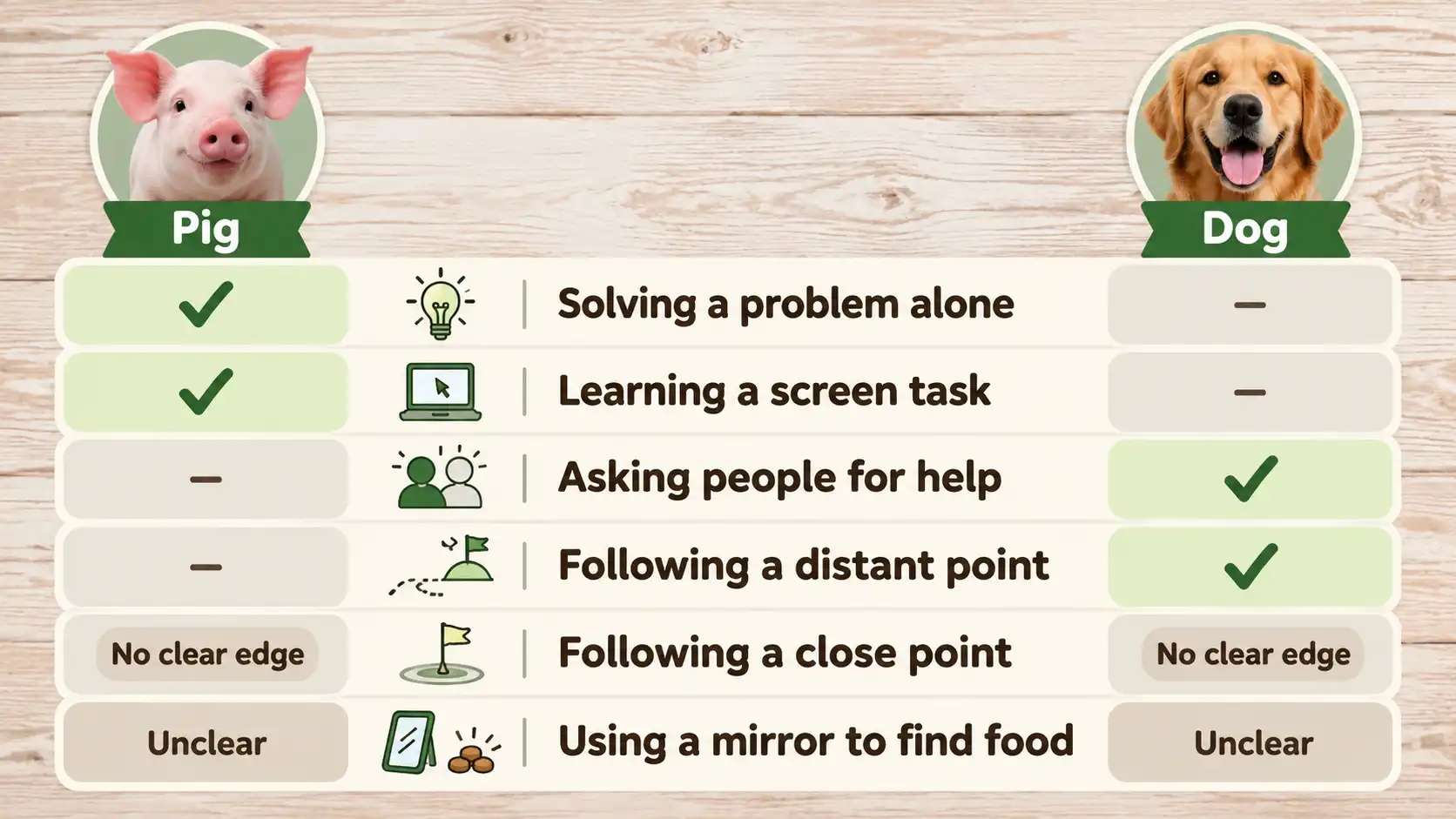
On the published evidence, each species leads on two skills, and the rest are a draw or untested.
| Skill | Edge | What the research shows |
|---|---|---|
| Solving a problem alone | Pigs | Pigs kept working an impossible task without human help (Eötvös Loránd, 2020) |
| Learning a screen task | Pigs | Four pigs hit joystick targets above chance; dogs were not tested (Purdue, 2021) |
| Asking people for help | Dogs | Dogs looked to humans when a task failed (Eötvös Loránd, 2020) |
| Following a distant point | Dogs | Only dogs followed it untrained; pigs chose by side (Eötvös Loránd, 2019) |
| Following a close point | No clear edge | Young pigs with little human contact used it (Halle-Wittenberg, 2014) |
| Using a mirror to find food | Unclear | Shown in 2009 (Cambridge), not repeated in 2014 (Utrecht) |
In short, pigs lean toward solving it themselves, and dogs lean toward solving it with you.
Are Mini Pigs Smarter Than Dogs?
Mini pigs are neither smarter nor less smart than dogs; they show the same split as farm pigs. They are the same species, so they solve problems alone well and read people less readily. In fact, the Eötvös Loránd studies above used miniature pigs. Those results are the mini pig versus dog comparison.
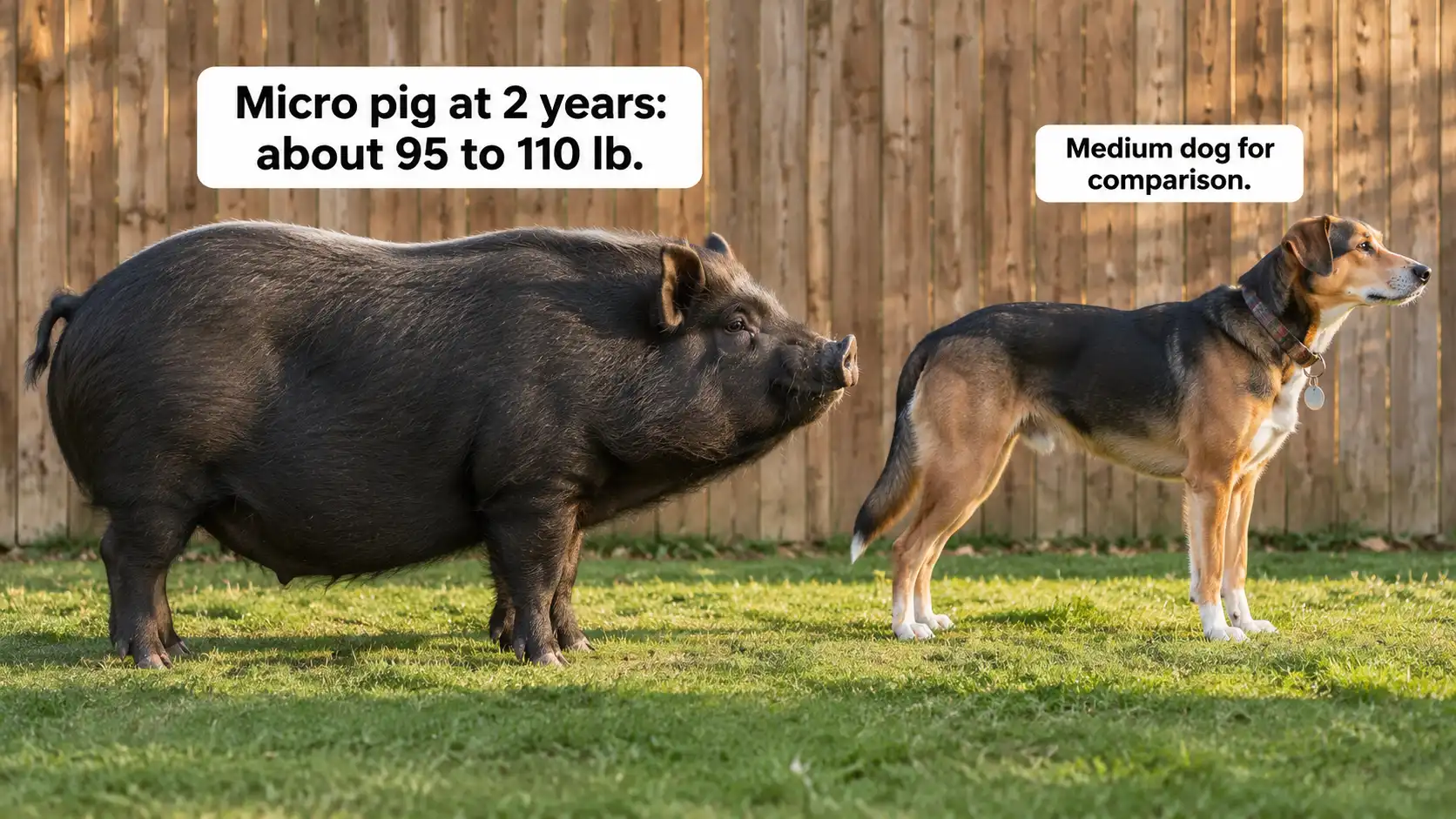
“Mini” also does not mean small. The two Panepinto micro pigs in the Purdue joystick study weighed about 95 and 110 pounds at 2 years old. A pig that size needs pig-sized pens and fencing, whatever the sale listing called it. Our overview of pig breeds and their sizes shows how much mature size varies.
Research comparing mini pigs with commercial breeds is thin. We found no study testing the two side by side on the same tasks. Therefore, any claim that minis are smarter than farm pigs, or the reverse, goes beyond the evidence. Both breed types in the joystick study did learn the task.
Are Guinea Pigs Smarter Than Dogs?
Guinea pigs are rodents, not pigs, and no published study we found tests them against dogs. So there is no fair answer to the comparison.
What does exist is maze work. A University of Münster team found that domestic guinea pigs learned a water maze faster than their wild ancestor, the wild cavy. They did so even though their brains are about 13 percent smaller relative to body size. That shows solid spatial learning. However, it says nothing about the social skills where dogs excel.
Guinea pigs fall outside the six livestock species this site covers, so we stop there.
What Pig Intelligence Means for Handling and Housing
A pig that solves problems alone and remembers bad experiences needs calm handling and something to work on. Both points follow directly from the research above.
Handle Pigs as if They Will Remember
Because pigs remember aversive events, the Croney fact sheet advises against rough or inappropriate handling. A pig that links the chute or the trailer with pain is harder to move the next time.
Persistence matters for containment, too. An animal that keeps working at a problem alone is also likely to keep working at a weak gate latch or a loose panel. Our guide to pig housing and fencing covers barriers that hold.
Give Them Something to Work On
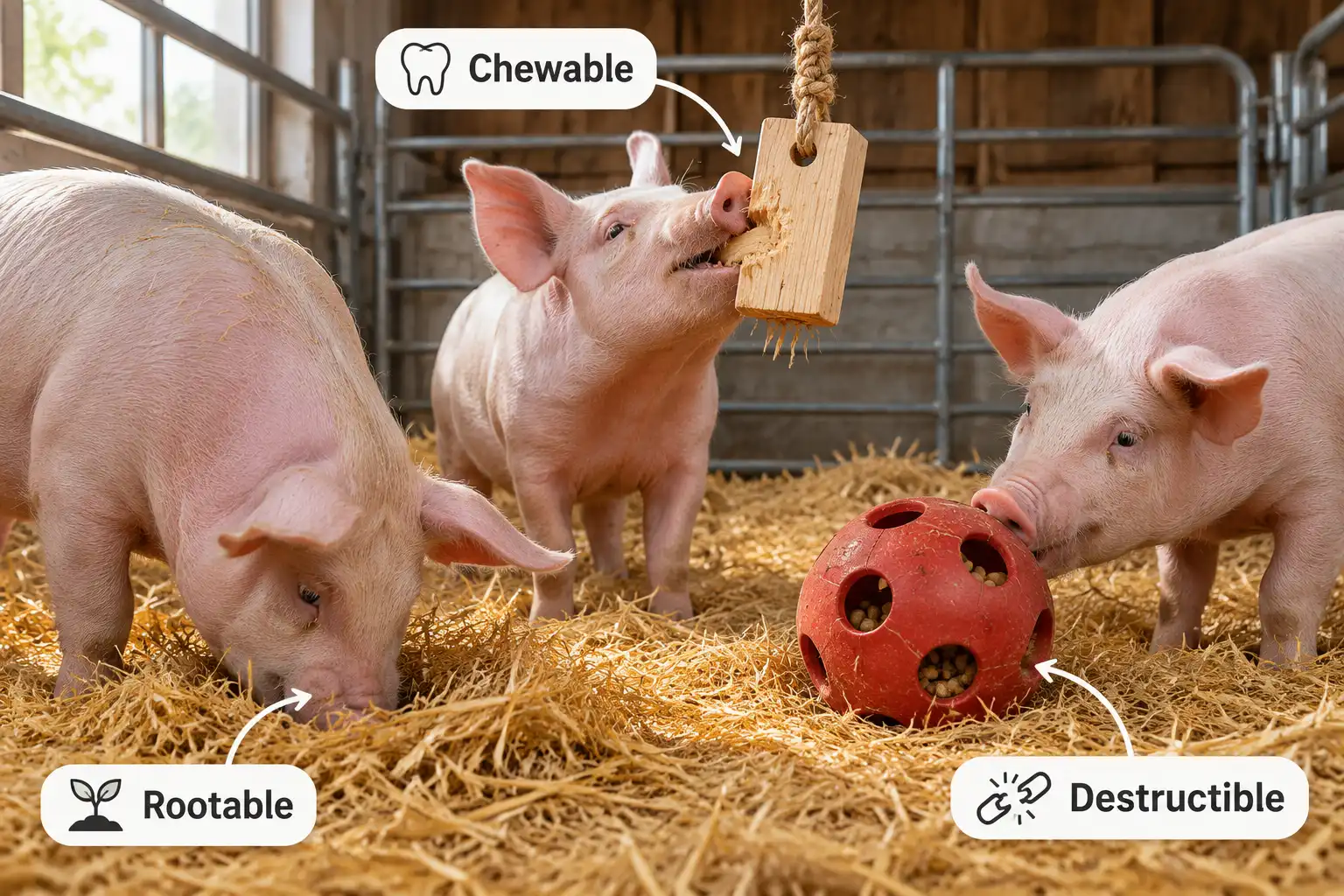
Pigs prefer materials they can eat, smell, chew, deform, and destroy, per Purdue Extension’s 2024 enrichment guide (AS-695-W). That rules out much of what gets hung in pens.
- Straw or hay: Good for rooting and nesting. However, it can clog slurry systems under slatted floors, and Purdue advises testing it for mycotoxins.
- Rope and wood blocks: Purdue lists both as useful. Wood blocks hung on sisal rope have been used in farrowing crates.
- Puzzle feeders and scatter feeding: These make pigs work for food, which raises activity. Check with your veterinarian before changing the ration.
- Metal chains and hard plastic balls: Not recommended. They do little to encourage natural behavior.
- Background music: If used, keep it below 70 decibels.
Rotate items or offer several at once, because pigs lose interest in the same object over time. Scatter feeding works best on top of a balanced pig ration, not in place of one.
Signs a Pig Is Under-Stimulated
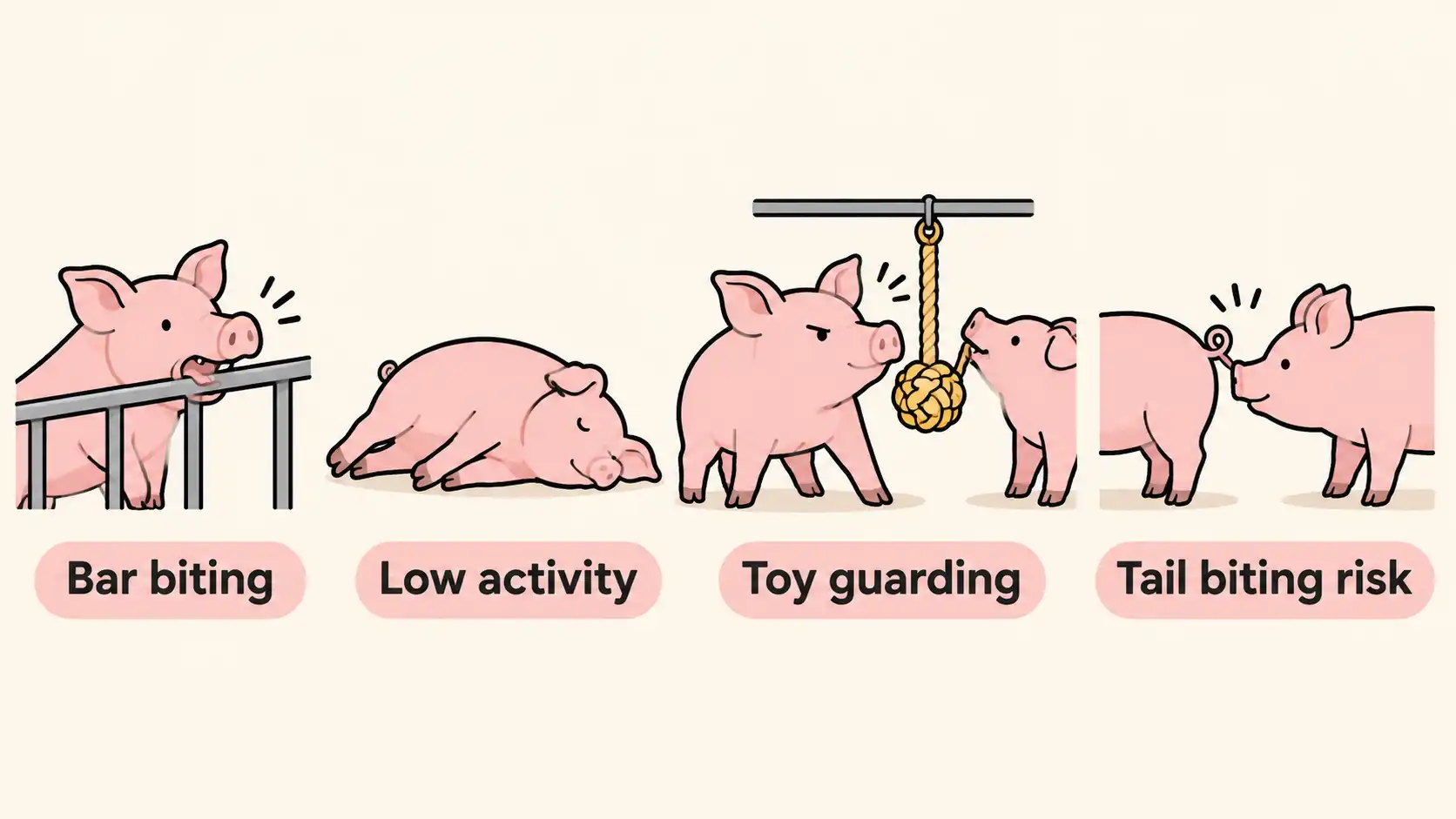
A barren pen is hard on an animal that learns this readily. The Croney fact sheet links barren housing to boredom, frustration, and chronic stress. Watch for these signs, drawn from that fact sheet and the Purdue guide:
- Tail biting or ear biting of penmates
- Bar biting or sham chewing, which is chewing with nothing in the mouth
- Lower activity or signs of frustration
- Guarding or fighting over enrichment items, which usually means the pen needs more of them
Bitten tails and ears can become infected, and the Croney fact sheet notes that such wounds can kill. Other health problems can also change behavior. So call a large animal veterinarian to examine any wounded or unusually inactive pig before treating it.
Frequently Asked Questions
Is a pig smarter than a 3-year-old child?
No study we found tested pigs and young children on the same tasks, so the comparison has no direct evidence behind it. Pigs do learn complex tasks, such as the joystick work at Purdue.
Can pigs recognize themselves in a mirror?
Pigs have not been shown to recognize themselves in a mirror. A 2009 Cambridge study found pigs could use a mirror to find food, but a 2014 Utrecht replication failed to repeat it.
Are pigs easier to train than dogs?
Usually not. Dogs follow human pointing and gaze readily, which speeds training, while pigs tend to rely on their own problem solving. Pigs can still learn trained tasks, as the Purdue joystick study showed.
Does my pet pig need toys?
Yes. Purdue Extension advises enrichment pigs can root, chew, and destroy, such as straw, rope, or wood blocks, rotated over time. Without it, pigs may develop bar biting, sham chewing, or tail biting.
Do mini pigs stay small?
Not always. The two Panepinto micro pigs in a Purdue cognition study weighed about 95 and 110 pounds at 2 years old. Plan housing for an adult pig of that size, not a piglet.
What is the smartest farm animal?
No published ranking settles it. Pigs score well on many cognition tests, yet goats and horses also follow human pointing in some studies, per Halle-Wittenberg researchers. Each species excels at different tasks.
Why do pigs bite each other’s tails?
Barren housing is one known cause, per the Croney fact sheet, which links unmet mental needs to tail and ear biting. Other causes exist, so have a veterinarian examine bitten pigs and help find the trigger.
What the Research Supports
Pigs are not smarter than dogs, and dogs are not smarter than pigs. The evidence shows pigs leading on solving problems alone and dogs leading on reading people. That split holds for mini pigs as well.
For anyone keeping pigs, the practical side matters more than the ranking. Handle calmly, because pigs remember. Build latches and fences for a persistent animal. Then give pigs something to root, chew, and destroy, and rotate it. Our overview of raising pigs covers the rest. A pet pig is also a long commitment, so check the typical pig lifespan before you buy.