How Long Do Horses Live? Lifespan, Age Chart, and Senior Care

A horse bought at 5 can still need hay, hoof care, and a vet 25 years later. That makes how long horses live a planning question, not trivia. The figures below come from USDA and university extension research.
Most domestic horses live into their late 20s or early 30s, per University of Georgia Extension. USDA APHIS treats horses over 20 as geriatric. With steady dental, feed, and veterinary care, many stay healthy beyond that.
How Long Do Horses Live on Average?
Most horses live into their late 20s or early 30s, per University of Georgia Extension. USDA does not publish a single life expectancy figure for horses. Still, the 25 to 30 year figure found on most horse sites sits inside the Georgia range.
The best national picture comes from USDA APHIS and its National Animal Health Monitoring System (NAHMS). The NAHMS Equine 2015 study surveyed operations with five or more equids in 28 states. In that study, 11.4 percent of resident equids were 20 or older, roughly 1 in 9.
Reaching 30 is far less common. In the 2005 NAHMS study, 6.9 percent of equids were 20 to 29, but only 0.7 percent were 30 or older. That works out to fewer than 1 horse in 100.
Newer national data is on the way. USDA began collecting data for its Equine 2026 study from operations in all 50 states in August 2026. Until it reports, the 2015 figures remain the latest.
The Longest-Lived Horse on Record
Old Billy holds the record at 62 years, per Guinness World Records. He was foaled in 1760 in Lancashire, England, and died on November 27, 1822. Treat that as a historical outlier, not a planning target.
What Age Is a Horse Considered Old?
USDA APHIS classes horses over 20 as geriatric. Oklahoma State Extension, by contrast, sets no fixed senior age. Instead, it advises closer monitoring once a horse reaches its late teens.
The two views fit together because calendar age and body age often differ. Oklahoma State names use, genetics, and environment as the reasons some horses show age sooner. As a result, two 18-year-old horses can need very different care.
Age alone does not end a working life, either. University of Georgia Extension notes that many horses have productive careers into their 20s. So judge the horse in front of you by its weight, teeth, movement, and coat, not the age on its papers.
Horse Life Stages by Age
A horse is fully mature by 4 to 5 years and spends most of its life as an adult, per USDA APHIS. The table below covers the full horse age span, following the stages APHIS describes in its Equine 2015 reports.
| Stage | Age | What changes |
|---|---|---|
| Foal | Birth to 1 year | Weaned at 4 to 6 months |
| Yearling | 1 to 2 years | Basic handling; riding or driving training may begin late in year 1 or early in year 2 |
| Young horse | 2 to 5 years | Competition starts at 2 in many disciplines; sexual maturity at 3 to 4; fully mature at 4 to 5 |
| Adult | 5 to 20 years | Peak athletic years; 65.6% of US equids in 2015 |
| Geriatric | Over 20 years | Highest yearly death rate of any age group, 3.1% in 2015 |
Yearly death rates run lowest from 1 to 5 years, at 0.5 percent. They then hold at 0.8 percent through the adult years. After 20, they nearly quadruple to 3.1 percent.
Horse Life Span by Breed: Do Ponies Live Longer?
They may, but US research has not measured it. We found no extension service or USDA study that publishes lifespan by breed. Breed lifespan tables online often disagree by five years or more for the same breed. Few name a study behind the figure.
The research does support a broader point. University of Minnesota Extension notes that many horses and ponies live into their 20s or 30s with good health care. Owners and breeders often report that ponies and miniature horses live longest and heavy draft breeds shortest. However, no US extension trial has confirmed that pattern.
For a buying decision, the individual horse tells you more than its breed. Teeth, weight, soundness, and history are things you can check, while a breed average is not. For more on keeping horses at every age, see our horse care guides.
Horse Years to Human Years
A 5-year-old horse is roughly a 23-year-old person, and a 20-year-old horse is roughly 60. No extension service or federal agency publishes an official conversion, so the chart below is our estimate. It lines up USDA APHIS life stages with human ones. Horses age fast until full maturity at 5, then about 2.5 human years for each horse year.
| Horse age | Approximate human age | Horse life stage |
|---|---|---|
| 1 | 6 to 7 | Yearling |
| 2 | 13 | Young horse |
| 3 | 18 | Young horse |
| 4 | 20 | Young horse |
| 5 | 23 | Adult |
| 10 | 36 | Adult |
| 15 | 48 | Adult |
| 20 | 60 | Geriatric begins |
| 25 | 73 | Geriatric |
| 30 | 86 | Geriatric |
| 35 | 98 | Geriatric |
| 40 | 110 | Geriatric |

Quick Formula for Horses 5 and Older
Subtract 5 from the horse’s age, multiply by 2.5, then add 23. For example, a 14-year-old horse works out to 9 times 2.5, plus 23, or about 45 human years. By the same math, Old Billy’s 62 years equal roughly 165 human years.
Why a Flat Multiplier Gets It Wrong
A single multiplier misses how fast horses grow up. Treat every horse year as 3 human years, for instance, and a 5-year-old horse comes out at 15. Yet USDA APHIS treats a 5-year-old horse as fully mature. Horses rush through childhood in about 5 years, then age slowly through a long adult stage. So use the chart to picture where a horse sits in its life, not to judge its health.
Why More Horses Reach 20 Than Ever Before
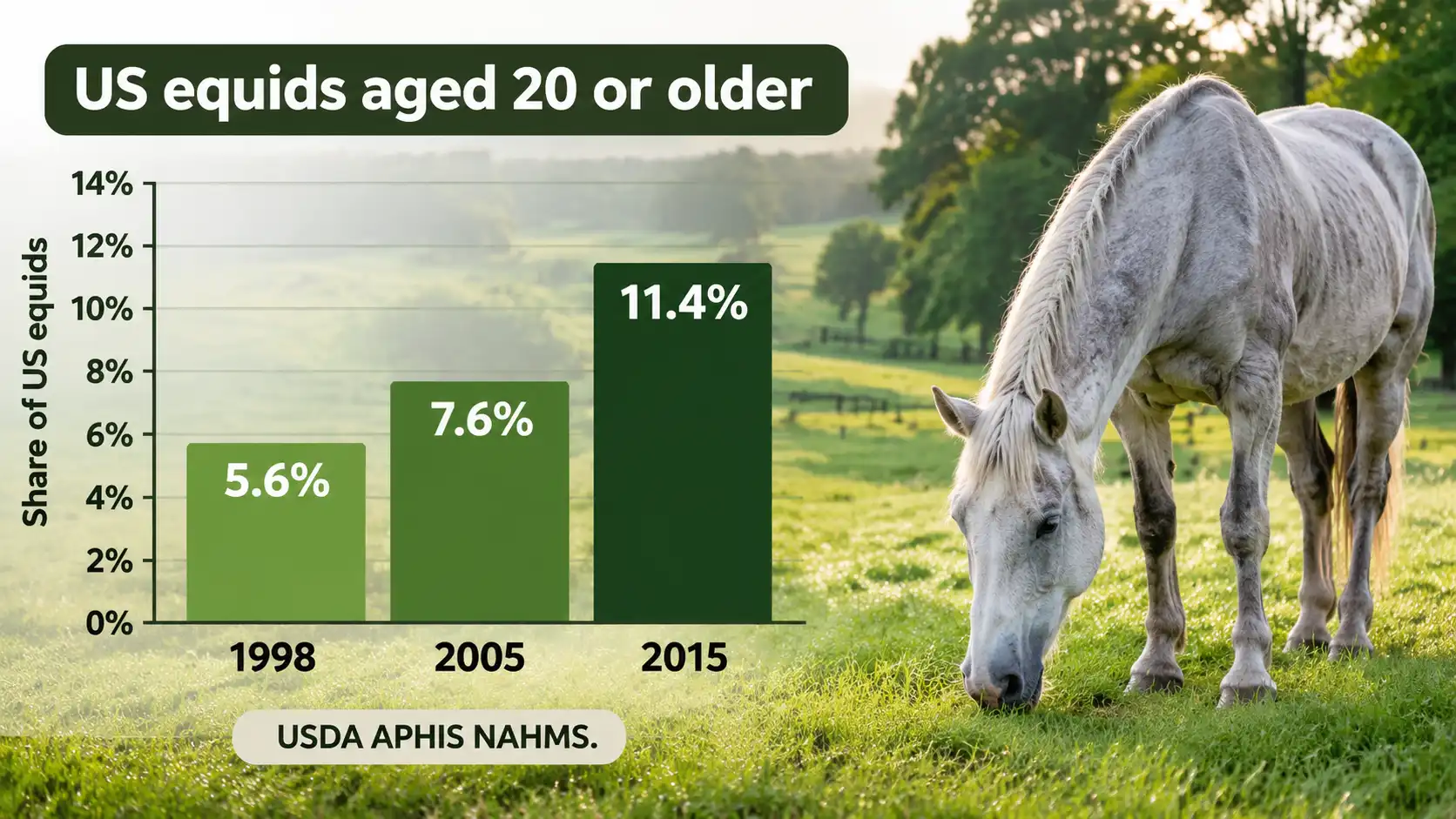
The share of US equids aged 20 or older roughly doubled between 1998 and 2015, per USDA APHIS. It rose from 5.6 percent in 1998 to 7.6 percent in 2005, then 11.4 percent in 2015. APHIS also found a lower death rate among horses over 20 in 2015 than in the earlier studies. That suggests horses are living longer.
There is a catch, though. Over the same years, the share of equids under 5 fell from 37.6 percent to 22.9 percent. Fewer foals raise the share of old horses even if no horse lives a day longer. So the rise reflects two trends at once: longer lives and fewer births.
APHIS points to four likely drivers of the longer lives:
- Feeds formulated for older horses
- Better treatment for equine Cushing’s disease and lameness
- Older horses moving into second careers
- Owners committing to lifelong care
What Shortens a Horse’s Life
Colic is the leading cause of death in horses aged 1 to 19, per USDA APHIS. After 20, old age leads. The life expectancy of a horse depends on getting through the risks of each age. The NAHMS Equine 2015 study recorded these shares of deaths:
| Age group | Leading causes of death (share of deaths) |
|---|---|
| 1 to 19 years | Colic 31.2%; injury, wounds, or trauma 16.3%; respiratory problems 10.4% |
| 20 years and older | Other causes, mostly old age, 26.6%; colic 13.4%; cancer 13.2%; neurologic problems 12.1%; chronic weight loss 11.7% |
Colic, sudden weight loss, and neurologic signs all call for a large animal veterinarian right away. These problems can look alike early, so do not wait to see whether they pass.
Some of this is in your hands. University of Georgia Extension notes that owners can influence dental and hoof care. They have little control over genetics, previous care, and previous use. That split matters when you buy an older horse. Its history is fixed, but its teeth, feet, weight, and parasite load are not.
Of the causes after 20, chronic weight loss is the easiest to track at home. A weight tape and a regular body condition score show a downward trend before it becomes obvious.
How to Help a Senior Horse Live Longer
Senior care comes down to teeth, weight, feed, hormones, parasites, and joints. A horse’s health needs change as it ages, per University of Minnesota Extension. So review each area at least yearly with your large animal veterinarian. Build those checks into your wider herd health planning so they happen on schedule.
Teeth
Plan on dental checks once or twice a year for an older horse. University of Minnesota Extension sets at least one yearly check for seniors. Oklahoma State Extension says inspections may need to happen as often as every six months. Teeth also wear down with age. Once a horse can no longer chew hay well, Minnesota Extension notes that senior pellets can become its whole diet.
Body Condition and Weight
Track weight and body condition on a fixed schedule. Oklahoma State Extension recommends recording body condition score, a weight tape reading, and photos at regular intervals. For aged horses, it suggests moving to monthly or even every other week. Also watch the topline, fat deposits, and coat, which Oklahoma State flags as signs of change.
Feed
Older horses often need more calories in an easier form. University of Minnesota Extension describes senior feeds for horses as typically pelleted, easy to chew, and more energy dense than other concentrates. Oklahoma State Extension prefers fat over starch for older horses, since many have insulin problems. It also suggests feeds near 12 to 14 percent protein for older horses. Give a slow eater a quiet spot and extra time, because competition at the feeder costs a senior horse weight.
PPID (Equine Cushing’s Disease)
PPID is a hormone disorder of the pituitary gland, and it becomes common after 15. Estimates differ by source. Utah State University Extension puts it at up to 25 percent of horses 15 or older. Oklahoma State Extension puts it at roughly 20 to 30 percent of older horses.
Signs include a coat that sheds late or not at all, topline muscle loss, and a pot belly. Affected horses may also drink and urinate more. Those signs overlap with other problems, so only a veterinarian’s testing confirms PPID. Oklahoma State also reports foot soreness or laminitis in about 30 percent of PPID cases.
Utah State notes that treatment usually means prescription medication for the rest of the horse’s life. It also calls for limiting starches and sugars in the diet. For many horses, that means rationing lush pasture, a job that ties straight into your grazing management plan.
Parasites and Vaccines
Older horses and horses with PPID tend to carry higher fecal egg counts, per Oklahoma State Extension. So run fecal egg counts on seniors more often than on younger horses. Then base deworming on the results and your veterinarian’s plan. Vaccines need review too. University of Minnesota Extension notes that seniors kept alongside show horses may need more frequent vaccination against strangles, herpes, and influenza. Your veterinarian sets that schedule.
Joints, Hooves, and Movement
Oklahoma State Extension reports osteoarthritis in 50 percent of horses over 15. Keep older horses moving on a steady routine, since Oklahoma State notes that lost fitness is harder to rebuild in an aged horse. Allow longer warm-ups and cool-downs. Also, a horse that resists lifting a foot for the farrier may be in foot pain rather than misbehaving. If you still ride, Minnesota Extension advises checking saddle fit, because senior horses often carry less back muscle.
How to Estimate a Horse’s Age by Its Teeth
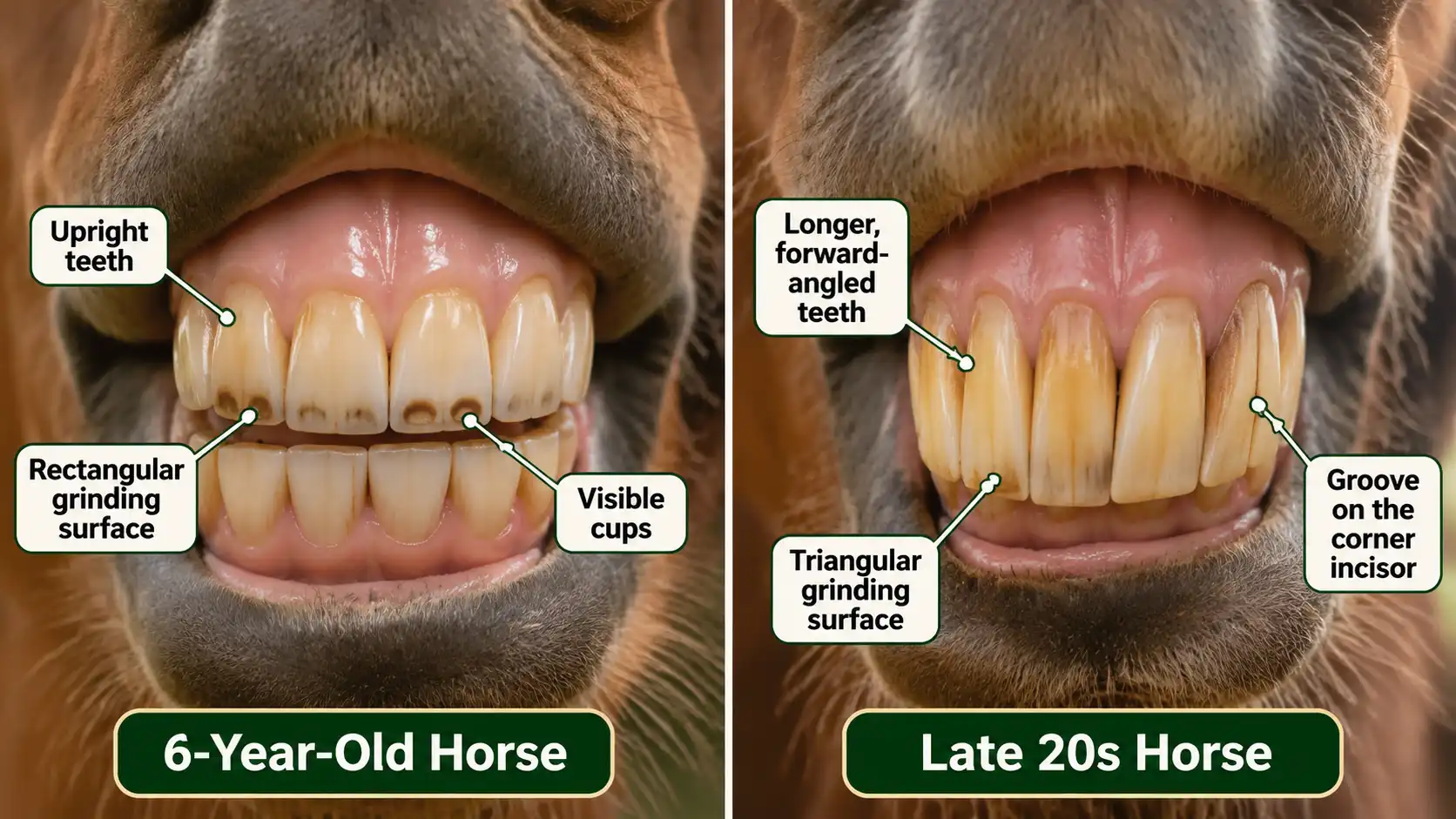
Teeth give the clearest clues before age 12, when the last cups wear away. After that, the signs change more slowly and estimates widen. Utah State University Extension calls aging by teeth “not an exact science,” but its guidelines still narrow the range.
| Age | What the incisors show |
|---|---|
| 5 years | Full mouth: all permanent teeth in wear |
| 6 to 8 years | Cups wear away on the lower incisors, centrals first |
| 9 to 11 years | Cups wear away on the upper incisors |
| 9 years to mid-teens | Grinding surface turns from rectangular to rounded |
| 10 years | Galvayne’s groove appears on the corner incisor |
| 12 years and older | Smooth mouth: all cups gone |
| 15 years | Galvayne’s groove reaches halfway down the tooth |
| Late teens and older | Grinding surface turns triangular; teeth angle forward |
| 20 years | Galvayne’s groove runs the full length of the tooth |
| 25 years | Only the lower half of the groove remains |
| 30 years | The groove is gone |
Diet and habits shift the pattern. Utah State notes that cribbing, for example, can wear down the upper incisors and throw off normal wear. Registration papers or breeder records are the only exact proof of age. Ask for them before buying an older horse.
Plan for the Full Lifespan Before You Buy
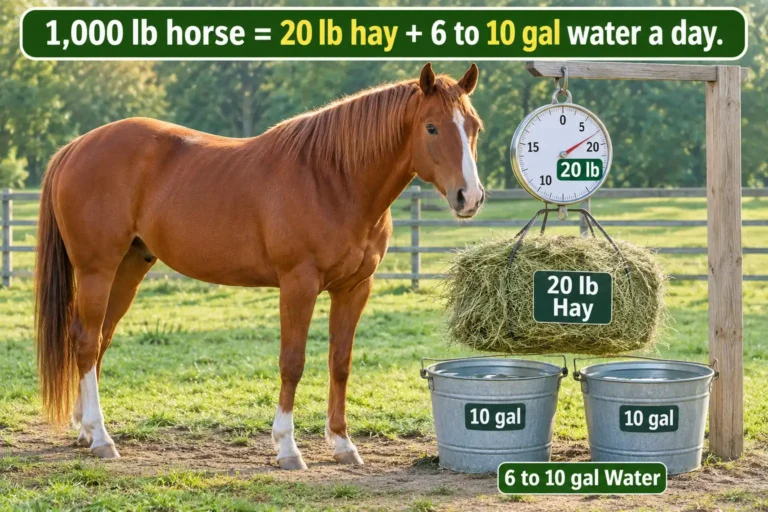
A horse’s remaining years set your hay bill, your vet budget, and who cares for it if your plans change. University of Minnesota Extension says most horses should eat about 2 percent of body weight in hay daily. For a 1,000 pound horse, that is 20 pounds a day, or about 3.65 tons a year. At 50 pounds per small square bale, that comes to roughly 146 bales a year before waste.
Here is the hay total if the horse reaches 30:
| Age when you buy | Years of care to age 30 | Hay at 20 lb a day | Small square bales at 50 lb |
|---|---|---|---|
| 5 | 25 | About 91 tons | About 3,650 |
| 10 | 20 | 73 tons | 2,920 |
| 15 | 15 | About 55 tons | 2,190 |
| 20 | 10 | 36.5 tons | 1,460 |
Adjust for the horse in front of you. Minnesota Extension targets 1.5 percent of body weight for easy-keeping horses and 2.5 percent for hard keepers. Add waste as well. Minnesota reports about 7 percent waste on small squares fed indoors without a feeder, against 1 percent with one. Outdoors, round bales can lose up to 57 percent without a feeder.
Late in life, a horse with worn teeth may move from hay to senior pellets. So the feed bill changes shape rather than shrinking. Fold these totals into your yearly feed and water planning so storage keeps pace.

Planning for the End of a Horse’s Life
A long life is a good outcome only while the horse stays comfortable. Sometimes care can no longer control pain, weight loss, or immobility. At that point, euthanasia by a veterinarian ends suffering that nothing else will relieve. That decision is easier to make well before a crisis.
Most operations already plan ahead. In USDA APHIS’s 2015 study, 59.8 percent of operations had an end-of-life plan for their equids. Among operations keeping equids 20 or older, the figure rose to 71.0 percent.
Oklahoma State Extension suggests settling three points with everyone involved in the horse’s care:
- The circumstances in which you will choose euthanasia
- Who will perform it
- How you will handle the body
Carcass disposal rules differ by state, so check with your state veterinarian’s office or county extension office ahead of time. Your veterinarian can also walk you through quality of life signs to watch as the horse ages.
FAQs About Horses Lifespan
Can a horse live to 40?
Yes, a horse can live to 40, but it is rare. In USDA APHIS’s 2005 study, under 1 in 100 US equids had reached 30, so 40 is a true outlier.
How old is a 20-year-old horse in human years?
A 20-year-old horse is roughly 60 in human years, right where USDA APHIS starts calling horses geriatric. The estimate assumes full maturity at 5, then about 2.5 human years per horse year.
At what age do horses stop growing?
Horses are fully mature by 4 to 5 years, per USDA APHIS, with height and bone development matching older horses. Sexual maturity comes a little earlier, at about 3 to 4 years.
How long can you ride a horse?
Many horses keep working into their 20s, per University of Georgia Extension. Let soundness, body condition, and comfort under saddle decide when to retire an older horse, not its age alone.
Is a 15-year-old horse too old to buy?
No, a healthy 15-year-old may have more than a decade of life ahead. Ask a veterinarian to check its teeth and soundness, and to discuss PPID screening, before you buy.
How can you tell a horse’s age without papers?
Look at the incisors, which give the clearest clues before age 12. Utah State University Extension notes cups wear away between 6 and 11, and Galvayne’s groove appears at about 10.
What do older horses usually die of?
Old age is the most common cause for horses 20 and older, per USDA APHIS. Colic, cancer, neurologic problems, and chronic weight loss follow, each near 12 to 13 percent of deaths.
Putting This Into Practice
Plan for a horse to reach its late 20s or early 30s, and budget hay and vet care to match. From the late teens on, track weight and body condition on a schedule. Book dental checks once or twice a year, and ask your veterinarian about PPID testing. Then settle the end-of-life plan while the horse is still healthy, so you can make the hardest decision calmly.