How Much Does a Cow Weigh? Beef, Dairy, Bull, and Half a Cow
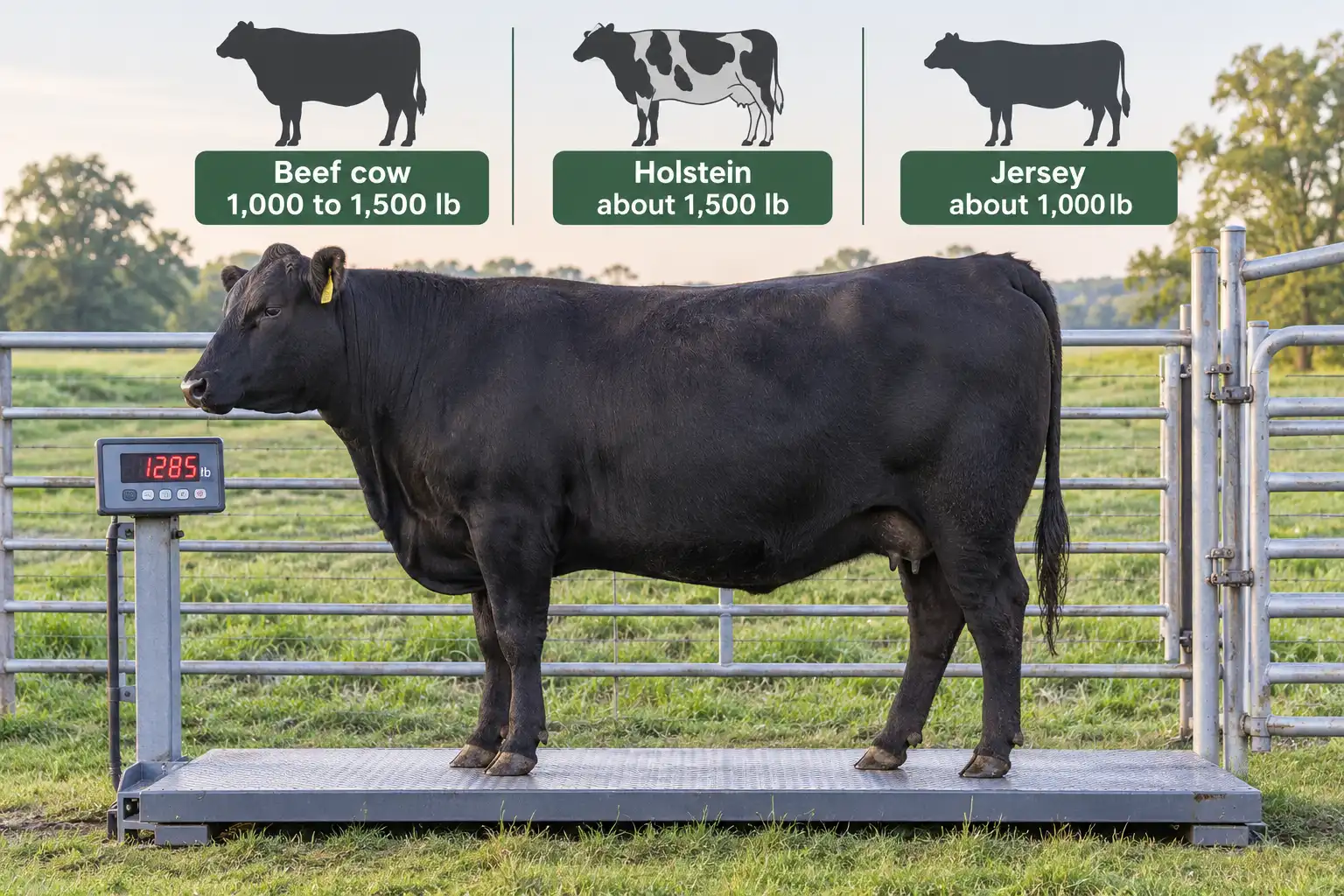
Ask how much does a cow weigh, and the answer is a range. Breed, sex, age, and body condition set it. Below are published figures for beef cows, dairy cows, bulls, and calves, carried through to hay, pasture, and half a cow.
A full grown beef cow weighs about 1,000 to 1,500 pounds, depending on frame size, per Texas A&M AgriLife Extension. Dairy cows vary by breed: Michigan State Extension puts a mature Holstein near 1,500 pounds and a Jersey near 1,000.
Cow, Heifer, Steer, or Bull: Which Weight Do You Need?
A cow is a female that has calved at least once. She is also not the animal behind most average cow weight figures you see quoted.
Four classes share the word “cow” in everyday talk:
- Cow: a female that has had a calf
- Heifer: a young female that has not calved
- Steer: a castrated male raised for beef
- Bull: an intact male kept for breeding
USDA NASS reported an average live weight of 1,432 pounds for federally inspected cattle slaughtered in 2025, up 33 pounds from 2024. However, steers made up 49.7 percent of that slaughter and heifers 31.7 percent. Dairy cows were just 9.0 percent. So that figure mostly describes finished young cattle at market, not mature cows on pasture.
The monthly figure keeps rising, too. USDA NASS put the August 2026 average at 1,441 pounds, 28 pounds above August 2025.
USDA NASS tracks slaughter weights, not the weight of cows standing in pastures. As a result, no single national figure exists for a mature beef cow. The ranges below come from extension frame score data and breed figures instead.
How Much Does a Beef Cow Weigh?
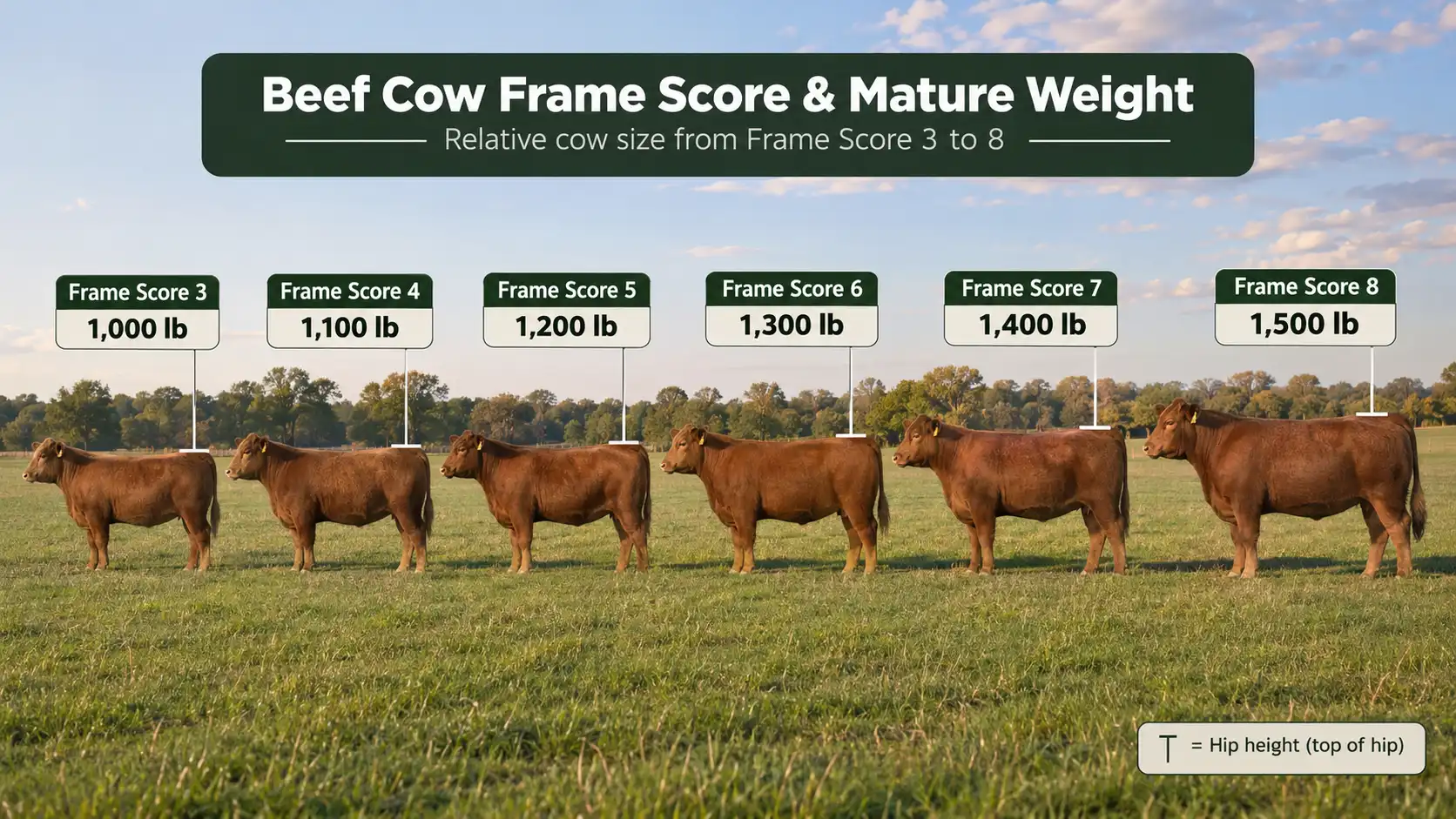
A mature beef cow weighs about 1,000 to 1,500 pounds, and frame size sets where she falls. Texas A&M AgriLife Extension ties mature weight to frame score, a measure of skeletal size taken at the hip. Its figures assume a body condition score of 5 on the 1 to 9 scale.
| Frame score | Mature cow weight | Mature bull weight |
|---|---|---|
| 3 | 1,000 lb | 1,570 lb |
| 4 | 1,100 lb | 1,730 lb |
| 5 | 1,200 lb | 1,890 lb |
| 6 | 1,300 lb | 2,050 lb |
| 7 | 1,400 lb | 2,200 lb |
| 8 | 1,500 lb | 2,360 lb |
For a breed example, Texas A&M AgriLife cites an analysis of American Angus Association records. In it, mature Angus cows of mid-5 frame and mid-5 condition averaged about 1,245 pounds. Weight moved about 95 pounds for each frame score step.
Breed type matters as well. Michigan State Extension notes that British breeds such as Angus and Hereford mature and fatten earlier than Continental breeds. So compare frame and mature size when you look across beef cattle breeds.
How Much Does a Full Grown Cow Weigh?
A full grown beef cow weighs her mature weight, usually 1,000 to 1,500 pounds, once she stops growing. In the Angus analysis Texas A&M AgriLife cites, cows counted as mature at 4 to 7 years old. So a 2 year old first-calf heifer still weighs less than she will at maturity.
Why Today’s Cows Outweigh Older Charts
Cow size keeps climbing. Oklahoma State Extension reports mature cow weight rose an average of 7.7 pounds a year over the past 60 years. The pace reached nearly 19 pounds a year between 1995 and 2005.
Carry that through. Sixty years at 7.7 pounds is about 460 pounds of added cow. As a result, a weight chart from an older bulletin can run light for today’s herd.
How Much Does the Average Dairy Cow Weigh?
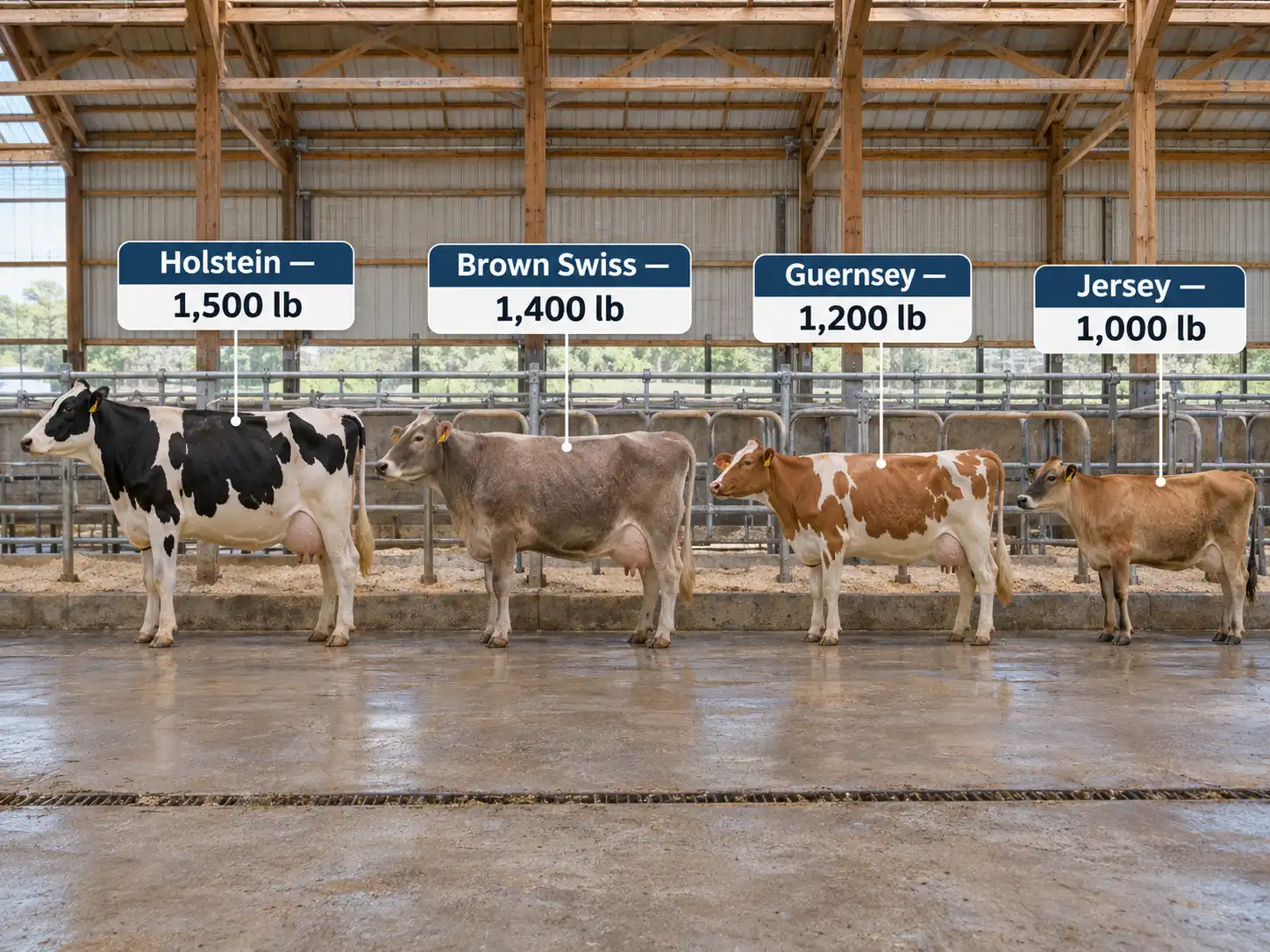
The average dairy cow weighs 1,000 to 1,500 pounds, and breed decides most of that spread. Michigan State Extension gives these mature cow weights:
| Breed | Mature cow weight |
|---|---|
| Holstein | about 1,500 lb |
| Brown Swiss | 1,300 to 1,400 lb |
| Guernsey | 1,200 to 1,300 lb |
| Jersey | about 1,000 lb |
Holstein figures differ by source. Michigan State Extension puts a mature Holstein near 1,500 pounds and 58 inches at the shoulder. University of Wisconsin Extension, however, builds its heifer targets on a herd mature weight of 1,650 pounds. It also notes Holsteins have grown heavier and taller over the past 10 to 20 years.
So plan on 1,500 to 1,650 pounds for a mature Holstein. Then weigh a few of your own mature cows to see where your herd sits. Body size also sets feed and stall needs, so it belongs in any comparison of dairy cattle breeds.
Dairy Heifer Weight Targets
University of Wisconsin Extension recommends breeding Holstein heifers at 55 percent of herd mature weight. For a herd with a 1,650 pound mature weight, its benchmarks run:
| Stage | Target weight | Share of mature weight |
|---|---|---|
| Breeding | 825 to 900 lb | 55% |
| Just before calving | 1,550 lb | 92 to 94% |
| Just after calving | 1,350 lb | 83 to 85% |
Swap in your own herd’s mature weight and the targets shift with it.
How Much Does a Bull Weigh?
A mature beef bull weighs about 1,570 to 2,360 pounds, per Texas A&M AgriLife Extension frame score data. Bulls run 55 to 60 percent heavier than cows of the same frame score. For example, in a herd of frame 5 cows near 1,200 pounds, a mature frame 5 bull weighs about 1,890.
Young bulls are far lighter. Texas A&M AgriLife puts a yearling bull at 50 to 60 percent of mature weight under most development programs. So a bull headed for 2,000 pounds should weigh roughly 1,000 to 1,200 pounds at 12 months.
That gap matters at the chute and on the trailer. Size gates, alleys, and headgates for the heaviest animal you work, not the average one. The same rule applies when you shop for cattle handling equipment.
Calf Weight From Birth to Yearling
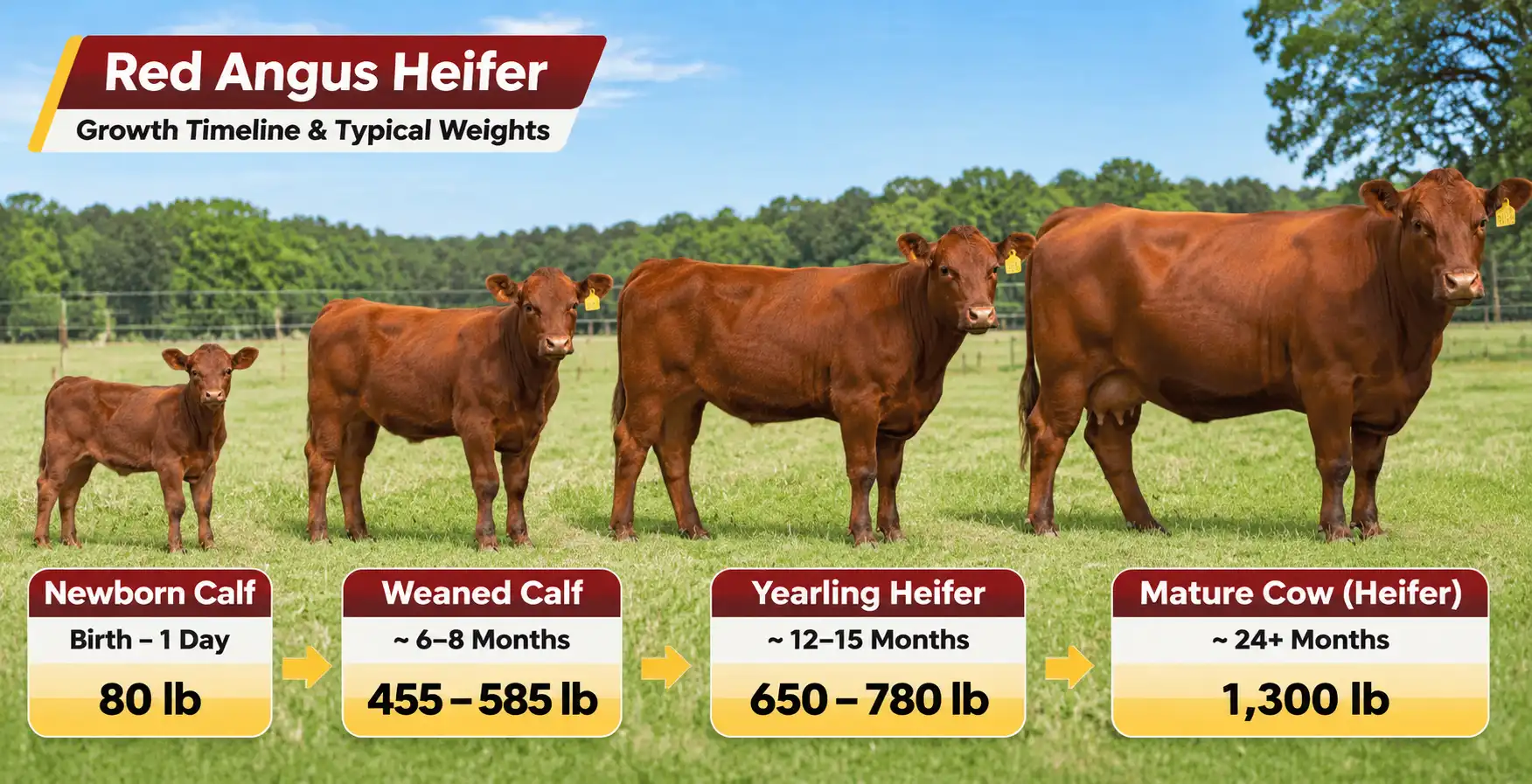
A beef calf weighs about 80 pounds at birth. Oklahoma State research recorded an average of 82.2 pounds for spring-born calves. Fall-born calves averaged 77.7 pounds, and all were sired by Salers or Limousin bulls. In that work, cows in late pregnancy during hot weather delivered lighter calves.
After birth, growth follows mature size. Texas A&M AgriLife Extension says cattle reach 35 to 45 percent of mature weight by 7 months. By 12 months, they reach 50 to 60 percent. Here is what that means for a heifer headed to a 1,300 pound mature weight:
| Age | Share of mature weight | Expected weight |
|---|---|---|
| Birth | about 6% | about 80 lb |
| 7 months, near weaning | 35 to 45% | 455 to 585 lb |
| 12 months | 50 to 60% | 650 to 780 lb |
| Mature, 4 years and up | 100% | 1,300 lb |
Bigger cows do not wean much bigger calves, though. Oklahoma State Extension finds each extra 100 pounds of mature cow weight adds only about 10 pounds of weaning weight. That means a 1,400 pound cow weans a calf about 40 pounds heavier than a 1,000 pound cow.
Body Condition Changes the Scale Reading
A cow’s weight swings 7 to 8 percent per body condition score, per Texas A&M AgriLife Extension. The same publication notes that a 1,200 pound cow in medium condition can weigh about 900 pounds when extremely thin. At the other end, she can reach 1,600 pounds when extremely fat.
Run that on a 1,300 pound cow at condition score 5. Dropping to a 4 takes off roughly 90 to 105 pounds. Her frame has not changed, only her flesh.
So record a condition score every time you weigh. Otherwise, a thin year looks like a herd of smaller cows. Weigh at the same point each year as well, such as at weaning, so the readings compare.
Unexplained weight loss is a different matter. Several health problems cause it, and a scale cannot tell them apart, so call a large animal veterinarian.
How Much Does Half a Cow Weigh?
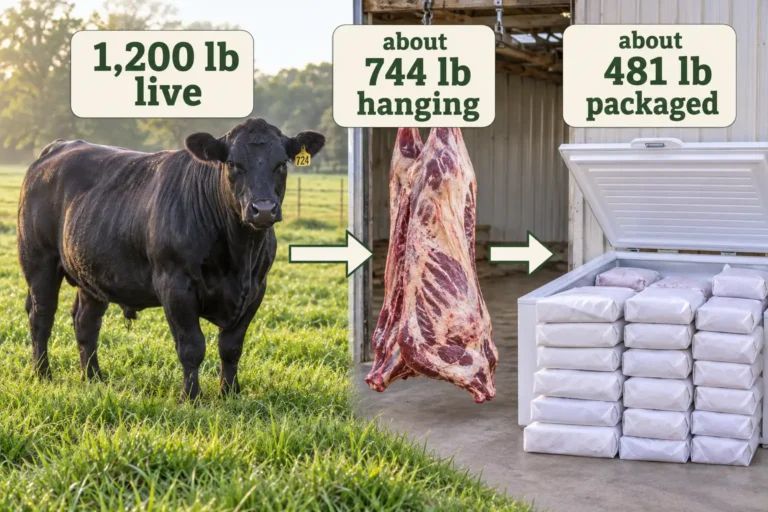
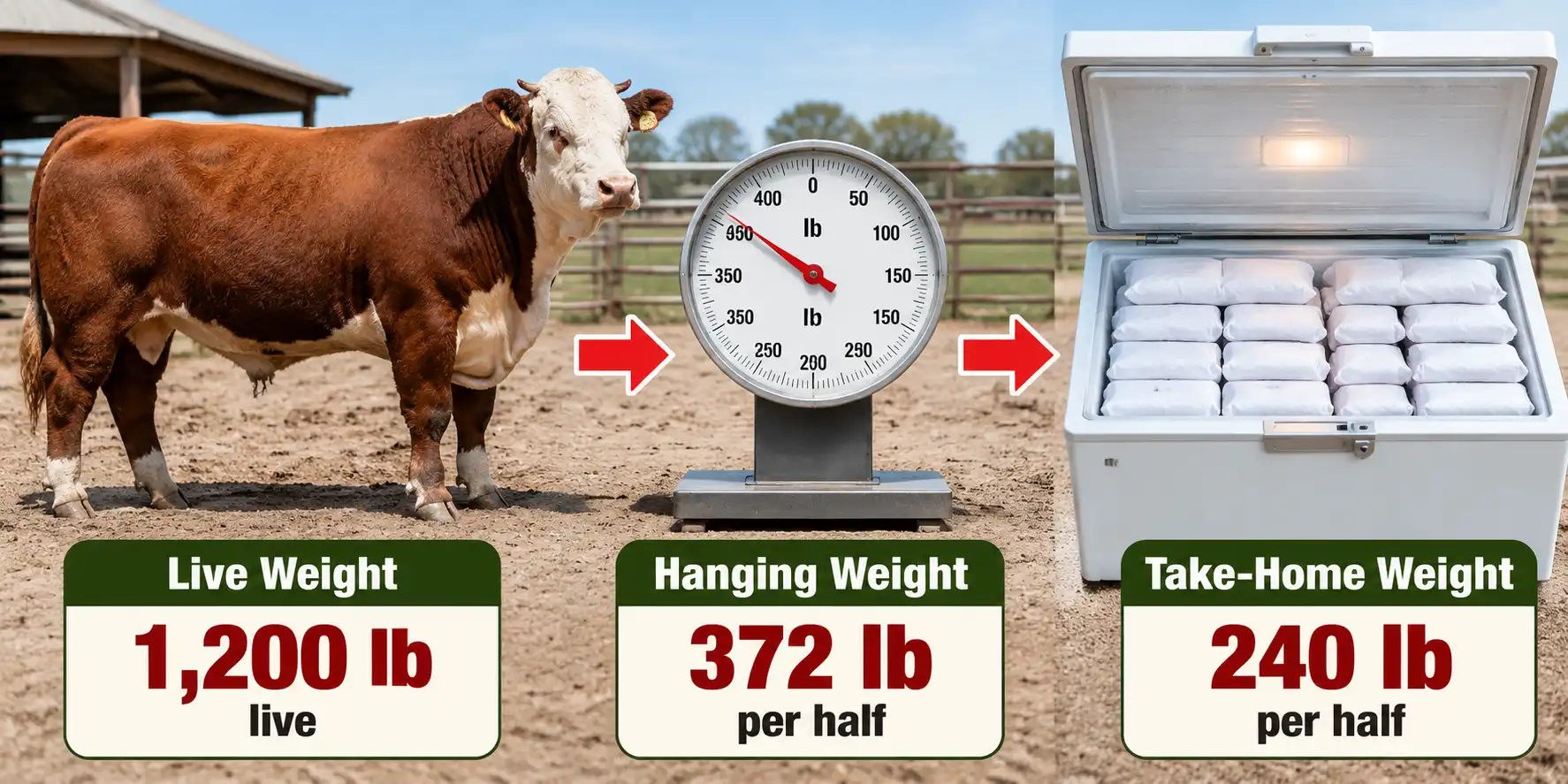
Half of a 1,200 pound steer gives about 372 pounds of hanging weight and roughly 240 pounds of take-home beef. Those figures follow University of Wisconsin Extension’s beef yield example.
“Half a cow” is a side of beef. It usually comes from a finished steer or heifer, not a mature cow. A steer at the 2025 USDA NASS slaughter average of 1,432 pounds would hang about 444 pounds per half. Finishing targets for finished cattle set how big that half will be.
| Live weight | Whole hanging weight | Half hanging weight | Half take-home beef |
|---|---|---|---|
| 1,000 lb | 620 lb | 310 lb | about 200 lb |
| 1,200 lb | 744 lb | 372 lb | about 240 lb |
| 1,400 lb | 868 lb | 434 lb | about 280 lb |
We applied Wisconsin’s percentages to the 1,000 and 1,400 pound rows. Your own animal will differ with fat cover and your cut sheet.
Hanging Weight vs Take-Home Weight
Three weights apply to bulk beef, and sellers quote different ones. Ask which one sets the price before you order.
- Live weight is the animal on the scale before harvest.
- Hanging weight is the carcass after the head, hide, feet, and organs come off. Wisconsin’s example uses a 62 percent dressing percentage, so a 1,200 pound steer hangs at 744 pounds.
- Take-home weight is the cut and wrapped meat. The carcass loses about 3.5 percent while chilling, and then about 67 percent of it becomes retail cuts. That leaves 481 pounds for the whole animal.
Boneless cuts and heavy trim pull the take-home figure lower. Bone-in steaks and roasts keep it higher.
Why Cow Weight Matters for Hay and Pasture
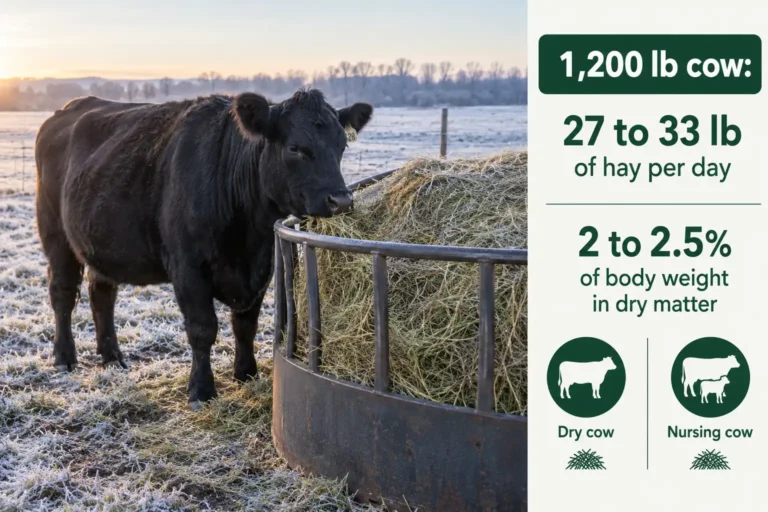
Heavier cows eat more, so cow weight drives your hay bill and your carrying capacity. Oklahoma State Extension found each extra 100 pounds of cow weight added about 1.4 pounds of daily hay intake. Over a year, a 1,400 pound cow needs about 1,861 more pounds of forage dry matter than one at 1,100.
Scale that to a herd. Thirty cows that each carry 300 extra pounds need roughly 56,000 more pounds of forage dry matter a year. That is close to 28 tons.
Pasture feels it too. Oklahoma State Extension figures that forage for 100 cows at 1,000 pounds carries only 71 at 1,400 pounds. So if your cows have grown, an old head count may now overstock the place.
Recheck your stocking rate for your pasture with current weights. Then rebuild the winter budget from daily hay intake at today’s cow size, not the size in an old chart.
How to Weigh a Cow Without a Scale
A weight tape gives a usable estimate when no scale is handy. Penn State Extension reports weight tapes read within 3 to 5 percent for dairy cattle over 330 pounds. For calves of 110 to 330 pounds, accuracy drops to 5 to 8 percent. Penn State built its tapes on Holstein research, and its dairy cow tape covers animals up to 2,125 pounds.
Eyeballing is far worse. University of Wisconsin Extension cites a study of dairy farmers’ guesses. They misjudged cow weights 81 percent of the time, by 214 pounds on average.
To use a tape:
- Stand the animal on level ground with her head up, because a lowered head changes the chest reading.
- Wrap the tape around the heart girth, just behind the front legs and shoulder blades.
- Pull it snug but not tight, since a tight tape reads low.
- Brush off mud or manure first, because it adds to the reading.
Use a tape made for the breed and age you are measuring. For sale weights, a scale is still the standard.
Many cattle product labels set the amount by body weight. A tape reading is a starting point only, so read the label and confirm the amount with your veterinarian.
FAQs About Cow Weigh
How much does a cow weigh in tons?
A mature beef cow weighs roughly half a ton to three quarters of a ton, per Texas A&M AgriLife Extension. That equals 1,000 to 1,500 pounds by frame size, and a large Holstein can top three quarters of a ton.
How much does a cow weigh in kilograms?
A mature beef cow weighs about 450 to 680 kilograms, which equals 1,000 to 1,500 pounds. A mature Holstein near 1,500 pounds weighs about 680 kilograms, and a Jersey near 1,000 pounds about 450.
How much meat do you get from half a cow?
Half of a 1,200 pound steer yields roughly 240 pounds of cut and wrapped beef, per University of Wisconsin Extension. Hanging weight for that half runs about 372 pounds before chilling and trim.
How much does a newborn calf weigh?
A newborn beef calf averages about 78 to 82 pounds in Oklahoma State research on Salers and Limousin sired calves. Fall-born calves in that work came in about 4.5 pounds lighter than spring-born calves.
Can I tell a cow’s weight just by looking at her?
Not with any accuracy, according to a study cited by University of Wisconsin Extension. Dairy farmers misjudged cow weights 81 percent of the time, by 214 pounds on average, so use a scale or tape.
Do cows weigh more today than in the past?
Yes, mature beef cows keep getting heavier, per Oklahoma State Extension. Their weight has risen 7.7 pounds a year on average over 60 years, so older charts often understate today’s cows.
Key Points for Your Herd
Start with the right animal. A mature beef cow runs 1,000 to 1,500 pounds by frame size. The 1,432 pound USDA figure describes market steers and heifers.
Next, weigh a sample of your own mature cows at weaning, and record condition score with each weight. Those weights belong in your hay budget and your head count. Forage for 100 small cows carries far fewer large ones.