How Long Do Cows Live? Dairy, Beef and Highland Lifespans

A cow can live about 20 years. Very few do. How long cows live on a working operation depends on the job: milking, raising calves, or going to market. Those answers sit years apart.
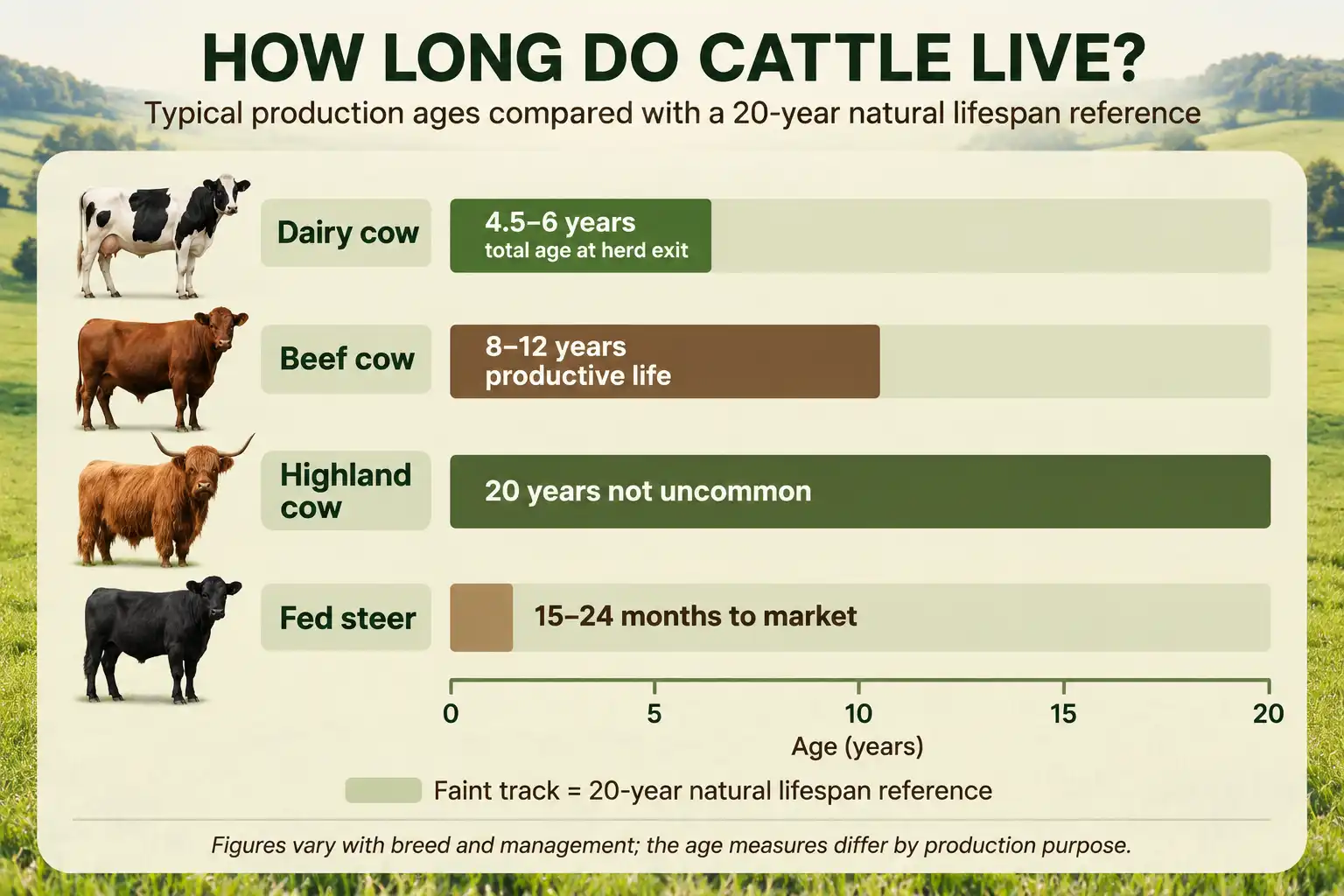
Cows can live about 20 years, per Penn State Extension. In U.S. herds, dairy cows leave at 4.5 to 6 years, beef cows often stay productive to about 10, and most fed steers are harvested before age 2.
Cow Lifespan: Natural Life Expectancy vs Herd Life
The natural life expectancy of a cow is about 20 years. Penn State Extension gives that figure for dairy cows and notes that modern dairies very rarely see it.
So two numbers matter. Natural lifespan is how long a cow can live. Herd life is how long she stays on the operation before she is sold, culled, or dies.
On most farms, herd life ends first. A cow keeps her place only while she pays her way. Once she stops breeding back, loses teeth, or falls behind on milk, she usually goes to market.
| Type of cattle | Typical age leaving the herd | Source |
|---|---|---|
| Dairy cow | 4.5 to 6 years | Penn State Extension |
| Beef cow | Rebreeding declines after about 10 years | Mississippi State Extension |
| Highland cow | May produce into late teens | American Highland Cattle Association |
| Fed steer or heifer | 20 months or younger for about 90 percent | USDA carcass maturity study |
| Any cow, natural lifespan | About 20 years | Penn State Extension |
How Long Do Dairy Cows Live?
Dairy cows in the United States usually live 4.5 to 6 years. Penn State Extension builds that range from two facts. Cows first calve near age 2, and most stay in the milking herd only 2.5 to 4 years after that.
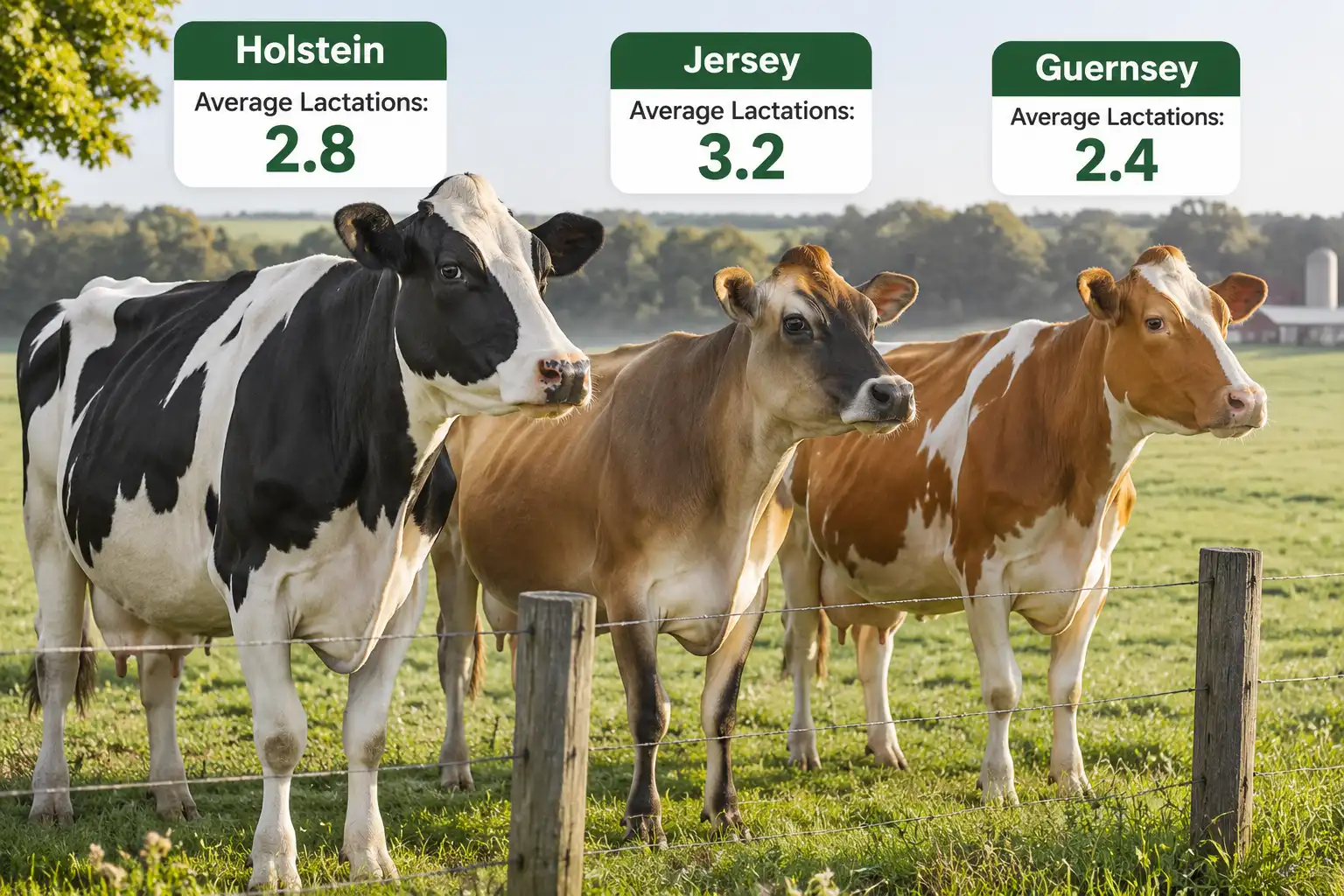
In lactation terms, the average milk cow completes fewer than three. A USDA Agricultural Research Service study of 13.8 million cows in Dairy Herd Improvement herds put Holsteins at 2.8 lactations. As a result, many cows leave before their most profitable years.
Herd life is also one of the clearest measures of how a dairy herd is doing. Cows that stay longer have usually had fewer health problems along the way.
Dairy Cow Lifespan by Breed
Breed shifts herd life a little. The USDA study tracked cows that first calved in 1994 and found these averages.
| Breed | Average lactations | Approximate age leaving herd |
|---|---|---|
| Jersey | 3.2 | 5.5 years |
| Ayrshire | 2.9 | 5.1 years |
| Brown Swiss | 2.9 | 5.1 years |
| Holstein | 2.8 | 5.0 years |
| Guernsey | 2.4 | 4.6 years |
The age column is our arithmetic. It assumes first calving at 24 months and a 13-month calving interval. The data come from an older group of cows. So read the gaps between breeds as relative, not as current averages.
Why Dairy Cows Leave the Herd So Young
Most dairy cows leave for health or fertility, not age. In the 2018 USDA NAHMS dairy study, Northeastern herds culled 31.4 percent of cows a year. They lost another 6.2 percent to death, per Penn State Extension. Together, that removes 37.6 percent of the herd every year.
The usual reasons are failure to breed back, mastitis, lameness, and low milk yield. Each one is a health or management problem first.
That turnover is a welfare question as well as a cost. A cow that leaves at 5 has lived about a quarter of her natural lifespan. Penn State Extension calls the short lifespan a problem the industry has recognized for decades.
Now scale it to your barn. At a 37.6 percent removal rate, a 100-cow dairy needs about 38 replacement heifers every year just to hold herd size.
Do Family Milk Cows Live Longer?
Published data on this is limited. The USDA herd-life figures come from Dairy Herd Improvement records, which mostly cover commercial herds.
A family cow milked once a day carries less production pressure. She may stay longer, but no extension trial has measured how much longer. Plan around the commercial figures, then treat any extra years as a bonus.
How Long Do Beef Cows Live?
Beef cows usually stay productive to about 10 years, roughly twice as long as dairy cows. They carry no milking load, and they keep their place as long as they wean a calf every year.
NDSU Extension says most beef cows enter the herd as 2-year-olds. They produce best from 5 to 9 and then start to drop off. Similarly, Mississippi State Extension found consistent rebreeding through about 8 years, a decline after 10, and a steeper drop after 12.
Individual cows can go well past that. Even so, most herds cull before the sharp decline, while the cow is still sound enough to sell well. Mississippi State Extension notes that cull cow sales usually make up 15 to 20 percent of gross income on a cow-calf operation. So the timing of that sale matters.
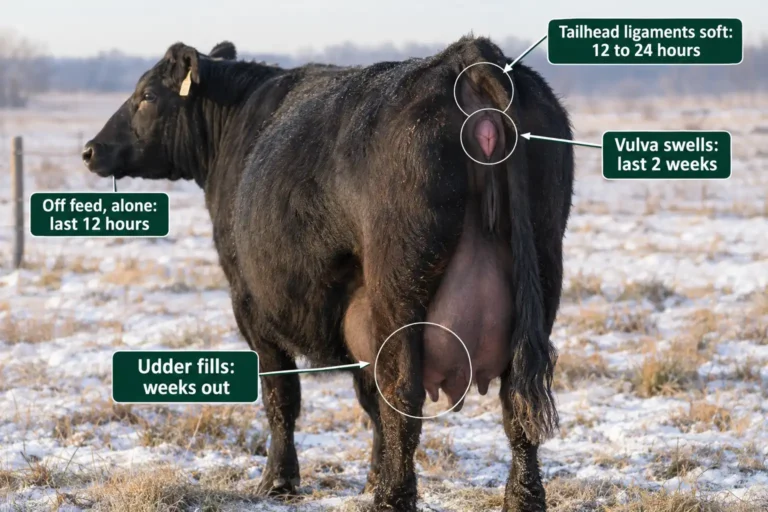
Calving trouble also ends careers early. Knowing the signs a cow is close to calving helps you catch a hard birth before it costs the cow or the calf.
How Calf Weight Changes With Cow Age
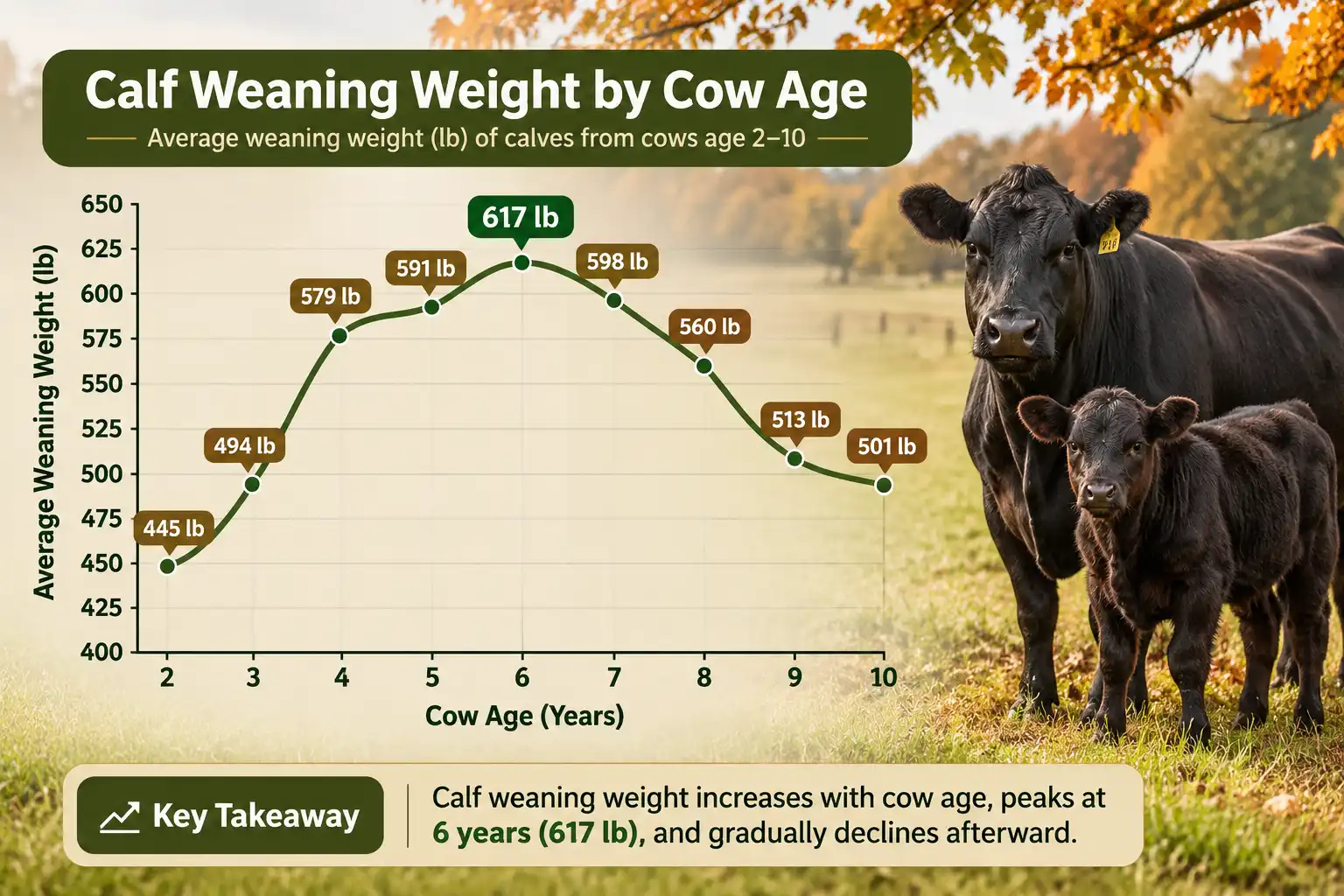
Cow age shows up on the scale at weaning. At the NDSU Dickinson Research Extension Center, average calf weaning weight by cow age in 2002 ran as follows.
| Cow age | Average calf weaning weight |
|---|---|
| 2 years | 445 lb |
| 3 years | 494 lb |
| 4 years | 579 lb |
| 5 years | 591 lb |
| 6 years | 617 lb |
| 7 years | 598 lb |
| 8 years | 560 lb |
| 9 years | 513 lb |
| 10 years and older | 501 lb |
That is one herd in one year, so read the shape more than the exact weights. Still, the pattern is clear. A cow 10 or older weaned about 116 pounds less calf than a 6-year-old. Across 30 older cows, that adds up to roughly 3,500 pounds of calf a year.
Brahman-Influenced Cows Often Last Longer in the South
Crossbred cows with Brahman blood tend to stay productive longer, especially in the Southeast and along the Gulf Coast. Texas A&M AgriLife Research at Overton kept F1 Brahman x Hereford cows to age 14. By then, they had averaged 12 calves each.
Teeth are a big part of the reason. Texas A&M breeding research has found that Bos indicus by British crosses usually keep sound mouths longer than straightbred cows. A cow that can still graze can still hold condition.
If you are weighing beef cattle breeds for a hot, humid region, that extra herd life belongs in the decision. Fewer replacements a year offsets some of the other tradeoffs.
How Long Do Highland Cows Live?
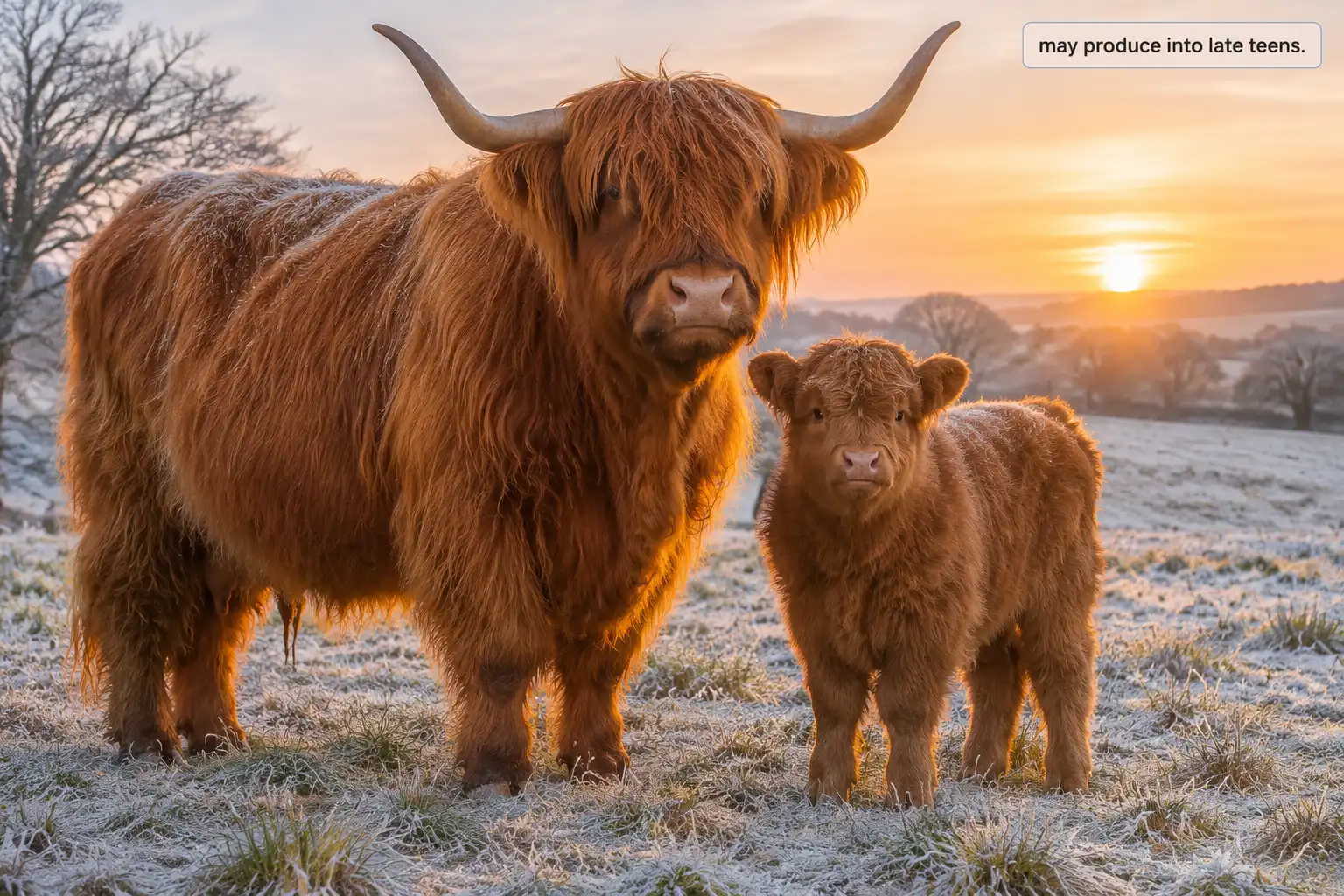
Highland cows have a reputation for long productive lives. The American Highland Cattle Association says cows may produce into their late teens, which reduces how often a herd needs replacements.
The association also credits small calves, about 60 to 70 pounds at birth, with less calving difficulty. Hard calvings are one of the common reasons beef cows leave early, so that trait supports the longevity claim.
However, those are the breed association’s own figures. Independent extension trials on Highland longevity are thin. For that reason, we cannot confirm how the breed compares head to head with Angus or Hereford cows under the same management.
Management also plays a part. Many Highland herds are small and lightly pushed. A cow kept for grazing and a calf a year has fewer reasons to leave, in any breed.
How Old Are Cows When Slaughtered?
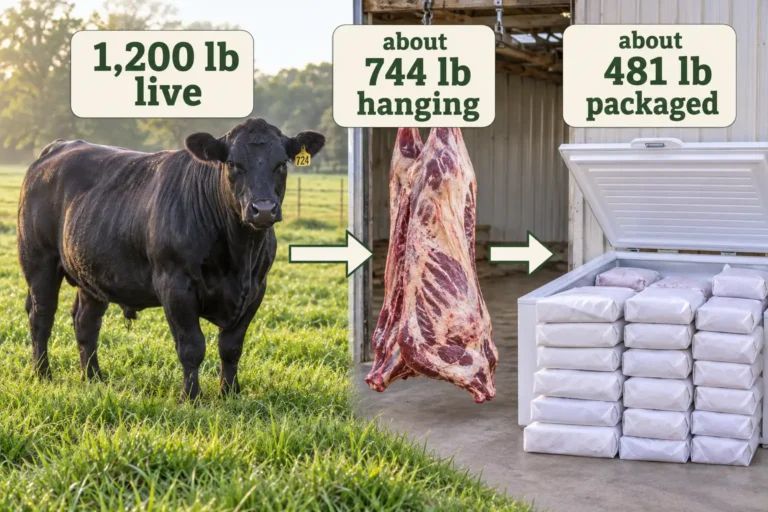
Most beef comes from steers and heifers under 2 years old, not from cows. In a USDA carcass maturity study, about 90 percent of graded steers and heifers were 20 months or younger. Only outliers were older than 24 months.
USDA describes the usual path in three stages. Calves wean near 6 months and graze for six to eight months. Then they spend three to four months in a feedlot for finishing. Most reach harvest within 15 to 18 months of birth.
Mature cows go to slaughter as culls, and their ages vary far more.
| Animal | Typical age at slaughter | Source |
|---|---|---|
| Fed steer or heifer | 15 to 18 months for most | USDA |
| Dairy cull cow | 4.5 to 6 years | Penn State Extension |
| Beef cull cow, culled for age | About 10 years or older | Mississippi State Extension |
A beef cow can also be culled young if she comes up open or has a bad udder. Age matters at the plant, too. USDA requires removal of specified risk materials, including the vertebral column, from cattle 30 months and older.
What Shortens a Cow’s Productive Life?
Most cows leave the herd for a problem, not for old age. Mississippi State Extension lists the main factors in a culling decision: pregnancy status, performance, age, mouth, udder, structural soundness, health, and disposition.
Here is how each one plays out:
- Open cows. A cow that fails to conceive eats a year of feed and produces no calf.
- Teeth. Worn or missing incisors, called a broken mouth, make grazing harder, so she loses condition.
- Udder. Large teats or a weak udder floor make nursing hard for calves. In dairy cows, repeat mastitis is a leading cause of culling.
- Feet and legs. A lame cow eats less, breeds back poorly, and falls behind.
- Disposition. A dangerous cow rarely gets a second chance, whatever her calf record.
- Low performance. Late calving or light calves year after year push her down the list.
A cow losing weight or going lame can have several causes, from teeth to infection to parasites. Have a large animal veterinarian examine her before you decide she is simply getting old.
How to Tell How Old a Cow Is
Records are the most reliable way. A birth date tied to an ear tag or a registration number gives you the exact age.
Without records, teeth give a rough estimate. Cattle have eight incisors on the lower jaw and none on the upper, just a hard dental pad. The baby incisors give way to permanent pairs in a fairly predictable order. After that, age is judged by wear.
Mississippi State Extension publishes a dentition guide, Publication 2779, with photos of each stage. It is worth keeping on hand when you buy older cows at a sale.
Keep in mind that teeth wear faster on sandy or gritty pasture. As a result, a mouth can look older than the cow actually is. Once all the permanent incisors are in, any estimate gets less precise.
How Herd Life Sets Your Replacement Needs
The longer your cows stay, the fewer heifers you raise or buy. You can work out your own number in three steps.
- Find your average herd life. Average how many calving seasons your cows stayed before they left. Use the last five years of records if you have them.
- Divide 100 by that number. The result is the percentage of the herd you replace each year.
- Apply it to your herd size. Multiply that percentage by your cow count.
For example, take a 40-cow beef herd where cows average 6 seasons. That is 100 ÷ 6, or about 17 percent, so you need about 7 replacement heifers a year. If those same cows average 8 seasons, the rate falls to 12.5 percent, or 5 heifers. That is two fewer heifers to develop every year.
Then add a margin. Not every heifer you keep will breed and stay, so most herds develop a few more than the math says. Build that number into your breeding plan before the season starts.
Caring for an Older Cow
Older cows often need more help holding condition, especially through winter. NDSU Extension makes the point that the youngest and oldest cows both need extra care.
A few steps help:
- Sort them. Feed older and thin cows apart from younger, pushier cows so they get their share.
- Score them. Check body condition before winter, when there is still time to add weight.
- Feed softer forage. Worn teeth handle leafy, high-quality hay better than coarse, stemmy hay.
- Watch the mouth. A cow dropping cud or wads of hay may be having tooth trouble.
Older cows also tend to eat more than the herd average to hold the same weight. Plan your winter hay needs with that in mind.
Keeping an old cow is also a welfare choice. A cow that can no longer hold condition, rise easily, or graze comfortably is not well served by another winter. At that point, you have two options: sell her while she is still fit to travel, or arrange humane euthanasia on the farm. Your veterinarian can help with both the decision and the method.
FAQs About Cows Lifespans
Can a cow live to 30 years old?
It is possible, but very rare for any breed in any herd. Penn State Extension puts natural life expectancy near 20 years, so a cow reaching 25 is already an outlier.
How many calves does a cow have in her lifetime?
A Holstein averages about 2.8 calvings before leaving the herd, per USDA herd-life data. Beef cows calve far more often, and Texas A&M F1 Brahman x Hereford cows averaged 12 calves by age 14.
Why are dairy cows slaughtered so young?
Most leave for fertility, udder health, or lameness rather than age. Penn State Extension reports Northeastern dairies remove about 37.6 percent of cows each year, so the average cow is gone by 4.5 to 6 years.
Do Jersey cows live longer than Holsteins?
Slightly, on average, though management matters more than breed. USDA herd-life data showed Jerseys averaging 3.2 lactations against 2.8 for Holsteins, which works out to roughly five more months in the milking herd.
How old do cows get as pets?
Pet and sanctuary cows are not culled, so they can approach the 20-year natural lifespan Penn State Extension describes. As they age, teeth, joints, and winter condition become the main limits.
At what age does a beef cow stop having calves?
There is no fixed age. Mississippi State Extension found reproductive performance declines after about 10 years and drops more steeply after 12, though individual cows can calve well beyond that.
How old is a steer when it goes to market?
Most fed steers reach harvest at about 15 to 18 months. In a USDA carcass study, roughly 90 percent of graded steers and heifers were 20 months old or younger.
Key Points for Your Herd
A cow can live about 20 years, but fertility, teeth, udder, and feet decide how long she stays. Expect dairy cows to leave near 5 and beef cows to stay productive to about 10. Brahman crosses and Highlands often run longer. Track the average age your cows leave, then use it to plan replacements. Every extra year a sound cow stays is one less heifer to raise.