Signs a Cow Is Close to Calving: A Timeline From Weeks to Hours
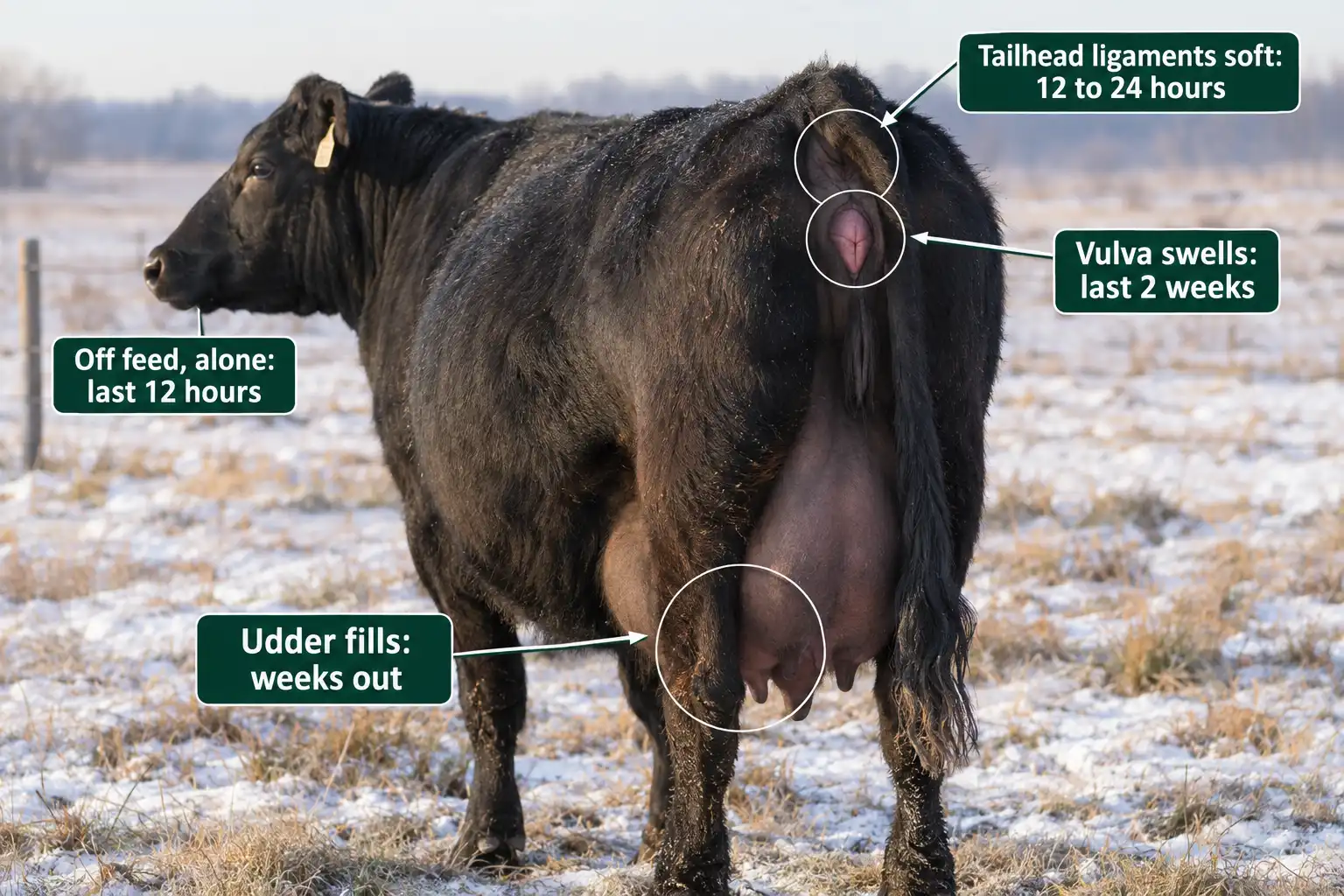
The signs a cow is close to calving show up in a rough order. The udder fills first, then the vulva swells, then the ligaments beside her tailhead go soft. Knowing which sign means weeks and which means hours tells you when to watch her closely.
Soft, sunken ligaments beside the tailhead are the most reliable of the signs a cow is close to calving. They usually mean birth within 12 to 24 hours. A full udder or swollen vulva only means days or weeks.
These signs tell you when to watch. They cannot tell you whether a calving is normal. If labor stalls or anything about the calf looks wrong, call a large animal veterinarian. Oklahoma State Extension notes that the sooner help arrives, the better the survival odds for cow and calf.
Calving Signs in Order, From Weeks to Hours
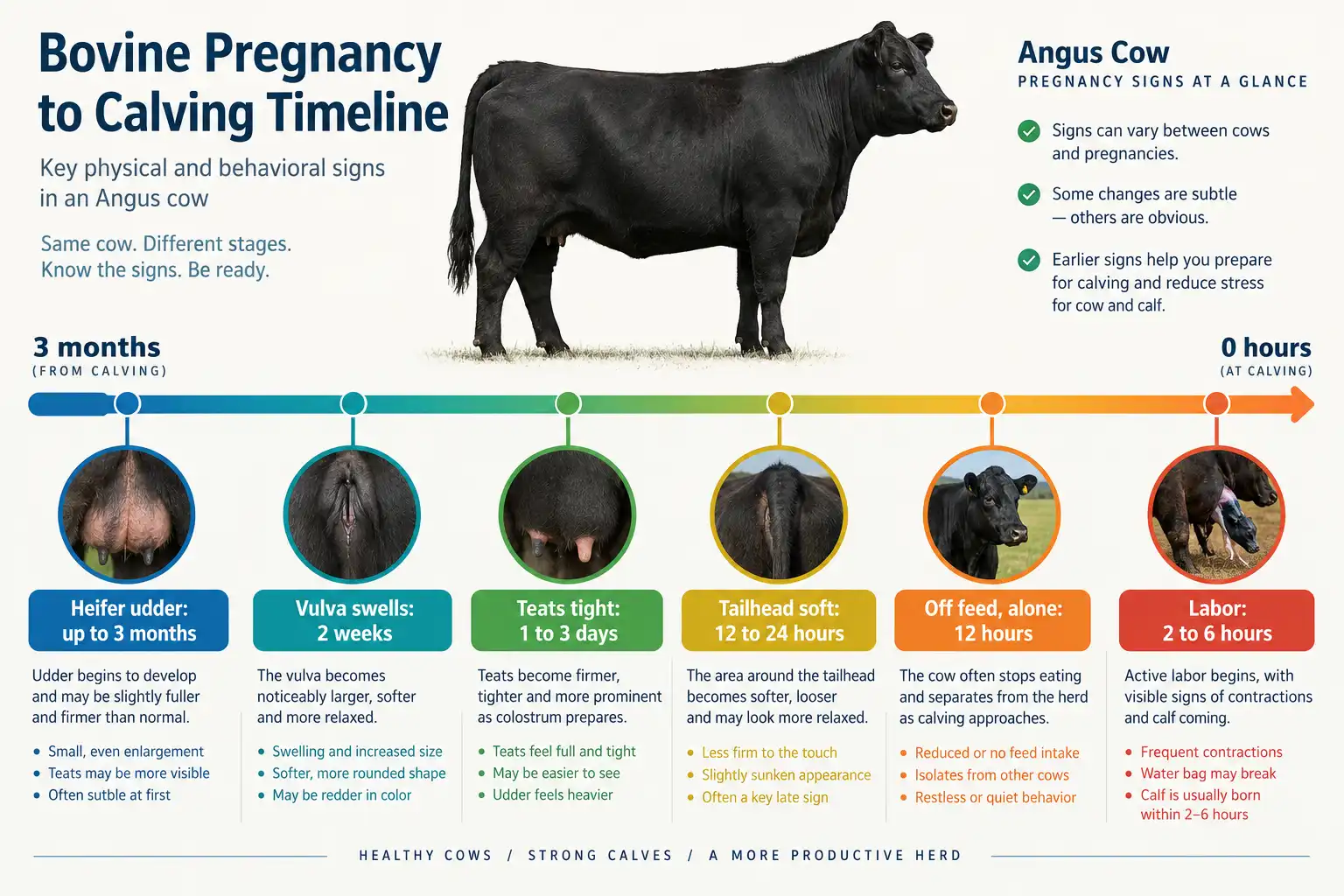
Calving signs run from slow changes weeks out to fast ones in the final day. The early ones tell you the season is close. The late ones tell you to check her again soon.
| Sign | When it usually shows | How far to trust it |
|---|---|---|
| Udder fills (“bagging up”) | Last 2 weeks in cows; up to 2 to 3 months early in first-calf heifers | Low for timing |
| Vulva swells and loosens (“springing”) | Builds over the last 2 weeks | Low; varies by breed |
| Thick cervical mucus plug | Can show weeks before calving | Low; not a same-day sign |
| Teats fill tight (“strutting”) | Last 24 hours; 2 to 3 days early in heavy milkers | Moderate |
| Tailhead ligaments soft and sunken | 12 to 24 hours before | High in thin to moderate cows |
| Off feed, walks off alone | Last 12 hours | Moderate; many cows show little |
| Restless, tail raised, kicking at belly | Stage 1 labor, hours before | High; labor has started |
Timings follow Oklahoma State and Nebraska-Lincoln Extension. The stage 1 labor signs come from Texas A&M AgriLife Extension.
Early Signs That Mean Weeks, Not Hours
A full udder, a swollen vulva, and a mucus plug all say calving season has arrived. None of them says she calves today.
Udder growth varies the most. First-calf heifers can make bag for two to three months, per Oklahoma State Extension. Heifers of milking breeds do it most. So a bagged heifer may still be weeks away. In the final two weeks, the udder keeps filling in heifers and cows alike.
Springing, the swelling and loosening of the vulva, varies too. The same Oklahoma State fact sheet notes that Brahman-influenced cattle spring much more than Holsteins. For that reason, compare each cow against herself from day to day, not against the cow beside her.
The cervical plug fools the most people. It is a thick, sticky mucus hanging from the vulva or pooled where she lay. Nebraska-Lincoln Extension notes it can appear weeks before calving, so it only confirms the season is here.
By contrast, mucus that comes with a raised, switching tail is a stage 1 labor sign, per Oklahoma State.
How to Check the Tailhead and Teats
The tailhead ligaments give the best timing of any outward sign. Teats help, but only alongside them.
Tailhead ligaments
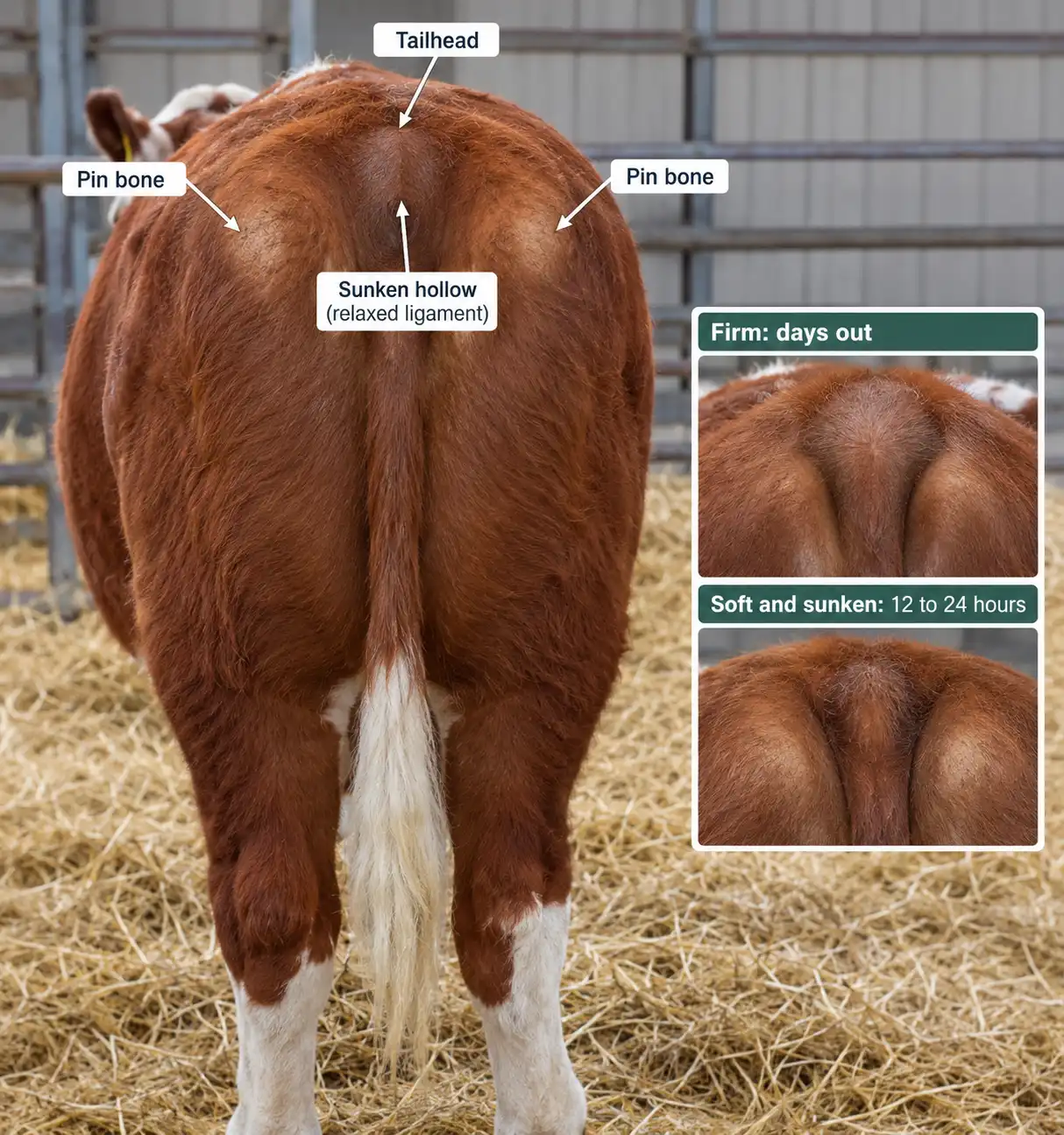
With the cow standing quietly, look at each side of her tailhead, between the tailhead and the pin bones. Early on, the ligament there feels firm. As calving nears, it goes soft and slack. The tailhead then looks raised, with hollows on each side.
Texas A&M AgriLife Extension says a very relaxed ligament edge predicts birth within about 12 hours. Nebraska-Lincoln Extension gives a wider window of 12 to 24 hours. Both tie the change to the cervix opening.
There is a catch, though. Nebraska-Lincoln notes the change is hard to see in fat cows at body condition score 7 or higher. So for fleshy cows, lean on behavior and check more often.
Teats
Strutting means the teats fill with colostrum and stand out stiff. Oklahoma State Extension calls it not very dependable on its own. Heavy-milking cows may strut two to three days early. Meanwhile, a thin, light-milking cow may calve with little teat change at all. So use teats to back up the tailhead check, not to replace it.
Behavior Changes in the Last 12 Hours
Behavior usually shifts in the final 12 hours, though plenty of cows hide it. Oklahoma State Extension notes a cow may skip feed or take herself off to a corner of the pasture. Still, most show little change until labor begins.
Age changes the picture. Texas A&M AgriLife says heifers may be very restless and show belly pain. That can start up to 24 hours before the cervix opens. By contrast, older cows may show almost nothing. Their only clue may be lying in an odd position or seeming more alert than the herd.
Once stage 1 labor starts, look for:
- Tail raised or switching, with the back arched
- Getting up and down, and kicking at the belly
- More mucus at the vulva
- In dairy cows, per Iowa State Extension, bawling, frequent urine and manure, and a leaking udder
Body temperature drops before calving too. Researchers at the USDA-ARS Fort Keogh laboratory in Miles City, Montana, tracked it in beef cows. It fell from about 48 to 8 hours before birth. The drop is small, so it only shows in herds that log temperatures on a schedule or use monitoring boluses.
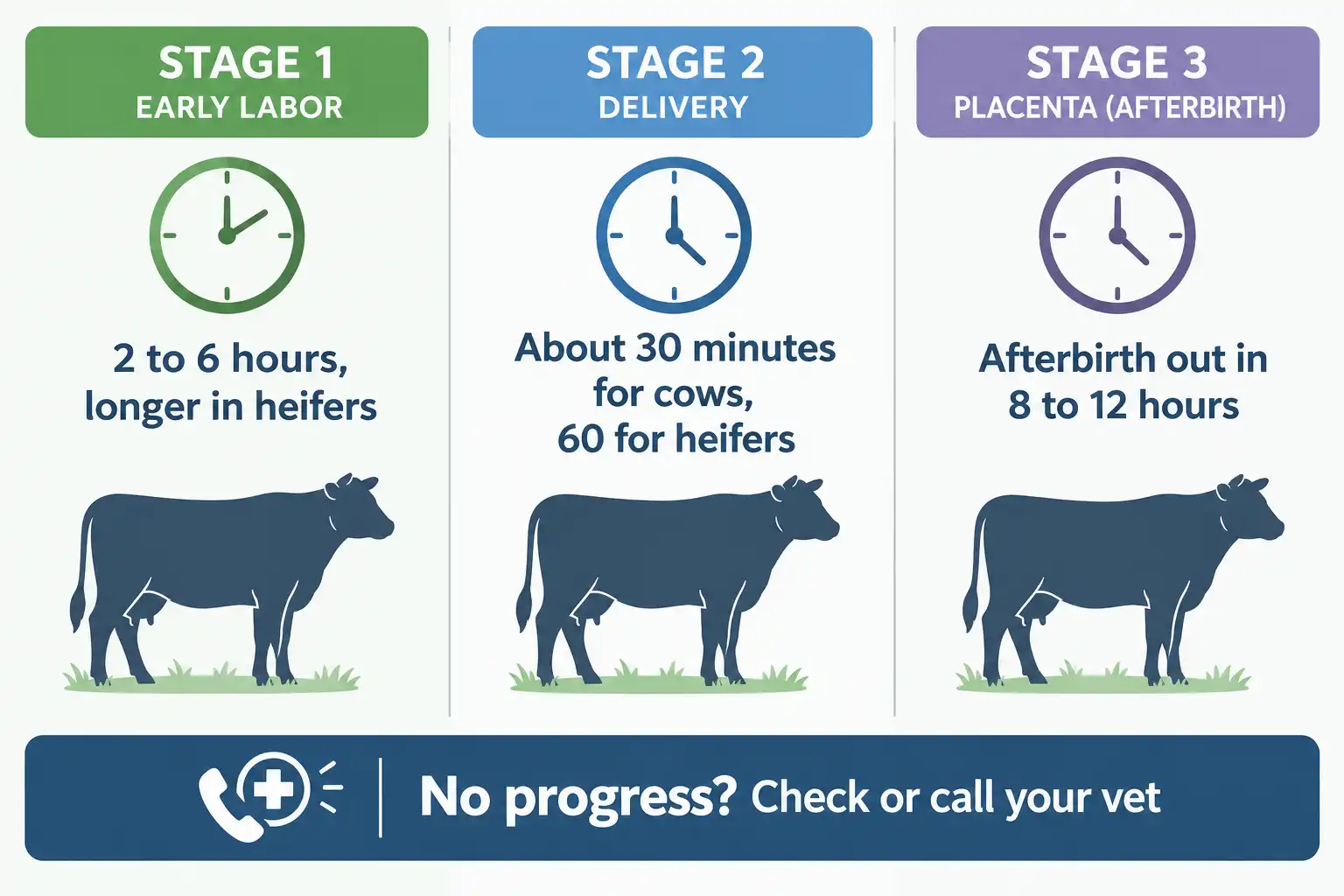
How Long Each Stage of Labor Should Take
Labor runs in three stages, and the second is shorter than many older guides state, per Oklahoma State Extension.
| Stage | What you see | Normal length |
|---|---|---|
| 1: Cervix opens | Restless, tail up, mucus | 2 to 6 hours, longer in heifers (Texas A&M AgriLife) |
| 2: Delivery | Water bag, then feet and nose | About 30 minutes in cows, 60 in heifers (Oklahoma State) |
| 3: Afterbirth | Placenta passes | 8 to 12 hours (Oklahoma State) |
The stage 2 figures come from timed births. Oklahoma State cites USDA’s Miles City station at about 23 minutes for mature cows and 54 minutes for first-calf heifers. Its own heifers averaged 55 minutes.
Stage 3 needs patience, not hands. Oklahoma State notes that pulling the placenta by hand harms uterine health and later conception. It treats membranes still in place after 12 hours as retained. Iowa State Extension, however, uses 24 hours for dairy cows. Either way, a retained placenta is a call to your veterinarian.
When to Step In or Call Your Veterinarian
Published guidance sets two clocks for a stalled delivery, so know both.
Oklahoma State Extension’s rule is the stricter one. If a heifer makes no real progress one hour after the water bag or feet appear, she needs an exam. A mature cow gets 30 minutes. If you cannot safely deliver the calf at that point, call your veterinarian right away.
Texas A&M AgriLife and Iowa State Extension instead allow up to two hours once the water sac or feet show. Treat that as the latest point, not a target. The shorter clock comes from timed births, while two hours marks a calving that has clearly gone wrong.
Waiting costs heifers most. For example, Oklahoma State cites a Montana study. Heifers allowed up to two hours of labor had a 17 percent lower cycling rate at the next breeding season. Their rebreeding rate also ran 20 percent lower. Calves from long deliveries start weaker, too.
Stage 1 can stall as well. Iowa State flags a dairy cow restless for 4 to 6 hours without straining. South Dakota State Extension flags stage 1 lasting 8 hours or more.
An internal exam takes training and clean technique. If no one has shown you how, the clock is your cue to call, not to reach in. Keep your calving supplies and your veterinarian’s number ready before the first due date.
Dairy Cows: Move Them Before Labor Starts
Dairy herds face a timing problem beef herds rarely do: the move to a maternity pen. Iowa State Extension puts dairy gestation near 280 days. In most herds, cows wait in a close-up group at the end of the dry period.
The timing of that move matters. For example, Iowa State summarizes a 2013 study. Cows moved in late stage 1 labor, about four hours before calving, had stage 2 labor about 40 minutes longer. They also spent half as much time lying down. In contrast, cows moved before labor or in early stage 1, about 12 hours out, calved normally.
So move a cow when the early signs show: a raised tail, a tight and leaking udder, or relaxed ligaments. Once bloody mucus and straining start, a move costs labor time. If she must go, move her calmly. Even with careful timing, Iowa State notes about 10 percent of calvings still happen outside the maternity pen.
Plan Your Checks Around the Due Date
Signs mean more when you know which cows are due. Oklahoma State Extension’s gestation table runs on 283 days for beef cows.
Run that on your own dates. In a spring-calving cow-calf herd, say bulls go in May 15 and out July 15. Calving then runs from about February 22 to April 24. Because udder and vulva changes build over the final two weeks, start daily checks about two weeks before that first date.
Then check heifers more often than cows. Texas A&M AgriLife’s figures show the return on labor rises with each added daily check. By contrast, a single check a day barely pays. Tighter breeding season dates also shorten the stretch of nights you spend checking.
Feed in the Evening to Shift Calving Into Daylight
Feeding time shifts calving time. South Dakota State Extension reports Iowa State research on beef cows fed once a day at 4 p.m. Feeding started two weeks before calving. As a result, 82 percent of the cows calved between 6 a.m. and 10 p.m. First-calf heifers in that data hit 90 percent. Meanwhile, cows in the same herds not on that schedule split about half by day and half by night.
In a 50-cow herd, that means about 41 calves born between 6 a.m. and 10 p.m. and 9 overnight.
South Dakota State adds a few conditions:
- Start a month before calving for the best effect, though a shorter lead still helps
- Keep feeding time within 15 minutes of the same hour, and avoid overfeeding
- Expect it to work best in a drylot, where you control all the feed
- Keep night checks, since storms can keep cows off the bunk
Producers know it as the Konefal method, after the Manitoba rancher who first reported it.
FAQs About Cow Is Close to Calving
How long after the water bag appears should a cow calve?
About 30 minutes for a mature cow and about an hour for a first-calf heifer, per Oklahoma State Extension. If there is no real progress by then, she needs an exam or a veterinarian.
Does a mucus plug mean a cow will calve today?
Not usually, since Nebraska-Lincoln Extension notes the thick cervical plug can show weeks before calving. Mucus paired with restlessness and a raised, switching tail is the sign that labor has actually started.
Can a cow calve without her teats filling up?
It happens, especially in thin, light-milking cows, per Oklahoma State Extension. Heavy milkers, by contrast, can strut two to three days early, so the tailhead makes a better timing check.
Why can’t I see my cow’s tailhead ligaments relax?
Fleshy cows hide it, since Nebraska-Lincoln Extension notes it is hard to see at body condition score 7 or higher. Watch their behavior closely and check those cows more often near the due date.
Do more cows calve at night or during the day?
Without a feeding change, herds split roughly evenly, per South Dakota State Extension. In Iowa State research, beef cows fed daily at 4 p.m. had 82 percent of calves born from 6 a.m. to 10 p.m.
Do heifers show calving signs differently than cows?
Yes, heifers usually show more, while older cows may show almost nothing. Texas A&M AgriLife notes heifers may show restlessness and belly pain up to 24 hours before the cervix opens.
Key Points for Your Herd
Start daily checks about two weeks before the first due date, and judge each cow against her own baseline. Treat the udder, vulva, and mucus plug as season signs. Treat soft tailhead ligaments and restlessness as your cue to check again within hours.
Once the water bag shows, start the clock: 30 minutes for a cow, an hour for a heifer. After that comes an exam or a call to your veterinarian.