
How Much Meat Do You Get From a Cow? Whole, Half, and Quarter Figures
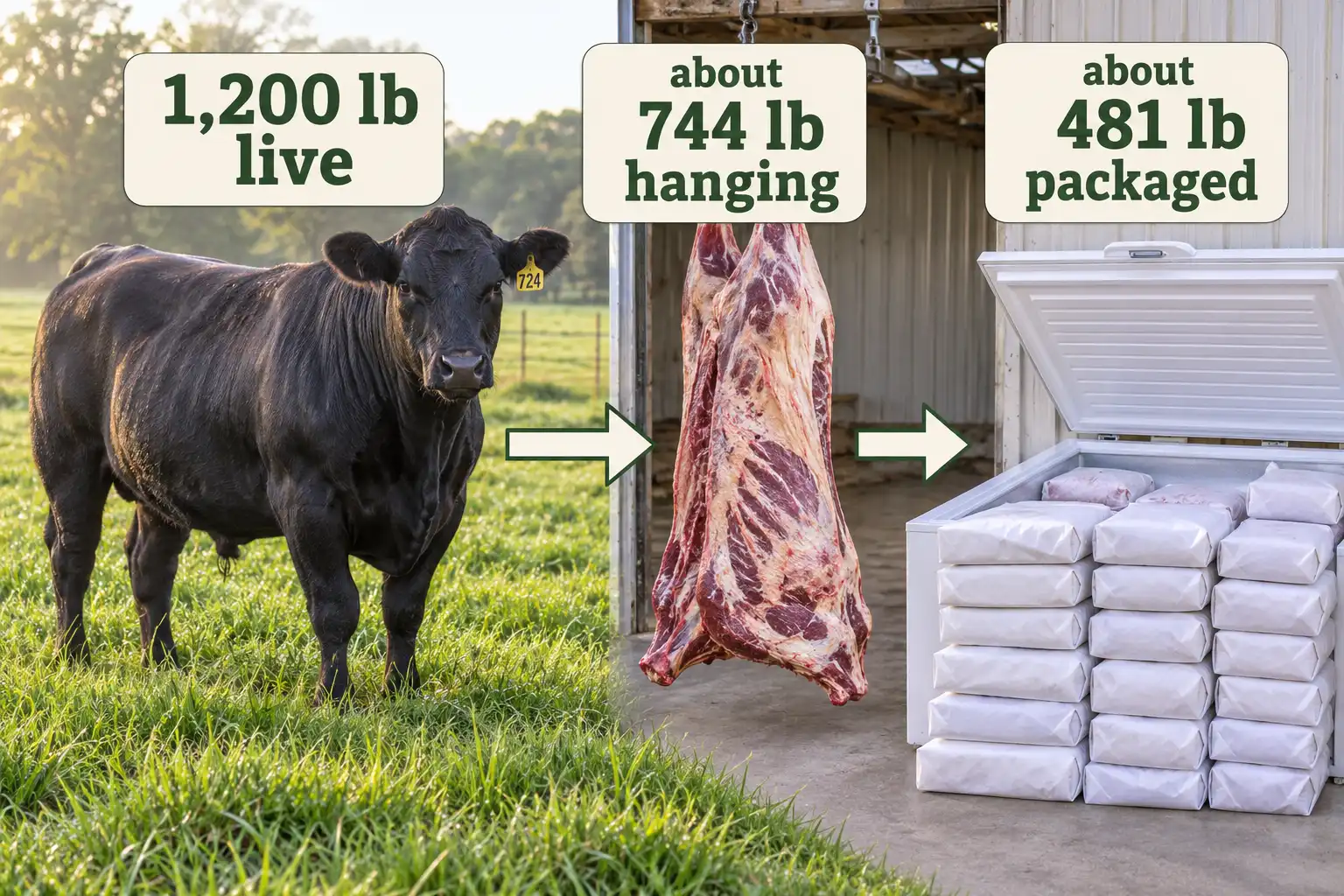
How much meat do you get from a cow? Far less than its live weight, and less than the hanging weight on the processor’s invoice. Below are whole, half, and quarter figures, the math behind them, and the freezer space each share needs.
How much meat you get from a cow depends on its weight: a 1,200-pound grain-finished steer yields about 355 to 481 pounds of packaged beef. A half yields 178 to 240 pounds; a quarter, 89 to 120.
How Much Meat Do You Get From a Whole Cow?
A whole 1,200-pound beef steer yields about 355 to 481 pounds of packaged beef. Two extension services cut the carcass differently, so both figures appear here instead of an average.
Oklahoma State Extension starts with a 756-pound hot carcass and dry ages it 14 days, which costs about 6 percent in shrink. Its cut yield then runs 50 to 65 percent of the aged carcass, depending on how many cuts are boneless. That lands at 355 to 460 pounds.
University of Wisconsin Extension uses a 62 percent dressing figure and 3.5 percent cooler shrink. It then applies a 67 percent cutting yield for closely trimmed retail cuts, which lands at 481 pounds.
Mississippi State Extension falls in between, at about 470 pounds. It also gives a rule of thumb: packaged beef runs near 40 percent of live weight.
| Share | Hanging weight (lb) | Packaged beef, Oklahoma State (lb) | Packaged beef, Wisconsin (lb) |
|---|---|---|---|
| Whole | 744 to 756 | 355 to 460 | 481 |
| Half | 372 to 378 | 178 to 230 | 240 |
| Quarter | 186 to 189 | 89 to 115 | 120 |
Every row assumes a 1,200-pound grain-finished steer. Buyers say “cow,” but freezer beef usually comes from finished steers and heifers. Mature cows are a different case for yield, covered further down, and the wider picture of raising beef cattle for meat starts with the animal you pick.
From Live Weight to Packaged Beef: Where the Weight Goes
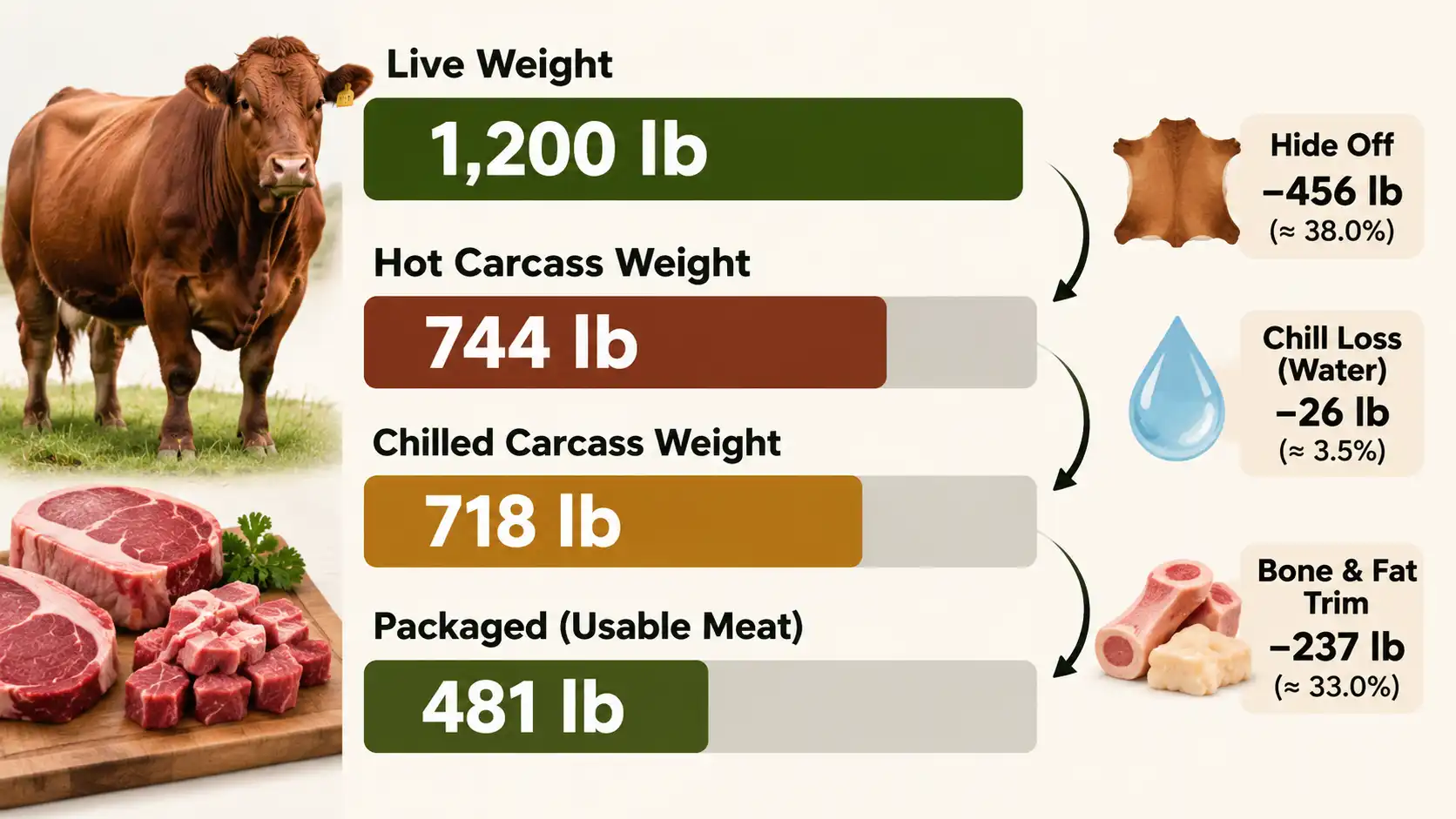
Only about 40 percent of a live steer ends up in packages. The rest leaves in three steps, and each step has its own name on a processor’s invoice.
| Stage | Pounds | Share of live weight | What leaves at this step |
|---|---|---|---|
| Live weight | 1,200 | 100% | Nothing yet |
| Hot carcass (hanging weight) | 744 | 62% | Head, hide, feet, blood, and organs |
| Chilled carcass | 718 | 60% | Water lost in the cooler |
| Packaged beef | 481 | 40% | Bone, fat trim, and cutting loss |
These figures follow University of Wisconsin Extension’s worked example.
Dressing percentage
Dressing percentage is hot carcass weight divided by live weight. Mississippi State Extension puts the beef cattle average at 60 to 64 percent. Still, a 63 percent steer does not send 63 percent of itself home as meat, because that carcass still holds bone and fat.
Cooler shrink
A carcass loses water as it chills. Wisconsin Extension puts the loss at 2 to 5 percent in the first 24 hours. Longer dry aging takes more, and Oklahoma State’s 14-day example loses about 6 percent.
Cutting yield
Cutting yield is the share of the chilled carcass that leaves as packaged cuts. Oklahoma State Extension gives 50 to 65 percent. For a quick estimate from hanging weight alone, its Cow-Calf Corner newsletter uses roughly two-thirds, which sits at the generous end.
How Much Meat Do You Get From Half a Cow?
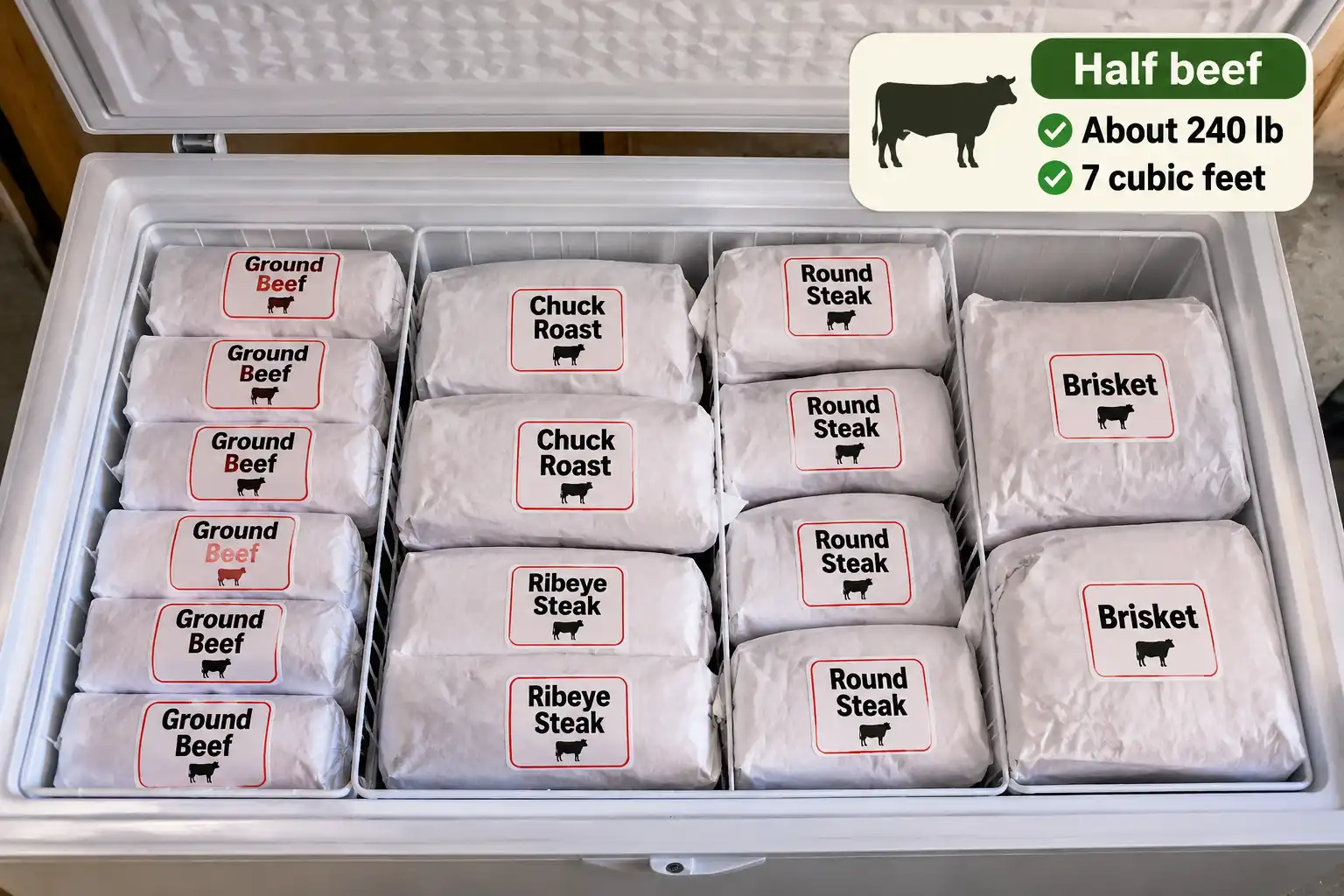
Half a cow yields about 178 to 240 pounds of packaged beef from a 1,200-pound steer. A half is one side of the carcass, split nose to tail, per Mississippi State Extension. So take the whole-animal figure and divide by two.
A half also carries every primal cut in the animal. Mississippi State’s breakdown of a 470-pound whole yield shows where the pounds sit in one half:
| Primal | Share of packaged beef | Pounds in a half |
|---|---|---|
| Chuck | 25% | 59 |
| Round | 24% | 56 |
| Sirloin | 9% | 21 |
| Rib | 9% | 21 |
| Short loin | 8% | 19 |
| Short plate | 7% | 16 |
| Brisket | 6% | 14 |
| Flank | 4% | 9 |
| Shank | 4% | 9 |
| Suet and hanging tender | 4% | 9 |
Chuck and round together make up nearly half the weight. That means roasts and ground beef outweigh steaks in any half, whatever the breed.
How Much Meat Do You Get From a Quarter Cow?
A quarter cow yields about 89 to 120 pounds of packaged beef from a 1,200-pound steer. But “quarter” covers two different purchases, and they do not weigh the same.
Straight forequarter or hindquarter
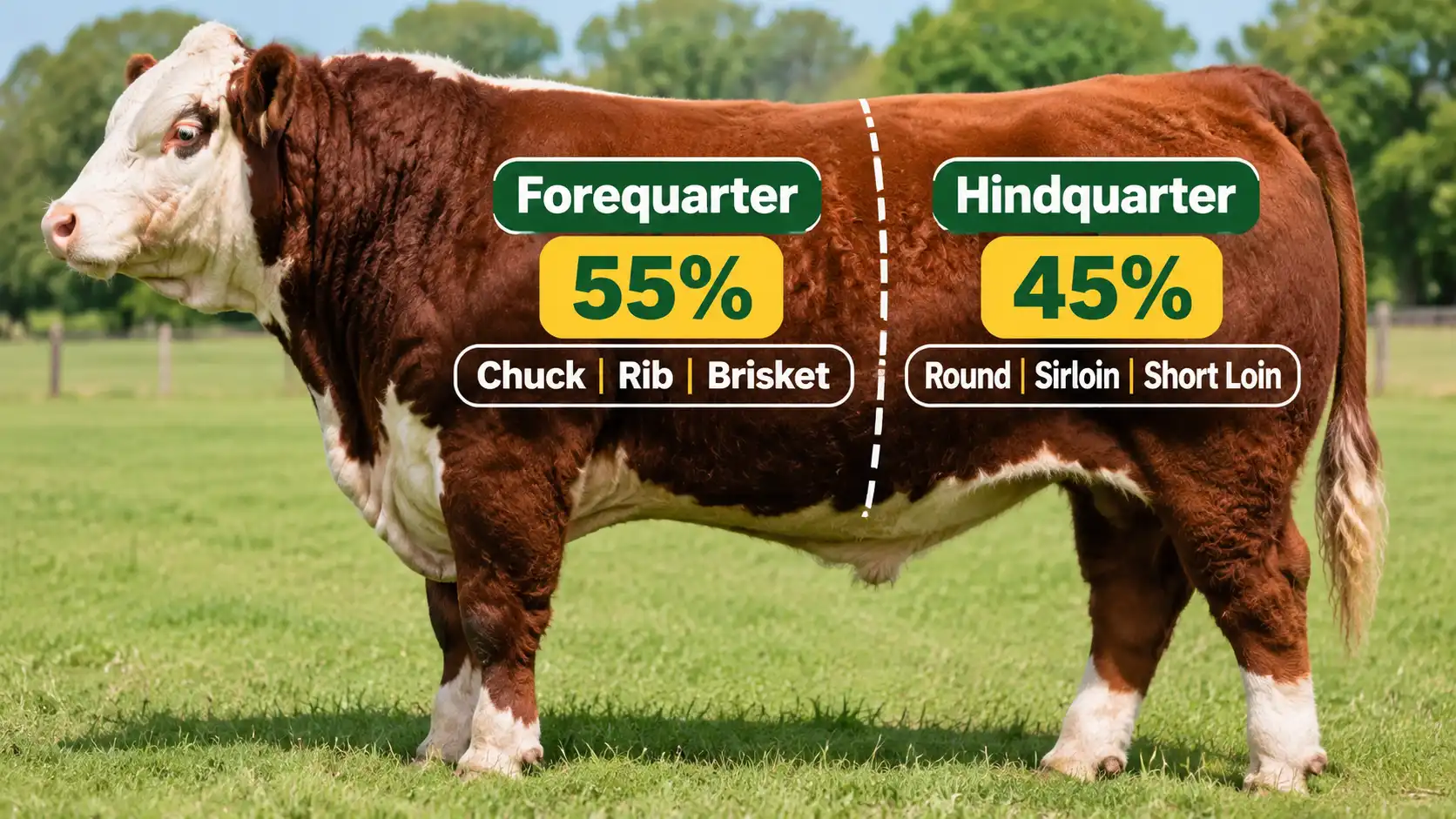
University of Wisconsin Extension describes a quarter as a whole forequarter or a whole hindquarter from one side. Mississippi State Extension puts the forequarter at about 55 percent of the beef and the hindquarter at 45. From a 470-pound whole yield, that comes to about 129 pounds for a forequarter and 106 for a hindquarter.
The forequarter weighs more. It holds the chuck, rib, brisket, plate, and shank. The hindquarter carries the round, sirloin, short loin, and flank, so it brings most of the steaks. Oklahoma State Extension notes that a forequarter has more cuts suited to pot roasting, but also a higher share of usable lean.
Split quarter
Many processors also sell a split quarter. That is half of a side, cut so each buyer gets some front and some hind cuts. Ask which kind you are buying before you compare prices between farms.
What Changes How Much Meat You Get
Finish, fat cover, muscling, and your cutting instructions move the take-home figure the most.
| Factor | Effect on yield | Source |
|---|---|---|
| Grass finishing | Dresses 53 to 58%, against 62 to 64% for grain-fed | Michigan State Extension |
| Heavy external fat | Dresses higher, but more trim comes off | Mississippi State Extension |
| Boneless cuts and lean grind | Fewer packaged pounds | Mississippi State Extension |
| Long dry aging | More moisture loss | Oklahoma State Extension |
| Dairy-type steer | Lower yield than beef-type | Oklahoma State Extension |
| Mature cow or pregnant heifer | Lower dressing percentage | University of Tennessee Extension |
Grass versus grain
On a 1,200-pound steer, grass finishing at 55 percent dressing leaves a carcass about 84 pounds lighter than grain finishing at 62. At Wisconsin’s cutting yield, that is roughly 55 fewer pounds of beef. Steers also dress a point or two above heifers, per Michigan State. So the route you pick for finishing beef cattle shows up directly in the freezer.
Fat cover
Fat works both ways. Mississippi State Extension calls trimmed external fat over a quarter inch the largest single source of lost weight. Oklahoma State adds that cutting, trimming, and boning remove 24 to 45 percent of a carcass, depending on its USDA yield grade. So a leaner Yield Grade 2 carcass sends home more beef per hanging pound than a fat Yield Grade 4.
Cull Cows, Calves, and Dairy Steers
Each of these yields less per pound of live weight than a finished beef steer.
Cull cows
Published take-home figures for cull cows are thin. University of Tennessee Extension lists mature cows as dressing lower than fed cattle, but none of the extension sheets cited here give a packaged-beef figure for one. Ask the processor for the hanging weight, then apply the low end of the cutting yield range until you have your own results.
Calves
Lighter animals carry less muscle on the same skeleton. Oklahoma State Extension’s 600-pound calf example dresses near 55 percent, ages down to a 307-pound carcass, and sends home 140 to 185 pounds.
Dairy steers
Heavier-muscled beef breeds such as Angus and Hereford carry more lean per pound of bone. In contrast, Oklahoma State Extension notes that dairy-type cattle such as Holstein steers typically yield lower. So a Holstein and an Angus at the same live weight will not fill the same freezer.
How to Calculate the Meat From Your Own Animal
Run three multiplications, then two divisions. If your processor already gave you the hanging weight, skip to step 3.
\text{Packaged beef} = \text{Live weight} \times \text{Dressing \%} \times (1 - \text{Shrink}) \times \text{Cutting yield}This example uses a 1,350-pound grain-finished Angus steer.
- Multiply live weight by dressing percentage. At 62 percent, the steer gives an 837-pound hot carcass.
- Take off cooler shrink. At 3.5 percent, the chilled carcass weighs about 808 pounds.
- Multiply by cutting yield. At 50 to 67 percent, that comes to about 404 to 541 pounds of packaged beef.
- Divide by your share. A half comes to about 202 to 271 pounds, and a quarter to about 101 to 135.
- Divide by 37.5 for freezer space. The whole animal at the high end needs about 14.4 cubic feet.
Pick the low cutting yield if you want mostly boneless steaks, extra-lean grind, or long aging. Pick the high one for bone-in cuts and standard trim.
Raising the steer yourself puts the same live weight behind your feed budget. The figures on daily hay intake for cattle help with winter planning, and grass finishing depends on the stocking rate for your pasture.
How Much Freezer Space Each Share Needs
Plan on 1 cubic foot of freezer space for every 35 to 40 pounds of packaged beef, per Michigan State University Extension. Odd-shaped bone-in roasts take extra room.
| Share (1,200 lb steer) | Packaged beef (lb) | Space needed (cu ft) | Freezer that fits |
|---|---|---|---|
| Quarter | 89 to 120 | 2.2 to 3.4 | 5 cu ft chest |
| Half | 178 to 240 | 4.5 to 6.9 | 7 to 9 cu ft chest |
| Whole | 355 to 481 | 8.9 to 13.7 | 14 to 15 cu ft chest or upright |
The last column leaves some headroom for packing. Also count what already sits in the freezer. A half beef going into a freezer that is half full of other food needs the next size up.
What Hanging Weight Pricing Means per Packaged Pound
Divide the hanging-weight price by the cutting yield to find what each packaged pound costs. At a 67 percent yield, every packaged pound costs about 1.5 times the hanging price. At 50 percent, it costs twice as much.
| Cutting yield | Multiply the hanging price by |
|---|---|
| 67% | 1.49 |
| 60% | 1.67 |
| 55% | 1.82 |
| 50% | 2.00 |
Live-weight pricing stretches further. At Mississippi State’s rule of 40 percent of live weight, each packaged pound costs about 2.5 times the live price.
Processors often charge the cut and wrap fee on hanging weight too, so add it before you compare against store beef. In practice, a farm quoting a lower hanging price can still cost more per packaged pound if your cutting instructions run lean and boneless.
How Much Meat Do You Get From a Cow Elk?
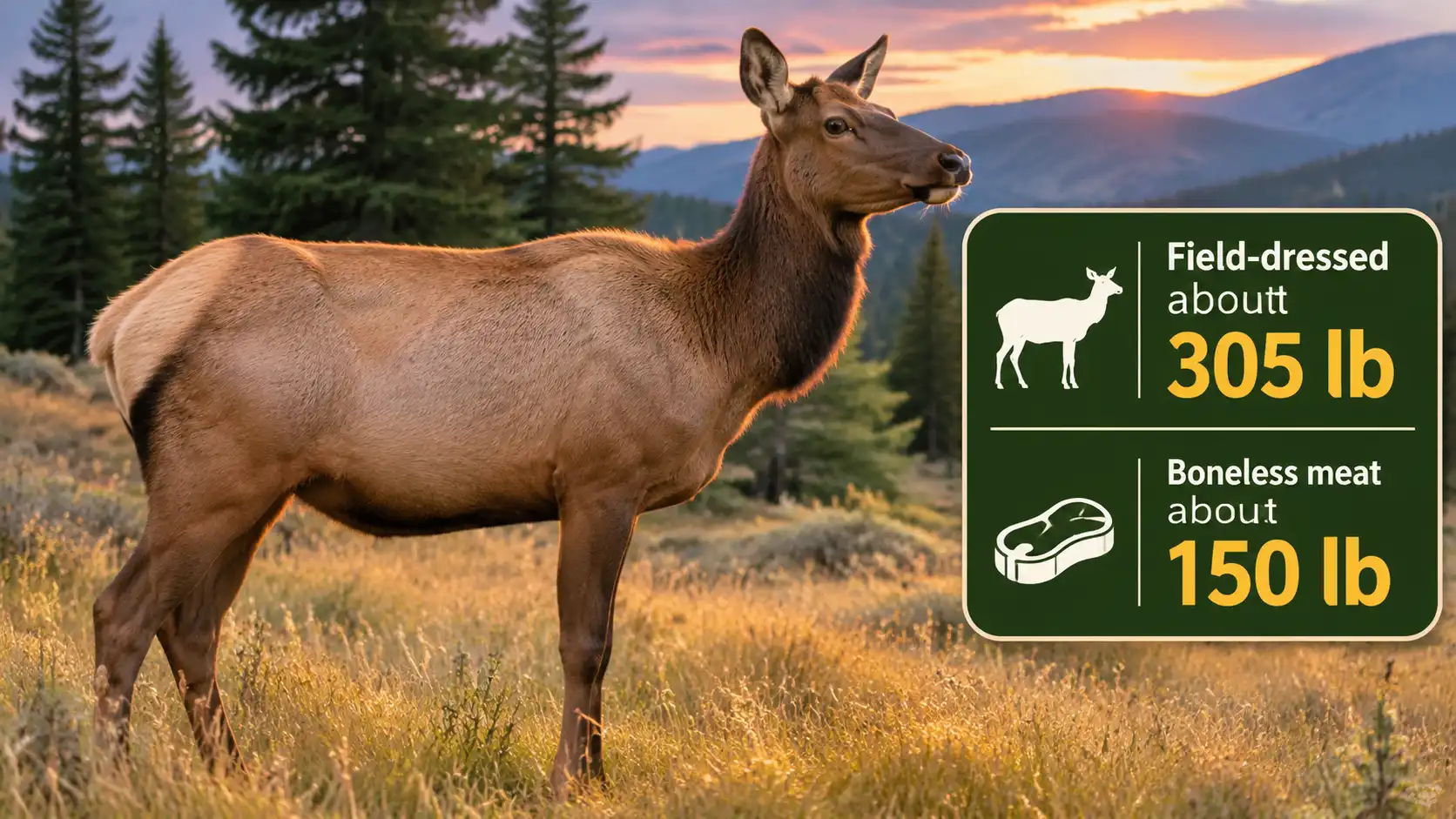
A cow elk yields roughly 150 pounds of boneless meat on average. In elk, “cow” means a female. Elk are wild game, not beef cattle, so the math starts from field-dressed weight instead of hanging weight.
University of Wyoming Extension found that boneless lean averaged 50 percent of field-dressed weight in its elk cutting work. Field-dressed cow elk across all ages averaged 305 pounds, which puts the average near 152 pounds boneless. By comparison, a locker plant processing hunter-harvested elk averaged 43 percent, or about 131 pounds from that same cow.
| Cow elk age (years) | Field-dressed (lb) | Boneless meat (lb) |
|---|---|---|
| Calf | 176 | 88 |
| 1½ | 244 | 122 |
| 2½ | 304 | 152 |
| 3½ to 4½ | 329 | 164 |
| 5½ to 6½ | 359 | 179 |
| 10½ and older | 394 | 197 |
Two caveats apply. First, Wyoming measured its conversion ratios on bulls and applied them to cows, so treat the cow figures as estimates. Second, bloodshot meat around the wound and poor field care come off the total. At about 150 pounds, a cow elk lands between a quarter and a half beef and fits in about 4 cubic feet of freezer space.
FAQs About Beef From a Cow
Is hanging weight how much meat I get?
No. Hanging weight is the carcass before chilling, aging, boning, and trimming, and packaged beef usually runs 50 to 67 percent of it, per Oklahoma State and Wisconsin extension figures.
How much meat comes from a 1,000-pound steer?
Expect about 400 to 420 pounds of packaged beef from a 1,000-pound grain-finished steer. That uses the 40 to 42 percent of live weight that Mississippi State and Oklahoma State extension give as a rule of thumb.
Does a forequarter or a hindquarter give more meat?
A forequarter gives more pounds, about 55 percent of the beef against 45 for the hindquarter, per Mississippi State Extension. The hindquarter holds more of the steaks, including the short loin and sirloin.
What size freezer do I need for a quarter cow?
A 5 cubic foot chest freezer holds a quarter cow with some room to spare. A quarter yields roughly 89 to 120 pounds, and Michigan State Extension figures 35 to 40 pounds per cubic foot.
Why did I get less beef than the farm estimated?
Boneless cuts, extra-lean ground beef, heavy fat trim, and long dry aging all lower the packaged total. Processors also trim out bruised or damaged tissue, which Mississippi State Extension lists as a further loss.
How much meat do you get from a bull elk?
A mature bull elk aged 5½ to 6½ yields about 252 pounds of boneless meat, per University of Wyoming Extension. That is roughly 70 pounds more than a cow elk of the same age.
What to Check Before You Buy a Share
Ask the farm for the animal’s expected live or hanging weight, and whether it is grain- or grass-finished. Then ask the processor whether its fees run on hanging weight and how long it dry ages.
Next, decide your cutting instructions. Bone-in cuts and standard trim send more pounds home; boneless cuts and lean grind send fewer.
Finally, run the five-step math above and clear the freezer space before pickup day.