What Do Sheep Eat? Grass, Hay, Grain, and Feeding by Season
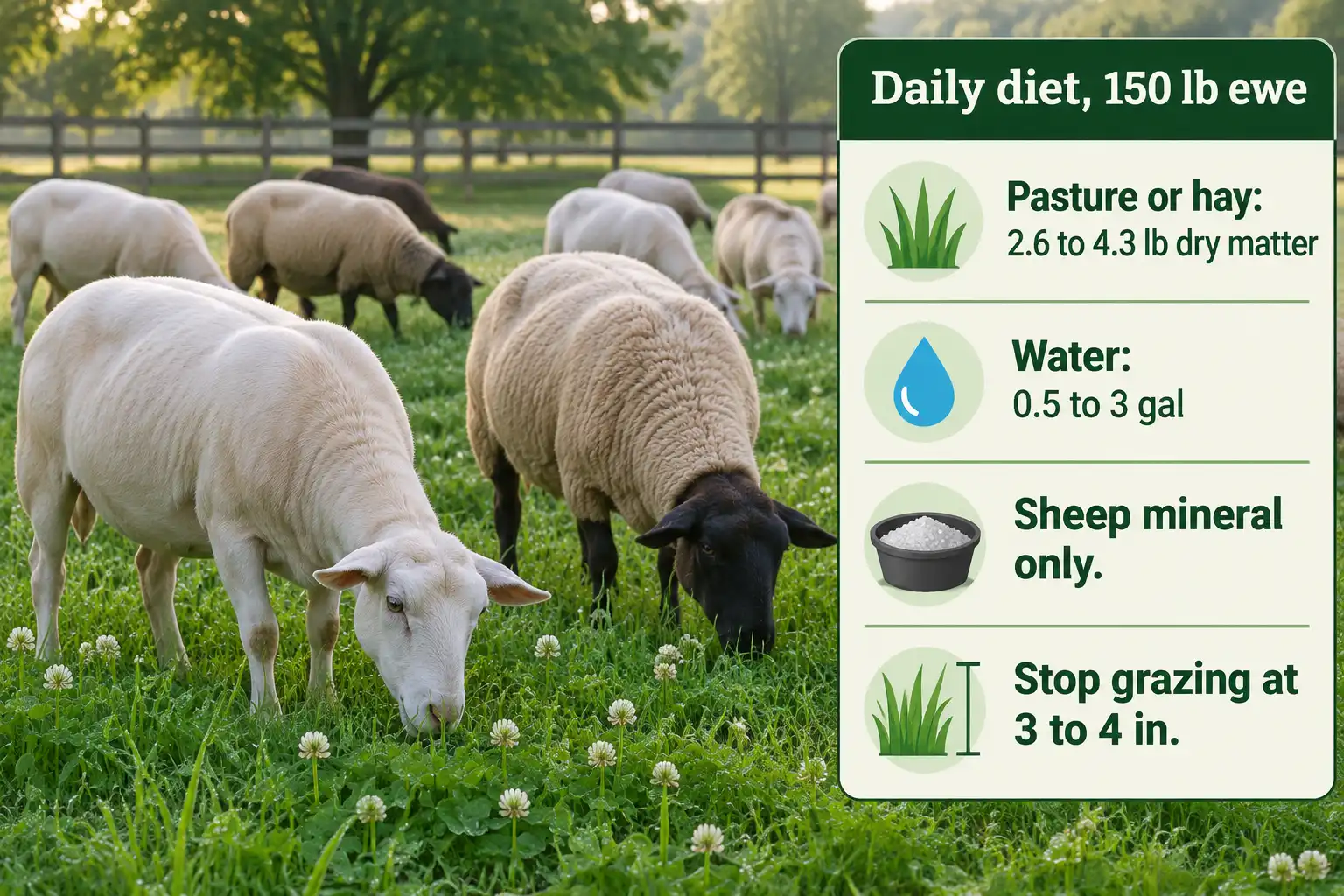
Sheep are grazing ruminants, so forage carries most of the load: pasture in the growing season and hay through winter. Beyond that, what sheep eat depends on stage, season, and breed. Getting copper, grain, and grazing height right prevents most feeding losses.
Sheep eat mostly grass and legumes, grazed fresh or fed as hay. Oregon State Extension notes most adult sheep hold condition on good grass hay, a sheep-formulated mineral, and water. Grain mainly supports late pregnancy, lactation, and growing lambs.
What Sheep Eat: The Four Parts of the Diet
A sheep diet has four parts: forage, concentrate, mineral, and water. Forage does most of the work. Oregon State Extension points out that forages supply protein and energy at a lower cost than concentrates. So a sound plan starts with pasture and hay, then adds the rest only where forage falls short.
| Part | Common examples | What it supplies | Watch for |
|---|---|---|---|
| Forage | Pasture grasses, clover, alfalfa, grass hay | Energy, protein, and fiber | Quality drops as plants mature |
| Concentrate | Corn, oats, barley, pelleted sheep feed | Extra energy for late pregnancy, lactation, and lambs | Acidosis if added too fast |
| Mineral and salt | Loose mineral labeled for sheep | Sodium and trace minerals | Copper from goat or cattle products |
| Water | Tank, trough, or automatic waterer | Drives feed intake | Dirty or frozen water |
Water deserves more attention than it gets. Penn State Extension notes that stale or dirty water lowers water intake, which then lowers feed intake. In other words, a neglected trough shows up weeks later as thin ewes and slow lambs.
Read next: How Much Does a Cow Cost
Do Sheep Eat Grass?
Yes. Grass is the backbone of a sheep’s diet. Oregon State Extension describes sheep as grazers that prefer to eat with the head down, while goats prefer to browse. Still, sheep are picky eaters. They take tender leaves first and often go for clover and other broadleaf plants, called forbs, before coarse stems.
That habit comes from the mouth. Sheep have a cleft upper lip and no upper front teeth. Instead, the lower incisors bite against a hard dental pad. As a result, a sheep can nip leaves much closer to the soil than a cow can.
Plants sheep graze well include:
- Cool-season grasses such as orchardgrass, perennial ryegrass, and Kentucky bluegrass
- Warm-season grasses such as bermudagrass in the Southeast
- Legumes such as white clover, red clover, and alfalfa
- Forbs such as dandelion, plantain, and chicory
Legumes raise protein, but lush, wet legume growth also raises the risk of bloat. For that reason, fill sheep up on hay or grass before their first turnout onto a clover-heavy paddock.
Do Sheep Eat Grass Down to the Roots?
No. Sheep bite off leaves and stems above the soil and do not eat roots. However, they can graze so close that a plant loses the leaf it needs to regrow. Oregon State Extension names grazing down to the crown as a common management mistake. The plant then draws on stored reserves and its roots shrink. Over time, the stand thins and weeds move in.
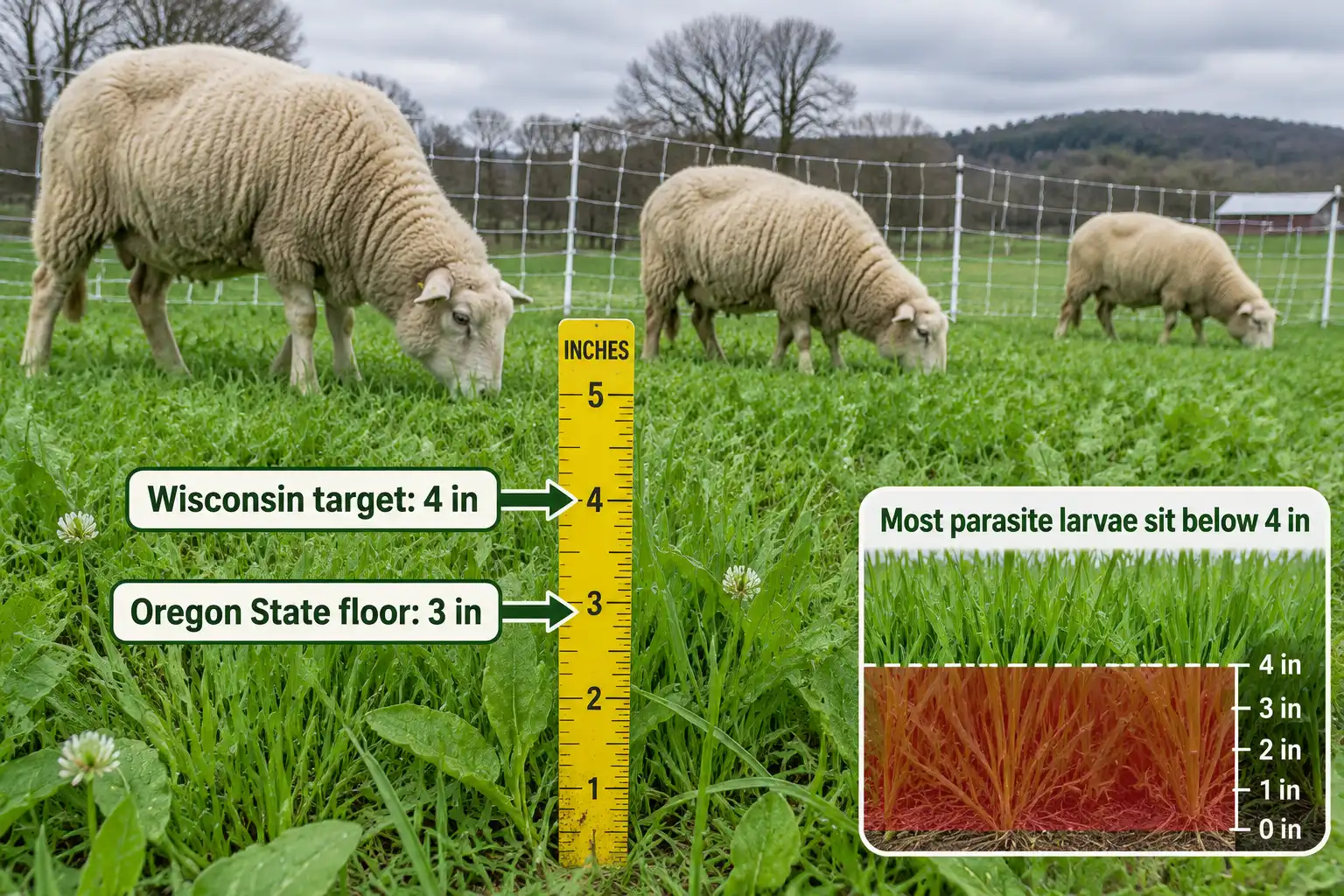
Close grazing costs the sheep too. Parasite larvae sit low on the plant, so the shorter the grass, the more larvae each bite carries. The two services below set the stopping point slightly differently:
- Oregon State Extension says not to let livestock graze below 3 inches.
- University of Wisconsin Extension recommends at least 4 inches of residual, because infective larvae sit mostly below 4 to 6 inches.
This is a difference in margin, not a disagreement about the risk. In practice, hold 4 inches when weather turns warm and wet, since that is when larvae climb and survive best. Treat 3 inches as the floor in dry spells. Rotating paddocks makes either target easier to hold. Our guide on how worms move from pasture into sheep covers rest periods and fecal egg counts.
Do Sheep Eat Dry Grass?
Yes. Sheep eat dry, cured, and dormant grass, and many western flocks rely on it for months. South Dakota State University Extension notes that standing range forage is least nutritious in winter. That period often overlaps breeding and gestation. So dry grass fills the rumen but may not cover protein and energy needs.
Three things change when sheep live on dry forage:
- Protein drops first. Mature, sun-cured grass carries less protein than leafy growth. Oregon State Extension notes wool breeds may need a protein supplement to support fleece growth on lower-quality grass.
- Water demand rises. NDSU Extension notes sheep get most of their water from forage. Take the moisture out of the feed, and the trough has to make up the difference.
- Testing pays. SDSU Extension advises knowing forage protein and energy before choosing a supplement. A forage test through your county office shows whether the gap is protein, energy, or both.
Dry grass is not the same as spoiled hay, though. Skip any bale that is moldy, dusty, or warm inside.
Do Sheep Need to Eat Grass to Grow Wool?
No. Wool grows on any diet that meets a sheep’s energy and protein needs, from pasture, hay, or a mixed ration. Wool is a protein fiber rich in the sulfur amino acid cystine. Even so, Oregon State University course material notes that rumen microbes usually supply enough protein and sulfur. Energy has the biggest effect on wool output.
What wool does need is steady feeding. The same Oregon State material notes that restricted nutrition produces finer, shorter fibers and lighter fleeces. Nutritional stress can also leave a weak point in the fiber, often called wool break or tender wool. The fleece then snaps at that point during processing, which lowers its value.
For wool flocks, that leads to four habits:
- Avoid sharp drops in feed, especially in late pregnancy and early lactation.
- Add protein when sheep graze mature or dormant grass.
- Keep parasite loads down, since worms drain nutrients the fleece would use.
- Shift between pasture and hay over one to two weeks.
Hair breeds such as Katahdin and Dorper shed rather than grow a fleece, so wool break does not apply to them. Their feeding follows the same rules otherwise. For shearing and fleece handling, see our section on wool production and shearing.
How Much Do Sheep Eat a Day?
A 150 pound ewe eats about 2.6 to 4.3 pounds of dry matter a day, per Penn State Extension figures. Her stage sets where she falls. Maintenance sits at the low end. By contrast, late pregnancy and early lactation push intake up by more than half.
| Stage (150 lb ewe, single lamb) | Dry matter per day | Hay as fed per day | Hay as fed per 30 days |
|---|---|---|---|
| Maintenance | 2.6 lb | 2.9 lb | 87 lb |
| Late gestation | 4.0 lb | 4.4 lb | 132 lb |
| Early lactation | 4.3 lb | 4.8 lb | 144 lb |
The as-fed columns assume hay at about 90 percent dry matter, which is typical for dry baled hay. Your hay test gives the exact figure. Ewes carrying twins need more than the single-lamb figures shown, and a ewe nursing twins needs the most of all.
How Much Hay Sheep Need for a Winter
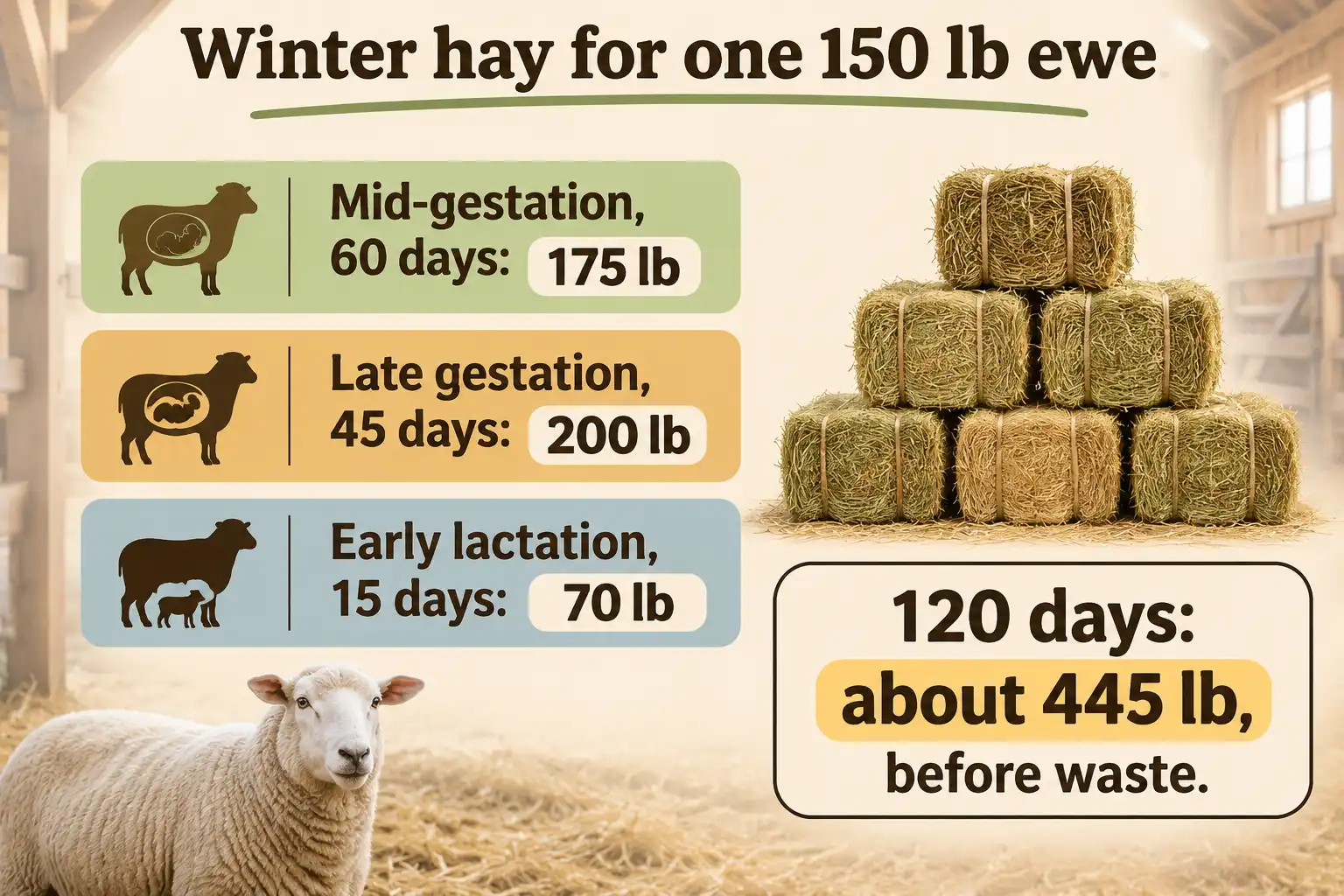
A 150 pound ewe on a 120 day hay season eats roughly 445 pounds of hay, before waste. Here is the arithmetic for a ewe that lambs near the end of winter:
- 60 days of mid-gestation at maintenance: 60 x 2.9 lb = about 175 lb
- 45 days of late gestation: 45 x 4.4 lb = about 200 lb
- 15 days of early lactation: 15 x 4.8 lb = about 70 lb
For 25 ewes, that comes to about 11,100 pounds, or roughly 5.5 tons. In 50 pound small squares, that is about 222 bales.
Then add waste, because feeders lose more than most budgets allow. In Penn State Extension round bale trials, ewes wasted about 2 to 2.9 pounds of hay dry matter each per day. Feeder design drove the difference. At that rate, waste can approach what a ewe actually eats. So a feeder that keeps hay off the ground can matter as much as hay price. Order with a cushion, then weigh what the flock goes through in the first month and adjust.
If you are sizing the grazing side as well, start with the stocking rate for your pasture.
How Do You Feed Sheep?
Feed sheep forage first, then fill gaps with mineral, water, and concentrate as the stage requires. These steps cover a typical small to mid-size flock:
- Start with forage. Use pasture in the growing season and grass or mixed hay in winter. Test the hay so you know its protein and energy.
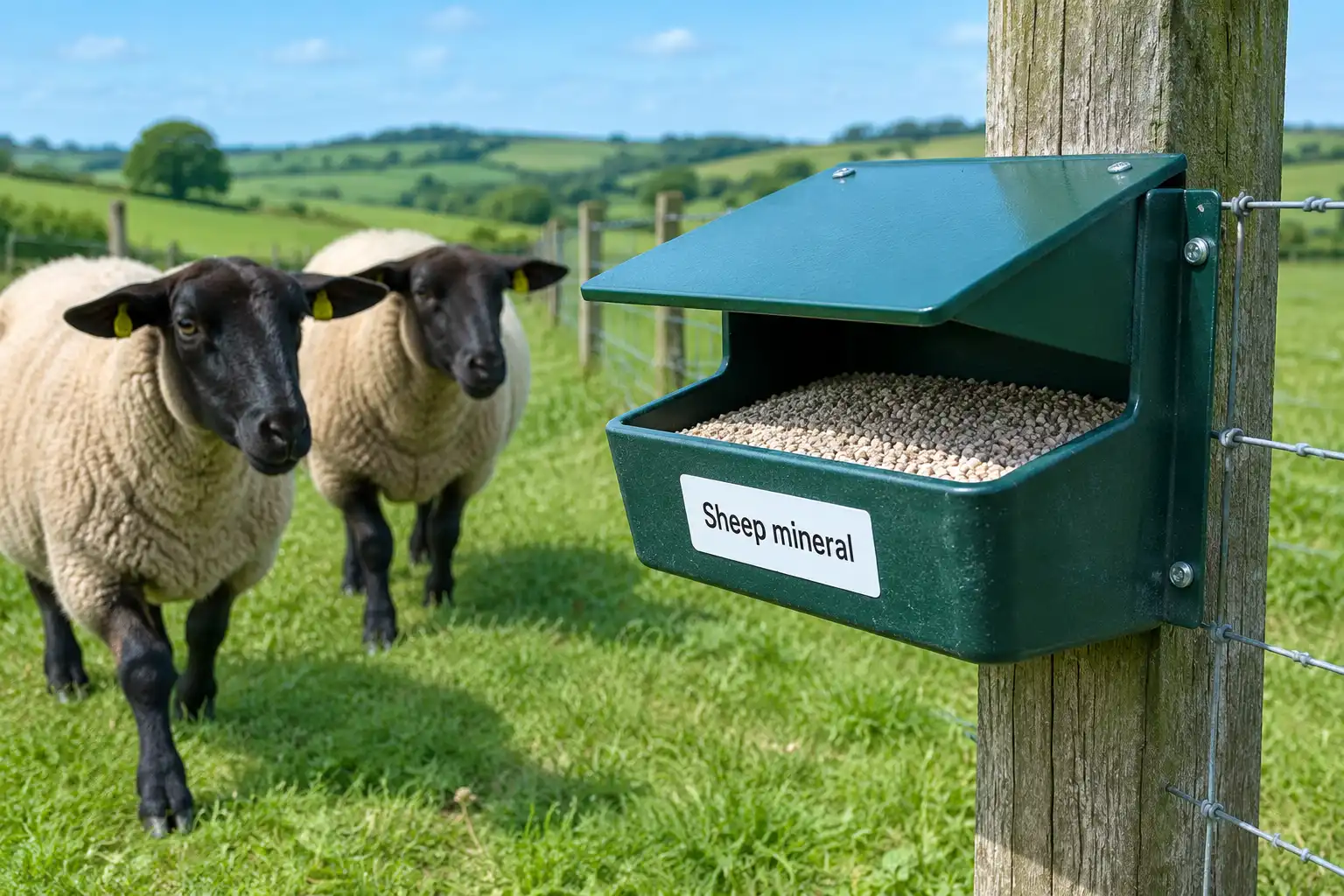
- Offer a sheep mineral free-choice. Oregon State Extension notes loose mineral is eaten more evenly across a flock than block forms.
- Keep water clean and unfrozen. Check it daily, more often in heat.
- Add concentrate only for a reason. Oregon State Extension notes growing, late-pregnant, and lactating sheep need supplements to reach their potential.
- Change feeds slowly. Shift any diet over one to two weeks, per Oregon State Extension, so rumen microbes can adapt.
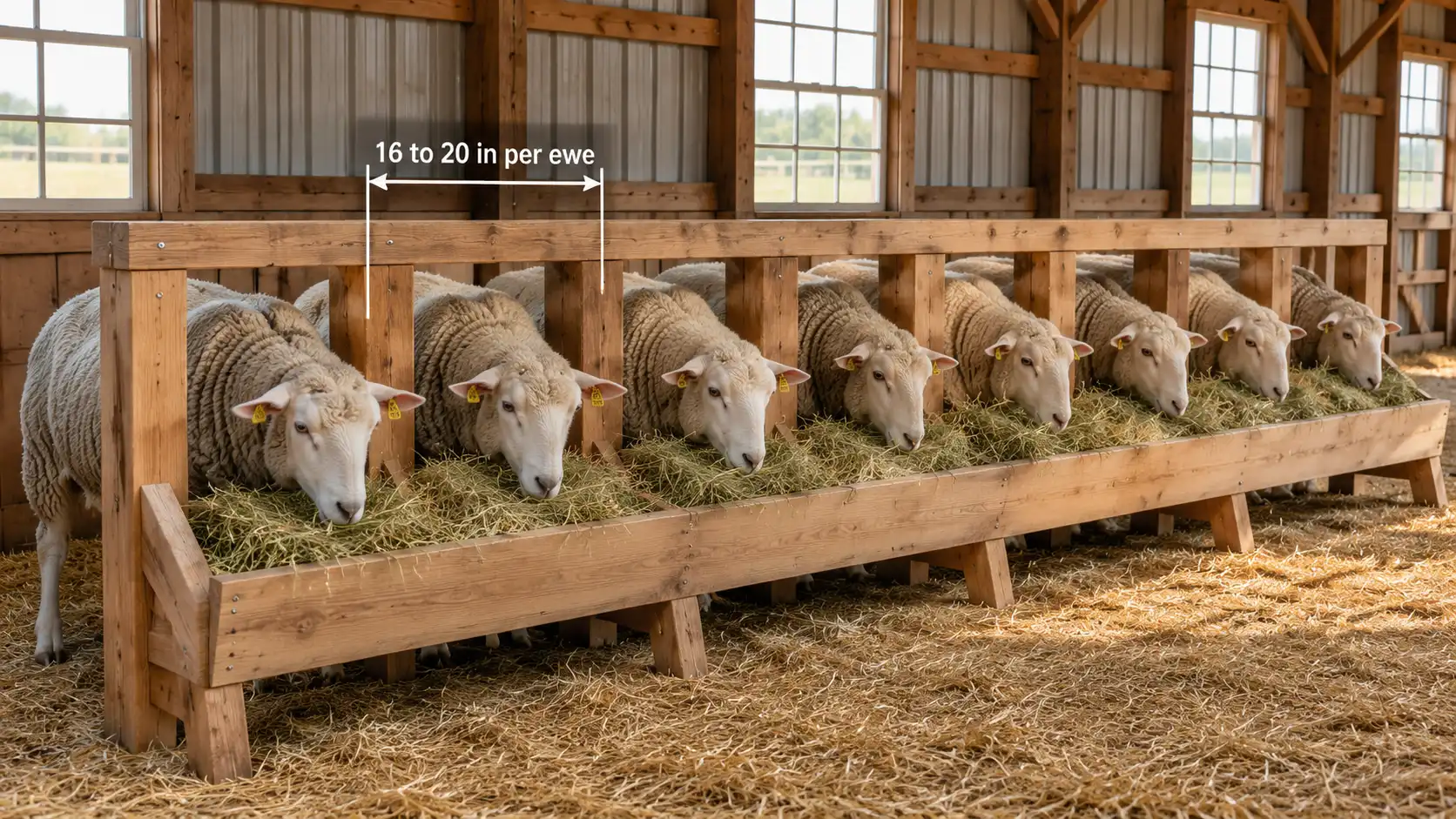
- Give every sheep a place to eat. For limit-fed sheep, Penn State Extension calls for 16 to 20 inches of feeder space per ewe and 12 per ram.
- Watch body condition. Score ewes by hand every few weeks and adjust feed before they slip.
Penn State Extension suggests ewes enter breeding at a body condition score of 3 or slightly less, on a 5 point scale. For timing that against a lambing date, see how to plan breeding around spring lambing.
How Often Do You Feed Sheep?
Hay-fed sheep need feed every day, while sheep on good pasture largely feed themselves. On pasture, the daily work is checking water and mineral. Then move the flock when grass hits its stopping height. In the barn, hay goes out free-choice or in one or two set feedings. Grain is the exception. Oregon State Extension recommends feeding concentrates in two or more meals daily rather than one large meal.
| Feed | How often | Why |
|---|---|---|
| Pasture | Continuous, moved by grass height | Protects regrowth and limits parasite intake |
| Hay | Free-choice or 1 to 2 feedings daily | Keeps the rumen supplied without long gaps |
| Grain or pellets | 2 or more feedings daily | Smaller meals steady the rumen and lower acidosis risk |
| Sheep mineral | Free-choice, checked weekly | Keeps intake steady |
| Water | Always available | Feed intake falls when water does |
Keep feeding times consistent. Late or irregular feedings bring crowding at the feeder, and timid ewes come away short. Penn State Extension advises enough feeder space that ewe lambs are not pushed off by mature ewes. Otherwise, feed ewe lambs as a separate group.
What Sheep Should Not Eat
Sheep should not eat feeds or minerals made for other livestock, large amounts of grain at once, or toxic plants. Each one causes losses on otherwise well-run farms.
Copper From Goat, Cattle, and All-Stock Products
Sheep store copper in the liver and can die from it. For that reason, Oregon State Extension advises a mineral formulated specifically for sheep. Goats and cattle, by contrast, need added copper. So goat minerals, cattle minerals, and many all-stock feeds carry copper at levels unsafe for sheep. The damage builds without signs, then can surface as a sudden crisis. In mixed groups, Oregon State Extension suggests hand-feeding goats and cattle their copper mineral where sheep cannot reach it. For the goat side of this problem, see how goat feeding differs.
Too Much Grain Too Fast
A sudden load of grain sours the rumen and causes acidosis. Oregon State Extension calls it common among inexperienced owners and notes severe cases can be fatal. Spilled feed and an open feed room gate are common triggers.
Toxic Plants
Ohio State Extension’s sheep team lists wilted wild cherry leaves, which release cyanide, among the common pasture hazards. It also names mountain laurel, rhododendron, and azalea as highly toxic to ruminants. Yew is deadly in small amounts, including hedge clippings. So never dump garden or shrub trimmings over the fence, and walk fence lines after storms bring down branches.
Feeding Sheep by Stage and Season
A ewe’s needs climb sharply in the last six weeks of pregnancy and peak in early lactation. So the feeding calendar matters more than any single feed.
| Stage | Diet focus | What to watch |
|---|---|---|
| Maintenance (open, dry ewe) | Pasture or grass hay, sheep mineral, water | Lowest needs; avoid letting ewes get fat |
| Before breeding | Rising nutrition on good pasture or hay | Body condition near 3 on a 5 point scale |
| Early and mid gestation | Maintenance-level forage | Steady feeding protects the fleece |
| Last 6 weeks of gestation | Better hay plus energy concentrate | Pregnancy toxemia in ewes carrying multiples |
| Early lactation | Best hay, concentrate, extra water | Highest feed and water needs of the year |
| Growing lambs | Creep feed, then grower ration | Feeder space and slow ration changes |
| Rams and wethers | Forage-based ration | Urinary stones on grain-heavy diets |
Oregon State Extension suggests starting ewes on about a quarter pound of energy concentrate a day, roughly six weeks before lambing. It then builds to about 1 pound per lamb carried by lambing day. Meanwhile, Oregon State Extension flags urinary stones as a serious concern for wethers and ties prevention to proper mineral intake.
How Much Water Do Sheep Need?
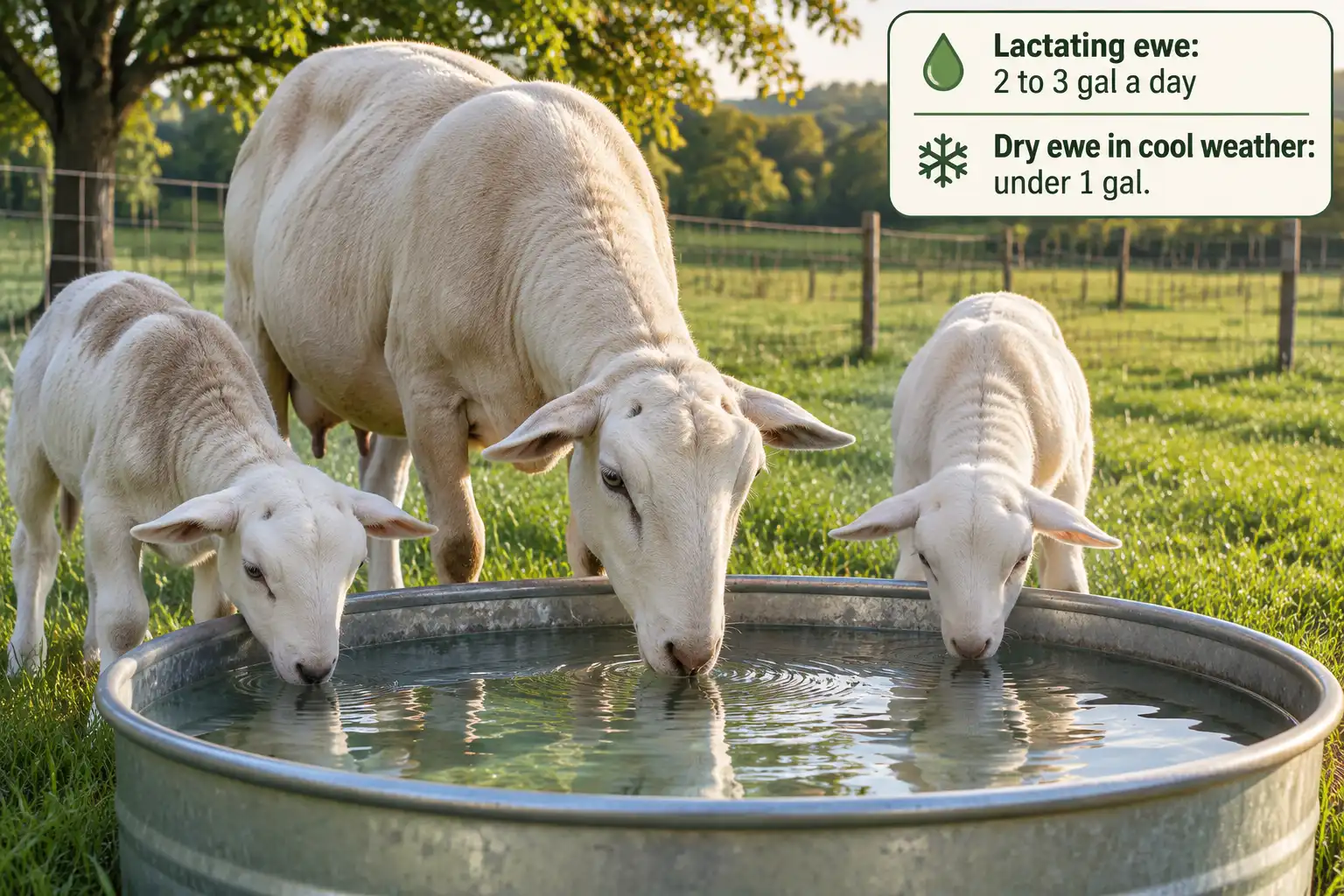
A lactating ewe can drink 2 to 3 gallons a day. A dry ewe in cool weather may need under one. NDSU Extension gives these daily figures:
| Class | Weight | Water per day |
|---|---|---|
| Lambs | 5 to 20 lb | 0.1 to 0.3 gal |
| Feeder lambs | 60 to 110 lb | 1.0 to 1.5 gal |
| Pregnant ewes | 175 lb and up | 1.0 to 2.0 gal |
| Lactating ewes | 175 lb and up | 2.0 to 3.0 gal |
| Rams | 175 lb and up | 1.0 to 2.0 gal |
Penn State Extension puts typical intake at one half to one and a half gallons a day. Heat, humidity, body size, and stage push it higher. Scale that to your flock. Thirty lactating ewes can drink 60 to 90 gallons a day, so a 100 gallon tank may need refilling daily. Plan for frozen lines in winter and longer refills in summer heat.
Feeding Problems to Watch For
Several feeding problems look alike early on, and some move fast. Call a large animal veterinarian for any sheep that stops eating, bloats, staggers, or goes down. The table helps you spot patterns. It does not replace an exam.
| Problem | Usually linked to | Prevention |
|---|---|---|
| Acidosis (grain overload) | Sudden grain, spilled feed | Slow ration changes, 2 or more grain meals daily |
| Pregnancy toxemia | Multiples plus low energy in late gestation | Rising energy across the last third of pregnancy |
| Bloat | Lush, wet legume pasture | Fill sheep on hay before legume turnout |
| Copper toxicity | Goat, cattle, or all-stock minerals and feeds | Sheep-formulated mineral only |
| Urinary stones | Rams and wethers on grain-heavy rations | Balanced mineral; ration review with your veterinarian |
| Wool break | Sharp drops in feed or illness | Steady feeding through stage changes |
Several of these share early signs, such as going off feed or standing apart from the flock. That overlap is the reason the veterinary call comes before any treatment.
Frequently Asked Questions
Can sheep live on grass alone?
Many adult sheep can live on good pasture with a sheep mineral and water during the growing season. Late pregnancy, lactation, growing lambs, and dormant or overgrazed pasture usually call for hay, protein, or grain on top.
Can sheep eat goat feed?
Not as a regular feed, because goat feeds and goat minerals usually carry copper at levels only goats need. Sheep store that copper in the liver until it turns toxic, so feed sheep products labeled for sheep.
Do sheep eat weeds?
Yes, and many weeds make good feed, since sheep often pick dandelion, plantain, and other broadleaf plants over grass. Some weeds and shrubs are toxic, though, so walk pastures and remove wild cherry and mountain laurel.
What treats can sheep have?
Small amounts of apple slices, carrots, or pumpkin are fine for most adult sheep. Keep treats to a handful a day, cut into small pieces, and never offer bread or grain in large amounts.
Should sheep get grain every day?
Not unless they need it, since adult sheep at maintenance usually do well on forage and mineral alone. Grain earns its place in late pregnancy, early lactation, and for growing lambs, introduced over one to two weeks.
Where to Start
Measure your pasture first, and move the flock when it reaches 3 to 4 inches. Before winter, test your hay and budget about 445 pounds per 150 pound ewe for a 120 day season. Then add a cushion for waste. Next, swap any goat, cattle, or all-stock mineral for one labeled for sheep. Finally, save grain for the stages that need it, and change every feed slowly.