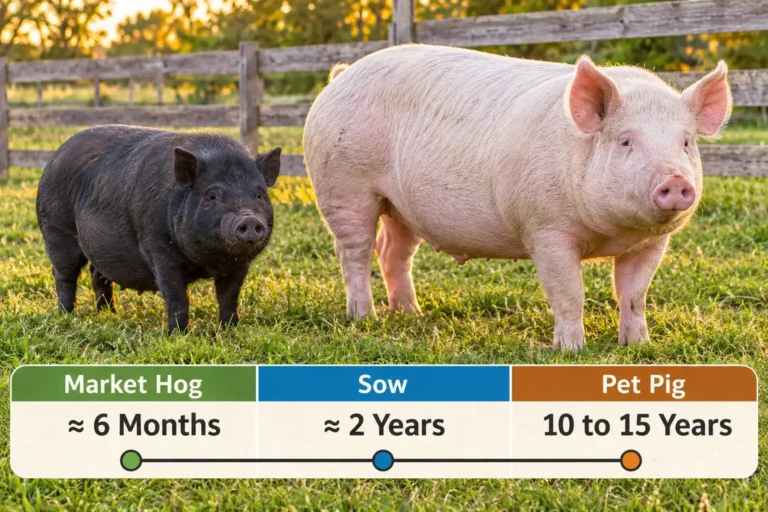
What Do Pigs Eat? Feed by Stage, Safe Extras, and What to Avoid
Pigs are omnivores with one simple stomach, and they will eat nearly anything. So the useful answer to what do pigs eat is narrower. It covers what they should eat at each stage, how much, and what stays off the menu.
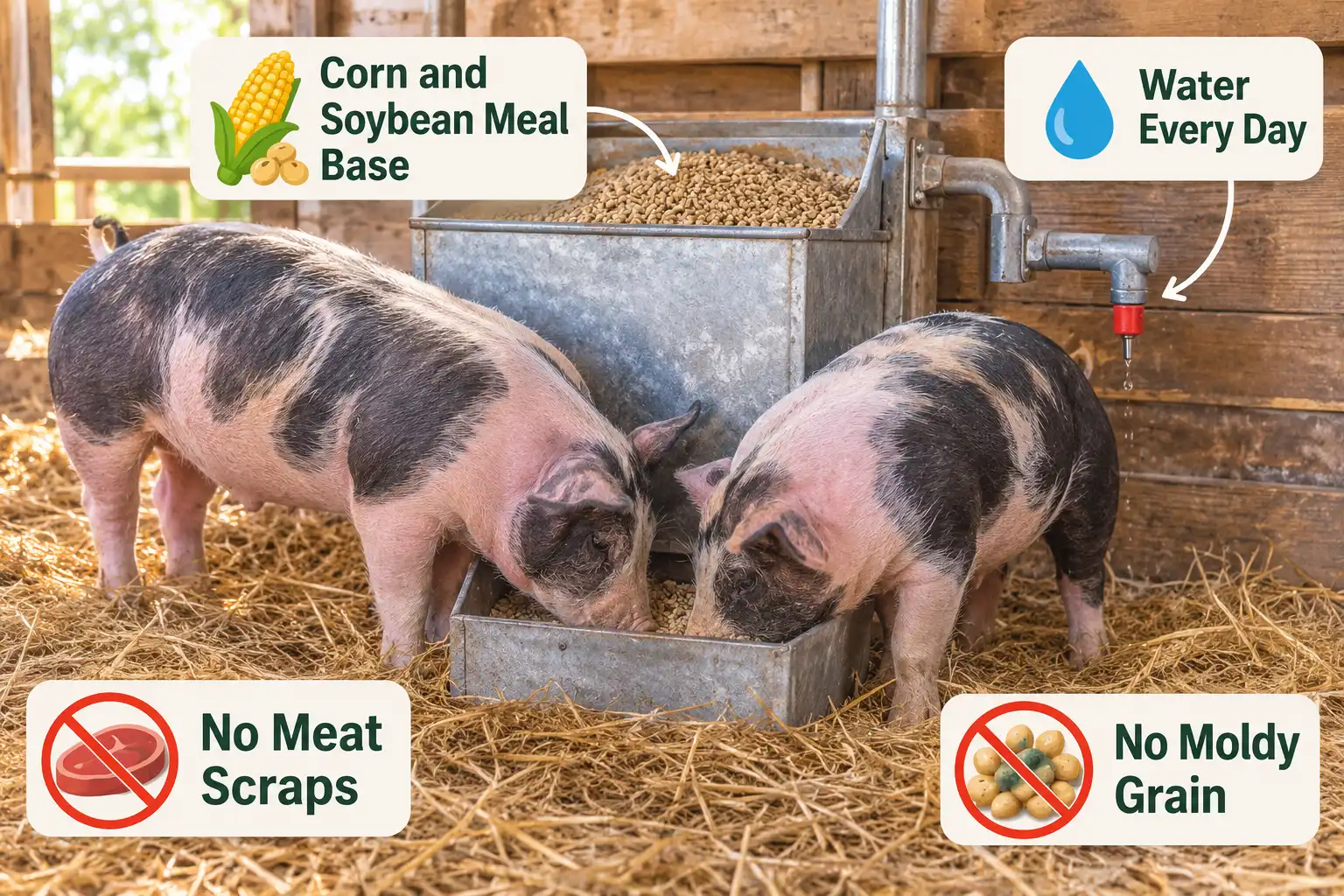
What do pigs eat for steady growth? A complete feed built on corn and soybean meal, balanced by stage for protein, lysine, vitamins, and minerals. Produce works as a treat. Meat scraps, moldy grain, and raw soybeans stay out.
What Pigs Eat: Omnivores With One Stomach
Pigs eat both plants and animal matter, but they digest it with a single stomach. Cattle, sheep, and goats ferment forage in a rumen. Pigs cannot, so grass and hay supply only a small share of what a growing pig needs. That is why a beef cow can live largely on daily hay. A pig on hay alone falls behind.
In the United States, most pig rations start with corn for energy and soybean meal for protein. A small premix then adds salt, vitamins, and trace minerals. The Iowa Pork Industry Center at Iowa State University builds its feed budgets from exactly those three parts.
Protein needs fall as a pig grows. Penn State Extension puts the requirement between 10 and 18 percent crude protein, depending on weight. Still, the protein number on the tag matters less than lysine. Corn runs low in this amino acid, so lysine sets how much lean a pig can build.
For a small group, Penn State recommends buying a premixed complete ration instead of mixing your own. A bagged complete feed removes the balancing work, which matters more with three pigs than with three hundred.
Feeding Pigs by Stage
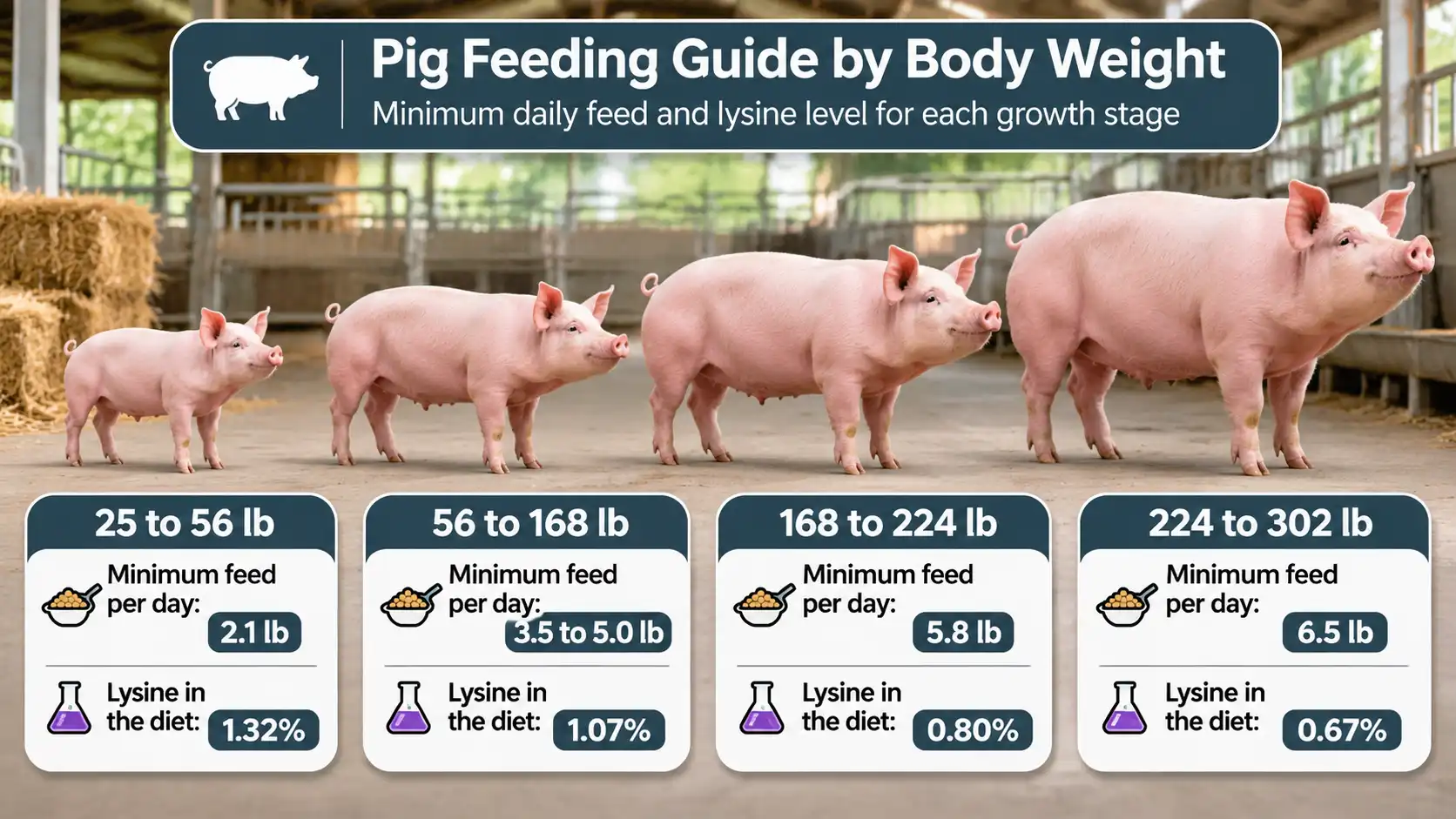
Feeding pigs well means changing the ration as they grow. Young pigs need dense protein and lysine. Heavier pigs eat more total feed but need a lower lysine share. Penn State Extension publishes minimum daily feed amounts adapted from the National Research Council’s 2012 swine requirements.
| Body weight | Minimum feed per day | Lysine in the diet |
|---|---|---|
| 25 to 56 lb | 2.1 lb | 1.32% |
| 56 to 168 lb | 3.5 to 5.0 lb | 1.07% |
| 168 to 224 lb | 5.8 lb | 0.80% |
| 224 to 302 lb | 6.5 lb | 0.67% |
Treat those figures as floors, not targets. Penn State wrote them for show pigs on controlled feed and says never to feed less. Most small producers self-feed instead. Penn State notes that pigs need feed and water 24 hours a day to grow efficiently. Free access also beats a set amount once or twice a day.
Heat changes intake, too. According to Penn State, heavier pigs kept at 50 to 70°F eat more, while pigs above 70°F eat less. So expect slower summer gains and set the market date with that in mind.
Most feed stores sell this as a starter, grower, and finisher sequence. Match the bag to the weight band, not the calendar.
How Much Feed a Pig Eats From Feeder to Market
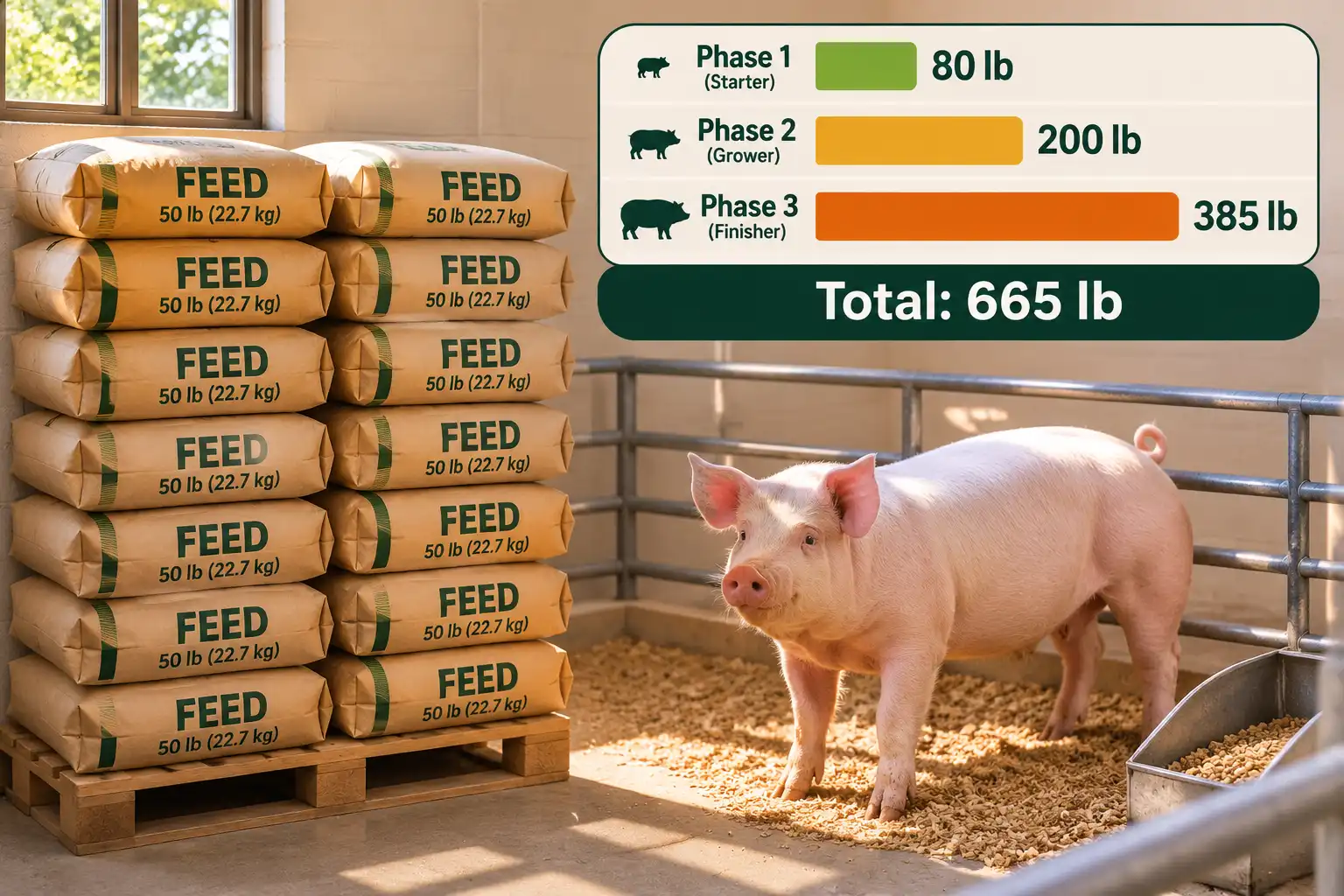
Iowa State’s Iowa Pork Industry Center budgets 665 pounds of feed to grow a 40-pound feeder pig to 270 pounds. That works out to about 2.9 pounds of feed per pound of gain.
| Phase | Weight | Feed per lb of gain | Feed used |
|---|---|---|---|
| 1 | 40 to 80 lb | 2.0 lb | 80 lb |
| 2 | 80 to 160 lb | 2.5 lb | 200 lb |
| 3 | 160 to 270 lb | 3.5 lb | 385 lb |
| Total | 40 to 270 lb | 2.9 lb | 665 lb |
Now put that in bags. At 50 pounds a bag, one pig needs about 13 to 14 bags. Two pigs need about 27, and five need about 67. Then add one bag per pig as a margin for spills, cold snaps, and a slow grower.
Notice where the feed goes. The last phase uses more than half the total, because feed efficiency drops as finishing pigs lay down more fat. As a result, every week past market weight costs more feed per pound than the week before.
Timing follows the same curve. Penn State Extension notes that 50-pound pigs started in May usually reach 250 to 280 pounds by November. Health, temperature, nutrition, and genetics all move that date.
How Much Water Pigs Need
Water comes before feed. A pig short on water eats less. A long dry spell can even turn the normal salt in its ration into a hazard. University of Minnesota Extension lists these daily intakes from the National Swine Nutrition Guide.
| Class of pig | Water per head per day |
|---|---|
| Nursery pig | 1 gal |
| Growing pig | 2.5 to 3 gal |
| Finishing pig | 4.5 gal |
| Gestating sow | 2.5 to 6 gal |
| Sow and litter | 6.5 to 11 gal |
| Boar | 8 gal |
Scale it to your pen. Two finishing pigs drink about 9 gallons a day, or roughly 270 gallons in a 30-day month. A sow nursing a litter can go through 195 to 330 gallons in the same month.
Delivery matters as much as volume. Penn State Extension advises automatic waterers set away from the feeder, because pigs tip and spill buckets. Penn State also says to scrub water containers at least weekly, since dirty or short water cuts feed intake. If you are choosing equipment, compare waterer setups before the pigs arrive, and plan for freezing weather.
Iowa State University’s swine manual lists frozen water sources, plugged nipples, and closed valves as common causes of water deprivation. So check flow every day, not only the trough level.
Can Pigs Eat Food Scraps? What the Law Says
Pigs can eat food scraps, but federal law draws a hard line at meat. Under the Swine Health Protection Act, USDA APHIS defines garbage as human food that contains or touched meat. Feeding it takes a license, and APHIS requires cooking the waste to 212°F for 30 minutes, then cooling it.
States decide whether garbage feeding is legal at all. APHIS lists 25 states that prohibit it, including Iowa, Illinois, Kansas, Nebraska, Michigan, New York, and Wisconsin. So check your state’s status with APHIS or your State Animal Health Official before you accept any food waste.
The rule exists because of foreign animal diseases. APHIS names foot-and-mouth disease, African swine fever, and classical swine fever. None is present in the U.S., yet each can arrive in contaminated meat. Penn State Extension adds Trichinella and treats household scraps as an occasional treat, never a base diet.
Meat-free scraps fall outside the federal garbage definition. However, the definition reaches further than most people expect. Vegetables cooked in the same pan as a roast count as meat contact. So does the crust from a ham sandwich.
If you sell pork, ask your state agency about feeding rules first. Penn State flags this for anyone marketing meat.
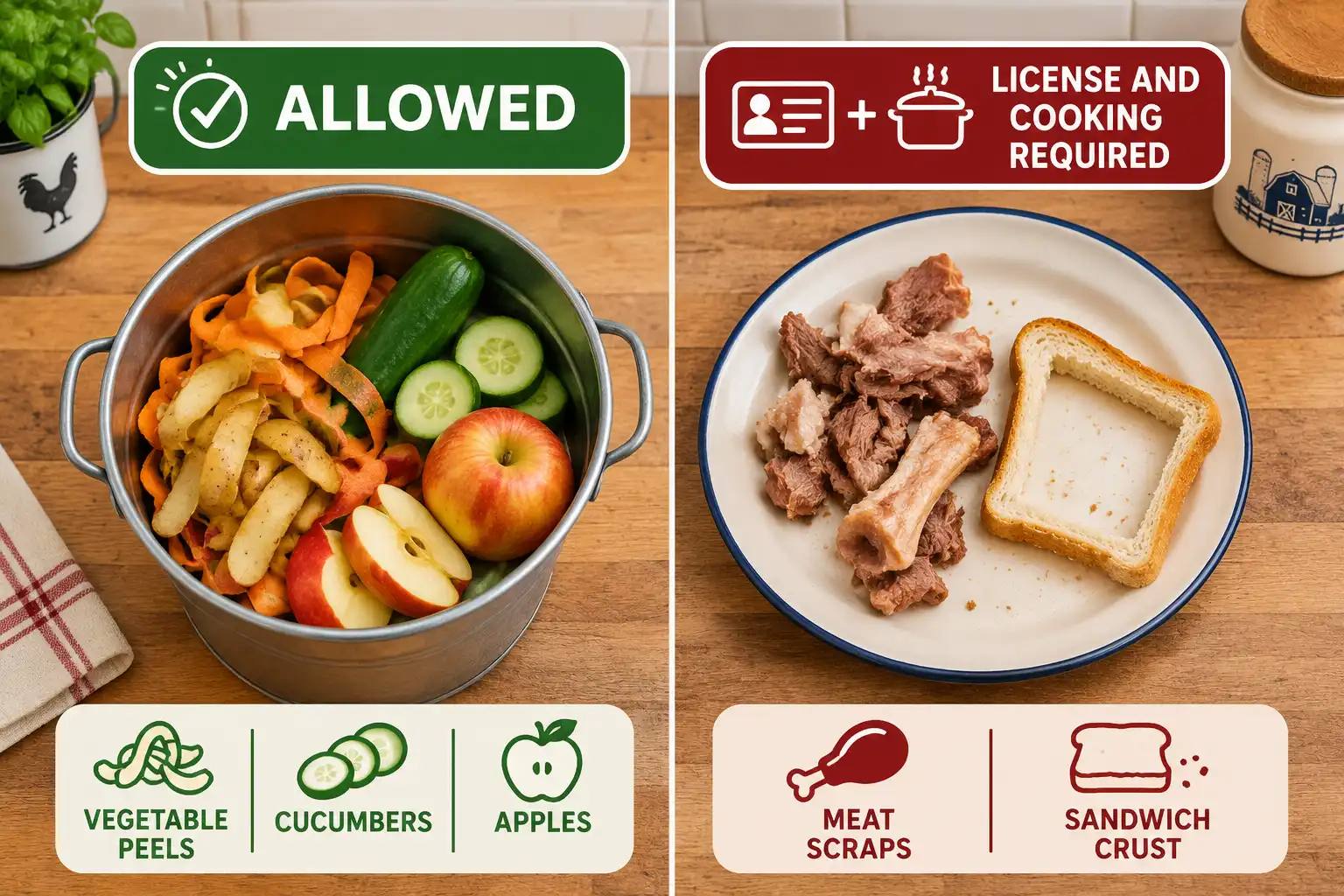
Fruits, Vegetables, and Garden Extras
Fresh produce makes a fine extra for pigs, as long as it never touched meat and shows no spoilage. Treat it as a supplement to complete feed, not a substitute. Most fruits and vegetables carry a lot of water and little protein. So a pig that fills up on garden surplus eats less of the ration that drives growth.
Good candidates include cull cucumbers, squash, pumpkins, leafy greens, and windfall apples. Offer what the pigs clean up in a day, then remove leftovers before they sour. Spoiled produce belongs in the compost. Iowa State University’s Veterinary Diagnostic Laboratory notes that visible mold is not a reliable sign of mycotoxins either way. So looks alone cannot clear a feed.
Can Pigs Eat Cucumbers?
Yes. Cucumbers are safe for pigs raw, whole or sliced, including the overgrown ones the garden missed. They are mostly water, so they add little energy or protein. Offer a few beside the regular feed rather than in place of it.
Pickles are a different food. They sit in salty brine. Iowa State’s swine manual links salt poisoning in pigs to excess salt, especially when water runs short. Keep brined and heavily salted foods out of the pen.
What Pigs Should Not Eat
A short list causes most feeding losses. If a pig has eaten something below and starts trembling, staggering, or convulsing, call a large animal veterinarian first. Several poisonings and infections look alike, and only an exam sorts them out.
- Meat and meat-contact scraps. Federal law requires a license and cooking, and 25 states ban the practice outright, per USDA APHIS.
- Moldy or mycotoxin-contaminated grain. Iowa State’s diagnostic lab associates vomitoxin in swine feed with feed refusal and slower gain.
- Raw soybeans. Penn State Extension has long warned that raw soybeans carry a trypsin inhibitor that limits protein digestion and slows growth. Soybeans need heat processing, which is why commercial feed uses soybean meal.
- Salty feeds and brine. Iowa State’s swine manual reports salt poisoning in pigs that drank brine from overflowing salt boxes meant for other livestock. Whey feeding has caused it, too.
- Pigweed. Pigs that reach pigweed in pastures or lots can suffer poisoning, mostly in late summer or fall, per Iowa State. Signs appear five to ten days after exposure.
- Cocklebur seeds and seedlings. Iowa State says the danger peaks at the two-leaf stage, often after spring rains sprout burs in low ground. Seeds ground into feed can poison pigs, too.
Cocklebur favors fencerows, ditches, and wet corners, per Iowa State. So walk those spots before turnout and pull what you find.
What Will Pigs Not Eat?
Pigs refuse very little, which is exactly why the list above matters. So when a healthy pig walks away from feed, treat it as a signal that something changed. Run three checks in this order.
- Water. A pig without water soon goes off feed. Iowa State notes that even a normal salt level can poison a water-deprived pig. Sudden unlimited water can also make signs worse. If water was off, call your veterinarian before refilling.
- The grain. Iowa State’s diagnostic lab links vomitoxin to feed refusal in swine, while cattle often show no apparent effect. So a load of corn the cows clean up can still put pigs off. The lab advises collecting 5 to 10 pounds as feed moves, such as during augering. Mix it, then submit 1 pound for testing.
- Heat. Penn State Extension notes that intake drops once temperatures pass 70°F. Plan shade and airflow before summer arrives.
If intake stays down after water, feed, and temperature check out, call your veterinarian. Going off feed is an early sign of many illnesses, and the cause takes an exam to find.
Can Pigs Live on Pasture Alone?
No. Pasture adds variety and some nutrients, but it cannot carry a pig by itself. Penn State Extension says pigs need more energy and protein than grass supplies. So pasture-raised pigs still need a complete ration.
Pigs also root, and that changes how you manage the ground. Penn State notes that outdoor pigs turn over soil, so paddocks need high-traffic management. In a rotated system, pigs move through paddocks so the vacant ones rest and regrow. Some producers also hog down a mature crop, letting pigs harvest the standing grain and forage after the plants die back. Penn State treats that as field maintenance, not a stand-alone pasture plan.
Pasture brings its own risks, too. Check paddocks for pigweed and cocklebur before turnout, and keep outdoor pigs away from feral swine. USDA APHIS advises preventing contact between wild and domestic pigs, since feral swine could spread foreign animal diseases into a domestic herd.
Budget feed as if the pasture were not there, then count any savings as a bonus. That way a dry August does not become a growth problem.
Feeding Sows and Boars
Breeding pigs follow different rules. Producers limit-feed gestating sows so they hold condition without getting fat. University of Minnesota Extension says most producers feed 4 to 6 pounds of gestation diet a day. About 4.5 pounds of a normal corn and soybean meal diet meets typical needs. Below 3 pounds, a sow risks falling short on vitamins and minerals.
Cold barns raise the need. Minnesota adds 1 pound of feed for every 20°F below 60°F. So a sow housed at 20°F needs about 2 extra pounds a day.
At 4.5 pounds a day, one gestating sow eats about 135 pounds a month, close to three 50-pound bags.
Lactation flips the rule. Minnesota advises feeding nursing sows two or three times a day to support milk production. Iowa State’s feed budgets assume about 16 pounds a day during lactation. That is more than triple the gestation ration, so plan storage before farrowing and the nursing period begin.
Mature boars on a gestation diet eat about 5 to 6.5 pounds a day, per Minnesota. Adjust any breeding animal by body condition. If a sow drops heavy condition while nursing, ask your veterinarian or a swine nutritionist about the ration.
Pig Feed and Other Livestock: The Copper Problem
Pig feed suits pigs and endangers sheep. Swine rations often carry added copper, and sheep are the most copper-sensitive livestock species. Oklahoma State University’s College of Veterinary Medicine ranks swine and poultry feeds as the most dangerous for sheep. Horse and cattle feeds come next.
Goats tolerate copper slightly better than sheep, yet Oklahoma State still sees copper toxicity in goats. So keep pig feed away from both species entirely.
Manure carries the same risk. Oklahoma State describes sheep deaths on a pasture below a swine barn that received runoff. If you keep a sheep flock near pigs, graze it away from the pig lot’s drainage.
Cattle face a different hazard. Pig feed corn is finely ground, and Oklahoma State warns that a steer breaking into it can bloat and die. Whole corn, by contrast, would more likely cause a bellyache.
On a mixed farm, store pig feed in a closed bin or room that sheep, goats, and cattle cannot reach. Then label it, so a helper never scoops the wrong bag.
What Do Wild Pigs Eat?
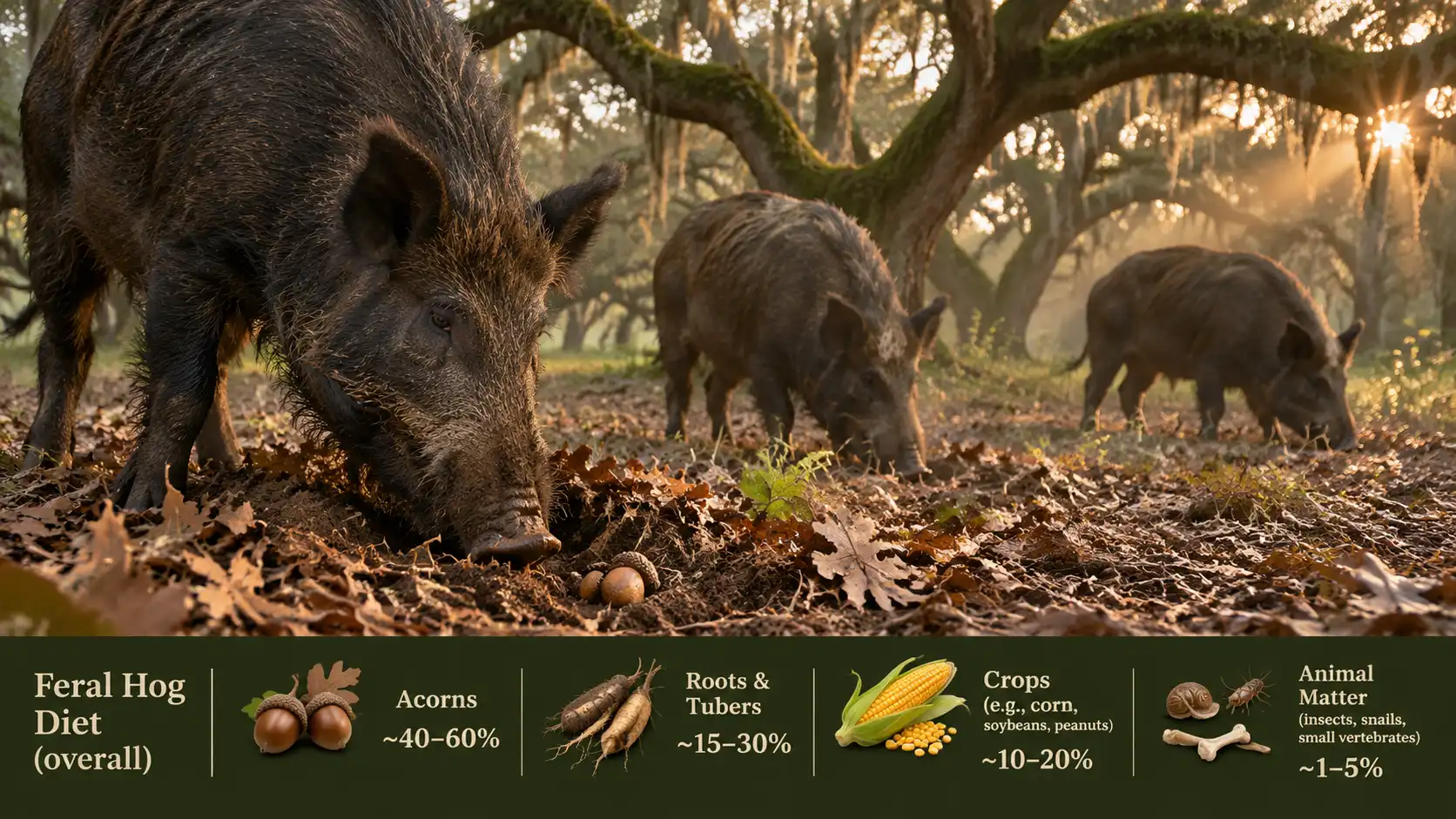
Wild pigs eat mostly plants. Texas A&M AgriLife Extension describes feral hogs as opportunistic omnivores whose diet is mainly plant matter. Acorns rank high, along with the roots, tubers, and bulbs they dig out by rooting. The mix shifts with season and location. Hogs concentrate wherever food is plentiful, such as a heavy acorn crop or a crop field.
Animal matter makes up a much smaller share. Texas A&M lists birds, mammals, reptiles, carrion, and earthworms.
Feral swine descend from escaped domestic pigs crossed with Eurasian wild boar, per USDA APHIS. APHIS puts the population above 6 million across at least 35 states. In other words, the wild pig and the farm pig are close enough to share diseases.
That is the part that matters for a pig keeper. APHIS warns that feral swine could carry a foreign animal disease into domestic herds, and it advises preventing contact between the two. Store feed where it will not draw wild pigs, and run fencing that keeps your pigs in and wild pigs out.
What Do Guinea Pigs Eat?
Guinea pigs eat grass hay, guinea pig pellets with vitamin C, and fresh greens. They are not pigs at all. They are small rodents, outside the six livestock species this site covers. Still, the name sends many searchers here.
Iowa State University’s Veterinary Diagnostic Laboratory says to keep hay available at all times. Timothy or orchard grass suits adult guinea pigs, while alfalfa suits young or pregnant ones. Next come vitamin C fortified guinea pig pellets, about an eighth of a cup a day. Fresh foods such as romaine lettuce and bell peppers add more vitamin C, and fruit stays limited.
Guinea pigs need vitamin C from their diet every day, so the pellets must be made for guinea pigs. Iowa State warns never to feed them rabbit food or avocado. Pig feed is no substitute either, because it is built for a different animal. For anything beyond basic feeding, an exotic animal veterinarian is the right call.
Troubleshooting Common Feeding Problems
Most feeding problems trace back to water, ration, or environment. Use this table to find the first thing to check. Any pig that is down, trembling, or not drinking needs a veterinarian, not a feed change.
| Problem | Check first | What to do |
|---|---|---|
| Slow growth on a self-feeder | Ration matched to weight, water flow, heat above 70°F | Switch to the right stage feed, fix flow, add shade |
| Whole pen suddenly off feed | Waterer flow, then the newest load of grain | If water was off, call your vet before refilling; test the grain for vomitoxin |
| Feed running out ahead of budget | Feeder gap set too wide, pigs rooting feed onto the floor | Narrow the feeder opening and clean up spilled feed |
| Pigs thin on pasture | No complete ration alongside forage | Full-feed a complete ration and count pasture as extra |
| Sow too fat in gestation | Daily ration above 4 to 6 lb | Limit-feed near 4.5 lb, adding feed for cold |
| Sick sheep or goats on a mixed farm | Access to pig feed or pig lot runoff | Move the animals and call your vet |
FAQs About Pigs Food
How much does a pig eat in a day?
A pig near market weight eats at least 6.5 pounds of feed a day, per Penn State Extension’s NRC-based minimums. Younger pigs eat less, starting near 2 pounds a day at 25 to 56 pounds.
What do baby pigs eat?
Baby pigs nurse their mother’s milk first, then move to a high-protein starter feed. Penn State Extension advises small producers to wean after five weeks, because earlier weaning calls for several specialized diets.
Can pigs eat meat?
Pigs will eat meat, but federal law limits feeding it. Any food that contains or touched meat needs a license and cooking, and 25 states ban it outright, per USDA APHIS.
Can pigs live on corn alone?
Corn alone falls short, because it supplies energy but too little protein and lysine for lean growth. Iowa State’s feed budgets pair corn with soybean meal and a base mix at every phase.
Do pigs need a salt or mineral block?
A complete pig feed includes salt and trace minerals, so pigs on it rarely need a separate block. Loose salt set out for cattle is a risk, since Iowa State links overflowing salt boxes to salt poisoning in pigs.
Can pigs eat acorns?
Pigs eat acorns readily, and Texas A&M AgriLife Extension calls them a highly sought food for feral hogs. For domestic pigs, treat a fall acorn drop as an extra, since acorns do not replace a balanced ration.
Putting This Into Practice
Start with a complete ration matched to weight, and budget about 665 pounds, or 14 bags, per feeder pig. Keep water flowing every day of the year, and check it before you blame the feed. Give produce as a treat, keep meat and moldy grain out, and store pig feed where sheep and goats cannot reach it. Our pig care basics cover housing, breeds, and the rest.